
Think about how you used technology ten years ago. If you wanted to send a message you typed it and if you wanted to search for something you typed it. If you wanted to control a game you pressed buttons.
Now look at today. You ask your smart speaker to play music. You send voice notes to your friends instead of texting and you speak to your language learning app to practice pronunciation.
We are shifting from a “touch first” world to a “voice first” world. But this shift is not happening by magic. It is happening because developers now have easier access to the tools they need.
In the past adding voice capabilities to an app was a nightmare. You needed to build a mini telephone company inside your server room. It was expensive and complicated.
Today that barrier is gone. The reason is voice API integration.
By allowing developers to plug into global voice networks with just a few lines of code APIs are acting as rocket fuel for the app economy. In this article we will examine how this technology is driving the next wave of innovation. We will look at the cost benefits and the technical shortcuts and how infrastructure providers like FreJun AI are building the highways that these new voice apps drive on.
Table of contents
- What Is the Current State of Voice Enabled Apps?
- How Does Voice API Integration Lower the Barrier to Entry?
- Why Is Infrastructure the Hidden Engine of Growth?
- What Features Can Developers Build with APIs?
- Is It Cheaper to Buy or Build?
- How Does FreJun AI Power This Acceleration?
- What Are the Future Trends Driven by APIs?
- The Role of Developer Experience
- How Do You Ensure Quality at Scale?
- Conclusion
- Frequently Asked Questions (FAQs)
What Is the Current State of Voice Enabled Apps?
Voice is no longer just for phone calls. It has infiltrated every category of the app store.
- Social Networking: Apps like Clubhouse and Discord proved that people want to talk in real time not just post photos.
- Gaming: Players coordinate strategies using voice chat without leaving the game.
- Education: Language apps listen to students speak and grade their accent instantly.
- Gig Economy: Riders and drivers connect anonymously to coordinate pickups.
This explosion is driven by user demand. People crave connection. Typing feels impersonal. Voice feels human.
However building these features is hard. Audio is heavy data. It needs to be streamed in real time. It needs to be clear. If you try to build this infrastructure from scratch you will spend years fixing bugs instead of building your product.
How Does Voice API Integration Lower the Barrier to Entry?
This is the most important factor in the growth of voice apps.
Imagine if you wanted to build a house but you had to manufacture your own bricks and cut your own lumber and make your own glass. You would never finish the house.
For a long time that is what building voice apps felt like. You had to deal with:
- SIP Protocols: The complex language of telecom.
- Codecs: Compressing audio so it fits over the internet.
- Carrier Negotiations: Signing contracts with phone companies in every country.
- Hardware: Buying servers to process media.
Voice API integration changes this. It provides pre made bricks.
A developer can use an API (Application Programming Interface) to say “Connect User A to User B.” The API provider handles the SIP and the codecs and the carriers.
This democratization means that a two person startup in a garage can build a global voice app that rivals the tech giants. It levels the playing field. When the barrier to entry drops innovation skyrockets.
Also Read: How Do Voice Bot Solutions Deliver Human-Like Voice Interactions?
Why Is Infrastructure the Hidden Engine of Growth?
APIs make it easy to write the code. But the code needs a network to run on.
If you build a beautiful Ferrari but drive it on a dirt road full of potholes you will not go fast. The infrastructure is the road.
Voice data is extremely sensitive. It cannot tolerate delay. If a webpage takes two seconds to load you wait. If a voice call delays by two seconds you hang up.
This is where FreJun AI plays a critical role. We handle the complex voice infrastructure so you can focus on building your AI and app features.
FreJun provides the high speed highway. We use FreJun Teler to provide elastic SIP trunking. This ensures that your app can connect to the public telephone network reliably.
More importantly we optimize for low latency. We route the audio data through the shortest possible path on the internet. This ensures that when your users talk it feels instant. By solving the “lag” problem infrastructure providers like FreJun give developers the confidence to add voice to mission critical apps.
What Features Can Developers Build with APIs?
The growth of voice apps is not just about more apps. It is about better apps. Voice API integration allows for features that were previously impossible.
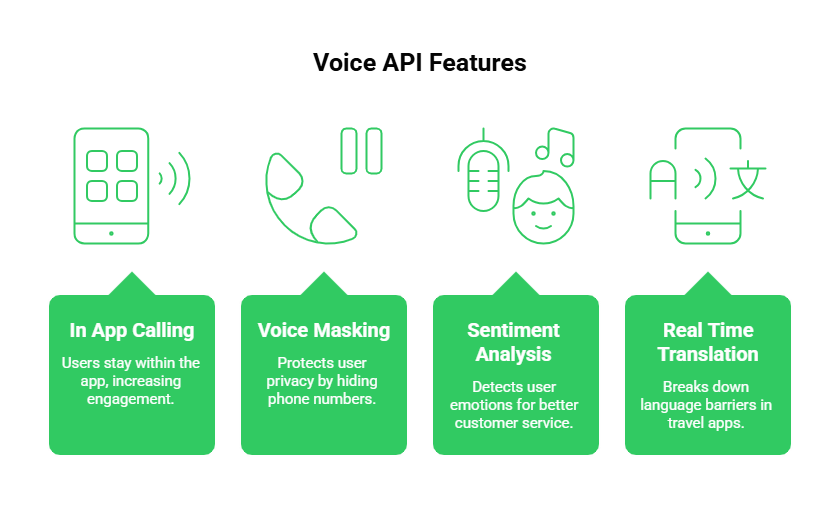
1. In App Calling
This keeps users inside your ecosystem. Instead of swapping phone numbers and leaving the app to dial, users just tap a button. This increases “time in app” metrics which investors love.
2. Voice Masking
Privacy is a major concern. APIs allow you to connect two people without revealing their real phone numbers. The API sits in the middle and bridges the call. This is essential for dating apps and delivery services.
3. Sentiment Analysis
Because the voice is processed digitally it can be analyzed. An API can feed the audio into an AI model to detect if a user is angry or happy. This allows customer support apps to route angry customers to senior managers automatically.
4. Real Time Translation
Imagine a travel app where you speak English and the local host hears Spanish. APIs can stream audio to translation engines in real time breaking down language barriers instantly.
Is It Cheaper to Buy or Build?
Finance is a major driver of growth. If adding voice costs a million dollars few companies will do it. If it costs a few cents they all will.
Voice API integration shifts the cost model from CapEx (Capital Expenditure) to OpEx (Operational Expenditure).
| Feature | Building In House | Using Voice API |
| Upfront Cost | Massive (Servers/Hardware) | Zero (Free to start) |
| Ongoing Cost | Maintenance/Staffing | Pay as you go (Usage) |
| Scalability | Limited (Must buy more servers) | Infinite (Elastic software) |
| Global Reach | Hard (Need local contracts) | Instant (Global network) |
| Time to Market | 12 to 18 Months | 1 to 4 Weeks |
This table shows why the industry is accelerating. It is simply bad business to build your own telecom stack in 2026. By renting the infrastructure from providers like FreJun companies have more money to spend on marketing and user acquisition.
Also Read: What Role Do Voice bot Solutions Play in AI-First Business Workflows?
How Does FreJun AI Power This Acceleration?
FreJun is not just another API provider. We are an infrastructure partner.
Many APIs are just wrappers around other services. FreJun owns the transport layer. We focus heavily on the needs of AI driven apps.
Model Agnostic
We know that AI is the future of voice apps. Maybe you want to use OpenAI to transcribe the call. Maybe you want to use a custom model to change the user’s voice. FreJun allows you to plug in any AI model you want. We handle the streaming audio and you handle the intelligence.
Elastic Scalability
Apps can go viral overnight. If you get 100,000 downloads in one day your voice infrastructure needs to handle the spike. FreJun Teler offers elastic SIP trunking that scales automatically. You never have to worry about your app crashing because it became too popular.
Ready to start building the next big voice app? Sign up for FreJun AI and get your API keys today.
What Are the Future Trends Driven by APIs?
The acceleration is just beginning. As APIs become more powerful we will see new types of apps emerge.
The Rise of AI Companions
We are seeing a boom in “AI Friend” apps. These are bots that you can talk to about your day. They require ultra low latency voice APIs to feel real. If the bot takes five seconds to respond the friendship feels fake. FreJun’s optimized network makes these conversations flow naturally.
Voice Commerce
“Buy this.” Shopping apps will integrate voice commands. You will be able to reorder your groceries just by speaking to your favorite supermarket app.
Emotional Intelligence
Future apps will not just listen to words. They will listen to tone. Health apps will detect signs of depression in a user’s voice. Sales apps will detect hesitation in a client’s voice.
The Role of Developer Experience
Speed is not just about the network. It is about the developer.
If an API is hard to use developers will ignore it. The growth of voice apps is directly tied to the quality of the documentation and the SDKs (Software Development Kits).
FreJun takes a “developer first” approach. We provide clean code examples and robust support. We make it easy to debug issues. When developers enjoy using a tool they build more with it. This creates a positive feedback loop that accelerates the entire industry.
How Do You Ensure Quality at Scale?
This is the final hurdle. It is easy to make one call work. It is hard to make a million calls work.
As voice apps grow they face “jitter” and “packet loss.” These are network errors that make the audio sound robotic.
A robust voice API integration includes tools to fight this.
- Jitter Buffers: Software that smooths out the audio.
- Redundancy: If one server fails the traffic moves to another.
- Global PoPs: Points of Presence all over the world to keep servers close to users.
FreJun provides all of this out of the box. We monitor the network 24/7 so you do not have to.
Also Read: Why Are Voice bot Solutions Critical for AI-Driven Customer Support?
Conclusion
The question was: Will voice API integration accelerate the growth of voice enabled apps?
The answer is a resounding yes. In fact it already is.
We are witnessing a golden age of audio. The convergence of fast internet and powerful AI and accessible APIs has created the perfect storm. Developers are no longer held back by the complexities of the telephone network. They are free to imagine new ways for humans to connect and communicating.
However the success of these apps depends on the foundation they are built on. A voice app with bad audio is useless. That is why choosing the right infrastructure partner is the most important decision a developer can make.
FreJun AI provides the speed and the scale and the reliability needed to win in this new market. With FreJun Teler handling the global connectivity and our developer friendly tools managing the integration we are helping to build a world where every app has a voice.
Want to discuss how our infrastructure can support your app’s growth? Schedule a demo with our team at FreJun Teler and let us help you build the future of communication.
Also Read: Predictive Call Routing: Using AI Insights to Boost Agent Efficiency
Frequently Asked Questions (FAQs)
It is the process of connecting a software application to the telephone network using code. It allows apps to make and receive calls without needing physical phone hardware.
Users prefer the speed and emotion of voice over typing. APIs have made it cheap and easy for developers to add these features leading to a boom in voice enabled apps.
No. That is the main benefit of using an API. The provider handles the telecom complexity. You just need standard coding skills to implement the features.
FreJun Teler provides elastic SIP trunking. This means the system automatically expands to handle high call volumes ensuring your app does not crash during usage spikes.
No. Most Voice APIs operate on a pay as you go model. You only pay for the minutes you use which makes it very affordable for startups.
Yes. FreJun is model agnostic. You can stream the audio from the call to any AI service you want for tasks like transcription or translation or automated conversation.
Yes. Reputable providers like FreJun encrypt voice data during transmission. This ensures that user conversations remain private and secure.
Latency is the delay in audio. High latency makes conversations awkward. FreJun optimizes its infrastructure to keep latency low ensuring calls feel natural.