
In the hyper-competitive world of startups, speed and agility are the currency of survival. A startup must be able to build, iterate, and scale at a pace that legacy corporations can only dream of. For years, this agile, software-first mindset has permeated every part of the startup stack, from cloud servers on AWS to payment processing with Stripe.
But one final, stubborn bastion of the old, rigid world has remained: telecommunications. Today, that wall is finally crumbling, and the technology leading the charge is programmable SIP.
For a growing number of innovative startups, the voice channel is not just a support line; it is a core part of their product. They are building the next generation of scalable voice AI, from intelligent sales agents to automated customer support platforms.
These applications demand a voice infrastructure that is not a static, pre-configured service, but a dynamic, developer-centric, and infinitely scalable tool. This is a need that traditional telecom cannot meet, and it is the primary driver behind the surge in programmable SIP adoption.
This article will explore the key SIP benefits for startups and why this API-driven approach is the non-negotiable foundation for building the future of voice.
Table of contents
What Was the Old World and Why Doesn’t It Work for Startups?
To understand the revolution, we must first understand the old regime. For decades, a business’s access to the global telephone network was a rigid and frustrating affair. It involved two primary components:
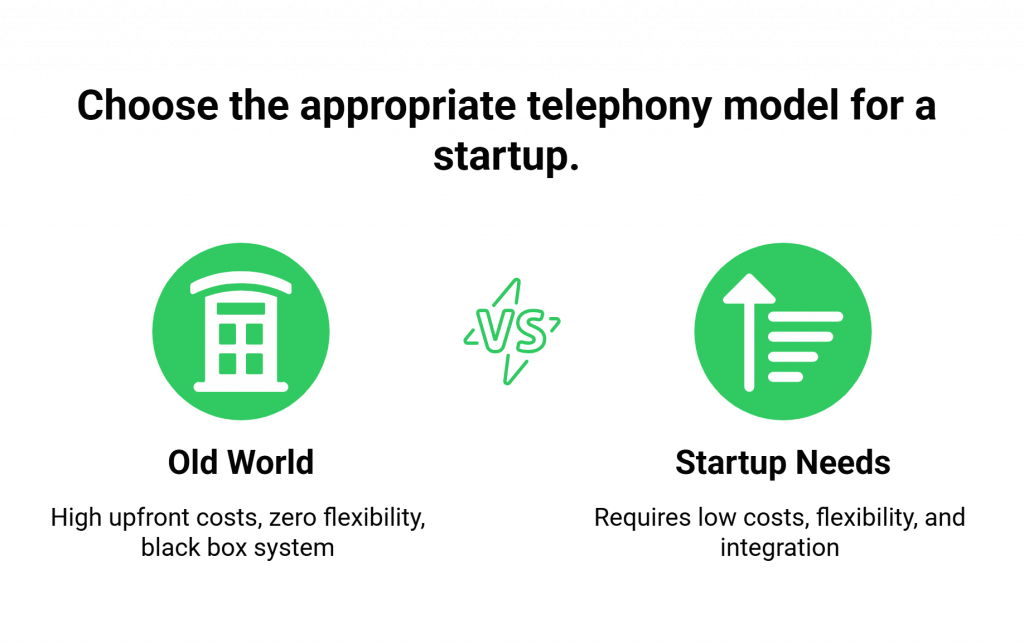
- The Hardware: An expensive, on-premise Private Branch Exchange (PBX) box that had to be purchased, installed, and maintained.
- The Connection: A set of physical Primary Rate Interface (PRI) lines or, later, channelized SIP trunks, which were contracted for a fixed capacity and a long-term commitment.
This model is a perfect storm of everything a startup must avoid:
- High Upfront Costs (CapEx): It required a massive capital investment in hardware, burning through precious and non-renewable startup cash.
- Zero Flexibility: A startup’s growth is a “hockey stick,” not a straight line. The old model’s fixed capacity meant you were either paying for a huge number of idle channels or, worse, hitting a hard ceiling and giving customers a busy signal right when your product went viral.
- A “Black Box” System: The phone system was a closed, proprietary box. For a startup’s software developers, it was an impenetrable fortress with no APIs and no way to integrate it into their agile, software-driven workflows.
This old world forced a choice: either invest a huge amount of capital in a system that would be obsolete in a year, or neglect the voice channel entirely.
Also Read: Best Practices for Testing and Debugging Voice Calling SDK Integrations
What is Programmable SIP and Why is it a Game-Changer?
Programmable SIP is not just an evolution; it is a complete philosophical rethinking of what a voice network should be. It takes the underlying SIP protocol, the standard for managing calls over the internet, and transforms it from a static connectivity tool into a fully programmable, developer-first platform.
The Shift from Configuration to Programming
This is the central concept.
- The Old Way: You would configure your phone system in a web-based GUI, setting up static rules for how calls should be routed.
- The New Way: With programmable SIP, your application’s code controls the voice network in real-time. The voice platform becomes just another microservice that your application interacts with via a well-documented API. You do not configure a call flow; you program it.
The Power of a Developer-First Abstraction
A modern provider of programmable SIP, like FreJun AI, does for telecommunications what a cloud provider does for computing. It abstracts away the immense, underlying complexity.
A startup developer using our platform does not need to know about carrier interconnects, least-cost routing, or the intricacies of the RTP protocol. They just need to know how to make a REST API call. This is a massive force multiplier for a small development team.
Also Read: How a Voice Calling SDK Can Improve Customer Experience in AI Voice Agents?
How Does Programmable SIP Specifically Enable Scalable Voice AI?
For the growing number of startups using SIP to build AI-powered voice applications, the programmable nature of the platform is not just a convenience; it is a fundamental requirement. An AI conversation is a dynamic, data-driven event that cannot be managed by a static call flow.
The Essential Need for Real-Time Media Access
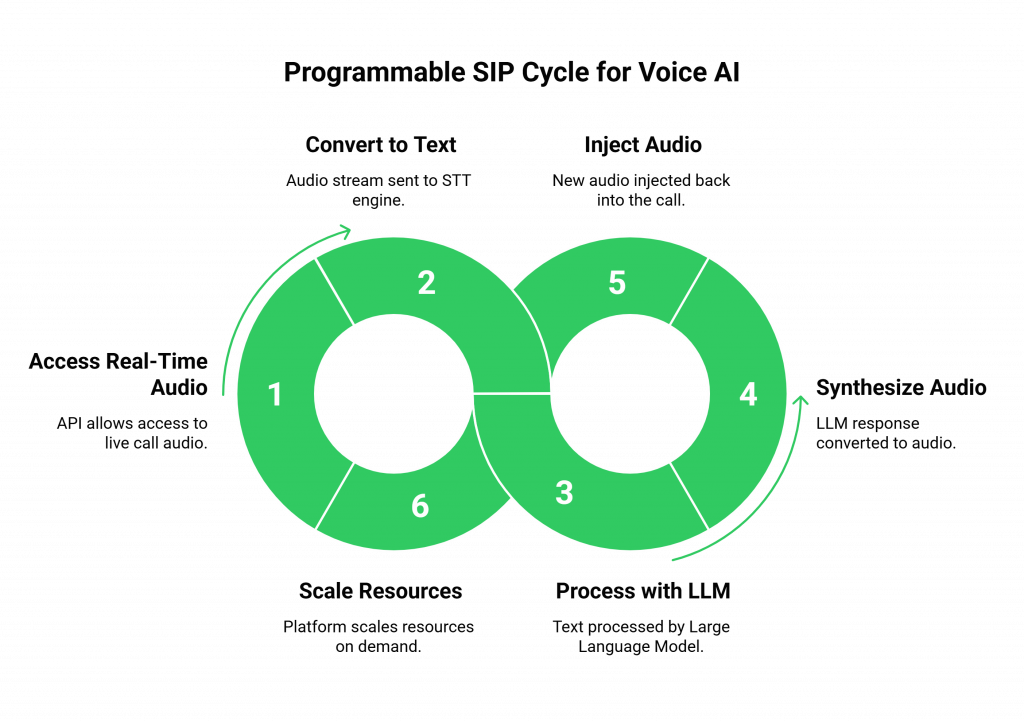
An AI needs to “hear.” This is the most critical function that programmable SIP enables.
- The platform’s API allows your application to programmatically access and “fork” the raw, real-time audio stream of a live call.
- This audio stream can be sent directly to your chosen Speech-to-Text (STT) engine.
- The resulting text is then passed to your Large Language Model (LLM) for processing.
- The LLM’s text response is synthesized into audio by a Text-to-Speech (TTS) engine.
- Your application then uses the API to “inject” this new audio back into the call.
This high-speed, back-and-forth data exchange is the very definition of a scalable voice AI conversation, and it is only possible with an API that provides deep, real-time control over the call’s media.
The Economics of Elasticity
The “elastic” nature of a modern SIP platform is the key to making the economics of voice AI work for a startup.
- Pay-as-You-Go: You are not paying for a thousand fixed channels in case your AI needs to make a thousand calls. You are billed based on your actual, second-by-second usage. Your telecom costs scale perfectly in sync with your application’s activity.
- Infinite Scalability: When your AI agent needs to make a thousand simultaneous outbound calls for a lead generation campaign, the platform simply provides the capacity on demand. There are no manual steps, no contract renegotiations, and no busy signals. This is a core benefit of programmable SIP adoption.
This table provides a clear summary of the SIP benefits for startups.
| Startup Need | The Old, Rigid Model | The Programmable SIP Model |
| Conserve Capital | High upfront hardware costs (CapEx). | Zero hardware costs; a pure, usage-based operational expense (OpEx). |
| Achieve Agility | Slow, manual configuration; vendor lock-in. | Fast, API-driven; build and iterate on voice features in hours. |
| Scale Unpredictably | Limited by fixed, pre-purchased channels. | Scales elastically and automatically to handle any call volume. |
| Integrate with Software | A closed “black box” with no easy integration. | API-first design, built for deep integration with your application stack. |
| Enable Voice AI | No access to real-time media; technically unsuitable. | Provides the core, programmable media access required for scalable voice AI. |
Ready to leave the old world of telecom behind and start building the future of voice? Sign up for FreJun AI and explore our powerful, API-driven platform.
Also Read: Voice Calling SDKs for Enterprises: Scaling Conversations with AI and Telephony
Conclusion
For a startup, the decision to adopt programmable SIP is not just a technical upgrade; it is a profound strategic advantage. It is the choice to move from a world of fixed costs, rigid constraints, and vendor lock-in to a world of variable costs, infinite scalability, and complete creative control.
It is the technology that finally puts the power of the global telephone network directly into the hands of your software developers.
As scalable voice AI moves from a niche technology to a core business function, the startups that will win are the ones that build on a foundation that is as agile, intelligent, and ambitious as they are. That foundation is programmable SIP.
Want to see a live demonstration of how our API can be used to build a scalable voice AI agent in minutes? Schedule a demo with our team at FreJun Teler.
Also Read: UK Mobile Code Guide for International Callers
Frequently Asked Questions (FAQs)
Standard SIP is primarily a connectivity tool, often managed via a web interface, to connect a phone system to the internet. Programmable SIP is a developer-first platform that treats the voice network as a fully programmable service, controllable in real-time via APIs.
They are very closely related and often used to describe the same modern approach. “Elastic” typically refers to the on-demand scalability and pay-as-you-go pricing model, while “programmable” refers to the API-driven, developer-first control. A modern provider offers both.
Startups using SIP benefit immensely from the zero-CapEx, pay-as-you-go model, which conserves cash. The API-driven nature also allows their small development teams to move quickly and build sophisticated voice features without needing specialized telecom expertise.
Real-time media access is the ability to programmatically get the raw audio stream of a live phone call. It is essential for scalable voice AI because this audio stream is the “input” that must be fed to the AI’s Speech-to-Text engine for it to “hear” the caller.
No. A key benefit of a modern, decoupled platform like FreJun AI is that it is model-agnostic. You are free to bring your own AI models from any provider (OpenAI, Google, Anthropic, etc.) and integrate them with the voice infrastructure.
The programmable SIP adoption process typically starts with signing up for a developer account with a provider, getting API keys, provisioning a phone number via the API, and then writing a small web application to receive a webhook for an inbound call and respond with a simple action.
A global programmable SIP provider has a network of data centers (Points of Presence) around the world. The platform automatically handles the complex international call routing, ensuring low-latency connections for users anywhere without the startup needing to negotiate with international carriers.
Yes, a production-grade platform must offer robust security. This includes encryption for all API communication (HTTPS), as well as for the call signaling (TLS) and the voice media itself (SRTP).
Yes. While its primary power is in connecting to applications, you can also configure it to route calls to any standard SIP-compliant endpoint, including software-based phones (softphones) or hardware IP phones.
FreJun AI provides a developer-first programmable SIP platform with a free tier and pay-as-you-go pricing, making it accessible for startups. Our comprehensive documentation, powerful APIs, and scalable global infrastructure (our Teler engine) provide the ideal foundation for startups looking to build the next generation of scalable voice AI.