
Imagine this all-too-common scenario: you have an urgent question for your bank. You dial their support number, only to be greeted by a lengthy automated menu. After navigating a maze of “press one for this, press two for that,” you are finally placed in a queue, where you are subjected to ten minutes of repetitive hold music.
By the time a human agent finally answers, your patience has worn thin, and your initial simple question is now colored by frustration. This is the broken promise of traditional customer support. It is a model that is failing to meet the demands of the modern, on-demand consumer.
In this high-stakes environment, modern voice bot solutions are emerging not just as an innovative feature, but as a critical, foundational component of any effective, AI-driven customer support strategy.
The customer of today has been conditioned by the instant, personalized, and effortless experiences of the digital world. They expect the same level of service from every brand they interact with, and the voice channel is no exception.
The old model of throwing more human agents at the problem is financially unsustainable and operationally inefficient. The future of customer support lies in a powerful, symbiotic relationship between human expertise and artificial intelligence. AI customer support voicebots are the linchpin of this new paradigm, acting as the tireless, intelligent, and infinitely scalable front line for your brand.
Table of contents
What Are the Fundamental Flaws of a Purely Human-Powered Support Model?
To understand why voice bot solutions are so critical, we must first be brutally honest about the inherent limitations of a purely human-powered contact center. While human agents are irreplaceable for complex and empathetic interactions, relying on them for every single call creates a system that is inefficient, costly, and difficult to scale.
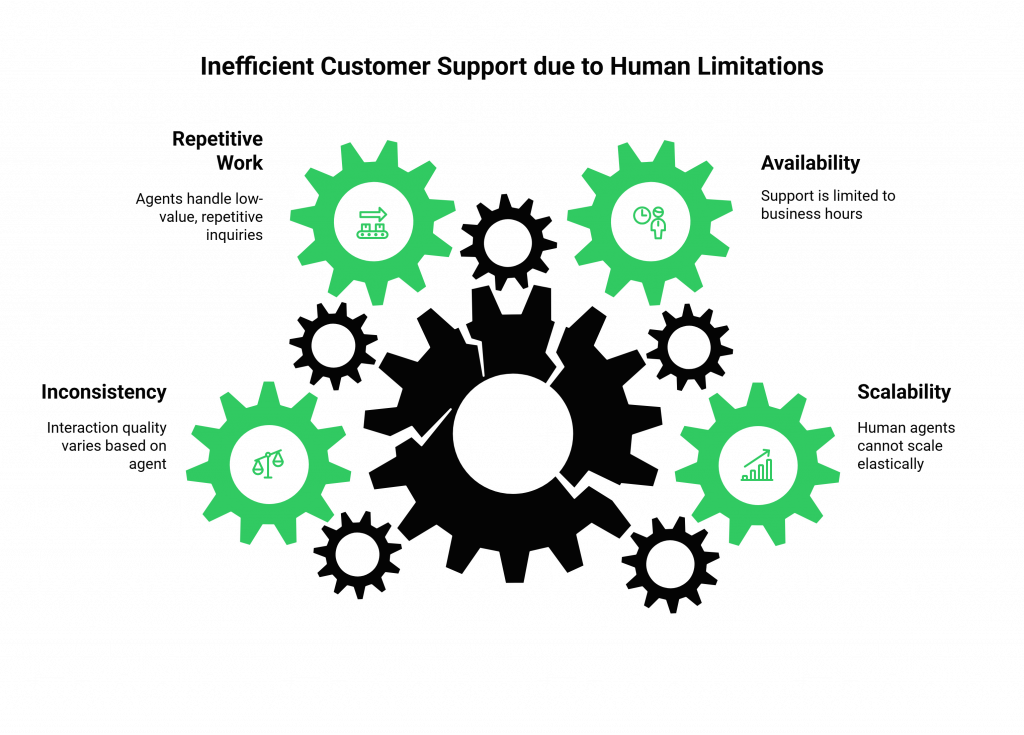
The Unsolvable Scalability Problem
Human beings do not scale elastically. You cannot instantly hire and train a thousand new agents to handle a sudden surge in calls caused by a product recall or a service outage. This means that a traditional contact center is always either overstaffed (and burning cash) or understaffed (and burning customer goodwill).
The 24/7 Availability Gap
Your customers’ problems do not keep a 9-to-5 schedule. A customer who discovers a billing error at 11 PM on a Saturday should not have to wait until Monday morning to get help. A purely human-powered model creates a massive “availability gap,” leaving customers in the lurch outside of standard business hours.
The High Cost and High Turnover of Repetitive Work
A huge percentage of inbound support calls are for simple, repetitive, and low-value inquiries like password resets, order status checks, and balance inquiries. Forcing your highly trained human agents to spend their day answering these same questions over and over is a massive operational expense. It is also a primary driver of agent burnout and high turnover, a costly problem in the contact center industry.
The Inconsistency of the Human Element
Even the best agents have bad days. The quality of a human-powered interaction can vary based on the agent’s training, their mood, or simply how many difficult calls they have had that day. This can lead to an inconsistent brand experience for your customers.
Also Read: Why Is A Voice API For Developers Essential For Low Latency Voice Apps?
How Do Voice Bot Solutions Address These Core Challenges?
Modern voice bot solutions are not just a simple upgrade to the old IVR; they are a completely new architectural approach that is specifically designed to solve these deep-seated problems.
An intelligent voicebot, acting as the front line for your automated support calls, can:
- Scale Infinitely and Instantly: A cloud-native voicebot can handle a virtually unlimited number of simultaneous calls. Whether you get a thousand calls or a million calls in an hour, every single customer is answered instantly. There are no more busy signals or long hold times during a crisis.
- Provide True 24/7/365 Service: The voicebot is always on. It can provide instant assistance to your customers at any time, on any day, ensuring they always have a channel for immediate help.
- Automate the Routine, Escalate the Complex: The voicebot acts as an incredibly efficient filter. It can be trained to handle the top 80-90% of routine, repetitive inquiries completely on its own. This is known as “call containment.” For the small percentage of calls that are truly complex, novel, or emotionally charged, the voicebot can perform an intelligent “warm transfer,” routing the call to the appropriate human agent along with the full context of the conversation so far.
- Deliver Perfect, Unwavering Consistency: The voicebot delivers the same, perfectly accurate, and on-brand response to a given question every single time. It is your most consistent and reliable brand ambassador.
Also Read: How Can a Voice API for Developers Enable Real Time AI Calling?
What is the Role of AI in Making These Solutions Truly “Smart”?
The real magic of modern voice bot solutions lies in the “AI” part. This is what separates a truly helpful conversational agent from the rigid, frustrating phone menus of the past.
The Power of Natural Language Understanding (NLU)
Instead of forcing a customer into a rigid “press 1, press 2” menu, a modern voicebot starts with a simple, open-ended question: “Hello, how can I help you today?” It uses a sophisticated NLU or Large Language Model (LLM) to understand the customer’s intent from their natural, spoken language. This is the difference between a system that forces the customer to understand the machine, and a system that is designed to understand the customer.
The Revolution of Context and Personalization
A smart voicebot is not an island; it is a deeply integrated part of your technology stack. Before the conversation even begins, it can use the customer’s phone number to perform a real-time lookup in your CRM. This means the voicebot can greet the customer by name and has their entire history, their past purchases, their previous support tickets, their loyalty status, at its “fingertips.” This allows for a level of personalization that is a game-changer for customer experience.
This table provides a definitive comparison of the old and new models.
| Feature | Traditional IVR | AI-Powered Voicebot Solution |
| User Interaction | DTMF (Touch-Tones). Forces the user into a rigid menu. | Natural Language. Allows the user to speak their request in their own words. |
| Intelligence | None. It is a simple, static flowchart. | High. It uses AI (NLU/LLM) to understand intent, nuance, and context. |
| Personalization | Completely anonymous. Every caller is treated as a stranger. | Highly personalized. It integrates with your CRM to know who the customer is and their history. |
| Task Capability | Limited to basic call routing and playing pre-recorded audio. | Can perform complex, multi-step actions like processing a payment, booking an appointment, or troubleshooting a device. |
| Escalation | A “cold transfer.” The human agent has no context. | An intelligent “warm transfer.” The agent receives the full context of the AI conversation. |
Ready to build the intelligent brain for your next-generation support system? Sign up for FreJun AI to get your API keys and start building today.
What Underpins a Successful Enterprise Voice Bot Solution?
It is tempting to think that building voice bots is all about the AI models. But the most brilliant AI in the world is useless if the call itself is a bad experience. A successful deployment requires a world-class “brain” built on top of a world-class “body.” The “body”, the voice infrastructure is the domain of the voice AI platforms.
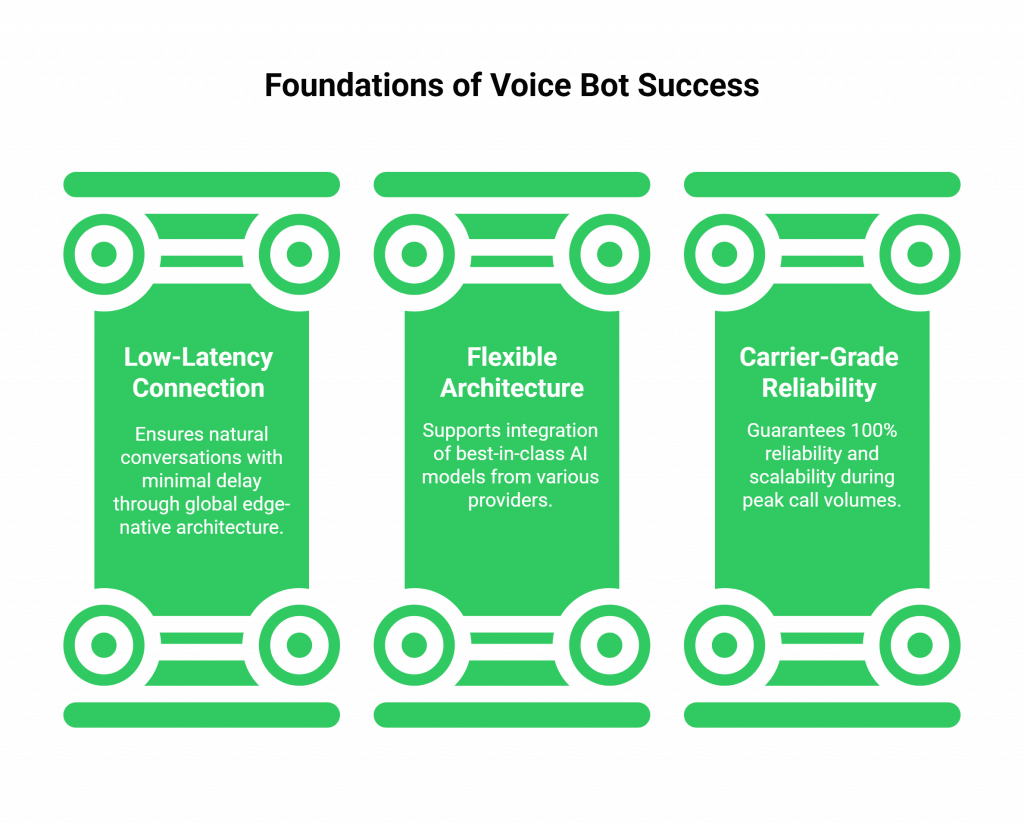
The quality of this underlying platform is a critical, and often overlooked, factor in the success of your project. It must provide:
- A Low-Latency, High-Quality Connection: For a conversation to feel natural, the delay must be imperceptible. The voice platform must be built on a globally distributed, edge-native architecture that can process the audio as close to the user as possible.
- A Flexible, Model-Agnostic Architecture: The world of AI is moving at a breakneck pace. A truly future-ready voice api is one that is model-agnostic. A platform like FreJun AI provides the flexible “plumbing” and gives you the complete freedom to integrate the best-in-class AI models from any provider you choose. This is our core promise: “We handle the complex voice infrastructure so you can focus on building your AI.”
- Carrier-Grade Reliability and Scalability: The platform must be able to handle a massive, sudden spike in call volume with 100% reliability. This requires a truly elastic, carrier-grade infrastructure.
Also Read: How Voice API Benefits For Businesses Reducing Manual Communication Tasks
Conclusion
The traditional, human-powered customer support model is breaking under the strain of modern customer expectations and economic realities. AI customer support voicebots are no longer an experimental technology; they are a proven, essential, and critical component of a modern, scalable, and customer-centric support strategy.
By providing an infinitely scalable, 24/7 first line of defense that can intelligently handle the vast majority of routine inquiries, voice bot solutions do more than just reduce costs.
They create a better experience for your customers, and they empower your human agents to do their best, most valuable work. They are, in short, the future of AI-driven customer support.
Want to do a deep architectural dive into the infrastructure required to power a high-performance, enterprise-grade voicebot? Schedule a demo with our team at FreJun Teler.
Also Read: What Is IVR Software? Complete Guide for Businesses
Frequently Asked Questions (FAQs)
The primary business case is a dramatic reduction in operational costs by automating high-volume, repetitive inquiries, which also improves the overall customer experience.
It integrates with your CRM in real time, using the caller’s phone number to look up their history and account details for a context-aware conversation.
Yes, by integrating with advanced, modern Speech-to-Text (STT) models, ai customer support voicebots can be trained to achieve very high accuracy across a wide variety of accents.
A “warm transfer” is when the voicebot passes the full transcript and context of its conversation with the customer to the human agent before they connect.
Yes, one of their key benefits is that they are always on, providing your customers with an immediate channel for support at any time of day or night.
A sophisticated voicebot can use sentiment analysis to detect a customer’s frustration and can be programmed to either use a more empathetic tone or to immediately escalate the call.
No, voice AI platforms differ greatly. A key differentiator is the underlying infrastructure’s quality, latency, and whether it allows you to bring your own AI models (model-agnostic).