
Imagine a sales representative named Sarah working inside a Customer Relationship Management (CRM) platform. She finds a promising lead. To call this lead she has to minimize her browser window. She picks up her physical desk phone or opens a separate softphone application. She manually types the ten digit number. She makes the call. After hanging up she maximizes the browser again to type her notes.
This process seems harmless if you do it once. But Sarah does it fifty times a day. That constant switching between applications is known as context switching. It destroys focus. It wastes time. It frustrates users.
For modern Software as a Service (SaaS) platforms this friction is a silent killer. It creates a gap where users leave the platform to communicate.
To close this gap leading tech companies are fundamentally changing how they build software. They are not just building databases or dashboards anymore. They are becoming communication hubs. They are achieving this by embedding voice API integration directly into their core workflows.
By adding a “Call” button directly inside the web interface SaaS platforms are keeping users engaged. They are turning static software into dynamic productivity engines. In this article we will explore why this shift is happening and how it benefits both the platform and the user and how infrastructure providers like FreJun AI make this seamless transition possible.
Table of contents
- What Is the Problem with Disconnected Communication?
- How Does Voice API Integration Solve the Workflow Gap?
- Which SaaS Industries Are Leading the Charge?
- Why Is Speed Essential for SaaS Retention?
- How Does FreJun AI Support High Volume SaaS Platforms?
- Comparison: SaaS With and Without Voice
- How Does This Unlock New Revenue Streams?
- What Are the Technical Benefits for Developers?
- How Does Context Improve User Satisfaction?
- What Is the Future of Voice in SaaS?
- How Do You Ensure Security and Compliance?
- How Does FreJun Teler Handle Global Connectivity?
- Conclusion
- Frequently Asked Questions (FAQs)
What Is the Problem with Disconnected Communication?
For a long time software and telephony existed in parallel universes. You had your email client and your spreadsheet and your phone. They did not talk to each other.
This separation creates inefficiencies. Every time a user has to leave your application to perform a core task you risk breaking their flow.
According to a study, the “toggle tax” or the time it takes to switch between apps can cost an employee up to four hours a week. That is 10% of a work week lost just to navigating messy workflows.
If you are a SaaS founder your goal is to keep users inside your app. If they have to leave your app to make a phone call you are effectively pushing them away. You are losing valuable data because the call happens on a device you cannot track.
Voice API integration solves this. It brings the phone function inside the browser. It allows the software to control the conversation.
How Does Voice API Integration Solve the Workflow Gap?
This integration acts as a bridge. It connects the internet based software to the global public telephone network (PSTN).
When a SaaS platform embeds this technology the workflow changes dramatically.
- Click to Call: The user sees a phone number on the screen. They click it. The call starts immediately through the computer microphone.
- Contextual Awareness: The system knows who is being called. It pulls up the relevant file or history automatically.
- Automatic Logging: When the call ends the duration and recording are saved automatically to the correct record.
The user never leaves the page. The experience is fluid.
This is not just about convenience. It is about data integrity. When calls happen outside the platform the data is lost. When calls happen inside the platform the data becomes an asset.
Also Read: Why Are Voice Bot Solutions Ideal for AI-Assisted Sales Calls?
Which SaaS Industries Are Leading the Charge?
While every software can benefit certain industries are adopting voice API integration at lightning speed.
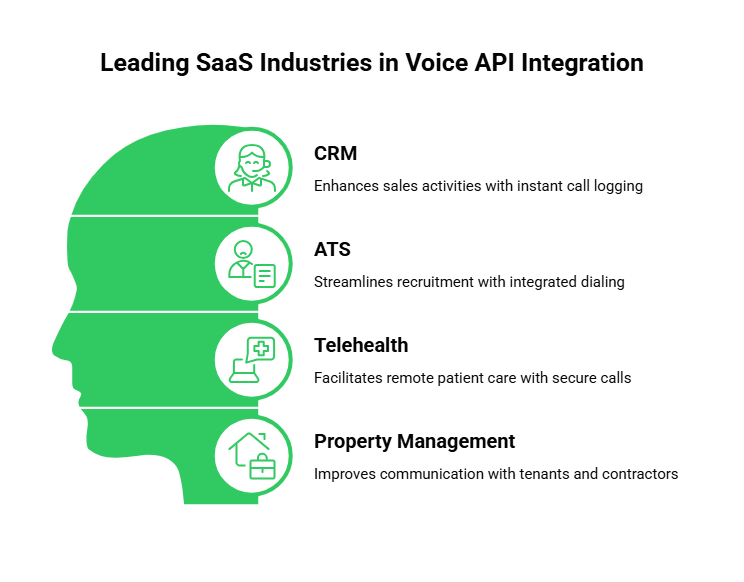
Customer Relationship Management (CRM)
Sales tools were the pioneers. Salespeople live and die by the phone. Platforms like Salesforce or HubSpot rely on integrated voice to track activity. By using FreJun AI as the underlying carrier these platforms ensure that every sales call is crystal clear and logged instantly.
Applicant Tracking Systems (ATS)
Recruiters spend their days screening candidates. Modern ATS platforms now include a dialer. A recruiter can view a resume and click “Call Candidate” right from the profile. They can interview the candidate and rate them on the screen simultaneously.
Telehealth Platforms
Doctors need to speak with patients remotely. Sending a patient a Zoom link can be complicated. calling their phone number directly from the secure medical portal is easier. It protects the doctor’s personal number and keeps the conversation compliant.
Property Management
Real estate agents use software to manage listings. Integrated voice allows them to call tenants or contractors directly from a maintenance ticket ensuring that all communication is documented for legal reasons.
Why Is Speed Essential for SaaS Retention?
SaaS is a competitive market. Users will churn if the software feels slow or clunky.
When a user clicks that call button they expect an instant connection. They do not want to hear silence for five seconds.
This is where infrastructure becomes critical. If the SaaS platform uses a cheap or poorly architected voice provider the audio will lag. The user will blame the SaaS platform not the phone carrier.
FreJun AI provides the low latency infrastructure that SaaS companies need to protect their reputation. We handle the complex voice infrastructure so you can focus on building your AI.
We route audio through optimized paths to minimize delay. This ensures that when a user clicks “Call” the ringing starts immediately. This “snappiness” makes the software feel premium and responsive which directly improves user retention.
How Does FreJun AI Support High Volume SaaS Platforms?
SaaS platforms have a unique challenge. They have thousands of users. If all those users decide to make a call at 9:00 AM on Monday the system faces a massive spike in traffic.
A standard phone system would crash. It cannot handle the concurrency.
FreJun utilizes FreJun Teler which enables elastic SIP trunking. This is a game changer for SaaS.
- Elasticity: We can scale from 10 concurrent calls to 10,000 calls instantly.
- Multi-Tenancy: We allow the SaaS platform to manage distinct numbers and billing for each of their thousands of customers under one master account.
This allows a SaaS company to offer voice features to enterprise clients without worrying about capacity limits.
Comparison: SaaS With and Without Voice
Here is a look at how the feature set differs between a standard platform and a voice enabled one.
| Feature | Standard SaaS Platform | Voice Enabled SaaS Platform |
| Communication | Email and Chat only | Email Chat and Voice |
| Workflow | Users switch apps to call | Users call from the dashboard |
| Data Capture | Manual data entry required | Automated call logging |
| User Retention | Lower (high friction) | Higher (sticky workflow) |
| Revenue Model | Subscription only | Subscription plus Usage |
| Mobile Experience | Limited calling features | Full VoIP capability |
| Setup | Simple | Requires API integration |
How Does This Unlock New Revenue Streams?
This is a massive incentive for SaaS founders. Voice API integration is not just a feature. It is a business model.
When a SaaS platform adds calling they can charge for it.
- Tiered Pricing: “Upgrade to the Pro Plan to unlock calling.”
- Usage Billing: Charge users per minute for the calls they make.
- Number Leasing: Charge users a monthly fee to have a dedicated phone number within the app.
By partnering with an infrastructure provider like FreJun the SaaS platform gets wholesale pricing on minutes. They can mark this up for their users creating a new high margin revenue stream that grows as their customers grow.
Also Read: What Future Trends Are Shaping Voice Bot Solutions in 2026?
What Are the Technical Benefits for Developers?
SaaS developers are experts in React or Python or database design. They are usually not experts in SIP or VoIP protocols.
Asking a web developer to build a phone system from scratch is a recipe for disaster. It is incredibly complex.
FreJun AI simplifies this. We provide a developer first toolkit.
- SDKs: We offer Software Development Kits for Client Side (browser) and Server Side logic.
- Webhooks: We send real time events to your application. When a call starts we ping you. When it ends we send you the recording URL.
- Documentation: We provide clear guides on how to embed voice with just a few lines of code.
This allows SaaS teams to launch voice features in weeks rather than years.
How Does Context Improve User Satisfaction?
The biggest advantage of embedded voice is context.
When a call comes into a support desk software the software knows who is calling. It can pop up the customer’s profile immediately.
But it goes deeper than that.
- Sentiment Analysis: The audio can be streamed to an AI model to detect if the customer is angry.
- Real Time Transcription: The agent can see a live transcript of the conversation helping them catch details they might have missed.
- Keyword Spotting: The system can alert a manager if a customer says “cancel” or “refund.”
FreJun supports the streaming of raw audio data which enables these advanced AI features. By providing clear uncompressed audio we ensure that the transcription and analysis tools work perfectly giving the user superpowered insights.
Ready to transform your SaaS into a communication powerhouse? Sign up for FreJun AI to get started.
What Is the Future of Voice in SaaS?
We are moving beyond simple “click to call.” The next wave is AI Voice Agents.
SaaS platforms are beginning to embed autonomous agents. Imagine a Property Management SaaS. A tenant calls to report a leak. Instead of ringing a property manager’s phone an AI agent answers. It asks about the leak. It categorizes the urgency. It dispatches a plumber. All of this happens inside the software ecosystem.
To build this you need a voice layer that is extremely fast. The AI needs to hear the user and respond in milliseconds.
FreJun is built for this AI driven future. Our Voice API integration is model agnostic. You can plug in any LLM you want. We simply provide the ultra low latency pipe that makes the conversation feel human.
How Do You Ensure Security and Compliance?
SaaS platforms often serve regulated industries like finance and healthcare. They cannot afford data leaks.
Voice data is sensitive. It contains personal information.
FreJun AI takes security seriously.
- Encryption: We encrypt voice traffic using SRTP (Secure Real-time Transport Protocol).
- Data Residency: We allow control over where data is processed.
- Compliance: We help SaaS platforms meet standards like GDPR or HIPAA by providing secure recording storage and access controls.
By using a trusted infrastructure partner the SaaS platform offloads much of the security burden ensuring their users are protected.
How Does FreJun Teler Handle Global Connectivity?
SaaS platforms are global. A CRM might have users in New York and London and Sydney.
If you use a local phone provider you cannot serve global users. You need a global network.
FreJun Teler provides this reach. We allow SaaS platforms to provision phone numbers in over 100 countries. We handle the carrier relationships in each region.
This means a user in France can buy a French phone number inside your US based software. It works seamlessly. FreJun routes the call through the nearest Point of Presence (PoP) to ensure high quality audio regardless of where the user is located.
Also Read: How Does a Voice API for Developers Help Build Smarter Voice Workflows?
Conclusion
The era of static silent software is ending. The most successful SaaS platforms of the future will be the ones that enable seamless communication.
Embedding voice API integration into core workflows is no longer a “nice to have.” It is a requirement for retention and efficiency. It saves users time. It captures valuable data. It creates new revenue lines.
However adding voice is not just about writing code. It is about ensuring quality. If the calls drop or sound robotic users will lose trust. That is why the infrastructure layer is so important.
FreJun AI provides the solid foundation that SaaS companies need. With FreJun Teler handling the global scale and elastic SIP trunking and our low latency media streaming handling the quality we enable you to build world class voice features. We take care of the telecom complexity so you can focus on building the features that make your SaaS unique.
Want to discuss how to add voice to your platform? Schedule a demo with our team at FreJun Teler and let us help you design the perfect integration.
Also Read: Call Routing for E-Commerce Businesses: Faster Support, Better Conversions
Frequently Asked Questions (FAQs)
It is the process of embedding phone calling capabilities directly into a web based software application using an API. This allows users to make and receive calls without leaving the website.
Yes. This is a common business model. You can track the usage via the API and add a markup to the per minute cost creating a new revenue stream for your SaaS.
Yes. FreJun Teler allows you to provision and manage phone numbers from over 100 different countries allowing your SaaS to serve a global customer base.
Since the call happens inside the software the system can automatically log the start time and end time and recording and even a transcript. This eliminates the need for users to manually type in call details.
Yes. FreJun AI uses optimized low latency routing and high quality codecs. This ensures that the voice quality is crystal clear often better than standard cellular connections.
Absolutely. FreJun is designed for AI. You can stream the audio to an AI model for real time transcription or sentiment analysis or even to power a fully automated AI voice agent.
Yes. FreJun uses enterprise grade encryption for voice traffic. We enable SaaS platforms to build compliant solutions that protect sensitive user data.