
Choosing a voice api for developers is a foundational architectural decision. It is not like picking a simple SaaS tool; it is like choosing the plot of land upon which you will build your entire house. The right foundation can support a magnificent, globally scalable, and future-proof structure.
The wrong one can doom your project to a future of cracked walls, a leaky roof, and a constant, frustrating struggle against the limitations of your initial choice. In the rapidly evolving world of voice technology, the stakes of this decision are higher than ever.
As more and more teams rush to integrate voice and AI into their products, they are encountering a series of common, and often costly, voice api pitfalls. These are the subtle, attractive traps that can look like a good decision in the short term but can become a massive source of technical debt and strategic limitation in the long run.
Avoiding these developer voice mistakes is the key to selecting a platform that will not just solve your problem today, but will also empower your innovation for years to come. This guide will explore the five most critical mistakes that teams must avoid when selecting a voice api for developers.
Table of contents
- Mistake #1: Prioritizing “All-in-One” Simplicity Over “Best-in-Class” Flexibility
- Mistake #2: Underestimating the Critical Importance of a True, Globally Distributed Network
- Mistake #3: Treating the API as a “Feature,” Not the Core Product
- Mistake #4: Overlooking the Importance of Observability and Debugging Tools
- Mistake #5: Not Thinking About the Total Cost of Ownership (TCO)
- Conclusion
- Frequently Asked Questions (FAQs)
Mistake #1: Prioritizing “All-in-One” Simplicity Over “Best-in-Class” Flexibility
This is the most common and most dangerous trap. Many providers, especially those with their own legacy AI models, offer a seemingly simple, “all-in-one” or “walled garden” platform. They provide the voice connectivity, the Speech-to-Text (STT), the Large Language Model (LLM), and the Text-to-Speech (TTS), all in one neat, proprietary package.
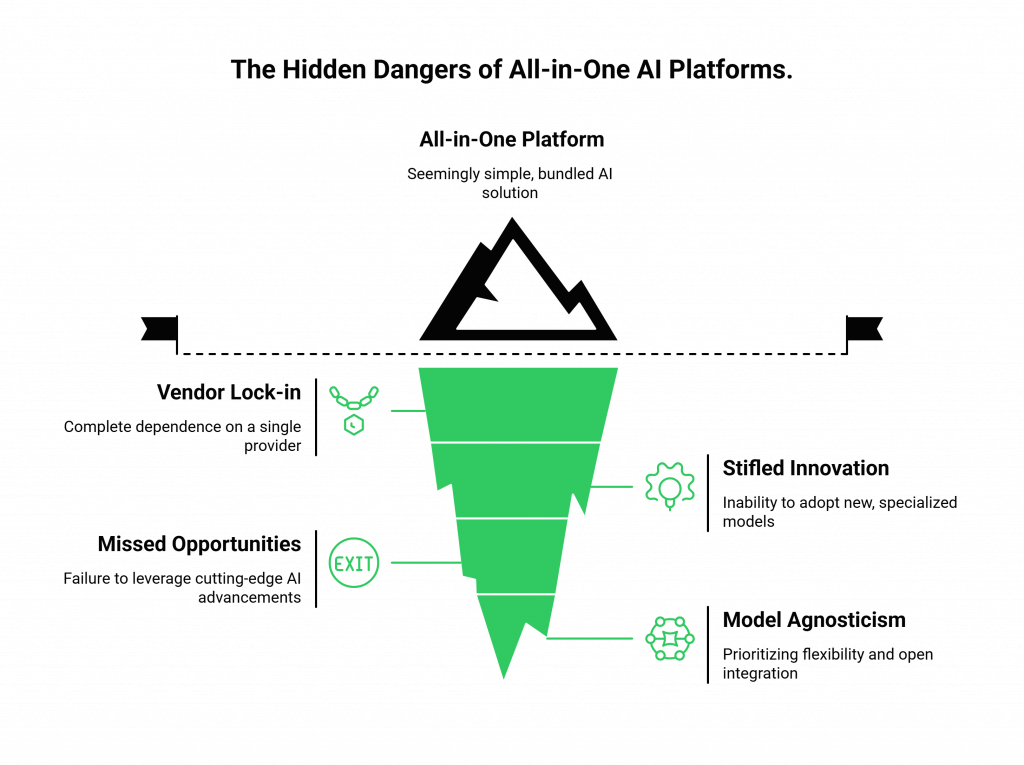
The Hidden Cost of the “Walled Garden”
- The Mistake: A team chooses a provider because it seems “easy.” Everything is bundled together, and they do not have to think about integrating different AI components.
- The Pitfall: You are now completely locked into that provider’s AI ecosystem. The world of AI is moving at a blistering pace, with new, more powerful, and more specialized models being released every month. The “all-in-one” provider’s STT model might be “good enough” for English, but what happens when you need a best-in-class model for Japanese? What happens when a new, hyper-realistic TTS provider emerges that would be perfect for your brand? You are stuck. Your ability to innovate is now a hostage to a single company’s product roadmap.
A recent report from Stanford’s Institute for Human-Centered Artificial Intelligence highlighted that the number of new, significant machine learning models has been growing at an exponential rate, and a walled garden prevents you from harnessing this explosion of innovation.
- The Smarter Choice: Prioritize a platform that is model-agnostic. A future-ready voice api is one that acts as a flexible, open bridge. It should be the expert in the voice infrastructure—the “body”—and give you the complete freedom to choose the AI “brain” from any provider on the market.
Also Read: Can A Smarter Voice Recognition SDK Improve App Experience?
Mistake #2: Underestimating the Critical Importance of a True, Globally Distributed Network
Many providers will claim to have “global” reach, but the devil is in the architectural details. True global performance is not just about being able to call a number in another country; it is about providing a low-latency experience for your users in that country.
The Illusion of “Global”
- The Mistake: A team chooses a provider based on a simple checklist of “countries supported,” without asking how those countries are supported.
- The Pitfall: The provider may have a single, centralized data center in North America. When your user in Australia makes a call, their voice data has to make a 12,000-kilometer round trip across the Pacific Ocean to be processed. The result is a high-latency, choppy, and frustrating experience. The platform is not truly global; it is a US-centric platform with long-distance capabilities.
- The Smarter Choice: Look for a provider with a true, globally distributed, edge-native architecture. This means they have a network of physical Points of Presence (PoPs) in data centers all over the world. This is the only way to solve the physics of latency and to provide a high-quality, real-time experience for a global user base.
Mistake #3: Treating the API as a “Feature,” Not the Core Product
In the modern, developer-first world, the API is not just a way to access the product; the API is the product. A provider whose primary business is selling a finished application and has “bolted on” an API as an afterthought is a major red flag.
The Telltale Signs of a “Fake” API-First Company
- The Mistake: A team is wooed by a flashy UI and a long list of features, and they assume the API will be just as good.
- The Pitfall: They quickly discover that the API is poorly documented, inconsistent, and that critical features are only available through the web portal. The platform is not truly programmable. This makes it impossible to automate their workflows, to integrate the voice data into their other systems, and to operate at a high scale.
- The Smarter Choice: Choose a provider that is radically API-first. Look at their documentation. Is it comprehensive, easy to search, and filled with code examples? Is every single function of the platform, from buying a number to accessing your invoices, available via the API? This is a clear indicator of a true developer-first philosophy.
Also Read: Why Use a Voice Recognition SDK for High Volume Audio Processing
This table provides a quick summary of these critical mistakes.
| The Common Mistake | The Immediate Appeal | The Long-Term Pain | The Smarter Choice |
| Choosing a “Walled Garden” | “It’s simple! Everything is bundled.” | Vendor lock-in; you cannot use the best AI models; your innovation slows down. | A model-agnostic platform that provides a flexible bridge to any AI. |
| Ignoring the Network Architecture | “They have a long list of supported countries.” | High latency and poor quality for your global users; a bad customer experience. | A globally distributed, edge-native network with Points of Presence in key regions. |
| Not Prioritizing the API | “Their web dashboard looks very polished.” | The platform is not truly programmable; you cannot automate your workflows or scale effectively. | A radically API-first company where the API is the core product. |
Ready to build on a platform that was designed to help you avoid these pitfalls from day one? Sign up for FreJun AI!
Mistake #4: Overlooking the Importance of Observability and Debugging Tools
In a real-time system like voice, things will inevitably go wrong. A call will drop, a user will have a poor connection, an API call will fail. When this happens at 2 AM, your team’s ability to quickly diagnose and resolve the issue is paramount.
The Danger of the “Black Box”
- The Mistake: A team chooses a provider without rigorously evaluating its logging, analytics, and debugging tools.
- The Pitfall: When a customer complains about a bad call, you are flying blind. You have no way of knowing if the problem was with the user’s network, a bug in your application, or an issue with the provider’s platform. This leads to long, frustrating support cycles and an inability to proactively improve your service.
- The Smarter Choice: Choose a platform that provides deep, granular observability. This includes real-time webhooks for every call event, detailed post-call analytics with quality metrics (jitter, packet loss, MOS), and a powerful, searchable API for your call logs.
Mistake #5: Not Thinking About the Total Cost of Ownership (TCO)
The per-minute price of a call is just one, small part of the total cost of running a voice application. A myopic focus on this single number is a classic developer voice mistake.
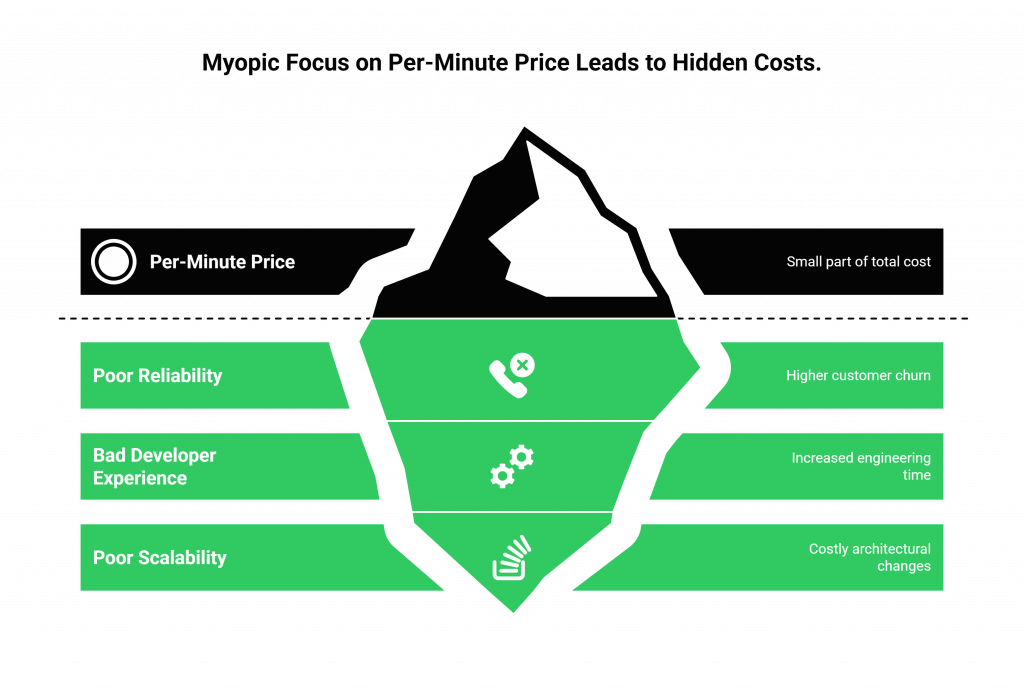
The Hidden Costs
- The Mistake: A team chooses a provider because their per-minute rate is a fraction of a cent cheaper than their competitors’.
- The Pitfall: They soon discover the hidden costs. The platform’s poor reliability leads to higher customer churn. The lack of a good developer experience means their engineering team spends twice as long building and maintaining the application. The poor scalability requires costly, last-minute architectural changes.
- The Smarter Choice: Evaluate the total cost of ownership. A platform with a slightly higher per-minute rate but with a powerful developer experience, carrier-grade reliability, and effortless scalability will almost always have a lower TCO in the long run because it will save you an immense amount of engineering time and will protect you from the high cost of a poor customer experience.
Also Read: Modern Voice Recognition SDK Supporting Multilingual Apps
Conclusion
Choosing a voice API is a long-term architectural decision. It deeply affects product performance, team agility, and innovation speed. Early excitement can lead to common pitfalls. Teams may choose “all-in-one” solutions. They may also chase deceptively low pricing.
But by taking a more strategic, long-term view, by prioritizing flexibility over simplicity, by scrutinizing the underlying network architecture, and by choosing a truly developer-first platform, you can avoid these mistakes.
The best voice API 2026 will be the one that empowers you to build, scale, and innovate without limits, and that is a decision worth getting right from the very beginning.
Want to do a deep architectural dive and see how the FreJun AI platform is specifically designed to avoid these common pitfalls? Schedule a demo with our team.
Also Read: IVR Software vs Call Routing Tools: Which One Does Your Business Need?
Frequently Asked Questions (FAQs)
The biggest pitfall is choosing a “walled garden” or “all-in-one” provider that locks you into their proprietary AI models, which stifles your ability to innovate.
It means the platform is a flexible bridge that allows you to use the best AI models (STT, LLM, TTS) from any provider you choose.
It is the only way to solve the problem of network latency for a global user base, which is critical for a high-quality, real-time conversation.
A key indicator is that every single function of the platform, from buying a phone number to accessing your invoices, is available and documented as an API endpoint.
Observability is the ability to have deep, real-time visibility into the performance of every call. It include detailed logs, quality metrics, and event notifications (webhooks).
Some common developer voice mistakes include ignoring the platform’s network architecture, not prioritizing the developer experience, and focusing only on the per-minute price instead of the total cost of ownership.
You should consider not just the direct pricing, but also the indirect costs. It mainly include the amount of engineering time required to build and maintain the integration.