
For the past decade, the mantra of digital transformation has been “mobile-first.” Businesses re-architected their websites, their applications, and their entire customer journeys around the smartphone. Today, we are on the cusp of a new and even more profound paradigm shift: the move to “AI-first.” An AI-first business is one that does not just use artificial intelligence as an add-on feature; it is a business that is fundamentally built around AI as its core operational engine.
In this new landscape, modern voice bot solutions are emerging as a mission-critical component. They are the essential “sensory input” that allows a business’s central AI brain to interact with the world through the most natural and universal interface of all: the human voice.
This is a fundamental re-imagining of what a “phone call” is to a business. In the old model, a call was a manual, one-to-one interaction, a silo of communication that was completely disconnected from the rest of the digital workflow.
In an AI-first model, a call is a rich, structured, and instantly analyzable data event, a core part of a deeply integrated and automated system. The intelligent voice automation provided by business voicebots is not just another channel; it is the key that unlocks the door to a new generation of hyper-efficient and deeply personalized ai-first workflows.
Table of contents
What Does an “AI-First” Business Model Actually Look Like?
An AI-first business is one that has a central AI “brain”, often a sophisticated Large Language Model (LLM) or a collection of specialized models at the very heart of its operations. This central intelligence is deeply integrated with all of the company’s data sources and business systems. The core principles of an AI-first model include:
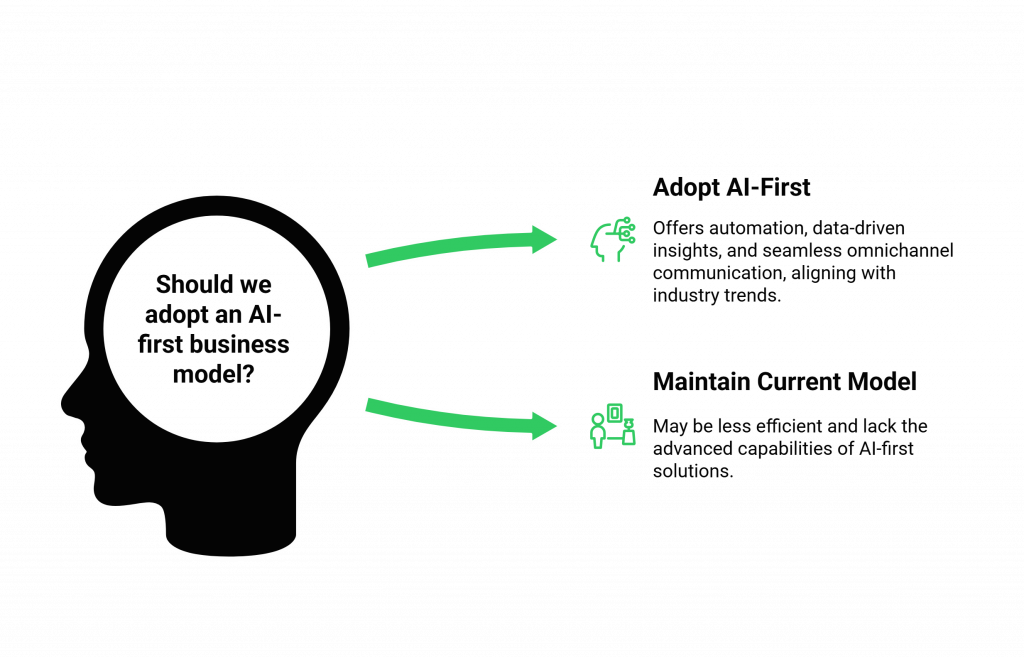
- Automation by Default: The default assumption is that any repetitive, data-driven task or workflow should be handle by the AI. Human involvement is reserved for exceptions, strategy, and high-value, empathetic interactions.
- Data as the Lifeblood: The AI’s intelligence is constantly being fed and refined by a real-time stream of data from every single customer interaction, on every channel.
- A Unified, Omnichannel Brain: There is no separate “chatbot,” “voice bot,” and “email bot.” There is a single, unified AI brain that can seamlessly communicate across all of these channels, maintaining a persistent and context-aware conversation with each customer.
A recent report from McKinsey on the state of AI highlighted the massive momentum behind this shift, finding that 63% of organizations expect to increase their AI investment over the next three years.
Also Read: Key Benefits of Programmable SIP for Building Context-Aware Voice Applications
The Voicebot as the “Ears and Mouth” of the AI-First Enterprise
In this AI-first architecture, the voice bot solution is not a standalone application. It is a critical I/O (Input/Output) layer for the central AI brain. It is the sophisticated “sensory organ” that allows the brain to hear and to speak.
Translating the Messy World of Voice into Clean, Structured Data
A human voice on a phone call is a messy, analog, and chaotic stream of data. The AI’s brain, on the other hand, operates in a world of clean, digital, and structured text. The first and most critical role of the voicebot’s underlying infrastructure is to act as a high-speed, real-time translator.
- The Connection: It connects to the global telephone network and captures the raw audio stream.
- The Transcription (STT): It pipes this audio to a Speech-to-Text engine, which turns the spoken words into a written transcript.
- The Input: This clean, structured text is then sent as an input to the central AI brain.
Translating Digital Intent Back into Human Speech
After the central AI brain has processed the input and has decided on a response, the voicebot’s infrastructure performs the reverse translation.
- The Output: The central AI brain generates a text-based response.
- The Synthesis (TTS): This text is sent to a Text-to-Speech engine, which synthesizes it into a natural, human-like voice.
- The Delivery: The voicebot’s infrastructure plays this synthesized audio back to the user on the live phone call.
This entire, bidirectional translation process must happen in a fraction of a second for the conversation to feel natural. This is the essence of intelligent voice automation.
Also Read: Why Programmable SIP Is the Backbone of Voice Infrastructure for AI Agents
What Do These AI-First Workflows Look Like in Practice?
When you combine a central AI brain with a powerful, real-time voice I/O layer, you can create ai-first workflows that are a quantum leap beyond the simple IVRs of the past.
This table showcases some powerful, real-world examples of this architecture in action.
| The AI-First Workflow | How the Voicebot Enables It | The Strategic Business Value |
| The Proactive, Conversational Sales Agent | Your central AI monitors your CRM for high-potential leads. When one is identified, it triggers an outbound call via the voicebot. The voicebot then has a natural, two-way conversation to qualify the lead and book a meeting. | Massively increases the speed and scale of your sales development, allowing your human sales team to focus exclusively on closing pre-qualified, high-intent deals. |
| The Instant, Self-Service Insurance Claims FNOL | A policyholder has an accident and calls the insurance company. The voicebot answers instantly, uses AI to understand the situation, gathers all the critical information (First Notice of Loss), and files the claim automatically. | Provides an instant, 24/7, and empathetic response in a moment of crisis. Dramatically reduces the cost of claims processing and accelerates the claims lifecycle. |
| The Intelligent, Predictive Field Service Dispatch | Your central AI’s scheduling and logistics model determines that a technician is running ahead of schedule. It automatically triggers a call via the voicebot to the next customer on the list to offer them an earlier appointment slot. | Optimizes field service routes in real-time, increases technician productivity, and provides a delightful, proactive experience for the customer. |
| The Continuous, Voice-Native Data Entry | A doctor is walking between patient rooms and uses a dedicated number to call their EMR system. The voicebot authenticates them and allows them to dictate their patient notes in natural language, which the AI then parses and structures into the correct fields. | Frees up highly skilled professionals from tedious, manual data entry, reduces administrative errors, and allows them to spend more time on their core, high-value work. |
Ready to start building the AI-first workflows that will define the future of your industry? Sign up for a FreJun AI.
What Underpins a Successful AI-First Voice Strategy?
Building these sophisticated ai-first workflows requires more than just a smart LLM. It requires an enterprise-grade voice infrastructure that is design for the unique demands of AI.
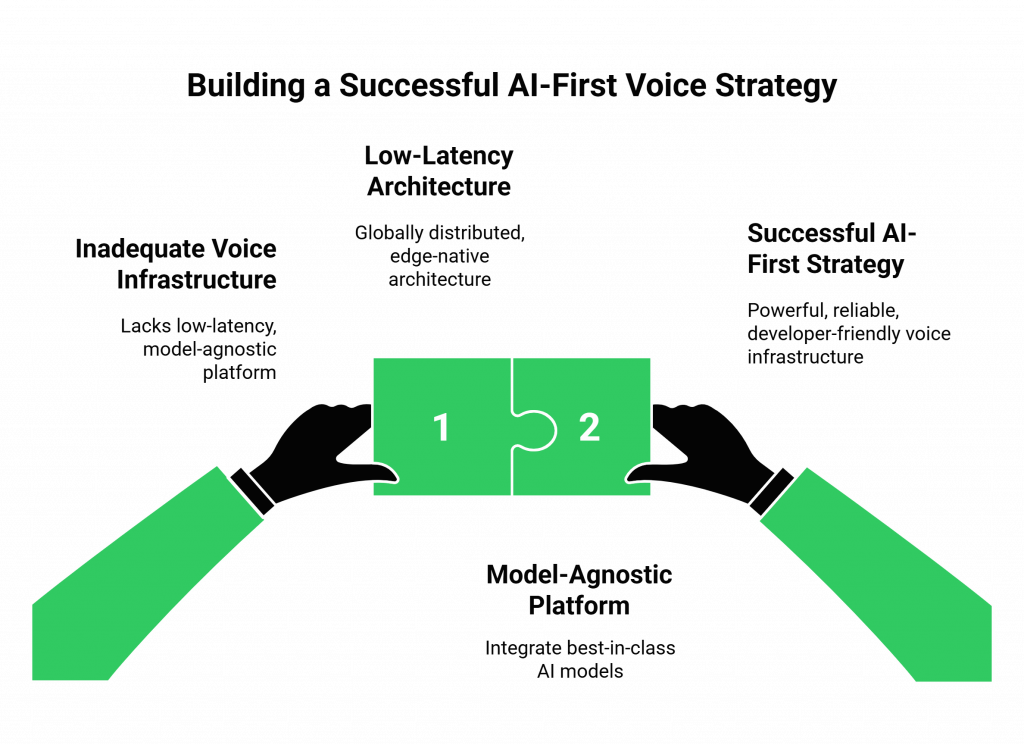
The Non-Negotiable Need for a Low-Latency, Model-Agnostic Platform
The voice platform that acts as your I/O layer must be:
- Low-Latency: The entire round-trip of a conversational turn must be imperceptibly fast. This requires a globally distributed, edge-native architecture.
- Model-Agnostic: The world of AI is moving too fast to be locked into a single provider’s models. A true AI-first platform, like FreJun AI, must be a flexible bridge, allowing you to integrate the best-in-class STT, LLM, and TTS models from any vendor on the market.
This is our core architectural philosophy. We do not build the “brain.” We provide the powerful, reliable, and developer-friendly “nervous system.” This is our promise: “We handle the complex voice infrastructure so you can focus on building your AI.” The importance of this flexibility cannot be overstated.
Also Read: The Developer’s Guide to Integrating LLMs with Programmable SIP Infrastructure
Conclusion
The rise of the AI-first business is a paradigm shift that is reshaping the very nature of how companies operate and how they interact with their customers. In this new world, voice bot solutions are evolving from a simple, siloed channel for deflecting calls into a mission-critical, deeply integrated component of the central AI’s nervous system.
They are the essential “sensory organs” that allow the business’s core intelligence to engage with the world in the most human way possible. For any business looking to lead in the AI-first era, building powerful, real-time intelligent voice automation is not just an opportunity; it is an inevitability.
Want to do a deep architectural dive into how our voice platform can act as the real-time I/O layer for your central AI brain? Schedule a demo with our team at FreJun Teler.
Also Read: Top Mistakes to Avoid While Choosing IVR Software
Frequently Asked Questions (FAQs)
An ai-first workflow is a business process that is design with an AI as the primary actor, automating the core tasks and decision-making, with humans managing exceptions.
The main role of business voicebots is to act as the real-time “ears and mouth” for the company’s central AI brain, allowing it to communicate over the phone.
Intelligent voice automation is the use of conversational AI to handle complex, two-way voice interactions, going far beyond the capabilities of a traditional, menu-based IVR.
It connects via a series of APIs. The voice platform streams the call’s audio to the AI brain for processing and receives the AI’s response to be play back.
It is important because it gives you the freedom to choose the best-in-class AI models for each part of your workflow, preventing vendor lock-in and future-proofing your stack.
Yes. Because it is power by a central AI brain, a single, unified voicebot can be train to handle a wide variety of tasks, from sales to support to operations.
With a modern, API-first voice platform, the integration is significantly simplified. The voicebot becomes another programmable microservice in your overall architecture.