
You have done the complex, innovative work and have mastered the art of building voice bots. You have engineered an AI-powered voice agent that can handle customer service inquiries, qualify sales leads, or schedule appointments with remarkable, human-like fluency.
Now comes the equally important, and often more challenging, question: how do you turn this incredible technology into a profitable business?
The path from a technical marvel to a commercially successful product is paved with strategic decisions about pricing, packaging, and value. Unlike a traditional software application, the value of a voice bot is not just in the code itself, but in the real-time, transactional work it performs. This unique nature opens up a variety of voice bot monetization models, each with its own strengths and weaknesses.
Choosing the right strategy is critical. It will not only determine your revenue streams from voice agents but will also shape your product’s positioning, your target market, and your long-term relationship with your customers.
Table of contents
Why is Monetizing Voice AI Different from Standard SaaS?
Before diving into the specific models, it is crucial to understand why monetizing a voice bot is a unique challenge. Unlike a standard SaaS product where the primary cost is the software itself, a voice bot has a significant, variable, and ongoing operational cost.
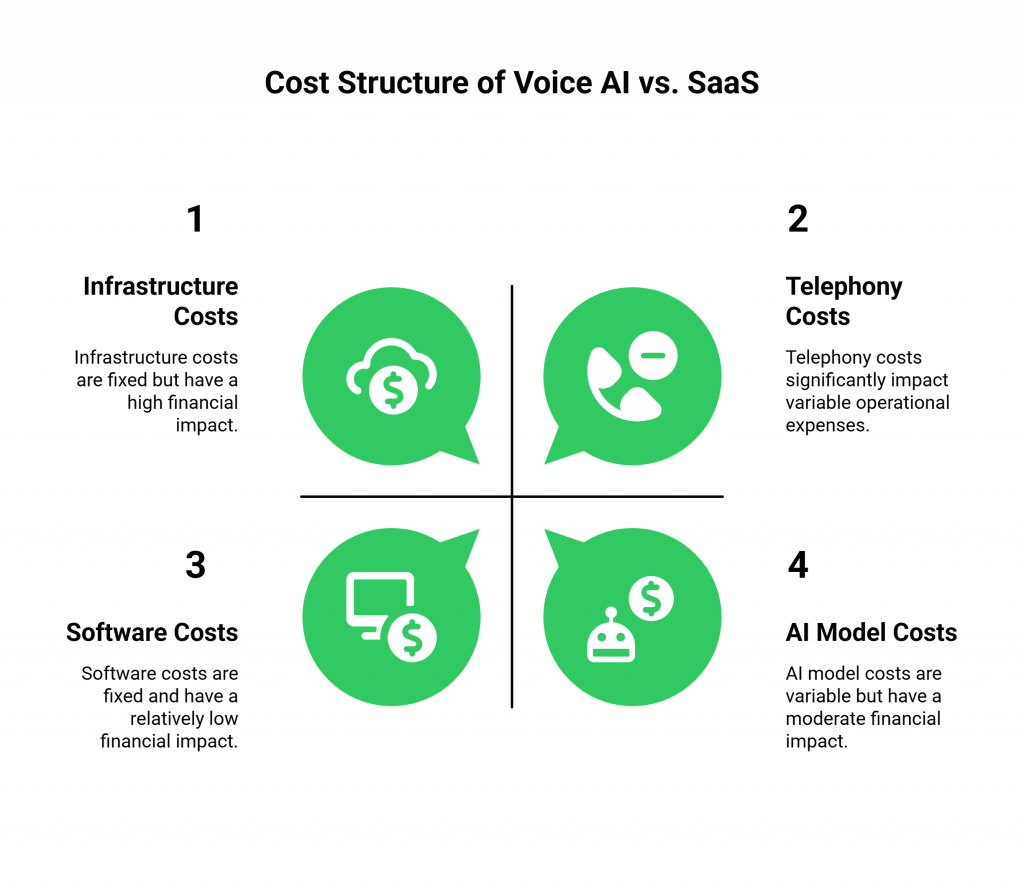
Every single call that your voice bot handles incurs a series of real-time costs:
- Telephony Costs: There is a cost for the phone number and a per-minute cost for the underlying carrier connection (the SIP trunking).
- AI Model Costs: Every interaction requires a series of API calls to third-party AI services: the Speech-to-Text (STT) for transcription, the Large Language Model (LLM) for intelligence, and the Text-to-Speech (TTS) for the voice. Each of these has its own usage-based cost.
- Infrastructure Costs: You have to pay for the cloud servers that run your application’s logic (your “AgentKit”).
This means that your cost of goods sold (COGS) is not fixed; it scales directly with usage. A successful monetization strategy must not only cover these variable costs but also generate a healthy profit margin on top of them. This is why simple, all-you-can-eat SaaS models for voice AI are often a recipe for financial disaster.
Also Read: From Text Chatbots to Voice Agents: How a Voice Calling SDK Bridges the Gap
What Are the Most Effective Voice Bot Monetization Models?
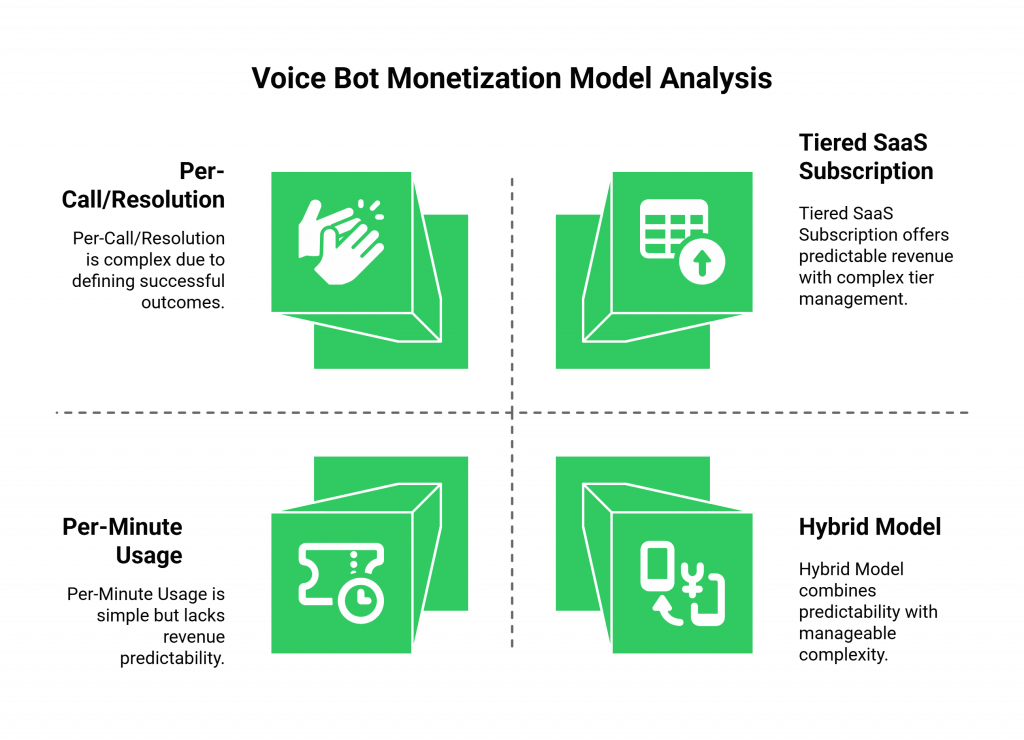
There are several proven strategies for monetizing a voice bot, and the best choice often depends on the specific value your bot provides to the business. The most successful companies often use a hybrid approach, combining a recurring subscription with a usage-based component.
Model 1: The Per-Minute, Usage-Based Pricing Strategy
This is the most direct and transparent model. It is a pure, pay-as-you-go approach where the customer is billed for the total number of minutes that your voice bot is on the phone.
- How It Works: You set a simple, all-inclusive per-minute rate (e.g., $0.15 per minute). This rate is calculated to cover your telephony costs, your AI model costs, and your profit margin.
Pros
- Simple and Transparent: It is very easy for the customer to understand. They only pay for what they use.
- Low Barrier to Entry: This model is very attractive for new customers, as there are no large upfront commitments.
- Directly Aligns Cost with Value: The customer’s cost is directly proportional to the amount of “work” the bot is doing for them.
Cons
- Unpredictable Revenue: Your revenue can be highly variable from month to month, which can make financial forecasting difficult.
- Can Discourage High Usage: For some high-volume use cases, a pure per-minute model can become expensive, which might discourage the customer from using the bot as much as they could.
Model 2: The Per-Call or Per-Resolution Model
This is a value-based model that is a slight variation of the usage-based approach. Instead of billing per minute, you are billing per outcome.
- How It Works: You define a specific, successful outcome and charge a flat fee every time the bot achieves it. This could be a cost-per-call monetization model (e.g., $1.00 for every inbound call the bot handles) or a cost-per-resolution model (e.g., $5.00 for every successful appointment the bot schedules).
Pros
- Value-Based: It directly ties your price to the tangible value you are creating for the business. This can often support much higher prices than a simple per-minute rate.
- Predictable Costs for the Customer: The customer knows exactly what they will be charged for each successful interaction.
Cons
- Complex to Define and Track: It can be difficult to define what constitutes a “successful resolution,” which can sometimes lead to disputes with the customer.
- Risk of Unprofitable Interactions: If a call takes an unusually long time to reach a resolution, your underlying costs could exceed the flat fee you are charging.
Also Read: Security in Voice Calling SDKs: How to Protect Real-Time Audio Data
Model 3: The Tiered SaaS Subscription Model
This is a more traditional SaaS model, but it must be implemented with care. It involves creating several subscription tiers, each with a different set of features and usage allowances.
How It Works: You create packages like a “Basic,” “Pro,” and “Enterprise” plan.
- Basic Plan: $200/month, includes up to 1,000 conversational minutes.
- Pro Plan: $1,000/month, includes up to 6,000 conversational minutes and advanced features like CRM integration.
- Overage Charges: Critically, each plan must include a clear “overage” rate for any usage that exceeds the monthly allowance (e.g., $0.12 for each additional minute).
Pros
- Predictable, Recurring Revenue: This is the holy grail for a SaaS business. It provides a stable and predictable revenue stream.
- Clear Upsell Path: The tiered structure makes it easy to upsell customers to a higher plan as their usage and needs grow.
Cons
- The Risk of Overages: Customers can be sensitive to and frustrated by unexpected overage charges if they are not managed and communicated properly.
- Complexity: Creating the right balance of features and allowances for each tier can be a complex and ongoing process of analysis.
This table provides a summary of the core monetization models.
| Monetization Model | How It Works | Best Suited For | Key Challenge |
| Per-Minute Usage | Pure pay-as-you-go based on total talk time. | Startups and businesses with highly variable, unpredictable call volumes. | Unpredictable monthly revenue for the provider. |
| Per-Call / Per-Resolution | Flat fee for each successfully handled call or outcome. | Value-driven use cases with a clear, definable outcome (e.g., appointment scheduling). | Accurately pricing the “value” and managing long, unprofitable calls. |
| Tiered SaaS Subscription | Monthly recurring fee that includes a set allowance of minutes/calls. | Established businesses with relatively stable and predictable call volumes. | Setting the right tier limits and managing customer sensitivity to overage charges. |
Ready to build the powerful voice bot that will be the engine of your new business? Sign up for FreJun AI and explore our powerful, low-cost voice infrastructure.
Also Read: 5 Common Mistakes Developers Make When Using Voice Calling SDKs
Conclusion
The technology for building voice bots has finally reached a point of incredible power and accessibility. But the technical achievement is only the first step. The true path to a successful business lies in a thoughtful and strategic approach to monetization.
There is no single “right” answer, but by understanding the unique cost structure of a voice AI application and by carefully considering the value you are providing to your customers, you can choose the right blend of subscription and usage-based pricing strategies.
The hybrid model, which combines the stability of a recurring SaaS fee with the scalability and fairness of a usage-based component, has emerged as the clear winner for most businesses, providing a powerful and sustainable engine for growth in the exciting new world of revenue streams from voice agents.
Want to do a deep dive into the underlying costs of a voice AI call and model out a monetization strategy for your specific use case? Schedule a demo with our team at FreJun Teler.
Also Read: Top Automation Features Every Call Center Needs: IVR, Chatbots, Routing & More
Frequently Asked Questions (FAQs)
The most common mistake is to offer a simple, “unlimited” flat-rate SaaS plan. Because every call has a real, variable cost (telephony and AI models), this can quickly lead to a situation where a high-usage customer becomes unprofitable.
There are three main variable costs: the per-minute cost of the underlying voice connectivity (the SIP trunking), the per-character or per-second cost of the Text-to-Speech (TTS) service, and the per-second or per-request cost of the Speech-to-Text (STT) and Large Language Model (LLM) services.
A “per-minute” model (usage-based pricing strategies) bills for the total duration of the conversation. A “per-call” model (cost-per-call monetization) bills a flat fee for every call that the bot handles, regardless of its duration.
It provides the best of both worlds. The subscription component gives the provider a stable, predictable recurring revenue stream, while the usage component ensures that their variable costs are always covered and that the pricing is fair for both low-usage and high-usage customers.
You need to do a cost-plus analysis. First, calculate your total, blended per-minute cost for all the underlying services (telephony, STT, LLM, TTS). Then, add the profit margin you want to achieve. For example, if your total cost is $0.08 per minute and you want a 50% gross margin, you would need to charge at least $0.16 per minute.
The biggest challenge is accurately defining and tracking a “successful resolution.” For example, if your bot’s goal is to schedule an appointment, what happens if the customer cancels the appointment later? This can lead to ambiguity and potential disputes with your client.
A free trial can be a very effective marketing tool, but it must be carefully controlled. Because every call has a real cost, your free trial should be limited, either by the number of calls, the number of minutes, or a specific time period, to prevent abuse.
This is where the hybrid model shines. Their base subscription fee remains the same, and they are simply billed for their overage usage at the pre-agreed rate. A good platform will also include alerting features that can notify both you and the customer when their usage is trending higher than normal.
FreJun AI provides the foundational voice infrastructure at a very low, transparent, and predictable usage-based cost. By knowing exactly what your underlying telephony costs will be, you have a solid and reliable baseline upon which you can build your own pricing and voice bot monetization models.
Most usage-based models bill in arrears. At the end of the billing period (e.g., the end of the month), you meter all of the customer’s usage and send them an invoice. The subscription component, however, is typically billed in advance.