
Imagine you are a customer calling your bank. You have lost your credit card and you are panicked. You dial the number. You hear silence. Then a click. Then static. Then the call drops. You try again. This time you get a busy signal.
How do you feel? You feel frustrated and angry and unsafe. You might even consider switching banks.
Now imagine a different experience. You dial the number. It connects instantly with crystal clear audio. A smart voice greets you by name. It knows you are calling from your registered phone number. It asks “Are you calling about the suspicious transaction we just texted you about?” You say yes. You are connected to a human agent who already has your account open on their screen. The problem is solved in two minutes.
This second scenario is not magic. It is engineering. It is the result of a robust inbound call flow powered by a modern voice calling API and SDK.
For businesses today the phone is still a primary channel for high stakes interactions. Whether it is healthcare or finance or customer support reliability is everything. In this guide we will explore exactly how these systems work and why infrastructure matters and how platforms like FreJun AI provide the invisible foundation that keeps these critical conversations flowing smoothly.
Table of contents
- What Is an Inbound Call Flow?
- How Does a Voice Calling API and SDK Work?
- Why Is Reliability Critical for Inbound Calls?
- How Do You Improve Agent Productivity with a Voice SDK?
- What Role Does Automation Play in Handling Calls?
- How Does FreJun AI Ensure Call Reliability?
- What Are the Key Features of a Modern Inbound System?
- How to Build a Simple Inbound Flow?
- Real-World Example: Healthcare Support
- Why Do Developers Prefer FreJun AI?
- How to Measure Success?
- Conclusion
- Frequently Asked Questions (FAQs)
What Is an Inbound Call Flow?
An inbound call flow is the path a phone call takes from the moment a customer dials your number until the moment the issue is resolved.
It is not just about a phone ringing on a desk. It is a digital journey.
- The Carrier Network: The call travels through the public telephone network (PSTN).
- The Entry Point: It hits your business infrastructure.
- The Logic: The system decides what to do. Should it play a menu? Should it route to Sales or Support?
- The Connection: The call is connected to an agent or an AI bot.
- The Resolution: The conversation happens and data is logged.
In the past this flow was managed by big expensive hardware boxes called PBXs sitting in a server room. Today it is managed by software. This is where the voice calling API and SDK come into play. They allow developers to build, control, and optimize this flow using code.
How Does a Voice Calling API and SDK Work?

To understand how to build a reliable system you need to understand the tools.
The API (The Engine)
The API (Application Programming Interface) is the server side intelligence. It handles the logic. When a call comes in FreJun sends a signal (webhook) to your server. Your server uses the API to tell FreJun what to do next.
- “Play this welcome message.”
- “Record this call.”
- “Forward this call to the agent with ID 105.”
The SDK (The Dashboard)
The SDK (Software Development Kit) is the client side tool. This is what lives inside your web app or mobile app. It allows the agent to answer the call directly through their browser. It handles the microphone and the speakers and the connection stability.
When you combine a voice calling API and SDK you get complete control over the experience. You are not stuck with the default settings of a phone company. You can build a custom flow that fits your exact business needs.
Also Read: The Future of Programmable SIP in the Age of AI and LLMs
Why Is Reliability Critical for Inbound Calls?
You might think that a dropped call here and there is no big deal. The data says otherwise.
In the world of customer experience (CX) voice is usually the channel of last resort. People text or email first. If they are calling it means the issue is urgent or complex. Emotions are high.
According to a report by Zendesk, roughly 50% of customers will switch to a competitor after just one bad experience. If that bad experience is a dropped call or poor audio quality you are losing revenue directly.
Reliability depends on infrastructure. This is where FreJun AI shines. We handle the complex voice infrastructure so you can focus on building your AI.
We utilize FreJun Teler which provides elastic SIP trunking. This means our network can stretch. If you suddenly get 1000 calls at once our system scales up to handle them. If a server in one region has an issue traffic is automatically routed to another. This redundancy ensures that your phone lines are always open.
How Do You Improve Agent Productivity with a Voice SDK?
Reliability gets the call to the agent. But what happens next? Efficiency matters.
If an agent has to struggle with a physical desk phone and then type on a computer and then toggle between three different tabs productivity dies.
An agent productivity voice SDK solves this. It embeds the phone directly into the software the agent uses every day (like a CRM or Helpdesk).
The Single Pane of Glass
With FreJun’s SDK the call controls (Answer, Hang up, Mute, Transfer) are right on the screen next to the customer data. The agent never has to look away.
Context is King
Because the API and SDK talk to each other the system can deliver “Context.”
- Who is calling? The SDK displays the customer name.
- Why are they calling? If they pressed “2 for Billing” in the menu the SDK shows “Billing Queue.”
- History: The SDK can show the last five tickets this customer opened.
This allows the agent to solve the problem faster. They do not have to ask repetitive questions. They can get straight to the solution.
What Role Does Automation Play in Handling Calls?
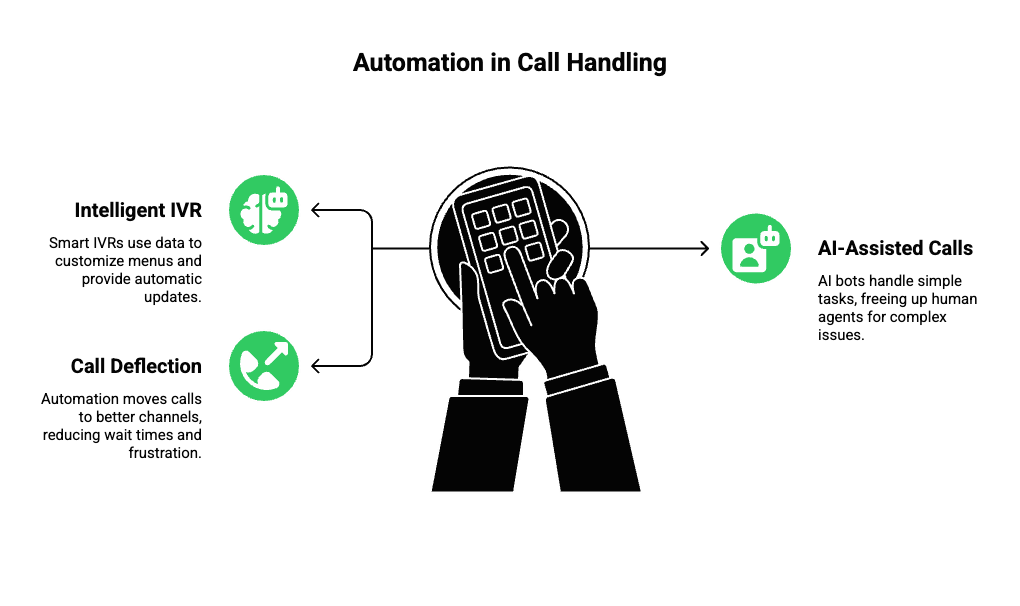
You cannot answer every call with a human immediately. It is too expensive. This is where automation becomes the best friend of reliability.
Using a voice calling API and SDK you can build smart automated layers that sit in front of your human agents.
Intelligent IVR (Interactive Voice Response)
Old IVRs were dumb. “Press 1 for this.” Smart IVRs use data. They can look up the caller’s number and customize the menu.
“Hi John. Are you calling about your order #1234?”
If John says yes the system gives him the tracking update automatically.
AI-Assisted Calls
This is the next level. You can use FreJun to stream the audio to an AI bot. The bot can handle the entire conversation for simple tasks like scheduling appointments or resetting passwords. This keeps the lines free for customers who truly need human help.
Call Deflection
Sometimes the best way to handle a call is to move it to a better channel. If the wait time is long the automation can say “Wait time is 15 minutes. Press 1 to receive a text message link to chat with us instead.” This reduces frustration and balances the load.
How Does FreJun AI Ensure Call Reliability?
We mentioned that software needs a strong foundation. You can write the best code in the world but if the network is bad the call will fail.
FreJun AI focuses heavily on the transport layer.
- Low Latency Routing: We route audio through the fastest possible path. This prevents the “talk over” effect where you and the customer interrupt each other because of a delay.
- Jitter Buffering: The internet is messy. Data packets arrive out of order. Our infrastructure smooths this out so the voice sounds robotic-free and natural.
- Global Reach: With FreJun Teler we offer global connectivity. Whether your customer is in New York or New Delhi our infrastructure ensures the call connects locally and clearly.
What Are the Key Features of a Modern Inbound System?
When you build your system using a voice calling API and SDK you gain access to features that legacy hardware simply cannot offer. Here is a comparison of what you get:
| Feature | Legacy Phone System | API-Driven System (FreJun) |
| Scalability | Limited by hardware lines | Infinite (Elastic SIP Trunking) |
| Data Integration | None (Siloed) | Full sync with CRM |
| Routing Logic | Basic (Ring everyone) | Advanced (Skills-based, Data-driven) |
| Analytics | Basic reports next day | Real-time dashboards |
| Setup Time | Weeks (Install wires) | Minutes (Copy API keys) |
| Audio Quality | Standard | High Definition (HD Voice) |
Also Read: Why Programmable SIP Is the Backbone of Voice Infrastructure for AI Agents?
How to Build a Simple Inbound Flow?
If you are a developer ready to start here is the roadmap.
Step 1: Get Your Numbers
You need a phone number that people can dial. Sign up for FreJun AI. You can purchase numbers in over 100 countries instantly via the dashboard.
Step 2: Configure Webhooks
Tell FreJun where to send the call data. In your dashboard set the “Incoming Call URL” to point to your server.
Example: https://api.yourcompany.com/voice/incoming
Step 3: Write the Logic
When your server receives the webhook write code to handle it.
- Scenario A: It is business hours. Return a command to dial your support team’s SIP addresses.
- Scenario B: It is midnight. Return a command to play a “We are closed” message and record a voicemail.
Step 4: Embed the SDK
Install the FreJun Client SDK in your agent’s web portal.
frejun.Device.setup(token)
This turns the browser into a phone.
Step 5: Test and Launch
Call the number. Watch the logs. Ensure the audio is clear and the routing works. Once verified you are live.
Real-World Example: Healthcare Support
Let us look at how this works in practice for a medical clinic.
A patient calls the clinic. The clinic uses FreJun Teler for their lines.
- Identification: The API sees the incoming number. It checks the patient database.
- Priority Routing: The database shows this patient had surgery yesterday. The system skips the general menu.
- Agent Context: The call routes to the nurse line. The nurse’s screen pops up with the patient’s surgery notes before they answer.
- AI Assistance: During the call the nurse needs to schedule a follow-up. The AI-assisted calls feature transcribes the conversation and suggests available slots based on the doctor’s calendar.
- Completion: The call ends. The recording and transcript are automatically saved to the patient’s secure file.
This flow is fast and safe and creates a great patient experience.
Why Do Developers Prefer FreJun AI?
There are many API providers out there. Why choose FreJun?
It comes down to the “Plumbing.” Many providers are just software wrappers. They resell other networks. FreJun owns the deep infrastructure.
We are model-agnostic. We do not force you to use a specific AI brain. You can bring your own LLM or Speech-to-Text provider. We just focus on being the best possible pipe for the audio.
Our voice calling API and SDK are designed to be developer-first. We provide clear documentation and robust testing tools. But mostly we provide peace of mind. With our elastic infrastructure you know that your inbound flows will hold up under pressure.
How to Measure Success?
Once you deploy your flow you need to track it. A digital system gives you digital data.
Answer Seizure Ratio (ASR)
This measures how many calls actually connect versus how many fail. A low ASR means network trouble. FreJun’s optimized routing ensures this number stays high.
Average Handle Time (AHT)
This tracks how long an agent spends on a call. With the agent productivity voice SDK features like screen pops and auto-logging you should see this number drop significantly.
Customer Satisfaction (CSAT)
You can automate a survey at the end of the call. “Rate this call from 1 to 5.” This gives you immediate feedback on your flow’s performance.
Also Read: What Ethical Issues Should Leaders Consider When Building Voice Bots?
Conclusion
The reliability of your inbound calls is not a “nice to have.” It is a survival requirement. If your phones do not work your business does not work.
By moving from legacy hardware to a modern voice calling API and SDK you gain control. You gain the ability to route calls intelligently and automate mundane tasks and empower your agents with data.
But remember that the software is only as good as the network it runs on. FreJun AI provides the robust infrastructure necessary to support these advanced features. With FreJun Teler handling the heavy lifting of global telephony and our developer tools managing the logic you can build an inbound flow that is not just reliable but exceptional.
We handle the complex voice infrastructure so you can focus on building your AI and your business logic. Don’t let your customers hear silence. Let them hear solutions.
Ready to upgrade your call reliability? Schedule a demo with our team at FreJun Teler and let us help you design the perfect inbound architecture.
Also Read: Create High-Impact WhatsApp Message Templates for Enterprises in Bahrain
Frequently Asked Questions (FAQs)
The API is the server-side tool that handles call logic (routing, recording, IVR). The SDK is the client-side tool that allows a browser or mobile app to act as a phone (microphone/speaker access). You typically use both together.
FreJun Teler uses elastic SIP trunking. This allows the system to automatically scale capacity up or down based on call volume, ensuring calls don’t get blocked during busy times.
You need some web development knowledge. However, FreJun provides copy-paste code samples and clear documentation, making it accessible for any standard software developer.
Yes. You can port (move) your existing numbers to the FreJun platform so your customers don’t have to learn a new number.
Latency is the delay in audio. High latency makes people talk over each other. FreJun optimizes the network path to keep latency low, ensuring natural, real-time conversations.
Yes. FreJun is model-agnostic. You can easily stream the call audio to OpenAI, Google, or any other AI provider to build voicebots or real-time transcription features.
Yes. FreJun uses enterprise-grade encryption for both signaling (SIP over TLS) and media (SRTP), ensuring your customer conversations remain private.
With an API-based system, you can program failover logic. If your office internet dies, the API can automatically reroute calls to your agents’ mobile phones.