
In the early days of cloud computing, the primary concern was cost. Today, the conversation has fundamentally shifted. For any business building a mission-critical application, and a customer-facing voice bot is the definition of mission-critical, the single most important metric is no longer cost; it is reliability.
When you are building voice bots that will act as the front door to your business, the infrastructure they are built on cannot just be “up”; it must be resilient, redundant, and unfailingly dependable. The promise of cloud telephony is a world of flexibility and scale, but that promise is meaningless without a rock-solid foundation of carrier-grade uptime standards.
The stakes are incredibly high. A voice bot that goes down during a product launch, a service outage, or a critical sales event is not just a technical glitch; it is a direct blow to revenue, customer trust, and brand reputation.
For developers and architects tasked with building voice bots, understanding what true reliability means in the world of cloud telephony is the most important prerequisite for a successful project. It is about moving beyond a simple “hello world” prototype and designing a resilient voice ai infrastructure that can withstand the chaotic and unpredictable nature of the real world.
Table of contents
- Why is Reliability in Cloud Telephony So Uniquely Challenging?
- What Are the Core Pillars of a High-Availability Telephony Design?
- How Does FreJun AI’s Teler Engine Embody These Principles?
- What Are the Developer’s Responsibilities in Building a Resilient Voice AI?
- Conclusion
- Frequently Asked Questions (FAQs)
Why is Reliability in Cloud Telephony So Uniquely Challenging?
Delivering a truly reliable cloud telephony service is one of the most difficult engineering challenges in the modern tech stack. It is far more complex than keeping a website online. A voice call is a real-time, synchronous, and stateful interaction that is unforgiving of even the smallest interruption. The unique challenges include:
- The “House of Cards” Problem: A single voice call is a complex chain of dependencies. It involves your application, the voice provider’s platform, multiple internet carriers, the Public Switched Telephone Network (PSTN), and the end-user’s local connection. A failure at any one of these links can bring the entire call down.
- The Intolerance of Jitter and Packet Loss: Unlike browsing a webpage, where a small delay is barely noticeable, a real-time voice stream is incredibly sensitive to network instability. A few dropped or delayed audio packets can turn a clear conversation into a garbled, unusable mess.
- The Immense Scale of the PSTN: The global telephone network is a century-old, massively distributed system with its own set of regional complexities and potential points of failure. Interfacing with this legacy system at a global scale is a monumental undertaking.
Also Read: How to Build Scalable Voice Calling Apps Using a Voice Calling SDK?
What Are the Core Pillars of a High-Availability Telephony Design?
To overcome these challenges, a modern, carrier-grade cloud telephony platform must be built on a set of core architectural principles. These are the high-availability telephony design elements that you, as a developer or architect, should be looking for in a provider. The goal is to build a system with no single point of failure.
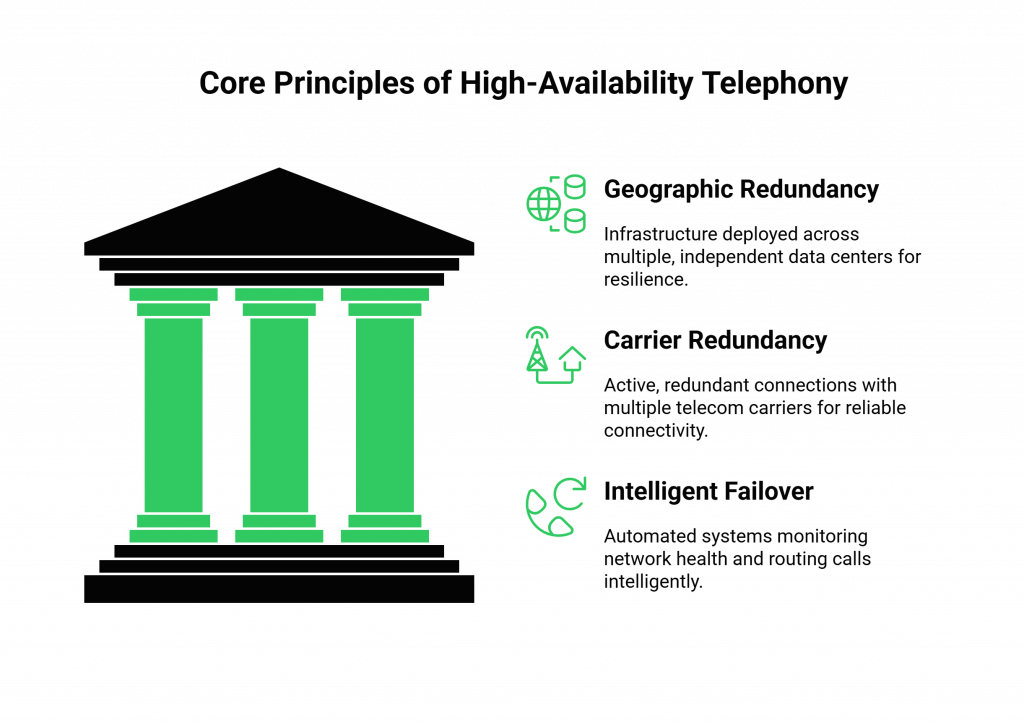
Geographic Redundancy and Multi-Region Architecture
This is the most fundamental principle. A reliable platform cannot live in a single data center.
- What it is: The provider’s infrastructure is deployed across multiple, geographically separate data centers (e.g., US-East, US-West, EU-Central, APAC-Southeast). Each of these regions is a fully independent and self-sufficient deployment of the entire voice stack.
- Why it matters: If an entire data center goes down due to a power outage, a fiber cut, or a natural disaster, the traffic can be automatically and instantly rerouted to the next-closest healthy region. For your voice bot, this means that even a catastrophic regional failure in the provider’s network will result in, at worst, a few seconds of degraded quality, not a complete outage.
Carrier Redundancy at Every Level
A voice platform’s connection to the outside world (the PSTN) is its most critical link. A truly reliable platform does not just have one connection; it has many.
- What it is: At each of its geographic regions, the provider maintains active, redundant connections with multiple, different Tier-1 telecom carriers. This is a core part of carrier-grade uptime standards.
- Why it matters: Telecom carriers have outages. A fiber-seeking backhoe is the oldest enemy of the internet. If one of the provider’s upstream carriers has a major issue, their platform can automatically and instantly reroute your calls through a different, healthy carrier, ensuring your connection to the outside world is never severed.
Intelligent Failover and PSTN Fallback Mechanisms
This is where the platform’s intelligence comes in. A resilient system is not just redundant; it is smart enough to use that redundancy automatically.
- What it is: This refers to the automated systems that are constantly monitoring the health of the network and can make real-time routing decisions. This includes pstn failover mechanisms.
- Why it matters: Imagine you use your FreJun AI-powered voice bot to make a critical outbound call. Our Teler engine might first attempt to place that call as a high-quality VoIP call over the internet.
But if our system detects that the end-user’s network is too poor to support a stable VoIP connection, it can be configured to automatically “fall back” and place the call as a standard PSTN call, ensuring the connection goes through, even if the quality is slightly lower. This intelligent failover is a key component of a truly resilient voice ai infrastructure.
This table summarizes these core pillars of reliability.
| Reliability Pillar | What It Is | How It Protects Your Voice Bot |
| Geographic Redundancy | Multiple, independent data center deployments. | Protects against a catastrophic regional outage (e.g., a data center fire). |
| Carrier Redundancy | Connections to multiple, different telecom carriers in each region. | Protects against an outage at one of the upstream phone companies. |
| Intelligent Failover | Automated, real-time rerouting based on network health. | Ensures calls are completed, even if the primary path is degraded. |
Also Read: VoIP API: Building Voice Communication into Your Applications
How Does FreJun AI’s Teler Engine Embody These Principles?
At FreJun AI, we understand that for our customers who are building voice bots, our platform is a mission-critical dependency. Reliability is not a feature; it is our most important product. Our Teler engine was architected from the ground up on these principles of high availability and resilience.
- Globally Distributed by Design: Our Teler engine is deployed in multiple geographic regions across North America, Europe, and Asia, with each region having its own redundant carrier connections.
- Automated Health Checks and Rerouting: Our platform is constantly monitoring the health of every component and every carrier link. If it detects a problem, our systems can automatically reroute traffic in a matter of seconds.
- Transparency and Trust: We provide a public status page that gives our customers real-time visibility into the health of our platform.
Ready to build your mission-critical voice bot on a foundation you can trust? Sign up for FreJun AI and explore our resilient, carrier-grade infrastructure.
What Are the Developer’s Responsibilities in Building a Resilient Voice AI?
While choosing a reliable cloud telephony provider is the most important step, the developer also has a crucial role to play in building a resilient application. The provider gives you a reliable engine; you have to build a reliable car around it.
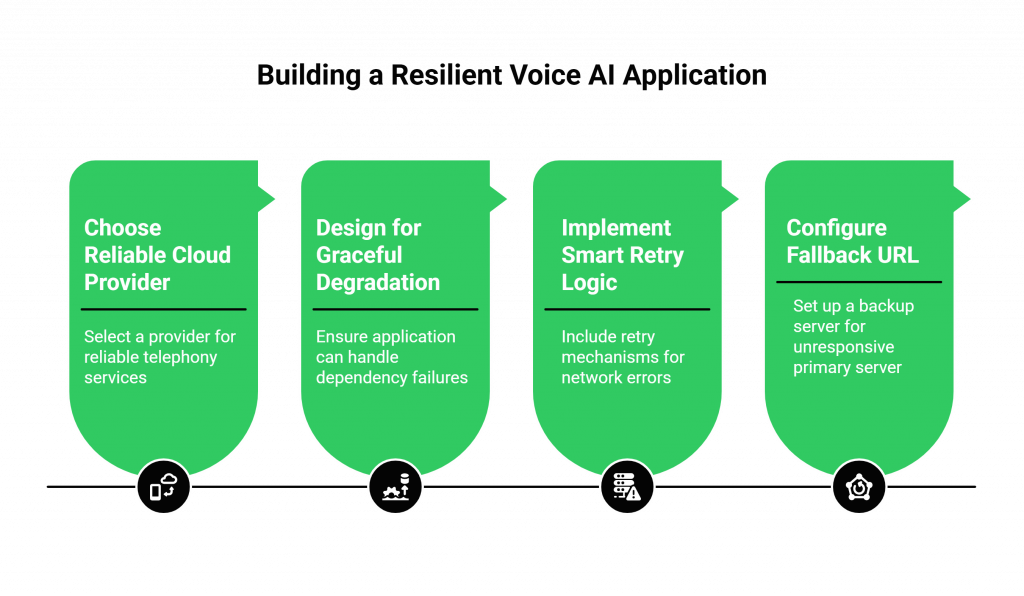
Design for Graceful Degradation
Your application’s logic should be able to handle a situation where one of its own dependencies (like your LLM provider or your CRM) is down. Instead of a complete failure, the voice bot could provide a “gracefully degraded” experience, such as, “Our systems are currently experiencing a delay. I can take a message and have an agent call you back as soon as we’re back online.”
Implement Smart Retry Logic and Fallbacks
Do not assume every API call will succeed. Your code should have smart retry logic for transient network errors. You should also have a clear fallback URL configured in your FreJun AI settings, so if your primary application server becomes unresponsive, our platform can automatically fail over to a backup.
Also Read: Voice Call API: Automating and Scaling Customer Communication
Conclusion
In the new era of automated, AI-driven customer interaction, the reliability of your voice channel is a direct reflection of your brand’s reliability. Building voice bots for a production environment is an exercise in designing for failure. It requires a deep understanding of the principles of high availability and a commitment to building on a platform that embodies those principles.
The fancy conversational skills of your LLM will mean nothing if the phone line is dead. By choosing a cloud telephony provider that is built on a foundation of geographic and carrier redundancy, and by designing your own application with a mindset of resilience, you can build a voice AI that is not just intelligent, but is also a dependable and trustworthy representative of your brand, ready to serve your customers 24/7, no matter what the world throws at it.
Want a technical deep dive into our high-availability architecture and discuss the best practices for building a resilient voice bot on our platform? Schedule a demo with our team at FreJun Teler.
Also Read: Solving Cloud Telephony Challenges: Downtime, Scale, and Number Porting
Frequently Asked Questions (FAQs)
Carrier-grade uptime standards refer to a level of reliability that is equivalent to or better than the traditional telephone network. This is typically defined as “five nines” (99.999%) uptime, which translates to less than six minutes of downtime per year.
One of the most important sip trunk reliability metrics is Post-Dial Delay (PDD), which is the time it takes for a call to start ringing after you have dialed it. A low PDD is an indicator of a high-performance network. Another is the Answer-Seizure Ratio (ASR), which measures the percentage of calls that are successfully connected.
PSTN failover mechanisms are automated systems that provide a backup route for calls. For example, if a call over the internet (VoIP) is failing due to poor network quality, a smart platform can automatically reroute that call over the traditional Public Switched Telephone Network (PSTN) to ensure it connects.
The single most important principle of high-availability telephony design is redundancy. This means having no single point of failure. This is achieved through geographic redundancy (multiple data centers), carrier redundancy (multiple telecom providers), and hardware redundancy (multiple servers within a data center).
This model is easy to implement, but it fails for real conversations. It introduces high latency. The application waits until the user finishes speaking. The full audio file must upload first. This delay is unavoidable. Natural back-and-forth conversation becomes impossible.
Geographic redundancy means that a provider’s service is running in multiple, physically separate data centers in different parts of the world. If one data center has a catastrophic failure, traffic can be automatically rerouted to another, ensuring the service stays online.
It is more complex because a voice call is a real-time, stateful interaction that is highly sensitive to network issues like latency and packet loss. A website can be served from a cache and can tolerate small delays, but a voice call cannot.
FreJun AI provides the foundational, highly available cloud telephony infrastructure. Our Teler engine is built on the principles of geographic and carrier redundancy, with intelligent, automated failover. We provide the rock-solid foundation so you can be confident that the “voice” part of your building voice bots project is always on.