
Customer expectations for instant, accurate support are higher than ever. Traditional IVRs and rule-based systems often fail, causing longer call times, repeated queries, and frustrated customers. Modern voicebot solutions, powered by AI, STT, TTS, RAG, and real-time tool integrations, transform call handling by enabling fast response voice bots that understand intent, retain context, and deliver precise answers. Yet, infrastructure remains a critical bottleneck. Businesses aiming for high-volume, multi-turn conversations need reliable, low-latency voice transport.
This blog explored how technical orchestration of AI and voice infrastructure can dramatically improve both speed and accuracy, creating measurable efficiency and satisfaction gains.
Why Are Call Centers Still Struggling With Speed And Accuracy?
Despite years of investment in automation, many call centers face the same issues:
- Long average handling times
- Multiple call transfers
- Low first-call resolution
- Customer frustration due to repeated questions
This happens because most legacy systems were designed for routing calls, not resolving problems.
Industry forecasts show that by 2026, approximately 10% of agent interactions will be fully automated, up sharply from just 1.6% in 2022, indicating rapid tooling adoption for efficiency gains.
Traditionally, call handling depended on:
- IVR menus
- DTMF inputs
- Rule-based call flows
- Agent availability
While these systems reduce some manual effort, they often increase friction. As a result, calls take longer and accuracy suffers.
Therefore, the root problem is not volume. Instead, it is how calls are understood and processed.
What Do Call Handling Speed And Accuracy Actually Mean?
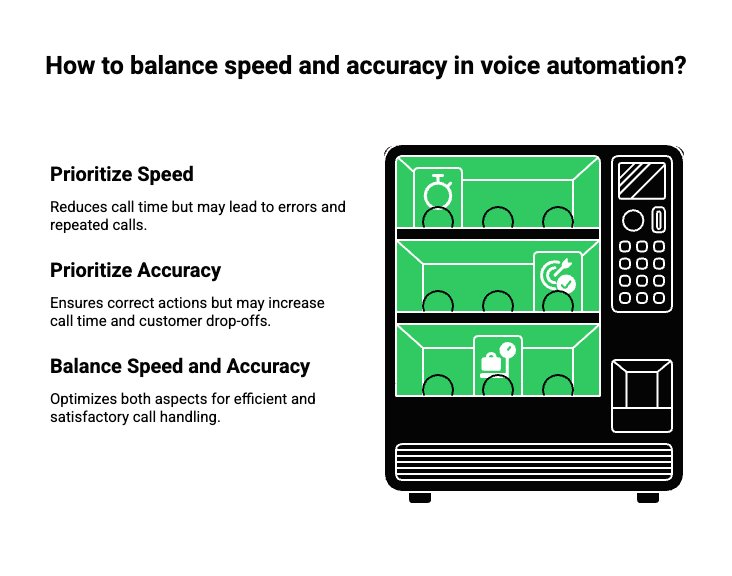
Before discussing solutions, it is important to define what speed and accuracy mean in a voice automation context.
Call Handling Speed Includes:
- Time taken to understand caller intent
- Latency between speech and response
- Average Handling Time (AHT)
- Number of steps required to reach resolution
Call Handling Accuracy Includes:
- Correct intent identification
- Context retention across the conversation
- Correct execution of actions
- Proper escalation when automation should stop
In other words, fast response voice bots must reduce time without sacrificing correctness. Speed without accuracy leads to repeated calls. Accuracy without speed leads to customer drop-offs.
Why Do Traditional IVRs And Rule-Based Voicebots Fail?
Most early voice bot solutions relied on fixed logic. Although this approach seems simple, it creates serious limitations.
Key Technical Limitations:
- Decision trees cannot adapt to unexpected inputs
- Keyword matching fails with natural language variations
- Stateless flows forget previous inputs
- Escalation rules trigger too early or too late
As a result:
- Callers are forced to repeat themselves
- Small deviations break the flow
- Calls get transferred without context
- Agents restart the conversation from scratch
Consequently, these systems often increase call duration instead of reducing it.
What Makes Modern Voice Bot Solutions Different?
Modern voice bot solutions are built around language understanding, not predefined paths.
Instead of asking callers to “press 1 or 2,” AI-driven voicebots allow users to speak naturally. This shift changes everything about speed and accuracy.
Core Differences:
| Traditional IVR | Modern Voice Bot Solutions |
| Menu-based | Conversation-based |
| Keyword matching | Intent understanding |
| Static flows | Dynamic responses |
| Stateless | Context-aware |
| High escalation | Intelligent resolution |
Because of this, modern call automation voicebots can handle more requests without human intervention, while still maintaining quality.
How Do AI Voicebots Understand Intent Faster?
Speed starts with how quickly the system understands why the customer called.
Modern voicebot solutions achieve this using a combination of real-time processing layers.
1. Real-Time Speech To Text (STT)
- Audio is transcribed as the caller speaks
- Partial transcriptions are processed instantly
- No need to wait for sentence completion
2. Intent Classification Using LLMs
- Large Language Models analyze meaning, not keywords
- Intent is inferred from context, tone, and phrasing
- Multiple intents can be detected within one utterance
3. Parallel Processing
- Speech recognition, intent detection, and response planning happen simultaneously
- Latency is reduced because steps are not sequential
As a result, fast response voice bots can reply within milliseconds instead of seconds.
How Do Voicebot Solutions Improve Accuracy During Calls?
Accuracy depends on understanding context and grounding responses in real data.
Modern voice bots are not standalone systems. Instead, they operate as part of a broader AI architecture.
Context Retention Across Turns
- The system remembers previous answers
- Follow-up questions are interpreted correctly
- Clarifications do not reset the flow
Knowledge-Grounded Responses Using RAG
- Retrieval-Augmented Generation (RAG) connects the AI to:
- Policy documents
- FAQs
- Product databases
- Customer records
- Policy documents
This ensures responses are:
- Up to date
- Relevant
- Aligned with business rules
Tool And API Integration
- Voicebots can call backend systems in real time
- Actions such as ticket creation or order lookup happen during the call
Therefore, accuracy improves because the system responds based on live data, not assumptions.
What Is The Technical Architecture Behind High-Performance Voicebots?
To understand why some voice bot solutions perform better than others, it helps to look at the full architecture.
A Modern Voice Agent Stack Includes:
- Speech-to-Text (STT)
- Large Language Model (LLM)
- Retrieval layer (RAG)
- Tool and API integrations
- Text-to-Speech (TTS)
- Real-time voice transport
Each layer must work together seamlessly. If one layer introduces delay or errors, overall performance drops.
Importantly, most call handling issues occur between layers, not inside the AI model itself.
Why Is Voice Infrastructure Often The Weakest Link?
Many teams focus heavily on choosing the “best” LLM. However, voice automation fails more often due to infrastructure limitations.
Common issues include:
- Audio latency causing unnatural pauses
- Dropped packets breaking conversations
- Unstable call sessions losing context
- Delays between AI response and playback
Because of this, even accurate AI models can appear slow or unreliable during live calls.
This is why separating AI logic from voice transport becomes critical at scale.
Why Does Voice Infrastructure Matter For High-Performance Voicebots?
Voice infrastructure is the hidden foundation for any fast and accurate voicebot solution. Without it, even the best AI models struggle to deliver consistent results.
Key Challenges With Traditional Infrastructure:
- Latency: Slow audio transmission interrupts natural conversation.
- Dropped Packets: Missing audio leads to misinterpretation by STT models.
- Unstable Connections: Calls disconnect or lose context.
- Scalability Issues: Traditional PBX or VoIP solutions cannot handle thousands of simultaneous AI calls efficiently.
Therefore, to achieve fast response voice bots and accurate call handling, businesses need infrastructure that is low-latency, reliable, and scalable.
What Makes FreJun Teler Different From Traditional Voice Platforms?
FreJun Teler is a voice infrastructure platform built specifically for AI-driven voice agents. Unlike conventional platforms that combine call routing and bot logic, Teler focuses solely on handling the real-time voice layer, allowing teams to plug in any AI, LLM, STT, TTS, or retrieval system.
Core Features:
- Model-Agnostic Integration: Works with any LLM or AI agent.
- Any STT/TTS Support: Seamlessly integrates text-to-speech and speech-to-text engines.
- Low-Latency Real-Time Streaming: Millisecond-level audio delivery ensures natural conversations.
- Context Preservation Across Calls: Maintains uninterrupted conversational sessions, essential for accuracy.
- Enterprise-Grade Reliability: Distributed architecture with high availability and redundancy.
In short: You control the intelligence; Teler controls the voice.
How Does Teler Improve Call Handling Speed?
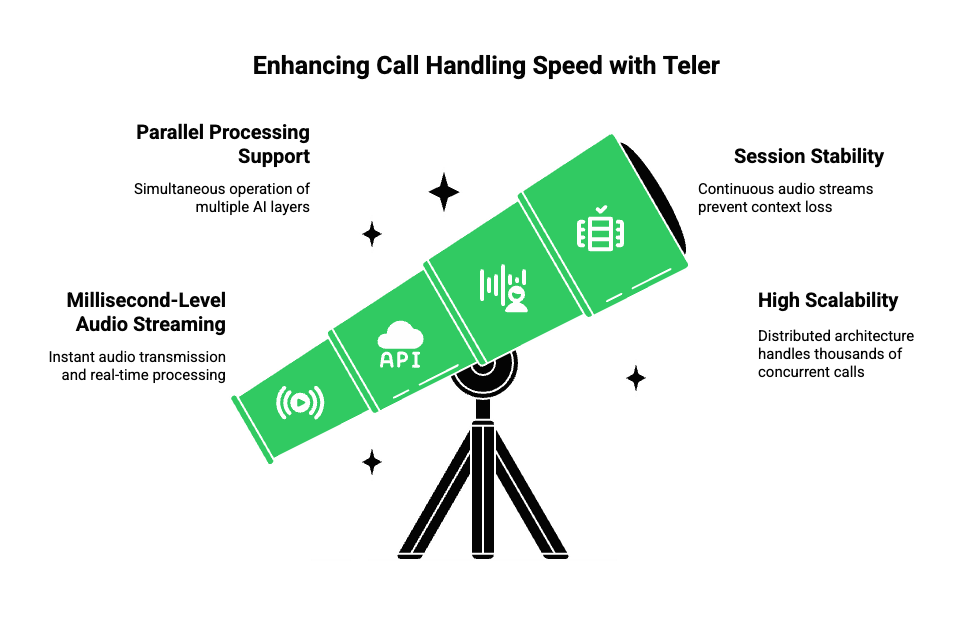
The main advantage of Teler lies in reducing the time between user speech and AI response, which is crucial for fast response voice bots.
1. Millisecond-Level Audio Streaming
- Audio from callers is transmitted instantly to the AI agent
- Partial speech is processed as it arrives, enabling near real-time STT and intent detection
- Responses can start before the caller finishes speaking, reducing silence gaps
2. Parallel Processing Support
- Multiple layers (STT, LLM, RAG, tool calls) operate simultaneously
- No sequential waiting for each step, which accelerates response time
3. Session Stability
- Continuous audio streams prevent context loss
- Reduces repeated questions or call restarts
- Critical for complex multi-turn conversations
4. High Scalability
- Teler’s distributed architecture handles thousands of concurrent AI calls
- No degradation in speed or performance during peak loads
Example: A sales AI bot can qualify leads, schedule meetings, and update CRM in a single call, faster than a human agent could handle manually.
How Does Teler Improve Accuracy?
Accuracy is not just about AI models; it also depends on how well the voice stream reaches the AI and how context is maintained.
1. Reliable Real-Time Transport
- Clean, uninterrupted audio ensures STT models correctly transcribe speech
- Reduces errors in intent detection
2. Context Retention
- Persistent sessions maintain memory across multiple turns
- No loss of conversation state even if the call lasts several minutes
3. Error Reduction Through Tool Integration
- Teler allows voicebots to call APIs or access databases in real time
- Examples:
- Checking account balances
- Updating support tickets
- Scheduling appointments
- Checking account balances
- Ensures that AI responses are grounded in real data, not assumptions
4. Intelligent Escalation
- If AI cannot resolve a query, Teler ensures a smooth handoff
- Full conversation context is passed to human agents
- Reduces repeated questions and prevents mistakes
Thus, Teler ensures that AI voice agents are both fast and correct, which is critical for high-volume call handling.
How Can Teams Build Custom Voice Agents With Teler?
FreJun Teler provides a developer-first SDK and API layer, enabling teams to integrate any AI stack without worrying about underlying voice infrastructure.
Recommended Architecture:
- User speech captured via Teler’s real-time streaming API
- STT engine transcribes audio to text in milliseconds
- LLM or AI agent interprets intent and generates a response
- RAG or knowledge base provides factual grounding
- Tool calls or backend integrations execute actions
- TTS engine converts AI output to natural speech
- Teler streams audio back to the caller seamlessly
Key Advantage: This modular approach allows businesses to choose their preferred AI stack, ensuring flexibility and future-proofing.
Who Benefits Most From Infrastructure-First Voicebot Solutions?
Not all teams need low-level voice infrastructure, but certain groups gain a strategic advantage:
- Founders building AI-first products that scale
- Product Managers who want fast, accurate call automation without vendor lock-in
- Engineering Leads responsible for system reliability and integration flexibility
- Enterprises with high call volumes seeking consistent customer experience
By separating AI logic from voice transport, teams can innovate rapidly while maintaining high-performance call automation.
What Are The Key Criteria For Selecting The Best Voicebot Solutions?
When evaluating voicebot platforms, consider these technical and operational factors:
| Criteria | Why It Matters |
| Low-Latency Streaming | Enables fast response voice bots and natural conversation pacing |
| Model Flexibility | Supports any AI/LLM/STT/TTS combination |
| Context Retention | Maintains accuracy over multi-turn conversations |
| Tool & API Integration | Executes actions in real-time, reducing human intervention |
| Reliability & Scalability | Handles thousands of concurrent calls without degradation |
| Separation of Voice & AI Logic | Future-proof and allows independent upgrades |
Platforms that fail in any of these areas will compromise either speed, accuracy, or both.
How Can Businesses Get Started With Voicebot Solutions Using Teler?
Implementing AI-driven voicebots requires both intelligence and infrastructure.
Recommended Steps:
- Identify Use Cases – e.g., customer support, sales qualification, reminders
- Select AI Stack – LLM, STT/TTS, RAG, tool integration
- Integrate With Teler – handle real-time voice streaming, call management, and session persistence
- Test & Optimize – monitor latency, accuracy, and user satisfaction
- Scale Gradually – leverage Teler’s distributed architecture for high-volume calls
Outcome:
Businesses can deploy AI voice agents that handle more calls, faster, and with greater accuracy than traditional systems or all-in-one platforms.
Conclusion
Implementing modern voicebot solutions is no longer optional; it is essential for businesses seeking to optimize call handling speed and accuracy. By leveraging AI-driven understanding, contextual memory, and integration with real-time business tools, organizations can reduce average handling time, increase first-call resolution, and maintain consistent service quality. However, even the most sophisticated AI models depend on robust infrastructure to function effectively at scale.
FreJun Teler provides this critical layer, offering low-latency, reliable voice streaming, full session stability, and compatibility with any LLM, STT, or TTS. For founders, product managers, and engineering leads, Teler enables fast deployment of production-grade voicebots without compromising speed or accuracy.
Schedule a Demo with FreJun Teler Today to accelerate your AI voicebot deployment.
FAQs –
- What is a voicebot?
A voicebot is an AI-powered system that interprets speech, responds naturally, and automates call handling efficiently. - How do voicebots reduce call handling time?
By transcribing speech instantly and generating context-aware responses in real-time, reducing unnecessary steps and transfers. - Can voicebots work with any AI model?
Yes, modern infrastructure-first platforms allow integration with any LLM, STT, or TTS engine for flexible deployment. - Do voicebots improve first-call resolution?
Absolutely, by retaining context, accessing knowledge bases, and executing real-time tool actions for accurate responses. - Are voicebots reliable at scale?
With robust infrastructure like FreJun Teler, voicebots maintain low-latency, stable connections even during thousands of simultaneous calls. - How is accuracy ensured in AI voicebots?
Through context retention, RAG-enabled responses, real-time backend integrations, and low-latency audio streaming for precise STT transcription. - Can voicebots handle complex multi-turn conversations?
Yes, AI-driven bots with session persistence manage complex dialogs while preserving context across multiple turns efficiently. - Do voicebots replace human agents?
They complement humans by handling repetitive or routine tasks, freeing agents for complex, high-value interactions. - How quickly can I deploy voicebots with Teler?
Deployment can be done in days, not months, leveraging Teler’s SDKs, APIs, and model-agnostic voice infrastructure.
Are voicebots secure for enterprise use?
Yes, enterprise-grade security protocols ensure data integrity, encryption, and compliance while managing sensitive conversations.