
In the world of programmable communications, the terms “API” and “SDK” are often used interchangeably, tossed around in marketing materials and technical documentation as if they were synonyms. While they are close cousins in the developer’s toolkit, they are not the same thing.
For a developer embarking on a project to build a real-time voice application, understanding the subtle but profound difference between a voice API and SDK is not just a matter of semantics; it is a critical decision that will shape their entire development process, their application’s performance, and their speed to market.
While both are tools for building on a voice platform, they operate at different levels of abstraction and solve different parts of the development puzzle. One provides the raw, foundational endpoints; the other provides the high-level, language-specific tools to work with those endpoints.
This guide will provide a clear voice SDK vs API comparison, explaining what each one is, what it does best, and how they work together to power everything from a simple click-to-call button to a sophisticated, SDK for voice AI.
Table of contents
What is a Voice API? The Foundational Layer
At its core, a Voice API (Application Programming Interface) is a set of rules and definitions that allows your application to communicate with a voice platform’s backend infrastructure over a network. It is the fundamental, language-agnostic contract that defines what you can ask the platform to do and how you can ask for it.
Think of It as the Raw HTTP Endpoints
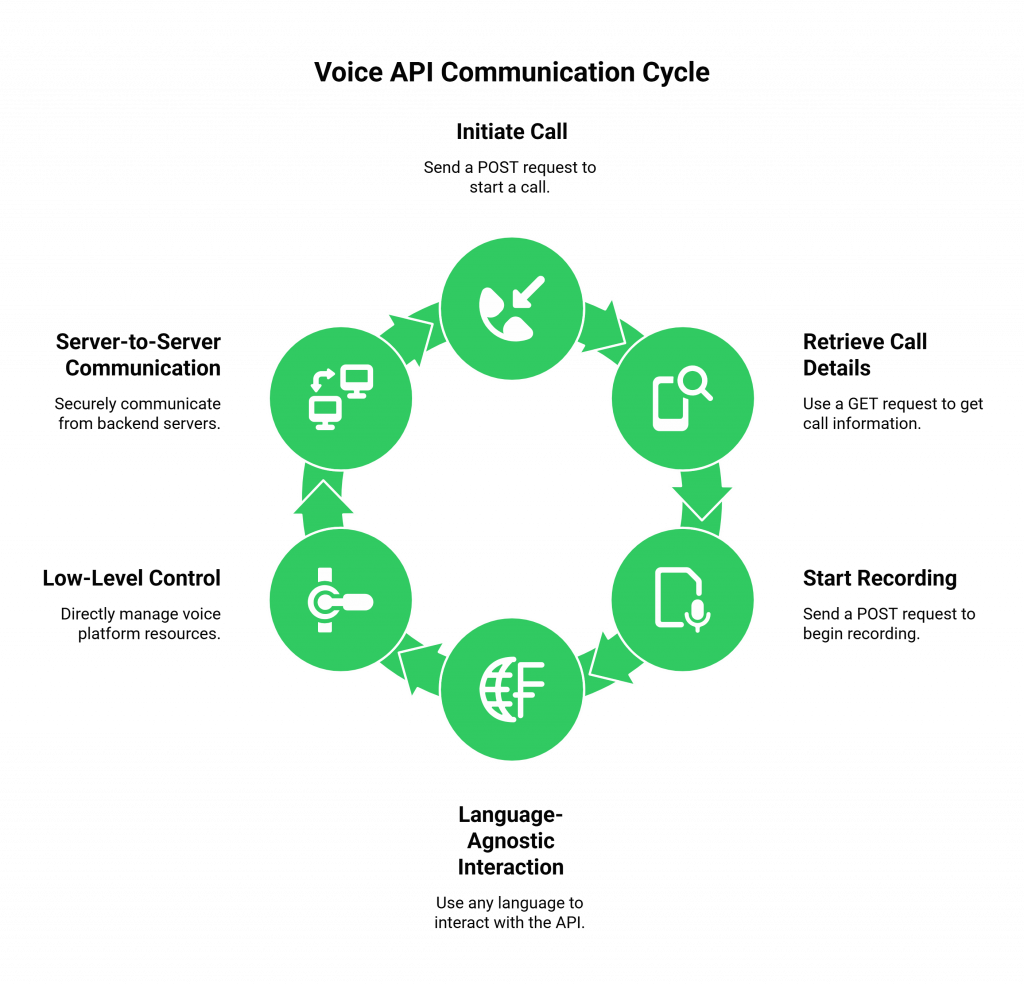
The Voice API is the collection of HTTP endpoints that you can make requests to. For example, a voice platform might have:
- An endpoint like POST /v1/Calls to initiate an outbound call.
- An endpoint like GET /v1/Calls/{CallSid} to retrieve the details of a specific call.
- An endpoint like POST /v1/Calls/{CallSid}/Recordings to start a recording on a live call.
The Key Characteristics of a Voice API
- Language-Agnostic: Because it is based on the universal standard of HTTP, you can interact with a Voice API from any programming language that can make a web request, from Python and JavaScript to C++ and Go.
- Low-Level Control: The API provides the direct, granular commands to control the voice platform’s resources. It is the ultimate source of truth for the platform’s capabilities.
- Server-to-Server Communication: The Voice API is primarily designed for server-side (backend) communication. Your secure backend server is what holds your secret API keys and makes authenticated requests to the voice platform’s API.
The Voice API is the powerful, foundational “engine.” You could build your entire application by making raw HTTP requests directly to this engine, but for most developers, that would be a slow, repetitive, and error-prone process. This is where the SDK comes in.
What is a Voice Calling SDK? The Developer’s Toolkit
A voice calling SDK (Software Development Kit) is a higher-level, language-specific toolkit that is built on top of the Voice API. It is designed to make a developer’s life dramatically easier by abstracting away the low-level details of the API and providing a more intuitive, productive, and powerful development experience.
Think of It as a Pre-Built, Professional Toolset
If the API is the raw engine, the SDK is the complete, professional-grade tool chest that comes with it. It contains not just the tools to interact with the engine, but also pre-built components, helper functions, and specialized libraries that solve common, complex problems.
Also Read: Voice AI in Fleet Dispatch Systems
The Key Characteristics of a Voice Calling SDK
Language-Specific: A provider will offer different SDKs for different programming languages (e.g., a Python SDK, a JavaScript SDK, a Swift SDK for iOS).
Abstraction and Convenience: The SDK wraps the raw HTTP API calls in clean, high-level functions or classes. Instead of manually constructing an HTTP POST request with the right headers and body, you can simply call a function like frejunClient.calls.create(to=’…’, from_=’…’).
Client-Side and Server-Side Libraries: A comprehensive voice calling SDK often comes in two parts:
- A Server-Side (Backend) SDK: This is for your backend application. It simplifies making API calls, handling authentication, and processing incoming webhooks.
- A Client-Side (Frontend) SDK: This is a specialized library for your web or mobile application. It is designed to handle the complex, real-time mechanics of capturing microphone audio, managing the device’s audio hardware, and handling the live, in-call media stream. This client-side component is particularly crucial for building an SDK for voice AI.
This table provides a clear, side-by-side voice SDK vs API comparison.
| Characteristic | Voice API | Voice Calling SDK |
| Level of Abstraction | Low-level. The raw HTTP endpoints. | High-level. Language-specific functions and classes. |
| Primary Interaction | Manually constructing and sending HTTP requests. | Calling a pre-built function in your chosen programming language. |
| Primary Use Case | Defines the core capabilities of the platform. | Accelerates developer productivity and solves complex problems. |
| Client-Side Media | Does not directly handle it. | Often includes a specialized client-side library for managing real-time audio. |
| Typical User | Can be used by any language, but requires more manual work. | The preferred tool for most developers for faster, more reliable development. |
Why is a High-Quality SDK Essential for Building Voice AI?
For a developer building a sophisticated voice AI agent, a high-quality voice calling SDK is not just a “nice-to-have”; it is an absolute necessity. The real-time, low-latency demands of an AI conversation introduce a level of complexity that is extremely difficult to manage with raw API calls alone.
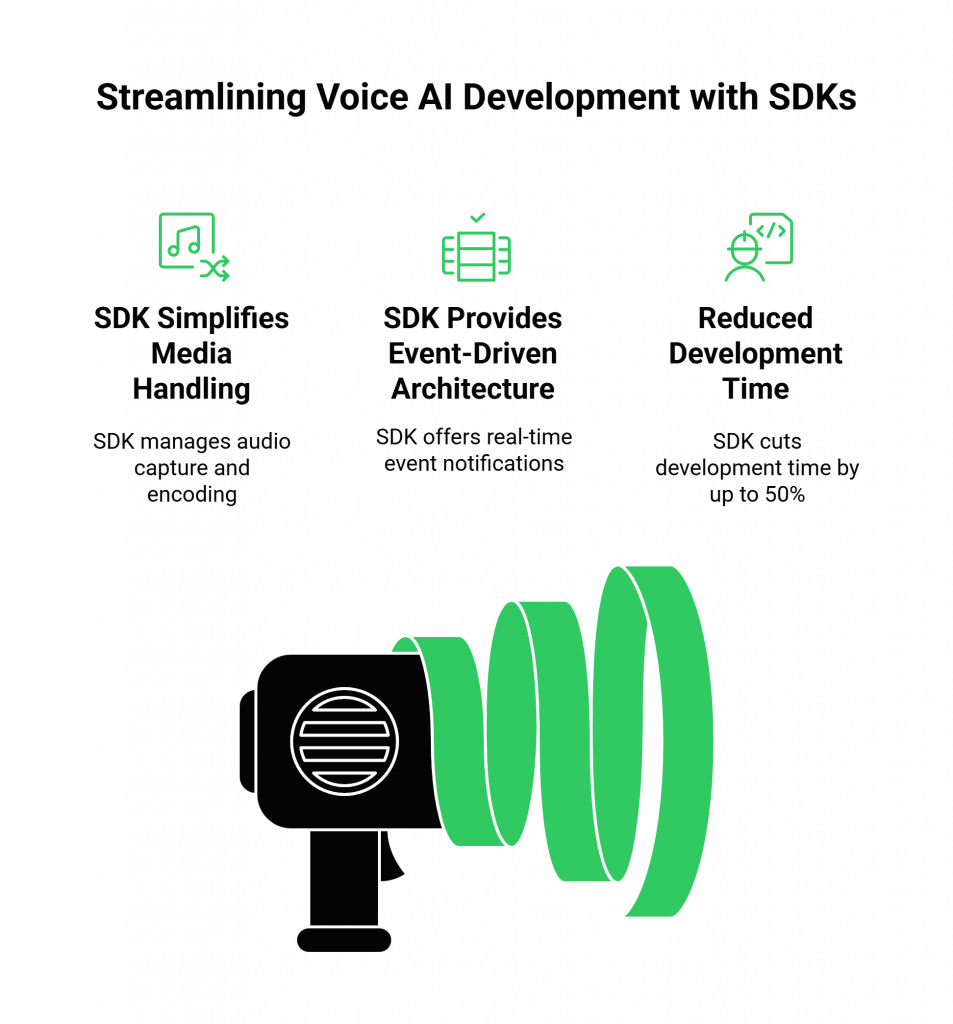
A recent industry report on developer productivity found that the use of SDKs and other high-level tools can reduce development time by up to 50%, an advantage that is magnified in the complex world of real-time voice.
Also Read: Managing Returns with AI Voice Support
The Challenge of Real-Time Media on the Client
This is where the client-side voice calling SDK becomes invaluable.
- The Problem: Capturing audio from a browser’s microphone, encoding it in the right format, handling permissions, and streaming it with low latency is a complex and browser-specific task. Doing this from scratch is a massive and error-prone undertaking.
- The SDK Solution: The client-side SDK handles all of this for you. It provides a simple, cross-browser function like device.connect() that takes care of all the complex, low-level WebRTC and media handling, giving your application a clean, stable audio stream to work with.
The Need for an Event-Driven Architecture
An AI conversation is a rapid-fire exchange of events.
- The Problem: Your application needs to know the instant a user starts or stops speaking, or when the network quality degrades. Managing this with low-level polling would be incredibly inefficient.
- The SDK Solution: A good SDK will expose a rich set of real-time events that your application can subscribe to. You can simply add an event listener for on(‘speechEnd’, …) or on(‘qualityWarning’, …), which makes building a responsive, event-driven application much simpler. This is particularly crucial for an SDK for voice AI, which must react to these conversational cues instantly.
Ready to see how a powerful SDK can accelerate your voice AI development? Sign up for FreJun AI.
How Do the API and SDK Work Together?
It is important to remember that this is not an “either/or” choice. The API and the SDK are designed to work in perfect harmony. The SDK is your day-to-day toolkit, but the API is always there as the foundational layer.
For example, if a provider releases a new, beta feature that is not yet available in the SDK, you can always make a direct HTTP request to the new API endpoint. The SDK provides the speed and convenience for the 99% of tasks, while the API provides the ultimate flexibility and control for the 1%.
Also Read: Real-Time Driver Support via AI Voice
Conclusion
In the landscape of modern software development, the goal is always to move faster, build more reliably, and focus on the unique business logic that creates value. The difference between a voice API and SDK is a perfect illustration of this principle.
The Voice API is the powerful, low-level engine of the voice platform, but the voice calling SDK is the high-performance toolkit that allows a developer to harness that power productively and safely.
For any developer looking to build a production-grade voice application, especially a complex, real-time SDK for voice AI, a well-designed, comprehensive, and developer-friendly voice calling SDK is not just a tool; it is their most essential and powerful ally.
Want a personalized walkthrough of our SDKs and a deep dive into our API? Schedule a demo with our team at FreJun Teler.
Also Read: UK Mobile Code Guide for International Callers
Frequently Asked Questions (FAQs)
Think of the Voice API as a car’s engine, the raw, powerful, and essential component. The voice calling SDK is the entire car built around that engine, the steering wheel, the pedals, the dashboard, all the pre-built, user-friendly controls that make it easy for a driver (the developer) to use the engine’s power.
For 99% of use cases, you should start with and primarily use the voice calling SDK for your chosen programming language. It will make your development process faster, easier, and less error-prone. You would only interact with the raw API directly for highly advanced or brand-new features that are not yet in the SDK.
Typically, no. The SDK is a “wrapper” around the API. Its primary job is to make the API’s capabilities easier to use. However, a client-side (frontend) SDK does provide a huge amount of value by handling complex, device-specific media and audio tasks that would be very difficult to build from scratch.
A client-side SDK is a specific library designed to run in the user’s environment, such as in their web browser (a JavaScript SDK) or on their mobile phone (an iOS or Android SDK). It is specialized for handling real-time audio from the microphone and speaker on that device.
For building an SDK for voice AI, the client-side SDK is particularly crucial. It handles the difficult task of capturing the user’s speech with low latency and high quality, which is the essential first step for any AI conversation.
A telephony API guide usually refers to the documentation for the raw, low-level HTTP endpoints. The SDK documentation is a guide for how to use the specific functions and classes within that pre-built software library. A good provider will offer both.
Yes, absolutely. This is a very common and recommended architecture. You would use the Python SDK on your server to handle authentication and high-level call control, and the JavaScript SDK in the user’s browser to manage the live, in-call audio.
A well-designed, modern voice calling SDK is built to be lightweight and modular. You can often import only the specific components you need, which keeps your application’s size to a minimum.
Look for clear and comprehensive documentation with plenty of code samples, active development with regular updates, and a strong presence in developer communities like GitHub and Stack Overflow.
At FreJun AI, we are developer-first. We provide a comprehensive set of server-side and client-side SDKs that are designed to accelerate your development. Our SDKs are thin, high-performance wrappers around our powerful and well-documented Voice API, giving you the perfect balance of ease-of-use and low-level control.