
As businesses evolve into connected ecosystems, the way we communicate defines user experience and operational efficiency. Voice calling APIs have transformed cloud communication, enabling real-time, programmable conversations that scale with business needs. By combining APIs, SDKs, and global cloud infrastructure, enterprises can automate support, streamline operations, and deliver personalized voice interactions powered by their own AI.
The future of communication is not about calls – it’s about intelligent, adaptable, and API-driven voice systems that align with business goals while maintaining performance, security, and low latency.
What’s Driving the New Wave of Voice Communication in Business?
In the last decade, business communication has moved from closed PBX systems to cloud-based, programmable voice platforms.
Today, almost every customer-facing product-whether a ride-hailing app, a fintech dashboard, or an AI assistant-requires real-time voice calls to deliver instant, personal interaction.
Why is this shift happening
- Remote-first operations: distributed teams and global customers need scalable, location-independent calling.
- Integration speed: APIs allow businesses to embed telephony in days, not months.
- Data-driven voice: call data, transcripts, and analytics can now feed product insights and customer experience loops.
- Cost efficiency: replacing on-premise PBX hardware with pay-as-you-go cloud telephony APIs reduces maintenance overhead.
As cloud infrastructure matured, enterprises started demanding voice interfaces that are programmable, secure, and analytics-ready. That is where the voice calling API emerged as a foundational layer.
What Exactly Is a Voice Calling API and How Does It Work?
A voice calling API is a programmable interface that lets developers make, receive, and control phone calls using code.
Instead of connecting to physical exchanges or SIP trunks directly, your application sends simple API requests over HTTPS or WebSocket.
| Function | Example API Operation | Description |
| Make a call | POST /calls | Initiates an outbound PSTN or VoIP call. |
| Answer a call | Webhook callback | Responds to inbound call events. |
| Stream audio | wss://media.stream | Sends and receives live audio packets. |
| Play media / TTS | POST /play | Injects synthesized voice into the call. |
| End call | DELETE /calls/{id} | Terminates session gracefully. |
How it fits in a modern stack
A cloud telephony API usually sits between your application logic and global telephony carriers.
It manages:
- Signaling through SIP or WebRTC.
- Media routing using RTP/SRTP for secure audio transport.
- Call control events such as start, pause, transfer, or record.
- Webhooks and SDKs that connect backend logic with the call flow.
In short, the API hides decades of telephony complexity behind modern developer tools.
This lets product teams embed real-time voice calls directly into mobile apps, CRMs, or AI workflows without owning any telecom infrastructure.
How Does a Voice Calling API Simplify Cloud Communication?
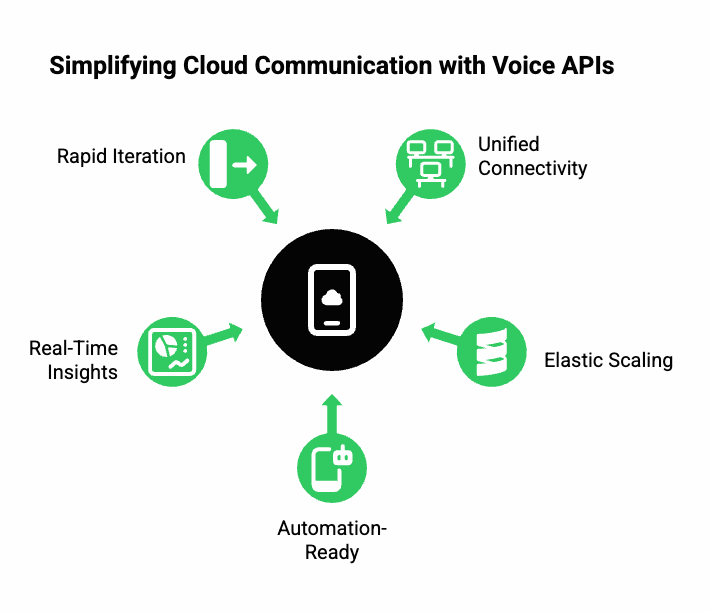
Before APIs, launching a call center or voice-enabled product required telecom provisioning, on-premise PBX servers, and dedicated engineers.
Now, businesses simply connect to a programmable voice platform and use REST or WebSocket calls.
Key advantages
- Unified connectivity: one API for PSTN, SIP, and VoIP calling API flows.
- Elastic scaling: handle ten or ten-thousand calls with the same architecture.
- Automation-ready: integrate voice triggers with chatbots, CRMs, or payment gateways.
- Real-time insights: APIs expose metrics like call duration, latency, or customer sentiment.
- Rapid iteration: voice experiences can be tested and deployed continuously like any other software feature.
Example use case
A fintech app can automatically connect a loan applicant with a verification officer when KYC data is missing.
The app simply triggers the API, streams voice in real time, and logs the conversation for compliance-all without a traditional phone system.
By abstracting away telecom layers, a voice calling API transforms voice into a software primitive that any developer can orchestrate.
What Technologies Power a Modern Voice API?
Even though the interface looks simple, the underlying stack is highly engineered.
Let’s break down the core layers that make a VoIP calling API reliable and scalable.
a) Signaling layer
Handles call setup, teardown, and routing:
- SIP (Session Initiation Protocol): standard for initiating calls between endpoints.
- SDP (Session Description Protocol): negotiates codecs and capabilities.
- WebRTC signaling: enables in-browser calls with NAT traversal support.
b) Media transport layer
Once a call is established, audio packets move through RTP (Real-time Transport Protocol) or SRTP for encrypted streams.
Low-latency jitter buffers and packet-loss concealment maintain voice quality even under unstable networks.
c) Codecs
Codecs compress and decompress audio:
- Opus – optimal for WebRTC; adaptive bitrate.
- G.711 / PCMU / PCMA – standard telephony quality.
- G.729 – bandwidth-efficient for limited networks.
Codec choice impacts clarity, CPU load, and latency.
d) Application control layer
This layer exposes the developer interface-REST endpoints, event webhooks, and a voice SDK for common languages.
SDKs simplify call flows, authentication, and reconnections, reducing boilerplate code.
e) Intelligence & integrations
Modern APIs extend beyond raw calling:
- Speech recognition (STT) to transcribe conversations.
- Text-to-speech (TTS) for dynamic message playback.
- Analytics & quality monitoring dashboards.
- Security modules: TLS, SRTP, and encrypted storage.
Together, these layers make a cloud telephony API a complete communications backbone rather than just a call dialer. Because human turn-taking averages roughly 200–240 ms, end-to-end voice latency must be kept well below the second scale – ideally under 300–400 ms – to preserve natural conversational flow and avoid jarring pauses during real-time voice calls.
How Are Businesses Using Voice APIs in Real Scenarios?
Because voice remains the most natural form of interaction, companies across industries use programmable voice to streamline workflows.
a) Customer support and IVR automation
- Replace static IVR menus with context-aware, rule-based call routing.
- Connect callers to agents or bots automatically based on issue category.
b) AI-assisted reception and scheduling
- Apps route inbound calls to virtual receptionists that capture intent and schedule meetings.
- Voice data integrates with calendars or ticketing tools through API webhooks.
c) Outbound notifications and surveys
- APIs trigger real-time voice calls for payment reminders, delivery updates, or feedback collection.
- TTS ensures personalized messages at scale.
d) Embedded calling in digital products
- In healthcare, secure in-app consultations.
- In on-demand services, anonymized driver-customer calling through masked numbers.
- In finance, instant human verification within a mobile workflow.
Because the architecture is programmable, every industry can tailor the voice flow to its product logic.
Why Are Voice APIs Critical for Intelligent Conversational Systems?
As applications become more interactive, they must handle two-way, human-sounding conversations.
While chat interfaces work, voice provides speed and empathy that text cannot match.
Inside an intelligent voice workflow
- Voice input captured and streamed through the voice calling API.
- Speech-to-text converts the user’s words into structured text.
- Business logic or large-language models interpret intent.
- Text-to-speech converts the response back into natural audio.
- API plays it to the user instantly, completing the conversational loop.
This pipeline depends heavily on media streaming speed and API reliability.
A 500-millisecond delay is enough to break the illusion of natural dialogue.
Therefore, real-time signaling, minimal buffering, and efficient codec negotiation are essential.
When designed correctly, such pipelines power intelligent assistants, sales automation, or personalized customer engagement-without needing humans on every call.
What Are the Challenges in Building Voice Infrastructure from Scratch?
Many engineering leads initially consider building their own voice layer.
However, once implementation begins, the depth of telephony engineering becomes clear.
| Challenge | Description | Business Impact |
| Network complexity | Managing SIP trunks, NAT traversal, firewall rules, and jitter buffers. | High maintenance, frequent outages. |
| Latency optimization | Balancing packet size, codec quality, and STT/TTS delays. | Noticeable lag during calls. |
| Scalability | Handling concurrent sessions, failover, and load balancing. | Infrastructure cost spikes and call drops. |
| Compliance | Regulations such as E911, DNC, and data residency laws. | Legal risk and certification overhead. |
| Observability | Monitoring jitter, MOS, and error rates across regions. | Difficult troubleshooting and quality assurance. |
Even if a team manages to build a basic prototype, maintaining uptime, redundancy, and compliance across multiple geographies can quickly exceed internal capacity.
That’s why most successful products rely on cloud telephony APIs or programmable voice platforms instead of maintaining SIP servers or media gateways themselves.
How Do These APIs Ensure Reliability and Security?
Trust and uptime are non-negotiable for enterprise communication.
To guarantee both, modern voice APIs adopt multi-layer safeguards.
Reliability strategies
- Geographically distributed servers to route calls through the nearest region.
- Automatic failover when a media node or carrier becomes unavailable.
- Real-time monitoring using RTCP stats, MOS scoring, and alert systems.
- Autoscaling clusters that handle call spikes during campaigns or outages.
Security measures
- TLS / SRTP encryption for control and media channels.
- Ephemeral tokens for short-lived call authentication.
- Access control lists (ACLs) to restrict traffic by IP or domain.
- Redaction and anonymization pipelines to protect sensitive audio or transcript data.
Because enterprises often operate in regulated industries-finance, healthcare, logistics-these features are essential for compliance and trust.
Why Are APIs Becoming the Default Voice Infrastructure Layer?
In a typical digital product, engineers already consume APIs for messaging, payments, or analytics.
Extending this architecture to voice ensures consistent tooling, CI/CD, and observability.
Furthermore:
- APIs turn telephony from capital expenditure into a usage-based service.
- SDKs standardize integration across platforms-web, Android, iOS, or backend services.
- Developers can embed real-time voice calls into workflows without telecom expertise.
- Startups can reach enterprise-grade reliability instantly by leveraging carrier-level infrastructure through APIs.
Because of these benefits, voice calling APIs are no longer optional-they’re the foundation for scalable, global, conversational products.
Want to connect your AI agents directly with real-time voice? Learn how Teler integrates with AgentKit for intelligent voice automation.
How Does FreJun Teler Simplify Real-Time Voice Communication?
While several platforms provide programmable voice services, FreJun Teler takes a fundamentally different approach. Instead of treating calling as a legacy communication feature, it re-engineers it for the new era of AI-driven, real-time voice interactions.
FreJun Teler serves as a global voice infrastructure layer that connects AI models, LLMs, and telephony systems seamlessly. It simplifies the heavy lifting of low-latency media transmission, call routing, and real-time audio streaming – allowing teams to focus on building intelligent voice agents rather than managing telecom complexities.
Core Differentiators of FreJun Teler
Here’s what sets FreJun Teler apart from conventional cloud telephony APIs and VoIP calling APIs:
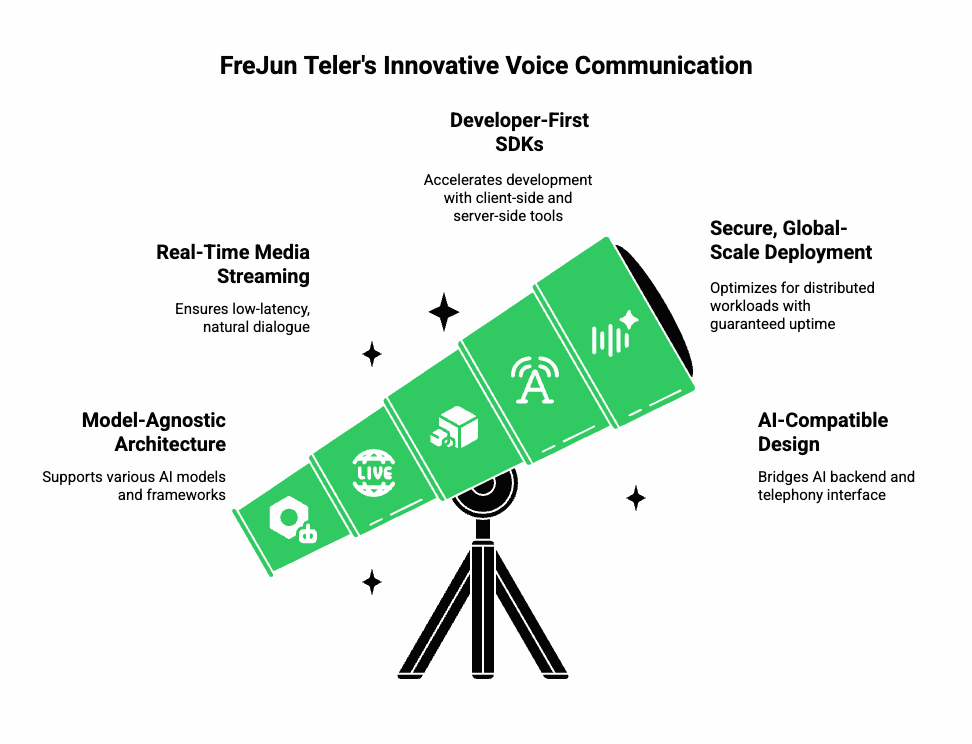
- Model-Agnostic Architecture: Works with any AI model or language framework – including GPT, Claude, Mistral, or custom enterprise LLMs.
- Real-Time Media Streaming: Built for millisecond-level audio latency. This ensures natural, interruption-free dialogue in real-time voice calls.
- Developer-First SDKs: Offers client-side and server-side voice SDKs that accelerate development while maintaining flexibility and control.
- Secure, Global-Scale Deployment: The platform is optimized for distributed workloads, enabling voice automation across continents with guaranteed uptime.
- AI-Compatible Design: Works as the missing bridge between your AI backend and telephony interface, making it ideal for deploying contextual, voice-aware applications.
By abstracting signaling, media streaming, and telephony routing into a unified programmable voice platform, FreJun Teler allows developers to prototype and scale AI-powered voice experiences in days, not months.
How Can You Integrate FreJun Teler with Your AI or Product?
Integrating Teler into an existing product stack or AI system is designed to be straightforward, yet technically robust. The process ensures end-to-end control over conversational context, latency, and voice response.
Step-by-Step Integration Flow
Let’s break down a typical integration using Teler + LLM + TTS/STT pipeline:
- Initiate the Call
- Use FreJun Teler’s voice calling API to make or receive calls.
- Calls can originate from a web client, mobile app, or backend system.
- Use FreJun Teler’s voice calling API to make or receive calls.
- Stream Voice Input in Real Time
- Teler’s media streaming layer captures voice input from the caller.
- The captured audio stream is transmitted to your backend over a WebSocket or secure RTP stream.
- Teler’s media streaming layer captures voice input from the caller.
- Process Audio with Your AI Model
- Use Speech-to-Text (STT) to transcribe the audio into text.
- Feed the text into your AI or LLM model to determine intent and generate a relevant response.
- Use Speech-to-Text (STT) to transcribe the audio into text.
- Generate Response via TTS (Text-to-Speech)
- Convert the AI-generated text into voice output using any TTS engine (e.g., ElevenLabs, Azure, or OpenAI’s TTS).
- The resulting audio is streamed back through Teler’s API for real-time playback.
- Convert the AI-generated text into voice output using any TTS engine (e.g., ElevenLabs, Azure, or OpenAI’s TTS).
- Maintain Conversational Context
- Teler acts as the stable transport layer, ensuring your backend maintains full dialogue state control.
- This enables continuity across multiple sessions or call transfers.
- Teler acts as the stable transport layer, ensuring your backend maintains full dialogue state control.
Architecture Overview
| Component | Role | Description |
| Teler Voice API | Communication Layer | Manages signaling, call initiation, and termination. |
| Media Stream (WebRTC/RTP) | Real-Time Transport | Handles low-latency bi-directional audio streaming. |
| STT Engine | Input Processor | Converts speech to text for analysis. |
| LLM or AI Model | Intelligence Core | Processes text and determines responses or actions. |
| TTS Engine | Output Generator | Synthesizes natural voice responses. |
| Teler Playback | Delivery Layer | Streams generated audio back to the user instantly. |
This modular approach enables teams to plug in their own AI stack without worrying about telephony handling or latency management.
How Does Teler Compare with Other Voice API Platforms?
When evaluating cloud telephony APIs, it’s important to distinguish between traditional communication platforms and AI-first voice infrastructures.
| Platform | Core Focus | Ideal For | Limitations |
| FreJun Teler | AI-driven real-time voice infrastructure | Voice agents, AI assistants, contextual calling | Designed for next-gen voice automation, not legacy IVR |
| Twilio / Plivo / Bandwidth | Programmable calling and IVR | General business communication | Not optimized for LLM or streaming AI integration |
| Tata CPaaS / Airtel IQ | Enterprise telephony and CRM integration | Customer service & compliance | Limited real-time AI voice support |
In essence, while competitors focus on call management, Teler is built for call intelligence – ensuring speech input and AI response flow in real time without human-like lag.
What Should Founders and Engineering Leads Look for in a Voice API Partner?
When choosing a voice API provider, decision-makers should evaluate not only the telephony features but also long-term scalability and technical compatibility with their AI systems.
Here are key aspects to consider:
- Latency and Real-Time Performance
- Look for providers offering sub-300ms latency for conversational voice agents.
- Low latency directly impacts the user’s perception of naturalness in dialogue.
- Look for providers offering sub-300ms latency for conversational voice agents.
- Integration Flexibility
- A good programmable voice platform should integrate easily with any LLM, STT, or TTS system.
- Model-agnostic APIs prevent vendor lock-in and ensure future adaptability.
- A good programmable voice platform should integrate easily with any LLM, STT, or TTS system.
- Developer Experience
- Well-documented SDKs, sandbox environments, and clear REST/WebSocket endpoints accelerate experimentation.
- Well-documented SDKs, sandbox environments, and clear REST/WebSocket endpoints accelerate experimentation.
- Reliability and Global Availability
- Ensure multi-region redundancy and guaranteed uptime (99.99% or higher).
- Voice quality should remain consistent across geographies.
- Ensure multi-region redundancy and guaranteed uptime (99.99% or higher).
- Security and Compliance
- Providers must ensure end-to-end encryption, DNC compliance, and adherence to telecom regulations.
- Providers must ensure end-to-end encryption, DNC compliance, and adherence to telecom regulations.
- AI Readiness
- The platform should natively support real-time streaming, session state management, and context persistence – key for AI-driven systems.
- The platform should natively support real-time streaming, session state management, and context persistence – key for AI-driven systems.
How to Measure the ROI of Implementing a Voice Calling API?
While the technical advantages of a cloud telephony API are clear, measuring its business impact is equally critical.
Key ROI Metrics
| Metric | Description | Business Impact |
| Operational Cost Reduction | Lower infrastructure maintenance and call handling costs. | Up to 40% savings over legacy PBX systems. |
| Deployment Speed | Reduced development cycles using SDKs and pre-built call functions. | Weeks instead of months to launch voice automation. |
| Customer Experience | Real-time voice calls without delay or drop. | Higher satisfaction and reduced churn. |
| Scalability | Ability to handle thousands of concurrent calls dynamically. | Supports rapid business expansion. |
| Integration Efficiency | Unified voice layer across products and AI systems. | Simplifies architecture and improves reliability. |
By focusing on these parameters, product managers and engineering teams can quantify the benefits of adopting a programmable voice platform like Teler.
What’s the Future of Voice Communication in AI-Driven Businesses?
The next phase of digital transformation is voice-native automation – where machines can hold context-rich, human-like conversations across industries.
Key trends shaping this evolution include:
- LLM-Oriented Call Automation: Calls powered entirely by AI logic that can reason, adapt, and personalize.
- Real-Time Data Retrieval (RAG): Integrating retrieval-augmented generation to make responses dynamic and accurate.
- Emotion Recognition: AI systems analyzing tone and sentiment to adjust responses mid-call.
- Cross-Platform Voice Presence: Seamless continuity across mobile, web, and IoT interfaces.
As businesses adopt these models, programmable voice APIs like Teler become central – acting as the connective layer between telephony infrastructure and intelligent AI cores.
Ready to Simplify Your Cloud Voice Infrastructure?
Speed, reliability, and intelligence define business success. A voice calling API transforms ordinary calls into programmable experiences, connecting customers, products, and AI-driven systems effortlessly.
FreJun Teler delivers the infrastructure to make this possible – combining global telephony coverage, developer-first SDKs, and real-time voice streaming to help you build and deploy scalable, AI-powered voice automation. Whether you’re creating an intelligent virtual assistant or integrating voice capabilities into your AI product, Teler provides the foundation for high-quality, low-latency communication.
Start building your AI voice experience today.
Explore FreJun Teler’s developer platform or schedule a demo to discover how our programmable voice platform can simplify your cloud communication.
FAQs –
- What is a Voice Calling API?
It enables applications to make and receive voice calls over the internet using programmable communication interfaces. - How does a Voice SDK help developers?
A Voice SDK simplifies integration by providing prebuilt methods for call control, audio streaming, and event handling. - What’s the difference between Voice API and Cloud Telephony API?
Voice API manages in-app calling; Cloud Telephony API connects apps with traditional PSTN or VoIP networks globally. - Can Voice APIs work with AI models like GPT or Claude?
Yes, they stream real-time audio to and from AI models for natural, conversational experiences. - Why choose a programmable voice platform like FreJun Teler?
It provides global coverage, low-latency streaming, and full developer control over AI-driven voice workflows. - Is latency a major issue in real-time voice calls?
Yes, and platforms like Teler minimize it through optimized media streaming and distributed infrastructure. - How secure are voice communications over APIs?
Enterprise-grade APIs use encryption, authentication, and region-based routing to maintain compliance and data privacy. - Can Teler integrate with existing telephony systems?
Yes, Teler works across SIP, VoIP, and cloud telephony networks for seamless interoperability. - Does Teler support AI-driven outbound campaigns?
Yes, developers can automate outbound calls for reminders, lead qualification, or feedback collection using voice APIs. - How long does it take to integrate Teler?
With ready SDKs and documentation, developers can deploy production-grade voice experiences in days.