
Sales today are defined by speed. When a lead reaches out, the window to respond is measured in seconds, not hours. However, most sales systems are still built around manual calls, delayed callbacks, and agent availability. As a result, high-intent leads often go unanswered or lose interest before engagement even begins. This is where Voice APIs fundamentally change the equation. By turning voice communication into software-controlled infrastructure, businesses can automate calls, respond instantly, and scale sales conversations without sacrificing quality.
This blog explains how Voice APIs increase sales response speed, how AI-driven voice workflows work in practice, and what it takes to implement them correctly.
Why Is Sales Response Speed Critical For Modern Businesses?
Sales response speed is no longer a performance metric. Instead, it has become a revenue determinant.
Today, when a customer submits a lead, clicks a call button, or dials a number, they expect an immediate and meaningful response. However, most businesses still respond minutes or hours later. As a result, intent fades, competitors step in, and conversion rates drop.
More importantly, voice remains the fastest decision-making channel. Unlike email or chat, voice conversations compress trust-building, clarification, and intent validation into minutes. Therefore, any delay in voice engagement directly impacts sales outcomes.
According to industry benchmarks, businesses that respond to a new lead within one minute can see up to a 391% increase in conversions compared to slower follow-ups.
Because of this shift, businesses are now rethinking how they handle sales calls, callbacks, and follow-ups at scale.
What Slows Down Sales Response In Traditional Calling Systems?
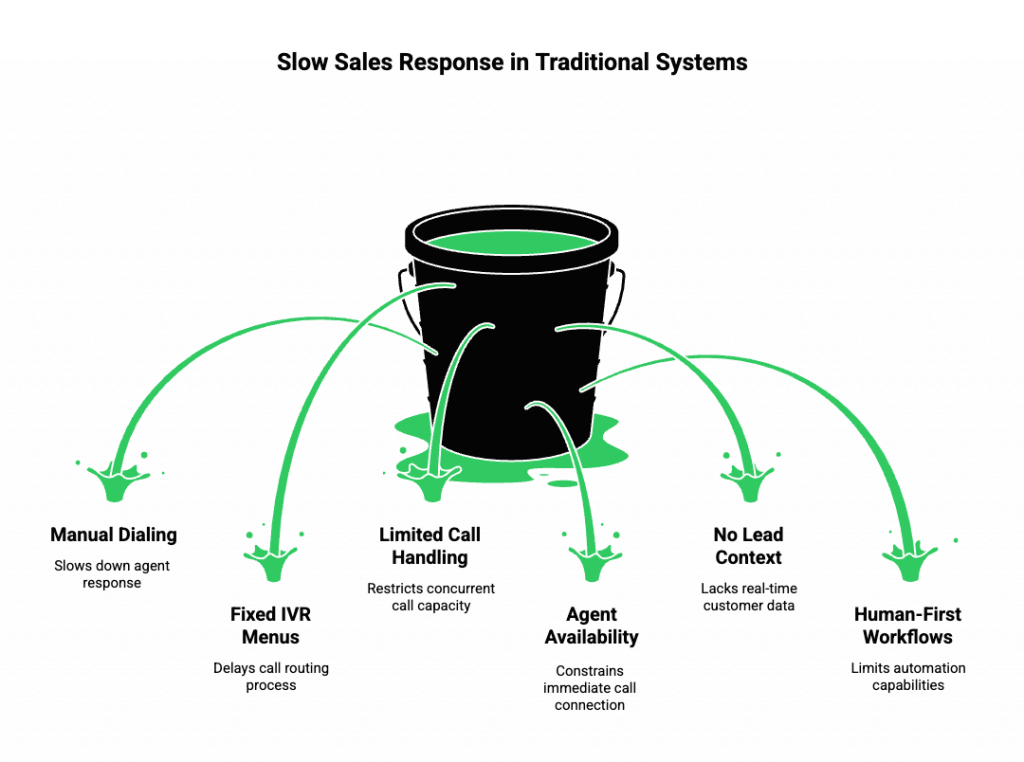
Before understanding how Voice APIs improve response speed, it is important to examine why existing systems fail.
Common Bottlenecks In Legacy Sales Calling
- Manual dialing or agent-dependent callbacks
- Fixed IVR menus that slow down routing
- Limited concurrent call handling
- Agent availability constraints
- No real-time lead context during calls
As a result, sales teams spend more time managing calls than closing deals.
Additionally, most traditional calling platforms are built for human-first workflows, not real-time automation. Therefore, scaling response speed becomes expensive and operationally complex.
What Is A Voice API And How Does It Work In Sales Workflows?
A Voice API allows businesses to programmatically control phone calls using software.
Instead of relying on agents to initiate or receive calls, systems can:
- Trigger calls instantly
- Stream audio in real time
- Route calls dynamically
- React to call events programmatically
In simple terms, a Voice API turns voice communication into software-controlled infrastructure.
How Voice APIs Differ From Traditional Calling Tools
| Feature | Traditional Calling | Voice API |
| Call initiation | Manual | Programmatic |
| Routing logic | Static IVR | Dynamic, event-driven |
| Scalability | Agent-limited | Infrastructure-based |
| Response speed | Human-dependent | Instant |
| Integration | Limited | Native with backend systems |
Because of this flexibility, Voice APIs form the foundation of sales calling automation.
How Do Voice APIs Enable Faster Lead Response?
Voice APIs remove the delay between intent and interaction.
Instead of waiting for agents to become available, systems can respond immediately when a lead action occurs.
Key Ways Voice APIs Improve Response Speed
- Instant Call Triggers
Leads can be called the moment they submit a form or request a demo. - Parallel Call Handling
Hundreds or thousands of calls can be initiated simultaneously. - Dynamic Routing
Calls can be routed based on lead source, geography, or priority. - Automated Follow-Ups
Missed calls or unanswered leads can trigger instant callbacks.
Because of these capabilities, businesses reduce time-to-first-contact from minutes to seconds.
Why Is Automation Alone Not Enough For Sales Calls?
Although automation improves speed, it does not guarantee effectiveness.
Script-based systems can place calls quickly. However, they fail when conversations deviate from predefined paths.
This is where many businesses face a limitation.
- Customers ask unstructured questions
- Sales conversations require reasoning
- Context changes during calls
- One-size scripts break trust
Therefore, while Voice APIs solve speed, intelligence is still required to close deals.
What Role Does AI Play In Modern Sales Voice Workflows?
AI enables sales workflows to move beyond scripted automation.
Instead of fixed responses, AI systems can:
- Understand intent
- Adjust conversation flow
- Ask follow-up questions
- Make decisions in real time
However, AI alone cannot handle phone calls.
It needs a voice infrastructure that can stream audio, manage call state, and maintain low latency. This is why Voice APIs and AI are deeply connected.
What Makes Up An AI Voice Agent For Sales?
An AI voice agent is not a single model. Instead, it is a system composed of multiple components working together.
Core Components Of A Sales Voice Agent
- Speech-To-Text (STT)
Converts live caller speech into text. - Large Language Model (LLM)
Processes intent, context, and conversation logic. - Retrieval-Augmented Generation (RAG)
Fetches real-time data such as pricing, availability, or CRM details. - Tool Calling
Executes actions like booking meetings or updating lead status. - Text-To-Speech (TTS)
Converts AI responses back into natural-sounding audio.
Because these components work in real time, response speed becomes a system-level outcome, not a manual process.
How Does Voice Infrastructure Impact AI Response Speed?
Even the best AI models fail if voice delivery is slow.
In sales conversations, delays longer than a few hundred milliseconds feel unnatural. Therefore, the voice layer must support:
- Low-latency audio streaming
- Bidirectional real-time media
- Stable call connections
- Event-driven call control
This is why many calling platforms struggle with AI integration. They were built for call routing, not real-time AI conversations.
Why Are Businesses Replacing Dialers With AI Voice Workflows?
Traditional dialers focus on call volume. However, modern sales teams focus on conversion quality and speed.
Limitations Of Traditional Dialers
- No real-time understanding of user intent
- Fixed scripts with poor personalization
- Heavy agent dependency
- Slow feedback loops
Advantages Of AI-Driven Voice APIs
- Faster lead response
- Personalized conversations
- Automated qualification
- Scalable sales voice workflows
As a result, businesses are actively adopting AI dialer replacements powered by Voice APIs.
How Do Voice APIs Improve Lead Conversion Rates?
Faster response leads to higher engagement. However, engagement alone does not convert leads.
Voice APIs improve conversion because they enable:
- Immediate engagement at peak intent
- Context-aware conversations
- Seamless transitions between automation and humans
- Consistent follow-ups without delays
Together, these factors significantly improve lead conversion using Voice APIs.
How Should Businesses Think About Sales Voice Workflows?
Instead of designing calls as isolated actions, businesses should design event-driven voice workflows.
For example:
- Lead submitted → call triggered
- Call unanswered → instant retry or fallback
- Qualified lead → meeting scheduled
- Disqualified lead → CRM updated
Because Voice APIs integrate deeply with backend systems, sales workflows become faster, measurable, and scalable.
How Do Voice APIs Connect AI Agents To Real Phone Calls?
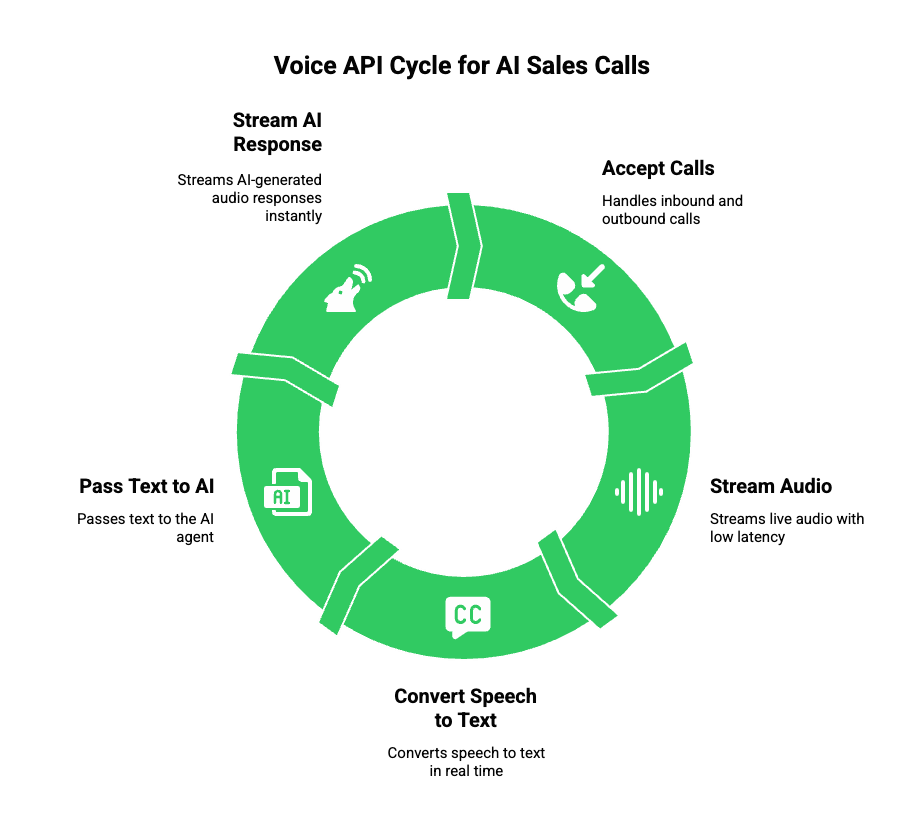
AI systems do not understand phone calls by default. They process text, tokens, and tool outputs. However, sales conversations happen over real-time voice channels, not APIs alone.
This is where voice infrastructure becomes critical.
To enable AI-driven sales calls, a system must:
- Accept inbound and outbound calls
- Stream live audio with low latency
- Convert speech to text in real time
- Pass text to the AI agent
- Stream AI-generated audio responses back instantly
Because of this, the Voice API acts as the real-time transport layer between AI logic and telecom networks.
Without this layer, businesses face:
- Delayed responses
- Broken conversational flow
- Poor call stability
- Limited scalability
Therefore, Voice APIs are not optional when response speed is the goal. They are foundational.
Why Does Low Latency Matter In Sales Voice Conversations?
Speed is not only about when a call starts. It is also about what happens during the call.
In human conversations:
- Pauses longer than 300–500 ms feel unnatural
- Delays reduce trust
- Response lag breaks engagement
Because of this, AI sales systems must operate under strict latency constraints.
Latency-Sensitive Areas In Voice Sales Workflows
- Speech-to-text transcription
- AI reasoning and response generation
- Text-to-speech playback
- Network transport between systems
Even if the AI logic is fast, poor voice infrastructure will slow the entire interaction. Therefore, sales response speed depends on end-to-end system design, not a single component.
What Does A Production-Ready Sales Voice API Stack Look Like?
To increase sales response speed reliably, businesses need a modular but tightly integrated architecture.
Typical Sales Voice API Stack
| Layer | Responsibility |
| Voice Infrastructure | Call handling, media streaming |
| STT Engine | Real-time speech transcription |
| LLM | Intent handling and reasoning |
| RAG Layer | CRM, pricing, product data |
| Tool Calling | Scheduling, lead updates |
| TTS Engine | Natural voice playback |
Each layer must operate independently but communicate with minimal delay.
This architecture allows teams to:
- Swap AI models
- Change STT or TTS providers
- Evolve sales logic
- Scale call volume
Most importantly, it allows businesses to optimize response speed at every layer.
Where Does FreJun Teler Fit In This Architecture?
FreJun Teler operates at the voice infrastructure layer of the stack.
Instead of handling AI logic or business rules, Teler focuses on real-time voice delivery. This separation is intentional and technically important.
What FreJun Teler Provides Technically
- Real-time, low-latency audio streaming
- Inbound and outbound call handling
- Stable bidirectional media connections
- Event-driven call control
- Compatibility with any LLM, STT, or TTS
Because Teler is model-agnostic, engineering teams retain full control over AI behavior. At the same time, they avoid building complex voice infrastructure themselves.
As a result, teams can focus on improving sales logic instead of debugging call latency.
How Does This Architecture Improve Sales Response Speed In Practice?
The benefit becomes clear when looking at real workflows.
Example: Instant Lead Callback Workflow
- Lead submits form
- Backend triggers call via Voice API
- Call connects instantly
- AI agent greets the lead
- Qualification starts immediately
Total time to first contact: seconds, not minutes
Example: Intelligent Inbound Call Handling
- Customer calls sales number
- Voice API streams audio in real time
- AI agent answers without delay
- Context pulled from CRM using RAG
- Call routed or scheduled instantly
In both cases, faster response directly improves conversion probability.
How Do Voice APIs Replace Traditional Sales Dialers?
Traditional dialers were designed for volume, not intelligence.
They assume:
- Agents will handle conversations
- Scripts will cover most cases
- Speed depends on agent availability
However, modern sales teams need:
- Always-on availability
- Intelligent qualification
- Instant callbacks
Comparison: Dialer vs Voice API–Driven AI Workflows
| Aspect | Traditional Dialer | Voice API Workflow |
| Response speed | Agent-dependent | Instant |
| Personalization | Low | High |
| Scalability | Limited | Elastic |
| Intelligence | Scripted | AI-driven |
| Lead conversion | Inconsistent | Predictable |
Because of this, businesses increasingly adopt AI dialer replacements built on Voice APIs.
How Do Voice APIs Support Complex Sales Voice Workflows?
Sales workflows are rarely linear. They involve retries, fallbacks, handoffs, and updates.
Voice APIs support this complexity through event-driven logic.
Examples Of Sales Voice Workflow Events
- Call answered
- Call missed
- Silence detected
- Intent identified
- Qualification completed
Each event can trigger actions such as:
- Retrying the call
- Escalating to a human agent
- Updating lead score
- Scheduling follow-ups
Because workflows run in software, businesses can continuously optimize for faster lead response.
How Should Engineering Teams Approach Implementation?
To avoid complexity, teams should start small and iterate.
Practical Implementation Approach
- Start with one sales use case
- Measure response time baseline
- Introduce Voice API–based automation
- Add AI reasoning gradually
- Optimize latency step by step
This approach reduces risk while delivering quick wins.
Additionally, modular architecture ensures teams are not locked into vendors or models.
How Does Faster Voice Response Impact Sales Metrics?
When response speed improves, downstream metrics follow.
Business Outcomes Observed With Faster Voice Response
- Higher lead pickup rates
- Shorter sales cycles
- Better qualification accuracy
- Lower cost per conversion
- Improved customer experience
Because voice remains the most direct channel, improvements here create outsized revenue impact.
Why Are Voice APIs Becoming Core Sales Infrastructure?
Sales teams no longer compete only on product or price. They compete on speed and experience.
Voice APIs enable:
- Immediate engagement
- Intelligent conversations
- Scalable automation
- Consistent follow-ups
As AI adoption grows, businesses that control their voice infrastructure will move faster than those relying on legacy calling systems.
Final Thoughts
Sales response speed is no longer a process issue, it is an infrastructure decision. Businesses that rely on manual calling systems struggle to keep pace with customer expectations, while those using Voice APIs respond instantly and convert faster. By combining Voice APIs with AI components like LLMs, STT, TTS, and real-time workflows, sales teams can engage leads at peak intent, automate qualification, and scale without adding operational overhead.
FreJun Teler enables this shift by providing a low-latency, AI-ready voice infrastructure that connects any LLM to real phone calls reliably. Teams keep full control over AI logic while Teler handles real-time voice delivery at scale.
Schedule a demo to see how FreJun Teler accelerates sales response speed in production environments.
FAQs –
- What is a Voice API used for in sales?
Voice APIs automate inbound and outbound calls, enabling instant lead engagement and faster sales response without manual dialing. - How does a Voice API improve lead response time?
It triggers calls instantly from software, removing agent delays and ensuring leads are contacted at peak intent. - Can Voice APIs replace traditional sales dialers?
Yes, Voice APIs support intelligent, AI-driven workflows that outperform dialers in speed, personalization, and scalability. - Do Voice APIs work with AI models?
Voice APIs connect AI models to phone calls, enabling real-time speech understanding and dynamic conversational responses. - What components are required for AI sales voice agents?
A typical setup includes STT, LLMs, RAG, tool calling, TTS, and a low-latency voice infrastructure. - Is Voice API implementation complex for engineering teams?
With proper SDKs and infrastructure, teams can implement Voice APIs incrementally without rebuilding existing systems. - How does low latency affect sales conversations?
Low latency ensures natural conversations, faster responses, and higher trust during live sales calls. - Can Voice APIs scale during traffic spikes?
Yes, Voice APIs are infrastructure-based and handle concurrent calls without agent availability constraints. - Are Voice APIs suitable for outbound sales automation?
They enable instant callbacks, personalized outreach, and automated follow-ups at scale.
How does FreJun Teler support AI voice sales systems?
Teler provides real-time voice streaming and call control while allowing teams to plug in any AI model.