
Businesses today face mounting challenges from manual communication tasks. Repetitive dialing, answering frequent inquiries, and managing call flows consume significant time, limit scalability, and increase human error. Voice APIs combined with AI voice agents present a technical solution, automating call handling while maintaining conversational quality. By leveraging speech-to-text, text-to-speech, LLMs, RAG, and tool integrations, organizations can reduce manual workloads, enhance customer experience, and gain actionable insights from every interaction.
This blog explores how AI-powered voice automation, powered by robust platforms like FreJun Teler, delivers measurable operational efficiency, reliability, and strategic value across contact centers and business communication workflows.
Why Do Businesses Struggle With Manual Communication Tasks?
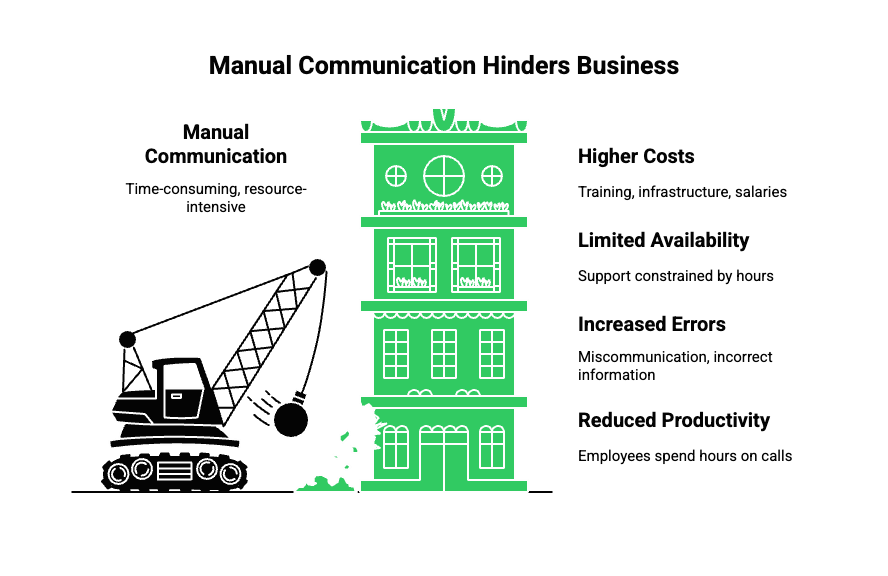
Companies are dealing with an overwhelming number of customer interactions daily. From inbound support requests to outbound follow-ups, managing communication manually consumes significant time and resources. Employees spend hours dialing numbers, answering repetitive queries, and transferring calls. These tasks not only reduce productivity but also increase the likelihood of human errors.
According to industry projections, conversational AI alone is expected to reduce agent labor costs by as much as $80 billion globally by 2026, highlighting the economic pressure on businesses to automate repetitive communication tasks
Several challenges often arise in traditional communication systems:
- Manual Dialing and Follow-Ups: Teams spend a considerable portion of their day calling customers individually, leading to delays in outreach.
- Repetitive Query Handling: Common questions, such as order status or service inquiries, are answered multiple times by different agents.
- Human Error and Inconsistency: Manual handling often leads to miscommunication or incorrect information being shared.
- Limited Availability: Support teams are constrained by working hours, reducing 24/7 accessibility.
- Operational Cost: Large teams require substantial training, infrastructure, and salaries, adding to business overheads.
Because of these limitations, businesses are increasingly looking for automating call tasks solutions that can maintain service quality while reducing human dependency. Voice APIs combined with AI voice agents present a solution to these challenges by automating repetitive communication tasks and optimizing workflow efficiency.
What Is A Voice API And How Does It Work?
A Voice API is a software interface that allows applications to make, receive, and manage voice calls over the internet or telephony networks. Unlike traditional phone systems, Voice APIs provide a programmable layer that integrates voice interactions into applications, enabling automated call handling, intelligent routing, and real-time monitoring.
Modern voice automation relies on a combination of several technologies:
- Large Language Models (LLMs): These models understand context and generate natural responses, allowing calls to be handled conversationally.
- Speech-To-Text (STT): Converts spoken words into text in real-time, enabling the AI to interpret customer queries quickly.
- Text-To-Speech (TTS): Converts AI responses back into clear and natural-sounding voice output.
- Retrieval-Augmented Generation (RAG): Pulls relevant information from internal knowledge bases or tools to answer complex queries.
- Tool Calling Integrations: Allows AI agents to perform actions like updating CRMs, scheduling appointments, or executing business workflows during a call.
The combination of these technologies forms a complete AI-powered voice agent. Unlike traditional IVRs, which follow scripted options, these agents understand intent, maintain conversational context, and respond dynamically.
Key Difference from Traditional IVRs:
| Feature | Traditional IVR | AI-Powered Voice Agent |
| Call Handling | Scripted menus | Context-aware responses |
| Flexibility | Fixed workflows | Dynamic task execution |
| Automation | Limited | Integrates with AI, RAG, and tools |
| User Experience | Often frustrating | Human-like and conversational |
| Scalability | Staff-dependent | Handles thousands of calls simultaneously |
By integrating Voice APIs into existing systems, businesses can automate call tasks, reduce manual dialing, and ensure consistent, high-quality communication.
How Can Voice APIs Reduce Manual Communication Tasks?
Voice APIs are designed to offload repetitive and manual communication tasks while maintaining a seamless customer experience. These APIs empower businesses to handle high-volume calls efficiently, without additional staff or overhead.
Key Technical Benefits Include:
- Automatic Call Dialing and Routing:
Voice APIs can programmatically initiate outbound calls to customers or route inbound calls to the appropriate agent or automated response system. This removes the need for manual dialing entirely. - Real-Time Transcription and Intent Recognition:
By converting speech to text in milliseconds, AI can immediately understand customer intent and respond accurately. This enables faster call resolution and reduces the dependency on human intervention. - Context-Aware Responses:
AI voice agents can retain conversation history and integrate with CRMs or databases. For example, if a customer previously inquired about a product, the agent can reference that interaction automatically. - Seamless Integration With Backend Tools:
By connecting with internal business tools, AI voice agents can perform tasks mid-call, such as updating records, scheduling meetings, or sending notifications. This eliminates manual steps that were traditionally handled by employees. - Scalable Call Handling:
Voice APIs enable businesses to manage hundreds or thousands of simultaneous calls, especially during peak hours or campaign rollouts. Scaling does not require additional hiring, reducing operational cost.
Transitioning from manual processes to automated voice systems also provides measurable performance gains. Businesses experience higher efficiency, improved call resolution times, and a reduction in operational errors.
How Does AI Integration Improve Call Quality And Customer Experience?
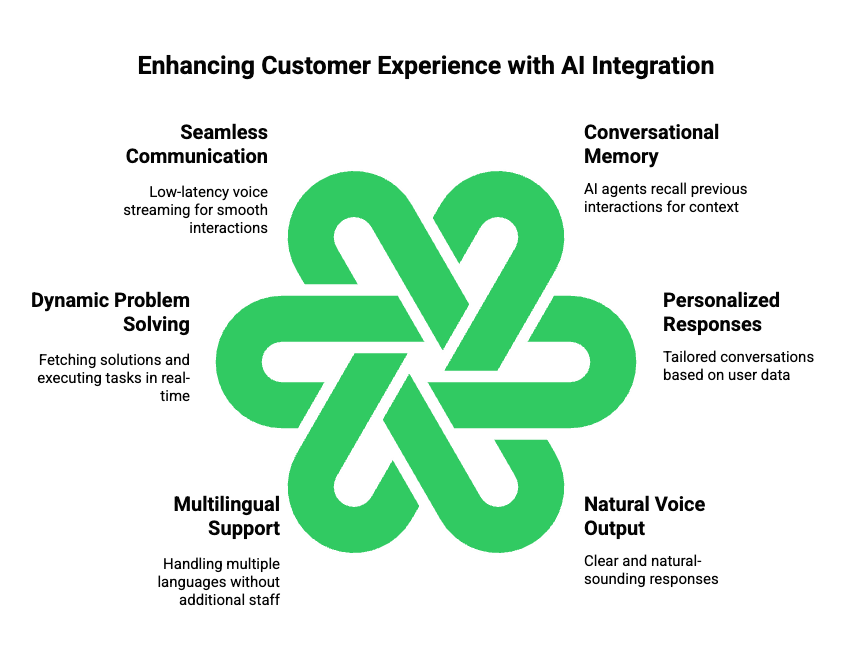
While Voice APIs handle the infrastructure, AI integration enhances the quality and intelligence of conversations. Businesses are no longer limited to static menus or pre-recorded messages. Instead, AI voice agents respond dynamically and maintain a conversational flow similar to speaking with a human agent.
Benefits of AI Integration:
- Conversational Memory With LLM + RAG: AI agents maintain context over multiple interactions. For instance, if a customer calls back, the agent recalls previous interactions, eliminating the need to repeat information.
- Personalized Responses: AI can tailor conversations based on user history, preferences, and real-time data, creating a human-like interaction.
- Natural Voice Output: Advanced TTS engines generate clear and natural-sounding responses, enhancing customer satisfaction and engagement.
- Multilingual Support: With STT/TTS integration, AI voice agents can handle multiple languages, supporting global customer bases without hiring additional multilingual staff.
- Dynamic Problem Solving: Using RAG and backend tool access, AI agents can fetch specific solutions from databases, execute transactions, or trigger workflows automatically, all during the call.
By combining low-latency voice streaming, real-time speech recognition, and AI logic, businesses can deliver seamless, human-like communication, reducing frustration and improving the overall experience.
How Can Businesses Achieve Reliable Automation Without Losing Control?
Implementing automated voice systems requires a robust infrastructure to ensure reliability and low latency. Simply connecting AI to a phone system is not enough; the system must handle audio streaming, maintain conversational context, and integrate with multiple tools simultaneously.
This is where FreJun Teler becomes critical. Teler is designed as a global voice infrastructure platform that enables businesses to implement AI voice agents efficiently. Key technical advantages of Teler include:
- Low-Latency Real-Time Media Streaming: Ensures that customer speech reaches the AI instantly, and AI responses return without noticeable delay.
- Model-Agnostic Integration: Businesses can connect any LLM or AI agent with any STT/TTS engine without vendor lock-in.
- Full Conversational Context Maintenance: Teler provides a stable transport layer, enabling AI agents to track dialogue state, session history, and integrate RAG-based responses seamlessly.
- Developer-First SDKs: Comprehensive server-side and client-side SDKs allow engineers to embed voice capabilities into web, mobile, and backend systems quickly.
- Enterprise-Grade Security and Reliability: Geo-distributed infrastructure, encryption, and uptime guarantees ensure mission-critical applications remain available and secure.
With Teler, businesses can focus on AI logic and workflow design, while the platform handles complex voice infrastructure. This separation of concerns significantly reduces manual intervention, minimizes errors, and accelerates deployment.
How Can Businesses Implement Voice API And AI Voice Agents Efficiently?
Transitioning from manual communication to AI-powered voice automation requires careful planning and structured implementation. A step-by-step approach ensures both technical reliability and business impact.
Implementation Steps:
- Select LLM and TTS/STT Engines:
- Choose AI models based on conversation complexity, domain knowledge, and language requirements.
- STT engines should offer high accuracy and low latency, while TTS should produce natural-sounding voice output.
- Choose AI models based on conversation complexity, domain knowledge, and language requirements.
- Connect AI With Voice API:
- Integrate your chosen AI with a Voice API to handle real-time audio streaming.
- Ensure the API supports bidirectional media flow to minimize conversational delays.
- Integrate your chosen AI with a Voice API to handle real-time audio streaming.
- Integrate RAG and Tool Calling Capabilities:
- Link AI agents to internal knowledge bases or databases using RAG.
- Enable tool calling to automate tasks such as CRM updates, appointment scheduling, or feedback collection.
- Link AI agents to internal knowledge bases or databases using RAG.
- Test Low-Latency Call Flows:
- Conduct stress tests with multiple simultaneous calls to validate stability.
- Measure latency, speech recognition accuracy, and TTS playback quality.
- Conduct stress tests with multiple simultaneous calls to validate stability.
- Monitor Performance and Optimize:
- Analyze call data and agent responses to identify bottlenecks or errors.
- Refine AI prompts, adjust call routing, and update workflows continuously.
- Analyze call data and agent responses to identify bottlenecks or errors.
Pro Tip: Start with a pilot program targeting a specific use case (e.g., appointment reminders) before scaling across all communication workflows.
What Are The Long-Term Benefits Of Voice API For Businesses?
Implementing voice automation and AI voice agents delivers measurable advantages that extend beyond immediate operational efficiency.
Strategic Benefits Include:
- Reduced Operational Cost:
Automated calls minimize staffing requirements, training needs, and human error costs. - Scalable 24/7 Operations:
AI voice agents can handle thousands of simultaneous calls, ensuring availability even during peak hours. - Enhanced Customer Experience:
- Faster response times
- Consistent, accurate answers
- Personalized interactions based on historical data
- Faster response times
- Data-Driven Insights:
Call logs, sentiment analysis, and intent tracking provide actionable intelligence for product, support, and sales teams. - Global Reach With Multilingual Support:
AI voice agents integrated with TTS/STT systems can converse in multiple languages without requiring additional staff. - Future-Proofing Communication Workflows:
Flexible AI integration allows businesses to adapt to emerging channels, customer preferences, and new technologies.
Table: Comparing Manual vs AI Voice Automation
| Aspect | Manual Communication | AI + Voice API |
| Call Volume Handling | Limited by staff | Scales to thousands of simultaneous calls |
| Response Consistency | Varies | Standardized and accurate |
| Operational Cost | High | Reduced through automation |
| 24/7 Availability | Not feasible | Fully automated, always available |
| Customer Experience | Can be inconsistent | Human-like, personalized, multilingual |
| Workflow Integration | Manual updates | Direct integration with CRM and tools |
Can AI Voice Agents Fully Replace Human Agents?
AI voice agents are highly capable but do not entirely replace human agents. Instead, they augment teams by handling repetitive and standardized communication tasks, freeing humans for complex, judgment-based interactions.
AI Voice Agents Handle:
- Appointment scheduling and reminders
- Lead qualification and follow-ups
- Routine customer queries (billing, order status, FAQs)
- Feedback collection and surveys
Human Agents Focus On:
- Escalated support queries
- Complex problem-solving requiring domain expertise
- Relationship-building and high-value negotiations
The hybrid approach ensures efficiency while preserving the human touch where it matters most.
How Secure And Reliable Are AI Voice Workflows?
Security and reliability are critical in enterprise communication. Voice APIs integrated with AI agents must provide:
- End-to-End Encryption: Protects sensitive customer data during transit.
- Access Control: Role-based permissions to manage who can interact with AI systems.
- Audit Logs: Detailed records of calls, agent decisions, and tool interactions.
- High Availability: Geo-distributed architecture ensures uptime even during network or server failures.
- Data Compliance: Meets enterprise standards such as GDPR, PCI-DSS, or HIPAA where applicable.
FreJun Teler’s Advantage:
By providing a resilient, enterprise-grade infrastructure, Teler ensures that automated voice operations are secure, stable, and reliable, while developers focus solely on AI and workflow logic.
How Do Businesses Measure The Success Of Voice API Automation?
To evaluate ROI and effectiveness, companies monitor several key metrics:
- Call Completion Rate: Percentage of successful automated calls without human intervention.
- Resolution Time: Average time to handle inquiries compared to manual handling.
- Customer Satisfaction (CSAT): Feedback collected via post-call surveys or follow-ups.
- Automation Coverage: Ratio of tasks handled by AI agents vs. manual agents.
- Cost Savings: Reduction in staffing, call duration, and operational overhead.
By continuously analyzing these metrics, businesses can optimize AI workflows, improve response quality, and scale operations confidently.
What Are Common Challenges And How To Overcome Them?
Even with advanced voice APIs, certain challenges may arise:
- Latency Issues: Can disrupt conversational flow.
Solution: Use low-latency media streaming platforms like Teler. - Speech Recognition Errors: Background noise or accents may affect STT accuracy.
Solution: Implement noise filtering, language models tuned to domain-specific vocabulary. - Integration Complexity: Connecting AI, RAG, and tools may require development resources.
Solution: Leverage developer-first SDKs and phased integration. - Fallback Handling: Not all queries can be automated.
Solution: Define escalation paths to human agents for complex or sensitive requests.
By addressing these challenges proactively, businesses can maximize the benefits of automating call tasks and reduce manual dialing effectively.
What Does The Future Hold For Voice API And AI Communication?
The future of business communication is shifting towards fully automated, intelligent, and human-like voice interactions. Emerging trends include:
- Proactive Customer Outreach: AI agents predicting customer needs and initiating calls.
- Contextual Multi-Turn Conversations: Long-form interactions with memory retention.
- Tool Orchestration and Workflow Automation: AI directly executing business processes across applications.
- Global Multilingual Conversations: Expanding global reach without additional staffing.
- Continuous AI Optimization: Models improve over time with ongoing learning and feedback loops.
Businesses adopting AI voice agents now gain a significant competitive advantage by reducing manual workloads, improving customer satisfaction, and unlocking new efficiency levels.
Conclusion
Automating manual communication tasks with AI voice agents and Voice APIs transforms how businesses handle customer interactions. By reducing repetitive dialing, streamlining inbound and outbound calls, and integrating intelligent workflows, companies achieve faster response times, lower operational costs, and higher customer satisfaction. AI-powered voice agents maintain conversational context, execute tasks with backend integrations, and provide actionable insights, enabling teams to focus on strategic priorities rather than repetitive tasks.
Platforms like FreJun Teler offer the enterprise-ready infrastructure needed to implement these solutions efficiently, with low-latency streaming, model-agnostic integration, and robust SDKs.
FAQs –
- Can AI voice agents completely replace human agents?
AI handles repetitive tasks, while humans focus on complex interactions, ensuring efficiency without losing personal touch in critical calls. - Do I need a specific AI model to integrate with a Voice API?
No, modern platforms like Teler allow integration with any LLM or AI model without restrictions. - How quickly can AI voice agents handle calls?
With low-latency streaming, AI agents can respond in milliseconds, providing real-time conversational experiences for customers. - Are AI voice interactions multilingual?
Yes, STT and TTS integration enable AI agents to converse fluently across multiple languages globally. - Can AI agents access backend systems during calls?
Yes, tool-calling integration allows automated tasks, CRM updates, and workflow execution mid-call. - How secure are AI voice interactions?
Platforms like Teler provide end-to-end encryption, compliance standards, and audit logs for enterprise-grade security. - Does AI improve call resolution times?
Yes, AI maintains context and executes relevant tasks quickly, reducing resolution time and improving first-contact efficiency. - What is the cost benefit of using AI voice agents?
Businesses can reduce operational costs by automating repetitive calls, minimizing staff hours and manual errors. - Is integration difficult with existing systems?
Developer-friendly SDKs and APIs simplify integration, allowing phased deployment without disrupting existing communication workflows. - Can AI agents handle peak call volumes?
Yes, AI voice agents scale seamlessly to manage thousands of simultaneous calls without human intervention.