
Customer expectations are higher than ever. Live calling remains a vital channel where trust, clarity, and speed define customer satisfaction. Traditional systems often struggle with latency, static call flows, and disconnected context, leaving both callers and agents frustrated. Voice APIs transform this landscape, turning calls into programmable, intelligent workflows that improve real-time caller experiences. By integrating AI-driven conversational logic, businesses can automate routine interactions, reduce wait times, and enhance personalization across inbound and outbound calls.
In this blog, we explore how implementing modern Voice API infrastructure enables smoother, efficient, and more engaging voice interactions for businesses at scale.
Why Does Live Calling Still Matter In A Digital-First World?
Even with chat apps, self-serve portals, and messaging bots, live calling continues to play a critical role in business communication. In fact, voice is still the preferred channel when urgency, trust, or clarity matters. Customers may start their journey online, but they often switch to calls when the issue becomes complex or time-sensitive.
According to industry research, 75% of customers prefer phone support when issues are complex, highlighting why real-time interactions continue to matter even as digital channels grow.
More importantly, voice conversations shape perception. A slow, rigid call experience can damage trust quickly. On the other hand, a smooth and responsive call builds confidence within seconds.
However, this is where many businesses struggle. While digital channels have evolved, calling systems often remain static. As a result, customers experience delays, repeated questions, and poor call quality. Therefore, improving the real time caller experience is no longer optional—it is a business requirement.
This is where Voice APIs come into focus.
What Is A Voice Api And How Does It Actually Work?
A Voice API is a programmable interface that allows applications to send, receive, and control phone calls using software. Instead of treating calls as fixed telecom events, Voice APIs turn them into dynamic, code-driven workflows.
At a technical level, a Voice API abstracts telecom complexity and exposes simple primitives that developers can work with.
Core Capabilities Of A Voice Api
- Call initiation and termination
- Inbound and outbound call handling
- Real-time audio streaming
- Event-based webhooks
- DTMF and speech input handling
- SIP and PSTN connectivity
Because of this abstraction, product and engineering teams no longer need to manage telecom hardware or carrier logic. Instead, they define call behavior using APIs and events.
How Voice Apis Fit Into Modern Systems
Traditional telephony systems operate in isolation. In contrast, Voice APIs integrate directly with:
- CRMs
- Ticketing systems
- Databases
- AI services
- Analytics pipelines
As a result, calls become part of the broader application stack. This shift is foundational for building interactive voice interfaces and intelligent calling workflows.
How Are Traditional Calling Systems Limiting Customer Experience Today?
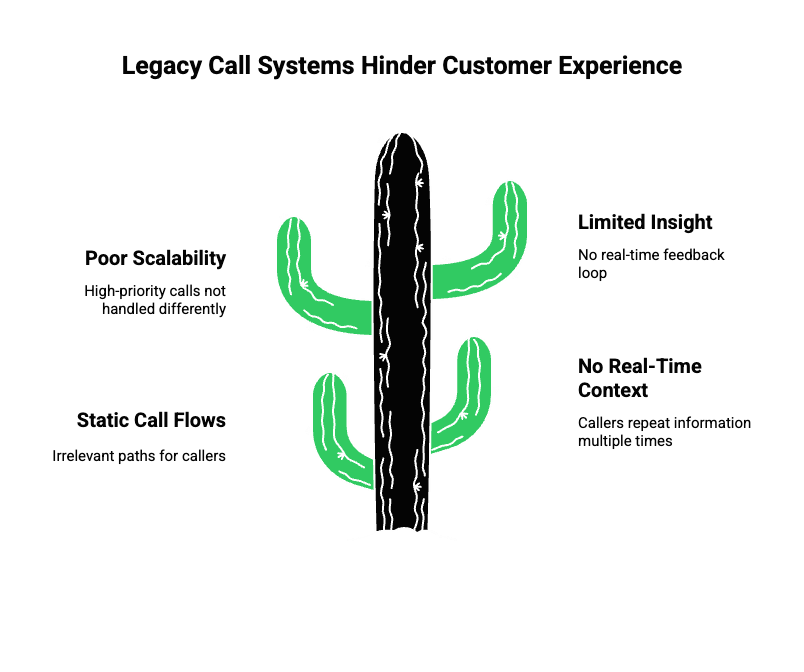
Although many businesses invest heavily in customer experience, their calling systems often lag behind. This creates friction at the exact moment when customers expect speed and clarity.
Key Limitations Of Legacy Call Systems
Static Call Flows: IVRs rely on fixed menus. They cannot adapt based on intent, history, or context. As a result, callers are forced into long and irrelevant paths.
No Real-Time Context: Agents and systems often lack access to live customer data during calls. Therefore, callers repeat the same information multiple times.
Poor Scalability: During peak hours, queues grow quickly. Since call routing is static, high-priority calls are not handled differently.
Limited Insight Into Call Quality: Although calls may be recorded, there is no real-time feedback loop. Consequently, businesses cannot improve experiences while calls are happening.
Because of these issues, call quality enhancement becomes difficult without changing the underlying infrastructure.
How Do Voice APIs Improve Real Time Caller Experience?
Voice APIs directly address the limitations of traditional systems by making calls programmable, responsive, and context-aware.
Real-Time Call Control
With a Voice API, applications can react to call events as they happen. For example:
- Route calls dynamically based on user input
- Adjust prompts in real time
- Transfer calls based on intent, not menus
This leads to a more natural and efficient real time caller experience.
Context-Aware Conversations
Voice APIs allow applications to pull data during a live call. As a result:
- Callers are identified instantly
- Past interactions are available in real time
- Responses are relevant and personalized
Instead of asking generic questions, the system responds with context. This alone reduces frustration significantly.
Faster Resolution And Lower Wait Times
Because call logic is driven by software:
- Simple issues are handled automatically
- Complex issues are routed correctly the first time
- Agents receive calls with full context
Consequently, resolution times drop and satisfaction improves.
How Do Voice APIs Enable Interactive Voice Interfaces?
An interactive voice interface goes beyond basic IVRs. It listens, responds, and adapts during the conversation.
Voice APIs make this possible by supporting real-time audio input and output, which is essential for modern voice systems.
Key Components Of An Interactive Voice Interface
| Component | Role In The Call |
| Audio Streaming | Captures and delivers voice in real time |
| Event Webhooks | Trigger logic based on call activity |
| Application Logic | Determines next actions dynamically |
| External Integrations | Fetches data or executes actions |
Because these components work together, the call becomes interactive rather than scripted.
Furthermore, this structure is what enables conversational ai to operate over phone calls. Without a real-time voice layer, even the best AI logic cannot function smoothly on voice.
How Do Voice APIs Support Conversational Ai Over Calls?
Conversational AI on voice is not a single tool. Instead, it is a system composed of multiple parts working together.
A typical voice agent includes:
- Speech-to-text for understanding caller input
- A language model for intent and response
- Retrieval systems for business data
- Tool calling for actions
- Text-to-speech for voice output
However, none of these components handle calls on their own. This is where Voice APIs play a critical role.
Role Of Voice Apis In Conversational Ai
Voice APIs provide:
- Continuous audio streams
- Low-latency delivery
- Call state management
- Reliable transport between systems
Because of this, conversational ai can operate in real time without breaking the flow of the conversation.
Importantly, the Voice API does not control intelligence. Instead, it ensures that intelligence can speak and listen without interruption.
Why Is Low Latency Critical For Call Quality Enhancement?
Latency is one of the most overlooked aspects of voice systems. Yet, it has the strongest impact on perceived quality.
In human conversations, even small delays feel unnatural. When pauses exceed a few hundred milliseconds, conversations start to feel broken.
How Latency Affects Call Experience
- Delayed responses reduce trust
- Overlapping speech increases confusion
- Callers interrupt systems unintentionally
- Conversations feel mechanical
Therefore, call quality enhancement depends heavily on infrastructure that supports real-time audio streaming with minimal delay.
Voice APIs designed for instant calling workflows prioritize:
- Stable media connections
- Efficient packet handling
- Geographic routing
- Resilience to network variation
As a result, conversations remain smooth, even when AI systems are involved.
How Can Businesses Build Instant Calling Workflows Using Voice Apis?
Once calls become programmable, they stop being isolated events. Instead, they turn into instant calling workflows that react in real time.
An instant calling workflow is a call that:
- Starts automatically based on an event
- Changes direction during the call
- Connects with systems while the call is active
Because Voice APIs expose call state and media events, applications can control the entire lifecycle of a call.
Examples Of Instant Calling Workflows
- Trigger an outbound call when a lead submits a form
- Route inbound calls differently based on account status
- Escalate calls when sentiment drops
- Execute actions such as booking, updating, or confirming during the call
As a result, calls become faster, smarter, and more relevant.
Why This Matters For Businesses
Instant workflows reduce delays. They also remove unnecessary handoffs. Most importantly, they improve the real time caller experience by responding immediately to user intent.
What Makes A Voice Api Suitable For Ai-First Businesses?
Not all Voice APIs are built for AI-driven systems. While many platforms focus on basic calling, AI-first teams need more control and flexibility.
Therefore, choosing the right Voice API becomes a strategic decision.
Key Requirements For Ai-First Voice Systems
Model Agnostic Design: The Voice API should work with any LLM, STT, or TTS service. This avoids lock-in and allows teams to evolve their stack.
Real-Time Media Streaming: Batch processing is not enough. AI conversations require continuous, low-latency audio streams.
Full Control Over Call Logic: Teams must control:
- Dialogue flow
- Memory handling
- Tool execution
- Context management
Scalability And Global Reach: AI systems often scale fast. The voice layer must handle traffic spikes without degrading call quality.
Because of these needs, AI-first businesses treat voice as infrastructure, not as a feature.
How Does Voice Infrastructure Impact Conversational AI Performance?
Many teams focus on improving prompts or models. However, voice infrastructure often has a bigger impact on user experience.
Even a well-trained AI fails if:
- Audio arrives late
- Responses are cut off
- Calls drop unexpectedly
Therefore, conversational AI performance depends heavily on the reliability of the voice layer.
Infrastructure Factors That Affect AI Conversations
- Media transport stability
- Latency between speech and response
- Audio clarity and consistency
- Failover during network issues
When these factors are handled well, AI feels natural. When they are not, even simple conversations break down.
How Does FreJun Teler Support AI-Driven Live Caller Experiences?
At this point, it becomes clear that businesses need more than basic calling APIs. They need a voice infrastructure layer designed specifically for AI conversations.
FreJun Teler is built to serve exactly this role.
What FreJun Teler Provides
FreJun Teler is a global Voice API platform designed to power real-time voice interactions for AI agents and LLM-based systems. It handles the entire voice layer while allowing teams to retain full control over their AI logic.
Technical Capabilities Of FreJun Teler
- Real-time bidirectional audio streaming
- Inbound and outbound call handling
- Low-latency media transport
- Compatibility with any LLM, STT, or TTS
- Stable transport layer for conversational context
Because Teler focuses on voice infrastructure, engineering teams can build voice agents without managing telecom complexity.
Why This Matters For Product And Engineering Teams
- Faster implementation timelines
- No restriction on AI models or tools
- Predictable performance at scale
- Clean separation between AI logic and voice transport
As a result, teams can iterate on intelligence without worrying about call reliability.
What Business Use Cases Benefit Most From Voice APIs Today?
Voice APIs deliver value across industries. However, their impact is strongest where voice interactions are frequent, time-sensitive, or high value.
Intelligent Inbound Call Handling
Businesses use Voice APIs to build:
- AI receptionists
- Context-aware IVRs
- Automated support agents
These systems answer common questions instantly. At the same time, they route complex issues correctly.
Scalable Outbound Engagement
Voice APIs support:
- Appointment reminders
- Lead qualification
- Feedback collection
Because workflows are automated, outbound calling scales without losing personalization.
Sales And Revenue Operations
Voice-driven systems:
- Qualify leads before agent handoff
- Collect intent data during calls
- Reduce time spent on low-value conversations
As a result, sales teams focus only on high-intent prospects.
How Do Security And Reliability Affect Live Caller Experience?
Voice systems handle sensitive conversations. Therefore, security and reliability directly influence trust.
A single dropped call or data issue can harm customer confidence.
Critical Infrastructure Requirements
- Encrypted audio streams
- Secure event delivery
- High availability architecture
- Geographic redundancy
- Monitoring and logging
When these elements are in place, businesses can deploy voice automation confidently.
Moreover, reliable systems ensure that conversational AI operates consistently, even during peak traffic.
How Should Teams Get Started With Voice APIs?
Implementing Voice APIs does not require rebuilding everything at once. Instead, teams should start small and scale gradually.
Recommended Approach
- Identify one high-impact call flow
- Integrate Voice API with existing systems
- Add AI logic incrementally
- Monitor latency and call quality
- Expand to additional workflows
This approach reduces risk while delivering quick wins.
Why Voice APIs Are Becoming Core Business Infrastructure
Voice is no longer just a communication channel. It is becoming a programmable interface between businesses and customers.
As expectations rise, callers demand:
- Faster responses
- Natural conversations
- Clear outcomes
Voice APIs make this possible by enabling real time caller experience improvements at scale.
When combined with conversational AI, they allow businesses to deliver voice interactions that are responsive, reliable, and intelligent.
Ultimately, the companies that invest in voice infrastructure today will set the standard for customer experience tomorrow.
Conclusion
In conclusion, Voice APIs are no longer optional; they are critical infrastructure for businesses seeking to elevate live caller experiences. By enabling real-time, low-latency audio, dynamic workflows, and integration with AI systems, these APIs ensure calls are faster, smarter, and more engaging. Companies leveraging programmable voice can reduce friction, improve first-call resolution, and deliver personalized experiences across every interaction.
FreJun Teler takes this further by providing a robust, scalable, and model-agnostic voice infrastructure that allows your AI agents to interact seamlessly with customers over any network. Transform your voice interactions into strategic assets today.
Schedule your Teler demo to see how real-time caller experiences can redefine your customer engagement.
FAQs –
- What is a Voice API?
A Voice API is a programmable interface that manages calls, audio streams, and events, enabling real-time intelligent workflows. - How does Voice API improve caller experience?
It reduces latency, delivers context-aware responses, enables dynamic routing, and allows personalized, real-time interactions for every caller. - Can I integrate any AI model with Voice API?
Yes, modern APIs are model-agnostic and support LLMs, STT, TTS, and retrieval-augmented generation for intelligent voice agents. - Does Voice API enhance outbound campaigns?
Absolutely. It automates reminders, surveys, and lead qualification calls while maintaining a natural, conversational voice experience. - How does latency affect call quality?
Even minor delays disrupt conversation flow, reduce perceived intelligence, and frustrate callers, making low-latency critical for natural experiences. - Are Voice APIs scalable for enterprise use?
Yes, with geo-distributed infrastructure and real-time streaming, APIs handle thousands of concurrent calls without quality degradation. - How do Voice APIs integrate with business systems?
They connect via webhooks and APIs to CRMs, ticketing, databases, and analytics platforms for seamless data-driven calls. - Is security maintained in Voice API calls?
Modern APIs encrypt audio streams, maintain data integrity, and provide compliance-ready infrastructure for enterprise-grade protection. - What types of businesses benefit most from Voice APIs?
Customer support, sales operations, appointment management, feedback collection, and regulated industries with high-value or frequent calls. - How quickly can I deploy Voice API with AI agents?
With robust SDKs and integration support, real-time voice agents can be live in days, not months, depending on workflows.