
Imagine a vast warehouse, a sprawling city of shelves reaching for the ceiling. Down one of the long, narrow aisles, a worker is picking an order. In one hand, they hold a clunky handheld scanner.
In the other, a piece of paper with a pick list. They scan a location, look down at the paper, look up at the shelf, pick the item, scan the item, and then mark it off the list.
Their hands are full, and their eyes are constantly shifting focus. This “hands-busy, eyes-busy” workflow is the single biggest source of inefficiency and error in modern logistics.
The solution is not a better scanner or a different kind of list; it is to remove the need for hands and eyes altogether with a powerful voice API for developers.
The global warehouse automation market is exploding, expected to reach a staggering $64.8 billion by 2030. This massive investment highlights a critical need for smarter, faster, and safer operations.
By integrating voice commands directly into their core Warehouse Management Systems (WMS), companies can unleash their workforce, creating a hands-free environment that dramatically boosts productivity, accuracy, and safety.
Table of contents
What Exactly is a Voice API for Developers?
Let’s break down the term. An API, or Application Programming Interface, is a set of rules that allows two different software applications to talk to each other. A voice API for developers takes this concept and applies it to spoken language.
Think of it as a set of sophisticated Lego blocks for voice communication. It is not a finished product like a smart speaker.
Instead, it is a powerful toolkit that gives your software developers the ability to embed voice functionalities like understanding spoken commands and providing audible feedback, directly into the applications your business already uses, like your WMS or inventory management software.
This is the key: a voice API for developers is not about buying an off-the-shelf solution; it is about creating custom, voice-powered workflows that are perfectly tailored to the unique needs of your warehouse operation.
Why is the Traditional Warehouse Workflow So Inefficient?
The traditional, scanner-based workflow in a warehouse is a system that creates constant friction and interruption. Every action requires the worker to stop, put down what they are doing, and interact with a device or a piece of paper. This is a model that is fundamentally at odds with the dynamic, fast-paced nature of a modern logistics environment.
The Problem of “Hands-Busy, Eyes-Busy”
This is the core challenge.
- Reduced Picking Speed: Every time a worker has to stop to read a screen or scan a barcode, seconds are lost. Over the course of a day and thousands of picks, this adds up to a massive loss in productivity.
- High Error Rates: The constant shifting of focus between a screen, a shelf, and an item is a major cause of errors. Picking the wrong item or the wrong quantity is a common and costly mistake. In fact, mis-picks are a huge issue, with the cost of a single picking error being estimated at anywhere from $50 to $300.
- Significant Safety Concerns: A worker looking down at a scanner screen is not looking at their surroundings. This increases the risk of collisions with forklifts, pallet jacks, or other personnel, creating a serious safety liability.
Also read: Voice AI For Emergency Response Centers
How Does Voice Automation Revolutionize Warehouse Operations?
By integrating a voice API for developers into your WMS, you can create a “voice-directed warehousing” or “pick-by-voice” system. This transforms the worker’s experience by freeing up their most valuable tools: their hands and their eyes.
The worker wears a comfortable headset with a microphone, and the WMS literally talks to them, guiding them through their tasks with clear, verbal instructions.
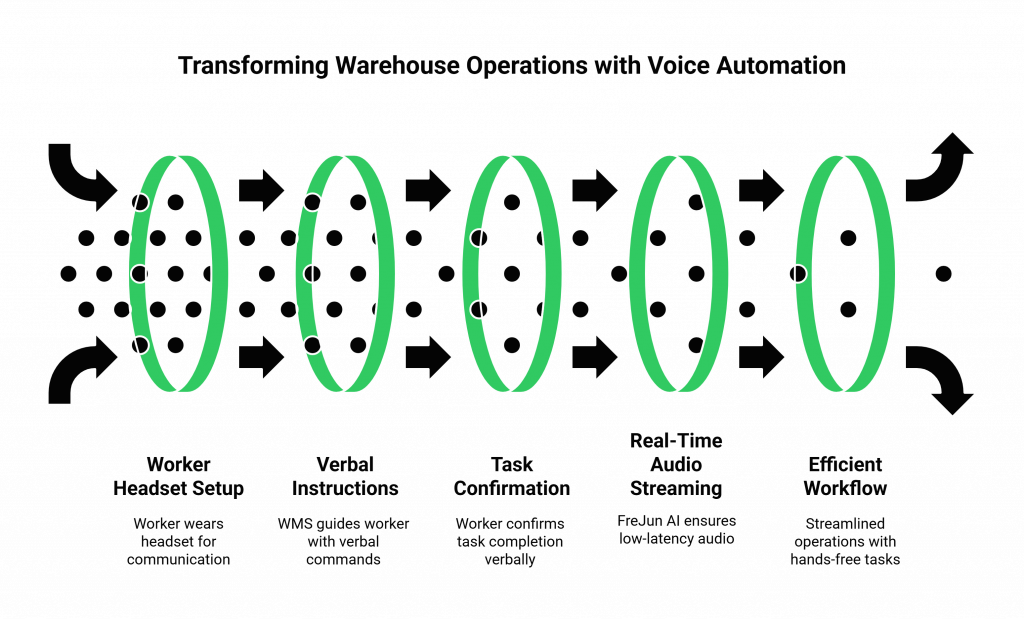
This new workflow is a seamless conversation between the worker and the WMS, enabled by a powerful voice infrastructure. For this to work, the conversation must be instant and clear. This is where a platform like FreJun AI is essential.
FreJun AI provides the low-latency “plumbing” that handles the real-time audio streaming between the worker’s headset and the AI models that interpret their speech. This ensures there are no delays, allowing for a rapid-fire, efficient workflow.
How Does It Supercharge Order Picking?
This is the most common and impactful use case. Instead of looking at a screen, the worker hears a command through their headset: “Proceed to Aisle 12, Rack 4, Shelf B.” When they arrive, they simply say a confirmation word like “check.” The system then instructs, “Pick 5 units of item number 86753.”
After picking the items, the worker confirms by saying “5 units complete,” and the system gives them their next instruction. Their hands are free to handle the products, and their eyes are focused on the task, not a screen.
How Does It Streamline Inventory Management?
The same principle can be applied to other critical tasks like cycle counting and put-away. A worker can approach a bin and say, “Begin cycle count for Bin C-4.” The system can then ask for the item number, and the worker can simply speak the quantity they see. This makes the tedious process of inventory checking much faster and more accurate.
How Does It Improve Safety and Training?
A voice-enabled system can also be a powerful tool for safety. The system can be programmed to provide audible safety reminders like, “Caution: Forklift approaching,” when integrated with vehicle proximity sensors.
For new employees, a voice-guided system can act as a virtual trainer, walking them through processes step-by-step and reducing the time it takes for them to become productive.
Here is a clear comparison of the two workflows:
| Task | Scanner-Based Workflow | Voice-Enabled Workflow |
| Instruction Method | Worker reads instructions from a screen or paper. | Worker hears instructions through a headset. |
| Confirmation Method | Worker stops and scans a barcode. | Worker confirms task completion with a spoken word. |
| Worker’s State | “Hands-busy, eyes-busy.” | “Hands-free, eyes-free.” |
| Productivity | Slower, due to constant starts and stops. | 15-35% faster, with a continuous, fluid workflow. |
| Accuracy | Prone to scanning and picking errors. | Up to 99.9% accuracy, as every step is verbally confirmed. |
Also read: Inbound Call Handling for Public Utilities
How Do You Build a Voice-Enabled Warehouse System?
Building a custom voice solution for your warehouse is a more manageable project than you might think. It involves a logical process of connecting your existing systems to an intelligent voice platform.
- Define Your Voice Workflows: Start by mapping out the specific conversations you want to automate. Focus on the highest-volume, most repetitive tasks first, like order picking.
- Select Your Hardware: This typically involves choosing industrial-grade wireless headsets with good noise-cancellation technology, which is essential for a loud warehouse environment.
- Choose Your AI Stack: You will need the core components of conversational AI: a Speech-to-Text (STT) engine to understand the worker’s voice, a Large Language Model (LLM) to process the commands, and a Text-to-Speech (TTS) engine to generate the audible instructions.
- Integrate Using a Voice API for Developers: This is the glue that holds the entire system together. You need a powerful and reliable voice infrastructure to connect your WMS, your AI models, and your workers’ headsets in real time. This is the essential role of FreJun AI. Our model-agnostic platform gives you the freedom to choose the best AI models for your specific needs, such as an STT engine trained to handle noisy environments. We provide the developer-first toolkits to make this integration fast and seamless. We handle the complex voice infrastructure so you can focus on building your AI.
Ready to unleash the full potential of your warehouse workforce? Sign up for FreJun AI and get your API keys to start building.
Also read: AI Voicebot for Exam Information Hotlines
Conclusion
The “hands-busy, eyes-busy” paradigm of the traditional warehouse is a relic of the past. It is a system that is holding back productivity, compromising accuracy, and putting worker safety at risk.
The future of warehouse automation is not just about robots and conveyor belts; it is about empowering your human workforce with smarter tools. A voice API for developers is the key to unlocking this potential.
By creating a hands-free, voice-directed environment, you can build a warehouse that is faster, more accurate, and safer. This technology allows your workers to focus on the task at hand, transforming them into more efficient and effective operators.
For any company looking to gain a competitive edge in the fast-paced world of logistics, a custom-built voice solution is no longer a luxury; it is an operational necessity.
Want to discuss how a voice API can be tailored for your specific WMS and operational workflows? Schedule a personalized demo for FreJun Teler.
Also read: UK Mobile Code Guide for International Callers
Frequently Asked Questions (FAQs)
It is a programming toolkit that allows a company to build custom, voice-activated workflows directly into their Warehouse Management System (WMS). It enables workers to receive audible instructions and confirm tasks using their voice.
This is a critical challenge. The solution uses high-quality, noise-canceling headsets and, more importantly, integrates with a specialized Speech-to-Text (STT) model trained to filter out background noise and accurately understand the worker’s voice.
No, quite the opposite. A voice system is incredibly intuitive. Because it uses the most natural form of communication, speech – the learning curve is often much shorter than it is for a complex handheld scanner.
Absolutely. By integrating with multilingual AI models for both Text-to-Speech and Speech-to-Text, the system can be configured to communicate with each worker in their preferred language.
A well-designed system has built-in error correction logic. If the AI is not confident in what it heard, it can ask the worker to repeat the information (e.g., “Please say that again”). The confirmation at each step ensures that errors are caught and corrected instantly.
No, it is a tool designed to make your existing workers significantly more productive and accurate. It augments their abilities, allowing them to do their jobs faster and more safely.
For many large-scale operations, yes. A solution built with a voice API for developers integrates deeply with your unique WMS and tailors itself perfectly to your specific workflows, which a rigid, pre-packaged product often cannot do.
FreJun AI is not the AI model itself. We provide the foundational voice infrastructure—the “plumbing.” We are the experts in telephony and real-time, low-latency audio streaming. Our reliable, model-agnostic platform ensures that the critical conversations between your WMS and your workers are always crystal clear.
Security is a top priority. A platform like FreJun AI uses enterprise-grade security and encrypts all voice data in transit to keep your sensitive operational data confidential.
With a modern, developer-first platform like FreJun AI, the time to market is significantly reduced. Your development team can use our SDKs and documentation to build and test a functional prototype in a matter of weeks.