
The smart meter is a revolutionary piece of technology. It is the silent, digital nerve ending of a modern utility grid, capable of providing a constant stream of valuable, real-time data. But for the average homeowner, it is often just a mysterious box on the side of their house.
The rich data it collects, about energy usage, peak demand, and potential cost savings, is trapped, accessible only through a clunky web portal or a confusing monthly statement. What if you could bridge this data gap? What if a customer could simply ask their utility provider, “How much energy have I used today?” and get an instant, spoken answer?
This is not a futuristic vision; it is a practical and powerful application of a voice API for developers.
The global smart meter market is expanding rapidly, projected to reach over $54 billion by 2027. This flood of new data represents an incredible opportunity for utility companies to build a new kind of relationship with their customers, one that is proactive, data-driven, and helpful.
By integrating a voice API into their smart meter platforms, utilities can transform raw data into meaningful, conversational insights, creating a customer experience that is as modern and intelligent as the grid itself.
Table of contents
Why is Smart Meter Data So Underutilized?
Despite the massive investment in smart grid technology, the full potential of smart meter data is rarely realized at the consumer level. The primary reason for this is a “last mile” problem in data communication. The data is being collected, but it is not being delivered to the end-user in an accessible or intuitive way.
The Failure of Traditional Communication Channels
The current methods for sharing this data with customers are fundamentally passive and require a high degree of user effort.
- Complex Web Portals: While most utilities offer an online portal where customers can view their usage data, these are often difficult to navigate and require the user to actively log in and interpret complex charts and graphs.
- Delayed Monthly Statements: The traditional paper or PDF bill provides a historical snapshot of usage, but it is not real-time and offers little in the way of actionable insights.
- Overburdened Call Centers: When customers do have a question about their usage, their only real-time option is to call the main support line. This clogs the queue with data-related inquiries and puts a strain on human agents who have to act as human data interpreters.
What is a Voice API and How Can it Bridge the Data Gap?
An API, or Application Programming Interface, is a set of rules that allows different software applications to talk to each other. A voice API for developers takes this concept and applies it to spoken language.
Think of it as a set of sophisticated building blocks for voice communication. It is not a finished, off-the-shelf product. Instead, it is a powerful toolkit that gives your software developers the ability to embed voice functionalities like making calls, receiving calls, and, most importantly, orchestrating a conversation with an AI, directly into your own custom applications, such as your smart meter data platform.
This is the key: a voice API for developers allows a utility to create its own unique, branded, conversational experiences that are perfectly tailored to its customers’ needs. The potential for this kind of direct, data-driven communication is huge. A recent study by J.D. Power found that proactive communication is one of the single biggest drivers of customer satisfaction for electric utilities.
Also Read: Voice Assistants in Luxury Travel Experiences
How Can a Voice API Transform the Smart Meter Experience?
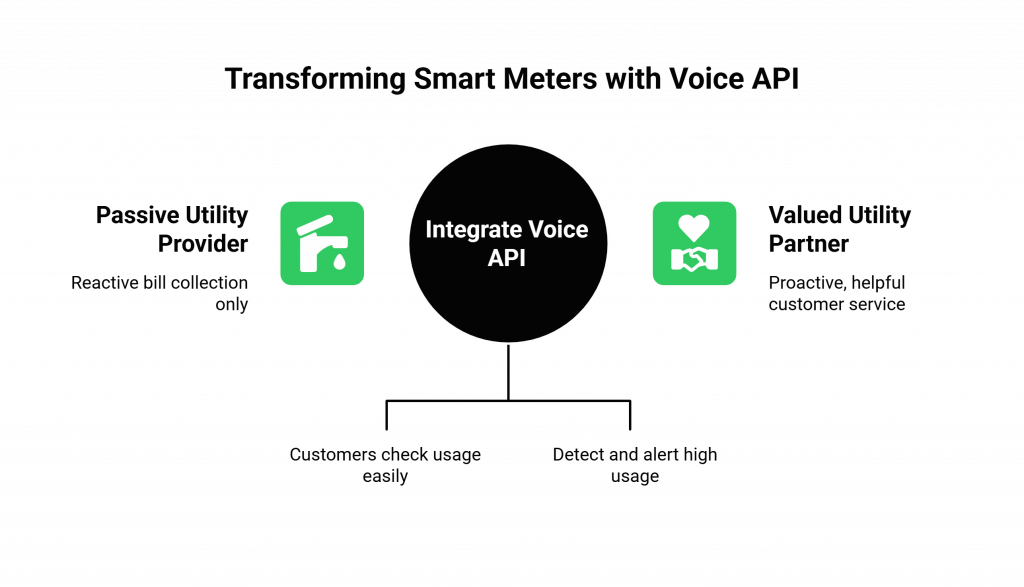
By integrating a voice API for developers into your smart meter platform, you can create a powerful, two-way conversational channel for your customers. This can take the form of an intelligent, automated agent that can be accessed through a simple phone call.
Enabling On-Demand Usage Inquiries
This is the most direct and powerful use case. A customer can call a dedicated number at any time and have a simple, natural conversation with an AI agent.
- Customer: “Hi, I’d like to check my electricity usage.”
- AI Agent: “Certainly. I see you’re calling from the number associated with 123 Oak Street. Can you please verify your date of birth to continue?”
- (After verification)
- AI Agent: “Thank you. So far this month, you have used 450 kilowatt-hours of electricity. Your usage today is slightly higher than your daily average. Would you like to hear some tips on how to reduce your peak-time consumption?”
Creating Proactive, High-Usage Alerts
A voice API is not just for inbound calls. It is a powerful tool for proactive outbound communication.
- Your smart meter platform can be programmed to detect anomalous usage patterns in real time. For example, if a customer’s consumption suddenly spikes, indicating a potential appliance malfunction or a leak (in the case of water meters).
- This data trigger can automatically initiate an outbound call from the AI agent. The agent can say, “Hello, this is a proactive alert from your utility provider. We’ve noticed an unusually high pattern of water usage at your property in the last 24 hours. This could indicate a possible leak. We recommend you check your appliances and fixtures.”
This proactive service can save a customer hundreds of dollars and transforms the utility from a passive bill collector into a valued and helpful partner.
Here is a clear comparison of the two models of customer interaction:
| Feature | Traditional Model | Voice API-Enabled Model |
| Data Access | Customer must log in to a complex web portal. | Customer can get data with a simple, 2-minute phone call. |
| Interaction | Passive and one-way (the utility presents data). | Interactive and two-way (the customer can ask questions). |
| Timeliness | Historical (monthly statements) or requires a manual check. | Real-time, on-demand, and includes proactive alerts. |
| Personalization | Generic charts and graphs. | Personalized, conversational insights and tips. |
Ready to turn your smart meter data into engaging customer conversations? Sign up for FreJun AI and get your API keys to start building.
Also Read: How to Handle Last-Minute Bookings via AI Calls?
How Do You Build a Voice-Enabled Smart Meter Platform?
Building a custom voice solution for your smart meter platform is a manageable project that involves a logical process of connecting your data to an intelligent voice infrastructure.
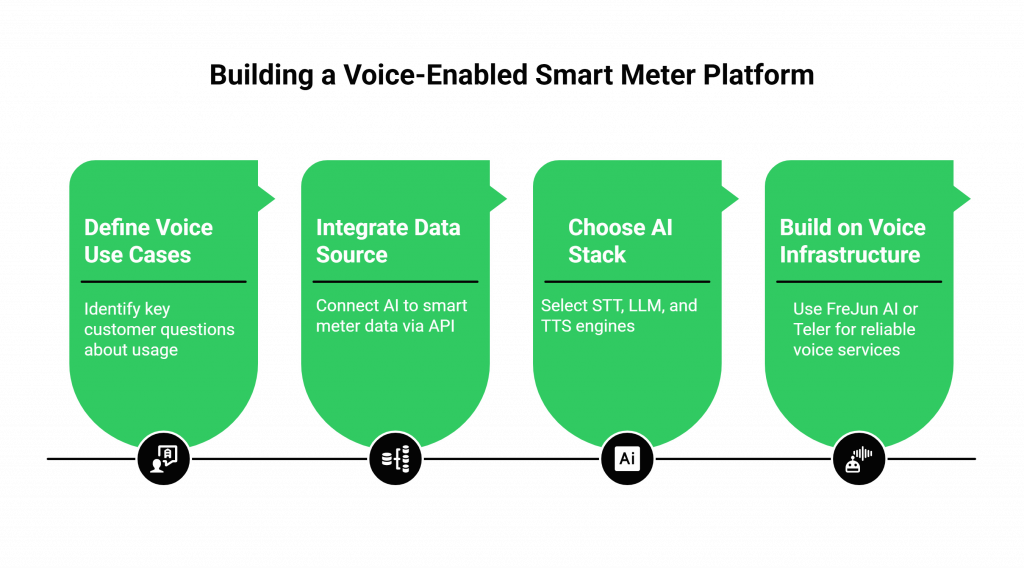
- Define Your Voice Use Cases: Start by identifying the top 2-3 questions that your customers have about their usage. This will be the initial focus of your AI’s capabilities.
- Integrate Your Data Source: The AI needs access to the smart meter data. This involves using a secure API to connect your voice platform to your Meter Data Management (MDM) system or your customer billing platform.
- Choose Your AI Stack: You will need the core components of conversational AI: a Speech-to-Text (STT) engine, a Large Language Model (LLM), and a Text-to-Speech (TTS) engine.
- Build on a Reliable Voice Infrastructure: The intelligence of your AI is only effective if the conversation is clear, instant, and secure. This is the essential role of FreJun AI.
FreJun AI or Teler provide the enterprise-grade “plumbing” that handles the complex telephony and real-time, low-latency audio streaming. Our model-agnostic platform gives you the freedom to choose the best AI models for your specific needs. We handle the complex voice infrastructure so you can focus on building your AI.
Also Read: Voice AI For Emergency Response Centers
Conclusion
The smart meter is a gateway to a more efficient and responsive energy grid, but its true potential can only be unlocked when the data it collects is turned into meaningful, actionable information for the end consumer. The traditional methods of sharing this data are failing to engage customers.
A voice API for developers provides the critical missing link. It is the tool that allows utility companies to transform their vast reservoirs of smart meter data into personalized, proactive, and helpful conversations.
By adopting this technology, utilities can build a smarter grid and, just as importantly, a smarter and more trusting relationship with the communities they serve.
Want to discuss how a voice API can be tailored to your specific smart meter platform and customer engagement goals? Schedule a demo for FreJun Teler.
Also Read: UK Mobile Code Guide for International Callers
Frequently Asked Questions (FAQs)
It is a programming toolkit that allows a utility company to build custom voice applications that can access smart meter data. It enables the creation of AI agents that can talk to customers over the phone to provide real-time usage information, process payments, and send proactive alerts.
A traditional IVR is a rigid, menu-based system (“press 1 for billing…”). A system built with a modern voice API for developers is conversational. A customer can speak naturally, and the AI will understand their request, making the experience much more intuitive.
Absolutely. Security is a top priority. FreJun AI builds its platform with enterprise-grade security, encrypts all communication, and handles sensitive customer data securely and confidentially.
The system can be integrated with your Customer Information System (CIS). It can use the customer’s Caller ID to automatically look up their account or can ask for a simple piece of verifying information, like a date of birth or a PIN.
Yes. A key benefit of a cloud-based voice infrastructure like FreJun AI is its massive scalability. It can automatically handle a huge, sudden spike in call volume without any degradation in performance.
No, it is a tool designed to make your agents more effective. The AI handles the high volume of simple, data-related inquiries. This frees up your human agents to focus on more complex issues, like financial assistance programs, service transfers, or technical support.
FreJun AI is not the AI model itself. We provide the foundational voice infrastructure—the “plumbing.” We are the experts in telephony and real-time, low-latency audio streaming. Our reliable, model-agnostic platform ensures that the conversations between your AI and your customers are always crystal clear.
With a modern, developer-first platform like FreJun AI, the time to market is significantly reduced. Your development team can use our SDKs and comprehensive documentation to build and test a functional prototype in a matter of weeks.