
We all know the sound. The generic, pre-recorded voice on the other end of the line, launching into a one-size-fits-all script about a product you do not want or an appointment you already remembered. This is the legacy of bulk calling: a blunt instrument of mass communication that prioritizes reach over relevance, and in doing so, has earned the universal disdain of its audience.
For businesses, this old model is a game of diminishing returns, where each call is more likely to damage their brand than to drive a conversion. But a new era of proactive communication is dawning, one powered by the fusion of a scalable voice API for bulk calling and the nuanced intelligence of AI.
The future of outbound voice is not about shouting the same message to a million people. It is about whispering a million different, perfectly tailored messages to a million individuals. This is the promise of ai personalization voice 2026 and beyond.
By leveraging a modern voice API for bulk calling, developers can now build sophisticated systems that do more than just dial numbers; they can initiate millions of unique, one-to-one conversations at scale.
This guide explores how this powerful duo is transforming outbound communication from an impersonal broadcast into a powerful engine for personalized engagement.
Table of contents
Why Did Traditional Bulk Calling Fail?
To appreciate the revolution, we must first diagnose the failure. The traditional “robocall” failed because it fundamentally disrespects the recipient’s time and context. It is a technology that is built on a foundation of assumptions, not intelligence. The core failures include:
- It is Entirely Impersonal: The same static, pre-recorded audio file is played to every single person, regardless of who they are or their history with your brand.
- It is Not Interactive: It is a one-way monologue. The system cannot understand or react to a user’s questions or responses, leading to a frustrating and dead-end experience.
- It Lacks Context: The traditional system has no connection to your CRM or other data sources. It does not know the customer’s name, their purchase history, or their preferred language.
- It is Incredibly Inefficient: Because the message is generic and cannot handle interaction, the vast majority of these calls result in a hang-up, achieving nothing but annoying a potential customer.
What is a Modern Voice API for Bulk Calling?
A modern voice API for bulk calling is not just a high-volume dialer; it is a programmable, cloud-native communication platform. It is a developer’s toolkit that provides the fundamental building blocks to initiate, manage, and add intelligence to a massive number of outbound calls simultaneously.
Unlike a closed, hardware-based auto-dialer, an API-first platform provides a set of commands that a developer’s application can use to control the entire calling process. This programmability is the key that unlocks the door to personalization. It transforms the outbound call from a static event into a dynamic, software-driven workflow, allowing for the creation of dynamic voice content that can be tailored to each individual recipient.
Also Read: How Do You Measure Success After Building Voice Bots? Which KPIs Matter?
How Does AI Enable True Personalization at Scale?
The voice API for bulk calling provides the “voice” and the “reach.” The Artificial Intelligence provides the “brain.” By integrating an AI, typically a Large Language Model (LLM), into the call workflow, you can create a system that crafts a unique conversation for every single person on your list.
From Static Recordings to Dynamic Voice Content
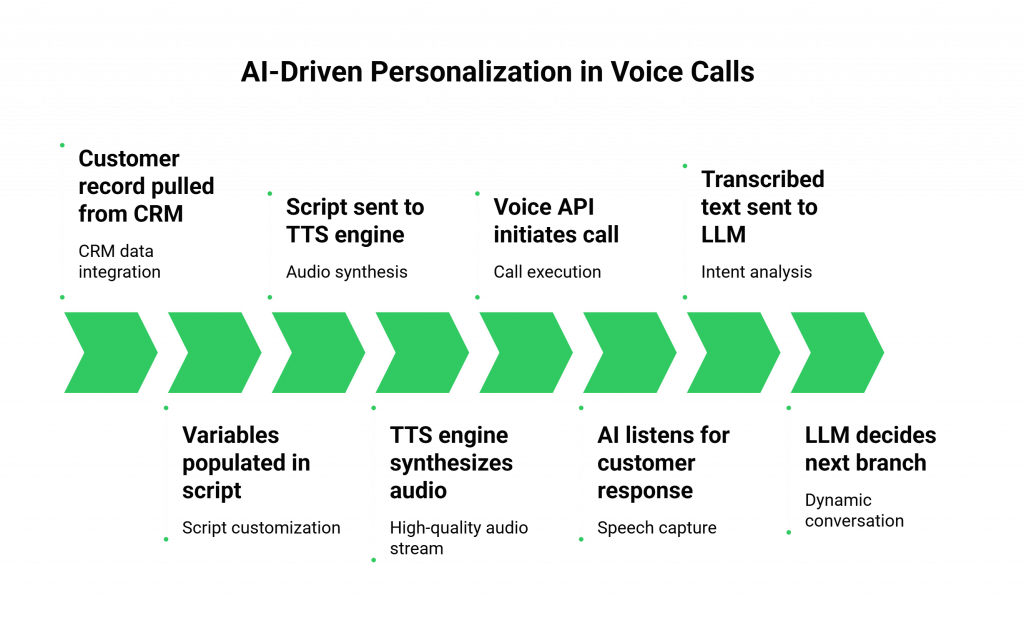
This is the most fundamental shift. Instead of a single, pre-recorded audio file, you start with a text-based script that is filled with variables.
- Your application pulls a customer’s record from your CRM.
- It uses this data to populate the variables in your script (e.g., [Customer_Name], [Last_Product_Purchased], [Appointment_Time]).
- Just before the call is made, this unique, text-based script is sent to a Text-to-Speech (TTS) engine.
- The TTS engine synthesizes a high-quality, natural-sounding audio stream that is specific to that one customer.
- The voice API for bulk calling then initiates the call and plays this custom-generated audio.
This allows you to go from “Hello, valued customer” to “Hello, Sarah. This is a reminder about your 10:30 AM appointment tomorrow for your Toyota Camry.” This level of personalization is no longer a luxury; it is an expectation. A recent report from McKinsey found that 71% of consumers expect companies to deliver personalized interactions.
The Power of Adaptive Calling
True intelligence goes beyond just speaking a personalized script; it involves listening and reacting. This is the concept of adaptive calling.
- The Workflow: After the AI speaks its initial personalized message, it listens for the customer’s response. The customer’s speech is captured by the voice platform and sent to a Speech-to-Text (STT) engine.
- The Intelligence: This transcribed text is then sent to your LLM. The LLM can understand the customer’s intent. Did they say “Yes,” “I need to reschedule,” or “Can you tell me more?”
- The Dynamic Path: Based on this intent, the LLM can then decide on the next branch of the conversation, generating a new, relevant response. This creates a true, interactive dialogue, not a monologue.
Also Read: How Do You Integrate LLMs When Building Voice Bots For Real-Time Calls?
This table showcases some real-world applications of this powerful technology.
| Use Case | How is AI Personalization Applied? | Business Impact |
| Healthcare Appointment Reminders | Uses the patient’s name, appointment time, and doctor’s name. The AI can understand and process a request to reschedule. | Drastically reduces costly patient no-shows and frees up administrative staff from making manual reminder calls. |
| Proactive Service Outage Alerts | Calls customers in a specific geographic area, addressing them by name and providing the estimated time of restoration for their specific neighborhood. | Reduces inbound call volume to the contact center during a crisis and improves customer satisfaction by providing proactive information. |
| Personalized Marketing & Promotions | The AI can mention a customer’s past purchases and offer a promotion on a related product. It can understand if the customer is interested. | Significantly increases conversion rates compared to a generic marketing blast and provides a more engaging brand experience. |
| Smart Delivery Notifications | The AI can call a customer when a driver is approaching their address and offer real-time options like “Leave with a neighbor” if they are not home. | Reduces the high cost of failed delivery attempts and provides a premium, convenient experience for the customer. |
Ready to transform your outbound communication from a monologue into a dialogue? Sign up for FreJun AI
What Technical Foundation is Required for AI-Driven Personalization?
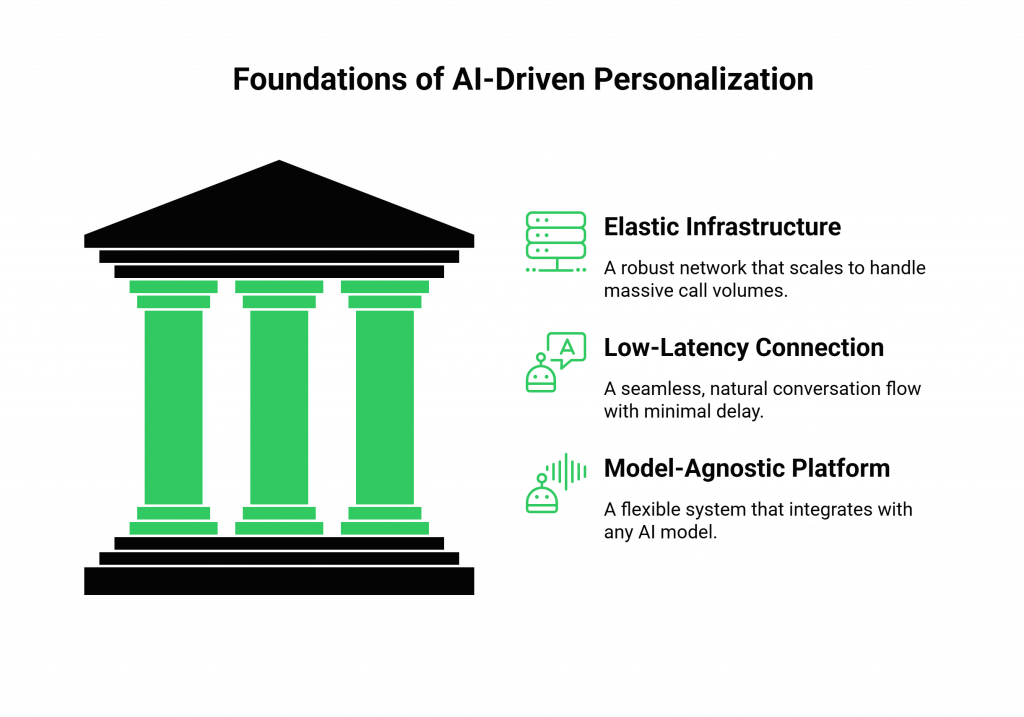
To build a system that can handle thousands of simultaneous, intelligent, and low-latency conversations, you need an infrastructure that is designed for it from the ground up.
An Elastic, Scalable Infrastructure
The “bulk” in voice API for bulk calling is a serious technical challenge. You need a platform built on the principles of elastic SIP trunking. A provider like FreJun AI has a globally distributed, cloud-native infrastructure that can automatically scale to handle a massive, sudden surge in outbound calls without any drop in quality.
A Low-Latency Connection
For adaptive calling to work, the conversation must feel natural. The round-trip, from the user speaking to your AI responding must happen in a fraction of a second. This requires a voice platform that is obsessively optimized for low latency, with an edge-native architecture that processes the call as close to the end-user as possible.
A Flexible, Model-Agnostic Platform
The world of AI is moving incredibly fast. A new, more powerful LLM or a more natural-sounding TTS engine is released every few months. A key feature of a future-proof platform is being model-agnostic. FreJun AI’s platform is designed to be a flexible bridge.
We provide the high-performance voice infrastructure, and you have the complete freedom to integrate the best-in-class AI models from any provider you choose. This is the core of our philosophy: “We handle the complex voice infrastructure so you can focus on building your AI.”
Also Read: Why Should Businesses Invest In Building Voice Bots, Not Just Chatbots?
Conclusion
The era of the impersonal, one-size-fits-all robocall is over. The future of proactive business communication is one of intelligent, helpful, and deeply personalized engagement at scale. The fusion of a powerful, developer-first voice API for bulk calling with the conversational intelligence of modern AI is the engine that is driving this transformation.
By embracing this new paradigm of adaptive calling and dynamic voice content, businesses can do more than just improve their operational efficiency; they can build stronger, more trusting, and more valuable relationships with every single customer they call.
Want to do a deep dive into the architecture and see how our voice API can power your specific personalized calling campaign? Schedule a demo for FreJun Teler.
Also Read: IVR Software & Call Automation: How Smart Routing Increases Efficiency
Frequently Asked Questions (FAQs)
It is a programmable interface that allows a developer’s application to initiate and manage a large number of outbound phone calls simultaneously and automatically.
Adaptive calling is when an AI voicebot dynamically changes its conversation path based on the user’s real-time verbal responses and expressed intent.
It uses Text-to-Speech (TTS) technology. Instead of a pre-recorded file, it synthesizes unique audio for each call using a script with personalized data.
With modern, natural-sounding TTS voices and a low-latency connection, the experience can be very human-like. Transparency is a best practice; you can choose to disclose this.
The main benefit is a massive increase in customer engagement and conversion rates compared to a generic, one-size-fits-all message.
No. A modern, developer-first voice API for bulk calling abstracts away the telecom complexity. If a developer can work with standard web APIs, they can build this.
Yes. By integrating with advanced, multilingual Speech-to-Text (STT) models, the system can be configured to understand a wide variety of languages and accents.