
In the modern experience economy, data is the lifeblood of improvement. Businesses are in a constant race to understand their customers better, to know what they loved about a recent purchase, what frustrated them about a service interaction, and what they think about a new product.
The traditional method for gathering this feedback has been the email survey. But in a world of overflowing inboxes and declining open rates, the email survey is a tool that is rapidly losing its effectiveness. It is a passive, asynchronous, and low-engagement channel in a world that demands an immediate and personal connection.
This is where a modern voice API for bulk calling emerges as a powerful and transformative tool. By enabling businesses to automate the process of making thousands of personalized, interactive phone calls, this technology transforms feedback collection from a passive, low-response-rate activity into an active, engaging, and real-time conversation.
This is more than just a new way to send a survey; it is a fundamental shift in how businesses can listen to their customers at scale, enabling a new era of automated customer outreach and mass notification API driven insights.
Table of contents
The Problem: Why is Traditional Feedback Collection Broken?
The email or SMS survey is the workhorse of modern feedback collection, but it is a tired and overburdened one. The system is plagued by a number of fundamental flaws that limit its effectiveness and the quality of the data it produces.
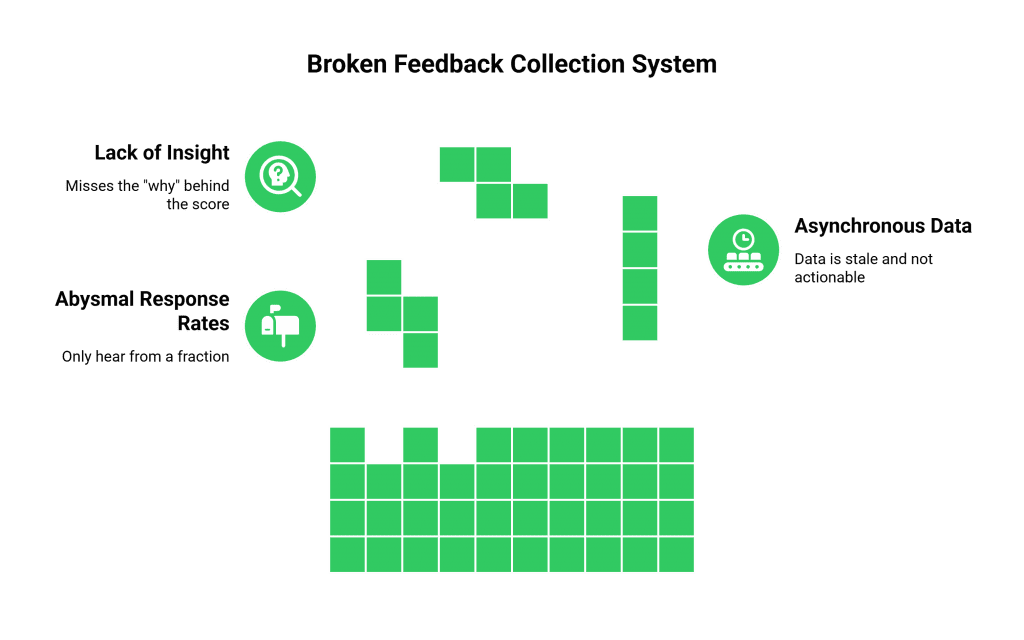
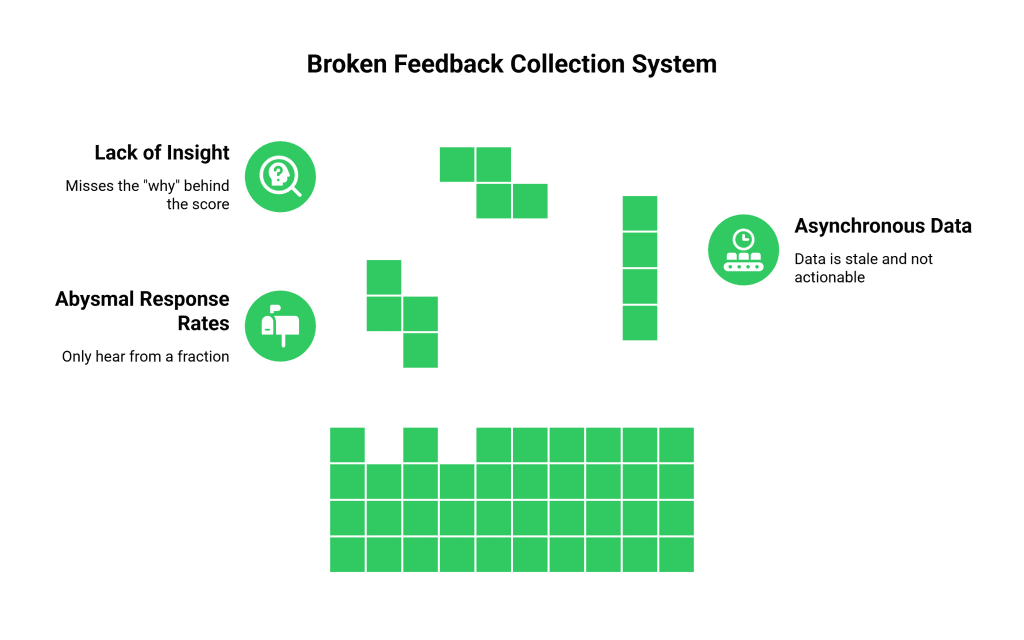
The Challenge of Abysmal Response Rates
This is the single biggest problem.
- Inbox Overload: The average office worker receives over 120 emails per day. A survey request from a business is just another drop in this overwhelming flood, and it is very easy to ignore or delete.
- Low Engagement: An email survey is a one-way, non-interactive experience. It requires the customer to stop what they are doing, click a link, and fill out a form. This friction leads to incredibly low response rates, often in the single digits. This means you are only hearing from a tiny, and likely unrepresentative, fraction of your customer base.
Also Read: How Do You Measure Success After Building Voice Bots? Which KPIs Matter?
The Lag of Asynchronous Data
The data that does come in from email surveys trickles in over a period of days or even weeks. This “stale” data is useful for historical analysis, but it is not actionable in real-time. You cannot use it to immediately address a customer’s frustration or to capitalize on a moment of delight.
The Lack of Rich, Qualitative Insight
Most email surveys rely on simple, multiple-choice or 1-to-5 scale questions because they are easy to answer. This provides quantitative data, but it often misses the “why” behind the score. Open-ended text fields are often left blank, robbing you of the rich, qualitative feedback that is essential for true understanding.
How Does a Voice API for Bulk Calling Revolutionize Feedback?
A voice API for bulk calling allows a business to build an automated system that can place thousands of outbound calls simultaneously and have a simple, interactive, and conversational exchange with each customer. This is not a blunt, one-way “robocall”; it is an intelligent, AI-powered survey agent.
The Power of an Active, Conversational Approach
The fundamental difference is that a phone call is an active medium. It commands attention in a way that an email cannot. The customer does not have to click a link; they simply have to answer the phone and talk.
- The Workflow: Imagine a customer has just had a product delivered. An hour later, an AI-powered agent calls them. A friendly, natural-sounding voice says, “Hi, this is a quick feedback call from Acme Corp. We see your order was just delivered. On a scale of 1 to 5, how would you rate your delivery experience?” The customer can respond by pressing a key (“5”) or by simply saying “Five.”
- Capturing the “Why”: The AI can then ask an open-ended follow-up question: “That’s great to hear! Could you tell me in a few words what made the experience a positive one?” The system can then record and transcribe this spoken, qualitative feedback.
The Engine of Real-Time Data Collection
This automated approach provides a stream of real-time feedback data. You can see the results of your survey on a live dashboard as they come in, not days later. This allows you to:
- Instantly Identify Service Failures: If a series of low scores starts coming in from a particular delivery route, you can identify and address the problem with that driver or route in real-time.
- Capitalize on Positive Experiences: If a customer gives a glowing verbal review, you can automatically flag that recording for your marketing team to use as a testimonial (with permission).
This table highlights the dramatic differences between the two feedback collection models.
| Feature | Traditional Email/SMS Survey | Voice API for Bulk Calling Survey |
| Engagement Model | Passive and asynchronous. | Active, conversational, and real-time. |
| Response Rates | Very low (often <10%). | Significantly higher, as it’s an active outreach. |
| Data Timeliness | Data trickles in over days/weeks. | Data is available on a live dashboard in real-time. |
| Qualitative Feedback | Poor; open-ended text fields are often skipped. | Rich; captures the customer’s actual voice and tone. |
| Urgency | Low; the survey can be completed at any time. | High; the call creates a moment of immediate engagement. |
Ready to transform your feedback process from a passive chore into an active, real-time conversation? Sign up for FreJun AI
Also Read: How Do You Integrate LLMs When Building Voice Bots For Real-Time Calls?
How Do You Build a Voice-Based Feedback System?
Building an automated feedback system with a voice API for bulk calling is a logical, API-driven process that can be accomplished by any competent development team.
The Key Architectural Components
The system is a powerful interplay between your business logic and the voice platform.
- The Trigger: This is the event in your business system that initiates the feedback call. It could be a “delivery completed” status in your logistics software or a “support ticket closed” event in your CRM.
- Your Application (The “Brain”): When the trigger occurs, your application’s code is responsible for making an API call to the voice platform to start the outbound call. Your application will also contain the logic for the survey questions.
- The Voice Platform (The “Mouth and Ears”): This is the role of a provider like FreJun AI. Our platform receives your API command, places the call using our mass notification API, plays your questions, listens for the customer’s response (either DTMF tones or speech), and then sends that response back to your application via a webhook.
The Importance of a Developer-First Platform
To build this kind of dynamic, AI powered phone survey system, you need more than just a provider that can make calls. You need a developer-first platform like FreJun AI.
- Robust APIs and Webhooks: Our entire platform is built around a clean, well-documented API and a real-time webhook system, giving you the granular control you need to orchestrate a complex survey flow.
- Scalability and Reliability: Our Teler engine is a carrier-grade, globally distributed infrastructure. It can handle the massive scale of making tens of thousands of simultaneous calls for a large-scale feedback campaign with unwavering reliability.
Also Read: Why Should Businesses Invest In Building Voice Bots, Not Just Chatbots?
Conclusion
In the competitive landscape of the modern economy, the businesses that win are the ones that listen to their customers most effectively. The old, passive methods of feedback collection are no longer sufficient. They provide a slow, incomplete, and often-inaccurate picture of the customer experience.
A voice API for bulk calling offers a powerful and modern alternative. It allows businesses to move from passively waiting for feedback to actively and conversationally requesting it.
By creating an engaging, real-time, and scalable feedback loop, this technology provides the rich, immediate, and actionable data that is essential for continuous improvement and for building a truly customer-centric organization.
Want to do a deep dive into our mass notification API and see how you can build an automated feedback system in a matter of hours? Schedule a demo for FreJun Teler.
Also Read: IVR Software & Call Automation: How Smart Routing Increases Efficiency
Frequently Asked Questions (FAQs)
It is a programming interface that allows a developer to write code that can automatically initiate a large number of outbound phone calls simultaneously.
A simple robocall is a one-way, pre-recorded message. A system built with a modern voice API for bulk calling is interactive. It can ask questions, listen for a user’s response (either a key press or spoken words), and then change its behavior based on that input, creating a two-way conversation.
While it varies by industry and customer base, response rates for voice surveys are typically significantly higher than for email surveys because a phone call is an active, real-time engagement that is harder to ignore than an email.
The voice platform uses a Speech-to-Text (STT) engine to transcribe the user’s spoken response into written text. This text, along with a recording of the audio, is then passed back to your application for analysis.
It is far more cost-effective than having human agents make the calls. A cloud-based voice platform with a pay-as-you-go pricing model makes automated customer outreach very affordable, as you only pay for the minutes you actually use.
A mass notification API is a specialized voice API. It supports large-scale and reliable message delivery. It sends one message or interactive survey to many recipients. Teams use it for emergency alerts or broad feedback campaigns.
Yes. By integrating with multilingual Text-to-Speech (TTS) and Speech-to-Text (STT) engines, the system can be configured to conduct surveys in dozens of different languages.