
Delivering seamless, automated, and personalized customer interactions is no longer optional. Companies struggle to manage fragmented channels, leading to inefficiencies and inconsistent experiences. By integrating voice APIs with AI-driven agents, organizations can unify communication, automate repetitive tasks, and scale intelligently across voice, chat, and email. This approach ensures a consistent, context-aware conversation at every touchpoint. Cross-channel automation not only reduces operational costs but also enhances customer satisfaction.
For founders, product managers, and engineering leads, understanding how to implement API-driven, omnichannel voice solutions is critical for future-ready business growth.
Why Should Businesses Care About Voice APIs Today?
Communication spans multiple channels, including phone calls, chat, emails, and web applications. Despite this, many organizations struggle to maintain consistency and efficiency. Fragmented systems lead to slow responses, duplicated work, and a disjointed customer experience.
This is where voice APIs become crucial. By providing a programmable interface to telephony systems, businesses can unify communication, automate repetitive tasks, and enable intelligent interactions across channels.
According to Genesys research, nearly 97% of consumers prioritize a seamless omnichannel experience and expect effortless transitions across communication channels, highlighting why integrated voice APIs are essential.
Moreover, modern voice agents are no longer simple call handlers. They are AI-driven conversational agents powered by a combination of:
- Language understanding models for interpreting queries
- Text-to-speech (TTS) engines for natural-sounding responses
- Speech-to-text (STT) systems to capture user input
- Retrieval-Augmented Generation (RAG) for accessing knowledge bases
- Tool calling to integrate workflows and external systems
Together, these components enable a truly intelligent voice agent that can handle complex interactions without human intervention. For businesses, this means higher operational efficiency and more personalized customer experiences.
In addition, adopting a voice API allows organizations to implement cross-channel automation, where the same AI agent can interact with users across multiple platforms seamlessly.
What Exactly Is A Voice API And How Does It Work?
At its core, a Voice API is a programmable interface that connects business applications with telephony networks. Unlike traditional PBX systems, a Voice API allows developers to embed voice capabilities into applications, automate call flows, and integrate AI-driven processing.
Core Capabilities of Voice APIs
| Capability | Description | Business Impact |
| Real-Time Voice Calls | Initiate, receive, and manage phone calls programmatically | Streamlines customer outreach and inbound support |
| Speech-to-Text (STT) | Converts voice input into text | Enables automated transcription, analysis, and routing |
| Text-to-Speech (TTS) | Converts text responses to natural-sounding audio | Facilitates automated notifications and responses |
| Call Routing | Programmatically redirect calls based on context | Ensures the right agent or system handles each interaction |
| Analytics Integration | Captures call metadata, duration, and interactions | Enables monitoring and continuous optimization |
By leveraging these capabilities, businesses can implement API-driven communication that scales across departments and geographies.
Additionally, Voice APIs are essential for modern omnichannel voice flow. They allow AI agents to maintain context across interactions, ensuring that a conversation started on a website or chat can seamlessly continue over a phone call.
How Can Voice APIs Enable Cross-Channel Automation?
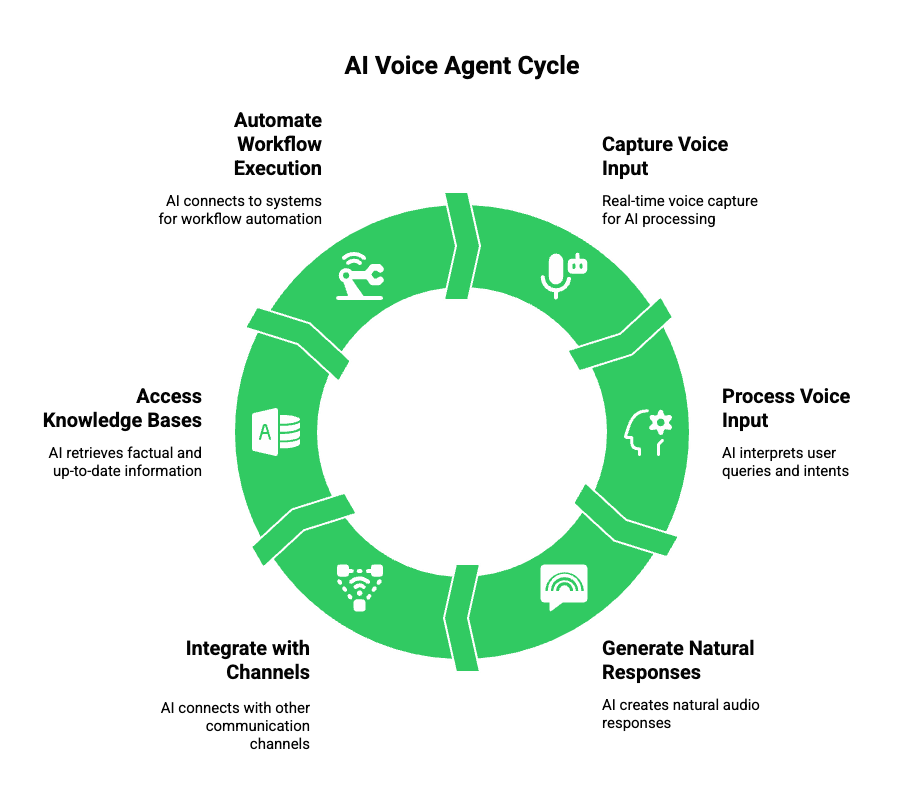
Cross-channel automation refers to the ability of a single system or agent to handle interactions across multiple channels without losing context or consistency. Voice APIs are pivotal in this because they:
- Capture real-time voice input and send it to AI processing engines.
- Enable AI agents to generate natural responses via TTS and send them back over the call.
- Integrate with other communication channels like chatbots, email, and CRM systems.
Building an AI Voice Agent
A modern AI voice agent typically consists of several technical components:
- Language Understanding Model
- Interprets user queries and intents.
- Allows dynamic response generation based on context.
- Interprets user queries and intents.
- Text-to-Speech (TTS) Engine
- Converts AI responses into natural audio.
- Supports multiple languages and voice personas.
- Converts AI responses into natural audio.
- Speech-to-Text (STT) Engine
- Converts user speech into structured text.
- Ensures high accuracy even in noisy environments.
- Converts user speech into structured text.
- Retrieval-Augmented Generation (RAG)
- Accesses knowledge bases or external data sources.
- Enhances response quality with factual and up-to-date information.
- Accesses knowledge bases or external data sources.
- Tool Calling
- Connects the agent to CRM, databases, or ticketing systems.
- Automates workflow execution without human intervention.
- Connects the agent to CRM, databases, or ticketing systems.
Together, these components form a robust cross-channel automation system. For instance, a customer who starts a query via a web chatbot can continue the conversation over a voice call without repeating information.
Furthermore, Voice APIs provide low-latency streaming, which is critical for ensuring real-time, human-like conversations. Without this, delays can disrupt conversational flow and degrade the user experience.
What Are The Key Benefits Of Voice API For Businesses?
Implementing a Voice API brings measurable benefits. Below are the primary advantages:
1. Enhanced Customer Experience
- 24/7 Availability: AI agents handle routine queries outside business hours.
- Personalization: Agents can tailor responses based on user history and context.
- Seamless Omnichannel Flow: Maintains conversation continuity across platforms.
2. Operational Efficiency
- Automates repetitive tasks such as appointment reminders, payment notifications, and lead qualification calls.
- Reduces the workload on human agents, allowing them to focus on complex or high-value tasks.
- Minimizes human error and ensures consistent responses.
3. Unified Voice Experience
- Centralizes call data and interaction history across channels.
- Supports cross-channel automation, where AI agents can maintain state across voice, chat, and email.
- Provides actionable insights into customer interactions for product and service improvement.
4. Cost Savings And Scalability
- Eliminates the need for extensive on-premises telephony infrastructure.
- Scales interactions without adding headcount.
- Flexible pay-as-you-go models reduce operational overhead.
In addition to internal efficiency, these benefits extend across multiple industries, showing how Voice APIs can transform sector-specific processes.
How Do Voice APIs Impact Different Industries?
Voice APIs are versatile and can enhance operations in various sectors.
Healthcare
- Automate patient appointment reminders.
- Enable telemedicine interactions with AI-driven pre-screening.
- Improve patient follow-up and compliance monitoring.
Retail And E-Commerce
- Provide automated order updates and delivery notifications.
- Offer personalized shopping assistance using AI voice agents.
- Conduct post-purchase surveys and feedback collection.
Finance And Banking
- Automate balance inquiries and transaction alerts.
- Support fraud detection notifications.
- Execute routine customer follow-ups and onboarding.
Logistics And Supply Chain
- Notify customers about delivery schedules and delays.
- Communicate routing changes to drivers in real-time.
- Track shipments and manage exception handling with AI support.
Table Example: Cross-Industry Voice API Applications
| Industry | Use Case | Benefit |
| Healthcare | Appointment reminders | Reduced no-shows, higher patient satisfaction |
| Retail | Automated order notifications | Improved engagement, reduced support calls |
| Finance | Fraud alerts | Faster action, enhanced security |
| Logistics | Delivery updates | Reduced missed deliveries, real-time transparency |
While these implementations demonstrate the potential of Voice APIs, businesses seeking to integrate LLM-powered AI agents require a specialized infrastructure to handle real-time voice, context management, and low-latency streaming.
Why Is FreJun Teler Ideal For Building AI Voice Agents?
For organizations aiming to implement AI-driven voice agents across channels, FreJun Teler offers a unique solution.
- Global Voice Infrastructure: Handles inbound and outbound calls over any cloud telephony or VoIP network.
- Real-Time Low-Latency Streaming: Ensures conversations feel natural and human-like, without awkward delays.
- Model-Agnostic: Works with any LLM, AI model, TTS, and STT solution.
- Context Management: Maintains conversational state across channels, enabling true omnichannel voice flow.
- Developer-Friendly SDKs: Available for web, mobile, and backend integration, allowing fast and flexible implementation.
By combining AI logic with Teler’s voice infrastructure, businesses can achieve cross-channel automation, unified voice experiences, and API-driven communication that competitors offering only traditional telephony cannot match.
How Should Businesses Implement Voice APIs Effectively?
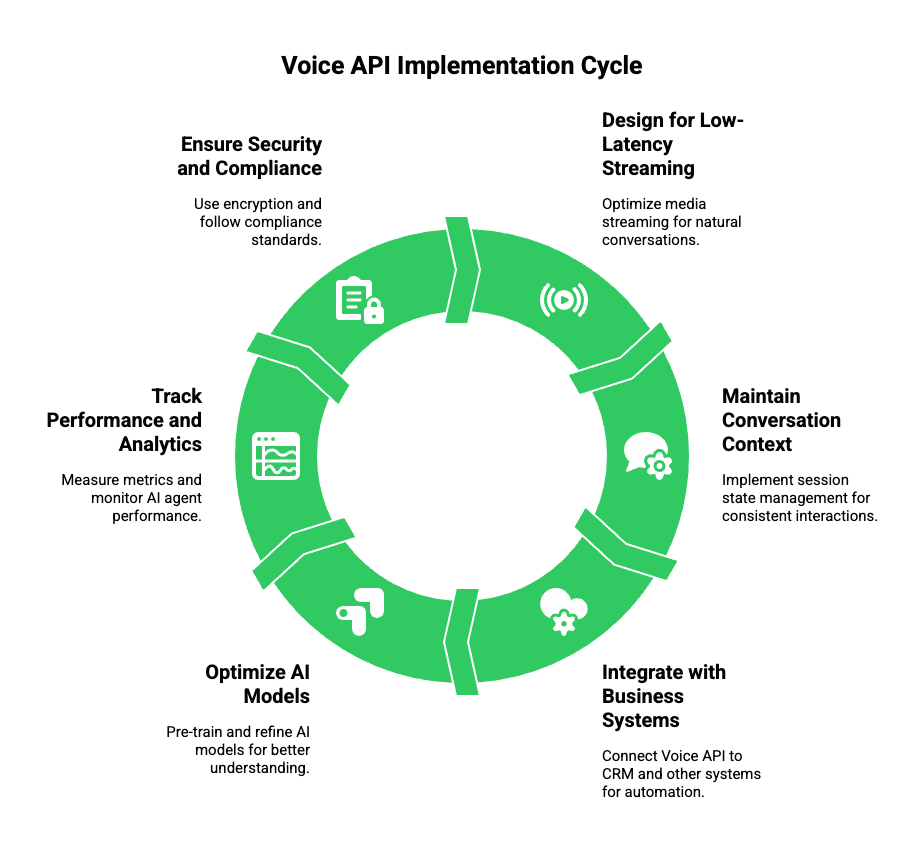
Implementing a Voice API goes beyond just connecting systems. It requires a thoughtful approach to technical architecture, integration, and workflow orchestration. Below are best practices that ensure cross-channel automation and unified voice experiences:
1. Design For Low-Latency Streaming
- Use WebRTC or equivalent real-time media streaming protocols.
- Minimize buffering to ensure natural conversation flow.
- Optimize encoding and packet handling to reduce network-induced delays.
2. Maintain Conversation Context
- Implement session state management for each user interaction.
- Use context IDs that persist across voice, chat, and email channels.
- Integrate with backend knowledge bases to provide accurate, consistent responses.
3. Integrate With Existing Business Systems
- Connect the Voice API to CRM, ERP, or ticketing systems.
- Automate tasks like lead qualification, order tracking, and customer feedback collection.
- Ensure workflow orchestration supports tool calling, so AI agents can trigger actions in external applications.
4. Optimize AI Models For Natural Conversations
- Pre-train models with domain-specific datasets for better understanding.
- Use TTS engines capable of expressing appropriate intonation and emphasis.
- Continuously monitor user interactions and refine model responses to reduce misinterpretation.
5. Track Performance And Analytics
- Measure metrics such as call duration, resolution time, and fallback frequency.
- Implement dashboards for real-time monitoring of AI agent performance.
- Use analytics to identify bottlenecks and optimize cross-channel workflows.
6. Ensure Security And Compliance
- Use encryption for voice data both in transit and at rest.
- Follow regional and industry-specific compliance standards (HIPAA, PCI DSS, GDPR).
- Implement access controls and audit trails to protect sensitive information.
By following these practices, businesses can fully leverage API-driven communication while maintaining operational efficiency and delivering a superior customer experience.
What Are Some Advanced Technical Considerations?
For engineering teams and product managers, several technical considerations are critical when designing cross-channel voice automation:
Real-Time Media Handling
- Bidirectional streaming: Simultaneous transmission of audio to the AI and playback from TTS responses.
- Echo cancellation and noise suppression: Crucial for clear voice recognition in noisy environments.
- Adaptive bitrate streaming: Adjusts quality based on network conditions, ensuring uninterrupted interaction.
Contextual Orchestration
- Use session tokens or conversation IDs to track state across channels.
- Employ RAG frameworks to fetch data dynamically from knowledge bases or APIs.
- Ensure fallback logic is in place for unrecognized inputs, routing to human agents if necessary.
Multi-Model Integration
- Support model-agnostic AI integration, allowing businesses to plug in preferred LLMs or proprietary models.
- Combine multiple TTS voices for multilingual or multi-persona experiences.
- Implement real-time switching between AI models based on query type, complexity, or user preference.
Monitoring And Reliability
- Maintain logs for audio streams, API requests, and agent responses.
- Implement automatic retry mechanisms for failed API calls.
- Use geographically distributed infrastructure to minimize latency and ensure high availability.
These considerations not only enhance the unified voice experience but also ensure that AI agents remain scalable, reliable, and ready for omnichannel voice flow.
How Can Businesses Leverage Voice APIs For Omnichannel Voice Flow?
Omnichannel voice flow means the same AI agent can handle interactions seamlessly across multiple channels while maintaining context. Voice APIs make this possible by providing:
- Consistent session management across voice, chat, and email.
- Programmable call routing that connects users to the right channel or agent.
- Integrated analytics to provide insights across all channels.
Example Workflow: Customer Support
- Customer initiates a support query via web chat.
- AI agent captures context and offers solutions in real-time.
- Customer prefers a phone call; the system routes the session seamlessly using the Voice API.
- AI continues the conversation with full awareness of the chat history.
- Interaction concludes, and logs are automatically synced with CRM.
Benefits of Omnichannel Voice Flow:
- Reduces repetitive queries for customers.
- Improves first-call resolution and response accuracy.
- Enables personalized and context-aware interactions.
What Are The Future Trends In Cross-Channel AI Voice Automation?
Voice APIs and AI-driven voice agents are evolving rapidly. Businesses planning for long-term investment should consider:
1. Predictive Automation
- AI agents will anticipate customer needs based on historical patterns.
- Automated proactive notifications and recommendations across channels.
2. Multimodal Interactions
- Integrating voice with visual interfaces, AR/VR, and IoT devices.
- Customers can switch between modalities seamlessly.
3. Advanced Context Retention
- AI agents will maintain long-term conversation memory.
- Enables highly personalized and adaptive interactions across campaigns.
4. Industry-Specific Voice Solutions
- Finance: AI-driven advisory calls or fraud detection notifications.
- Healthcare: Multichannel patient engagement and telehealth automation.
- Retail: Personalized shopping and recommendation calls, automated upselling.
Keeping these trends in mind allows businesses to future-proof their cross-channel automation strategies, ensuring that investments in Voice APIs continue to deliver value.
How Can Businesses Measure The Success Of Voice API Implementation?
Monitoring performance is key to proving ROI and optimizing operations. Metrics include:
- Call Handling Efficiency: Number of automated calls handled vs. escalated to human agents.
- Response Accuracy: Rate of correct AI-generated responses and reduced fallback incidents.
- Customer Satisfaction: Survey results, Net Promoter Score (NPS), or CSAT metrics.
- Cross-Channel Consistency: Ability to maintain context and conversation state across channels.
- Operational Savings: Reduction in agent hours and telephony costs.
Businesses should combine these metrics with real-time dashboards to monitor AI agent performance and identify areas for continuous improvement.
How Can Businesses Get Started With Voice APIs Today?
Implementing a Voice API does not need to be complex. Here is a recommended approach for founders, product managers, and engineering leads:
- Define Business Goals
- Identify areas where automation can improve efficiency, CX, or cost savings.
- Identify areas where automation can improve efficiency, CX, or cost savings.
- Select AI Models and Voice Services
- Choose LLMs for language understanding and TTS/STT engines for natural interactions.
- Choose LLMs for language understanding and TTS/STT engines for natural interactions.
- Integrate With Voice API
- Connect AI agents to telephony infrastructure using a scalable, model-agnostic Voice API.
- Connect AI agents to telephony infrastructure using a scalable, model-agnostic Voice API.
- Design Cross-Channel Workflows
- Map interactions across voice, chat, and email.
- Ensure context retention and fallback handling.
- Map interactions across voice, chat, and email.
- Monitor, Optimize, and Scale
- Use analytics to refine AI responses, optimize call flows, and scale deployments.
- Use analytics to refine AI responses, optimize call flows, and scale deployments.
Tip: Choosing a voice API platform that supports omnichannel voice flow and API-driven communication simplifies implementation and reduces development overhead.
Conclusion
Implementing voice APIs enables businesses to achieve cross-channel automation, unified voice experiences, and API-driven communication. By combining LLMs, STT/TTS engines, and workflow integrations, organizations can automate routine interactions, maintain conversation context, and deliver human-like experiences at scale. This technology not only improves efficiency and customer satisfaction but also provides actionable insights for continuous optimization.
Platforms like FreJun Teler provide the infrastructure to seamlessly integrate AI voice agents with any model, ensuring low-latency, real-time interactions across channels. For businesses aiming to stay competitive, adopting Teler accelerates voice automation deployment while reducing operational complexity.
Schedule a demo today to transform your AI agents into scalable, omnichannel voice solutions.
FAQs –
- Q: What is a voice API, and why is it essential for business automation?
A: A voice API enables AI-driven calls, automates workflows, integrates across channels, and maintains unified conversation context. - Q: How does cross-channel automation improve customer experience?
A: It ensures seamless transitions across voice, chat, and email while preserving context and personalizing interactions for each customer. - Q: Can any AI model integrate with voice APIs?
A: Yes, model-agnostic APIs allow LLMs, STT, TTS, and proprietary AI models to connect without technical restrictions. - Q: How does voice API reduce operational costs?
A: By automating repetitive tasks, reducing agent load, and scaling without additional infrastructure, lowering overall communication expenses. - Q: What industries benefit most from AI voice automation?
A: Healthcare, retail, finance, logistics, and service industries see efficiency, customer satisfaction, and personalization gains. - Q: How do voice APIs maintain conversation continuity?
A: Through session management, context tracking, and synchronized data across channels, enabling a seamless customer journey. - Q: Are there security concerns when using voice APIs?
A: Secure APIs use encryption, access control, and compliance standards like HIPAA, GDPR, and PCI DSS for protection. - Q: How fast can businesses deploy AI voice agents?
A: With proper APIs and SDKs, agents can be live within days, significantly faster than traditional telephony systems. - Q: Can voice APIs integrate with existing business workflows?
A: Yes, APIs connect to CRMs, ticketing, databases, and workflow automation tools for end-to-end operational efficiency. - Q: How does analytics help optimize voice automation?
A: By monitoring response accuracy, call duration, and customer feedback, analytics improves performance and automates better decision-making.