
Bulk calling has changed significantly over the last few years. Earlier, the goal was simple: dial more numbers in less time. However, today’s expectations are very different. Businesses now want conversations, not just connections. They want to react while a call is live, personalize responses instantly, and control outcomes at scale. Because of this shift, many teams are rethinking how bulk calling systems are built.
This is where a voice API for bulk calling becomes critical. More importantly, when combined with real-time control, a voice API turns bulk calling into a dynamic, programmable system rather than a static process.
To understand why this matters, we first need to look at where traditional bulk calling systems struggle.
Why Is Bulk Calling Still Hard To Scale Reliably?
At first glance, bulk calling looks like a solved problem. Many platforms can place thousands of calls per minute. However, scale alone does not guarantee reliability or quality. In fact, as call volume increases, hidden issues become more visible.
In fact, over 70% of businesses globally now rely on VoIP for core communications, and analysts predict that by 2026, VoIP traffic will make up around 66% of all IP-based communication, underlining how pervasive internet-based calling has become for enterprise calling stacks.
Common challenges include:
- Call drops during peak traffic
- Delayed audio or one-way voice
- Fixed call scripts that cannot change mid-call
- Limited visibility until the call ends
- Manual handling of retries and failures
Because of these limitations, teams often lose control once calls are in progress. As a result, they only discover issues after customers have already had a poor experience.
Moreover, traditional dialers were designed for human agents, not automated or AI-driven conversations. They assume that logic is predefined and rarely changes during the call. Consequently, they struggle when calls need to react to live user input.
Therefore, scaling bulk calling today is not just about dialing faster. Instead, it is about managing thousands of live conversations at the same time.
What Is A Voice API And How Is It Different From Traditional Calling?
A voice API is a programmable interface that allows software applications to control phone calls. Instead of relying on fixed IVRs or manual agent workflows, developers can manage calls using code.
In simple terms, a voice API lets you:
- Start inbound or outbound calls
- Receive call events in real time
- Capture and stream audio
- Control call flow programmatically
- React instantly to what happens during a call
Unlike traditional calling systems, a voice API does not lock you into rigid call paths. Instead, it exposes call behavior as events and streams that your application can control.
Voice API vs Traditional Systems
| Capability | Traditional Dialer / IVR | Voice API |
| Call logic | Predefined scripts | Dynamic, code-driven |
| Mid-call changes | Not possible | Fully supported |
| Real-time audio | Limited or none | Live audio streaming |
| Integration | Hard-coded | API-based |
| Scalability | Manual tuning | Programmatic scaling |
Because of this flexibility, voice APIs are now the foundation for modern bulk calling platforms.
How Does A Voice API Enable Bulk Calling At Scale?
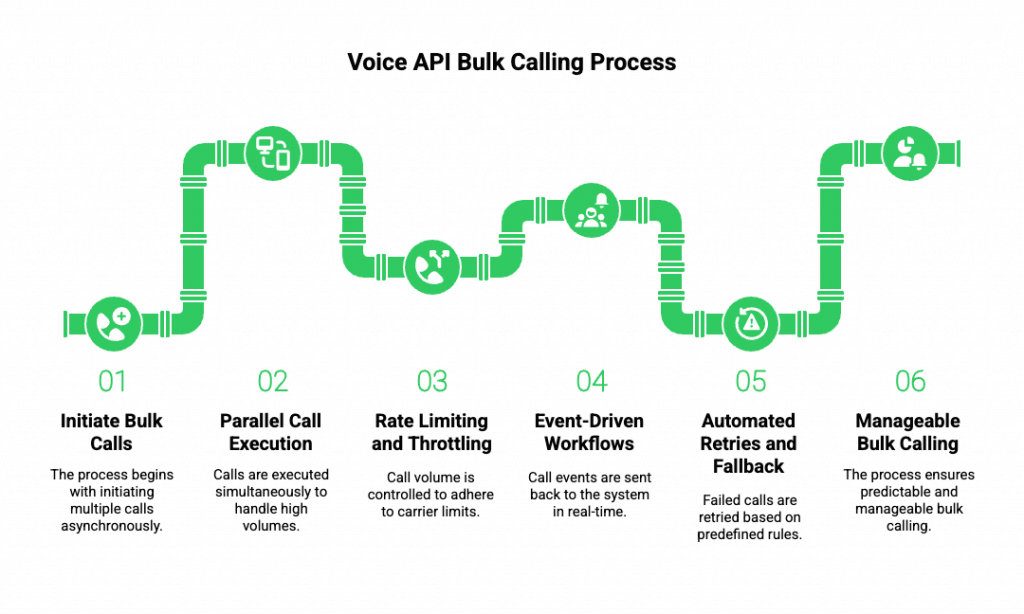
A voice API does not just place calls. Instead, it orchestrates them.
When bulk calling is built using APIs, each call becomes a managed session with its own lifecycle. This makes it possible to scale without losing control.
Key technical capabilities include:
- Parallel call execution
Multiple calls are initiated asynchronously, allowing thousands of calls to run at once. - Rate limiting and throttling
Call volume can be controlled to match carrier limits or business rules. - Event-driven workflows
Call events such as ringing, answered, failed, or ended are sent back to your system instantly. - Automated retries and fallback logic
Failed calls can be retried based on rules, time windows, or outcomes.
Because of this architecture, bulk calling becomes predictable and manageable, even at high volumes.
What Does Real-Time Control Mean In Bulk Calling?
Real-time control is the ability to observe and influence a call while it is still happening.
In traditional systems, most decisions are made before the call starts. Once the call is live, very little can change. However, with real-time control, this limitation disappears.
Real-time control allows systems to:
- Listen to live audio as the user speaks
- Make decisions within milliseconds
- Change call flow based on live input
- Route or escalate calls instantly
- Stop, pause, or transfer calls dynamically
Because decisions happen during the call, outcomes improve significantly.
Static Calling vs Real-Time Controlled Calling
| Aspect | Static Bulk Calling | Real-Time Control |
| Call logic | Fixed | Adaptive |
| User input | Limited | Fully processed |
| Monitoring | After call | During call |
| Personalization | Minimal | High |
| Error handling | Reactive | Proactive |
As a result, real-time control is no longer optional. It is essential for modern bulk calling.
Why Is Real-Time Media Streaming Critical For Voice APIs?
Real-time control is only possible when audio is streamed live. Without live media streaming, systems operate blindly until the call ends.
Real-time media streaming enables:
- Immediate speech capture
- Low-latency speech processing
- Fast response generation
- Continuous conversational flow
From a technical perspective, streaming audio allows applications to process speech in chunks rather than waiting for the full sentence. Therefore, systems can respond faster and more naturally.
This is especially important when integrating speech-to-text (STT) and text-to-speech (TTS) services. Latency at any stage directly affects user experience. Even a delay of a few hundred milliseconds can make a conversation feel unnatural.
Because of this, real time monitoring calls and live audio streaming have become core requirements, not advanced features.
How Do Voice APIs Power AI Voice Agents For Bulk Calling?
AI voice agents are becoming the default interface for bulk calling. However, they rely heavily on voice APIs to function correctly.
At a high level, a voice agent is built using multiple components:
- Speech-to-Text (STT) converts live audio into text
- Language models interpret intent and decide responses
- Business logic applies rules and workflows
- Text-to-Speech (TTS) converts responses back to audio
- Voice API streams audio and controls the call
The voice API acts as the transport layer that connects all these components together.
Because of real-time streaming, AI systems can:
- Interrupt when the user speaks
- Adjust tone and pace
- Ask follow-up questions instantly
- Handle unexpected inputs smoothly
This makes bulk calling conversational rather than robotic.
Why Do Most Calling Platforms Struggle With AI Voice Agents?
Despite the growth of AI, many calling platforms still struggle to support voice agents properly. The reason is architectural, not algorithmic.
Most platforms were built with assumptions such as:
- Calls follow linear scripts
- Audio does not need to be streamed
- Decisions happen before the call starts
- Human agents handle exceptions
Because of these assumptions, they lack:
- Real-time audio access
- Low-latency call control
- Flexible integration with AI systems
- Streaming voice dashboards
As a result, teams are forced to work around platform limitations instead of building clean solutions.
This gap is exactly why modern voice APIs are becoming the preferred choice for bulk calling with live call controls in 2026 and beyond.
What Architecture Is Required For Real-Time Bulk Voice Automation?
To support bulk calling with real-time control, the system architecture must change fundamentally. Traditional call stacks were built for linear execution. However, real-time voice systems must be event-driven, streaming-first, and highly decoupled.
At a high level, modern bulk calling requires five architectural layers working together in real time.
Core Layers In A Real-Time Voice Stack
- Voice Transport Layer
- Handles call setup and teardown
- Streams inbound and outbound audio
- Maintains call state in real time
- Handles call setup and teardown
- Speech Processing Layer
- Streaming STT for live transcription
- Partial results for fast decisions
- Streaming STT for live transcription
- Intelligence Layer
- LLMs or AI agents
- Intent detection
- Decision making
- LLMs or AI agents
- Knowledge And Context Layer
- RAG pipelines
- CRM or internal systems
- Conversation memory
- RAG pipelines
- Response Layer
- Streaming TTS
- Low-latency playback
- Streaming TTS
Because each layer operates independently, they can scale and evolve without breaking the system. As a result, teams gain flexibility while maintaining performance.
Why Is Observability Essential In Bulk Calling Systems?
As call volume grows, visibility becomes just as important as control. Without observability, teams operate in the dark.
Real-time bulk calling systems must provide insight while calls are live, not after they end.
What Real-Time Monitoring Should Include
- Live call state (ringing, answered, active)
- Streaming audio health
- Latency between speech and response
- Errors or timeouts during calls
- Call outcome prediction
This level of insight enables faster debugging, proactive issue handling, and better system tuning. Therefore, real time monitoring calls is not just an operational feature. It is a reliability requirement.
How Do Streaming Voice Dashboards Improve Control?
Traditional dashboards focus on reports. In contrast, modern systems require streaming voice dashboards.
A streaming voice dashboard provides:
- Live view of active calls
- Real-time call metadata
- Audio quality indicators
- AI response timing
- Intervention triggers
Because data updates continuously, teams can act immediately. For example, calls can be rerouted, paused, or stopped when issues are detected.
As bulk calling becomes more AI-driven, these dashboards shift from analytics tools to control panels.
Why Is Real-Time Control Critical For AI-Driven Bulk Calling?
AI voice agents are powerful, but only when they operate within strict time constraints. Delays break conversations. Missed events cause confusion.
Real-time control ensures:
- AI listens while users speak
- Decisions are made mid-sentence if needed
- Responses are streamed, not delayed
- Conversations feel natural
Without real-time control, even the best AI models fail to deliver good experiences. Therefore, live call controls are essential for voice automation at scale.
Where Does FreJun Teler Fit Into This Voice Stack?
At this point, it becomes clear that bulk calling systems need a strong voice infrastructure layer. This is exactly where FreJun Teler fits.
FreJun Teler is a global voice infrastructure platform designed specifically for AI agents and LLM-powered voice systems. Importantly, it is not an AI model, and it is not a bot builder. Instead, it focuses entirely on the real-time voice layer.
What FreJun Teler Provides
- Real-time bidirectional media streaming
- Low-latency call control
- Global PSTN and VoIP connectivity
- SDKs for fast integration
- A model-agnostic design
Because of this approach, teams can combine Teler + any LLM + any STT/TTS provider without being locked into a specific stack.
How Does Teler Enable Real-Time Monitoring And Live Call Control?
FreJun Teler exposes call state and audio streams as live data. As a result, applications can observe and control calls continuously.
Key technical capabilities include:
- Live audio streaming: Audio flows in and out without buffering delays.
- Real-time call events: State changes are delivered instantly.
- Mid-call decision support: Call logic can change based on live input.
- Low-latency playback: AI responses are streamed back smoothly.
Because Teler acts as the voice transport layer, your application retains full control over logic, intelligence, and data.
What Does A Modern Bulk Calling Stack Look Like With Teler?
A typical real-time bulk calling setup looks like this:
- FreJun Teler
- Manages calls and audio streams
- Manages calls and audio streams
- Speech-to-Text Service
- Converts live speech to text
- Converts live speech to text
- LLM Or AI Agent
- Understands intent
- Decides next actions
- Understands intent
- RAG Or Business Systems
- Injects real-time context
- Injects real-time context
- Text-to-Speech Service
- Generates voice responses
- Generates voice responses
Each component can be replaced or upgraded independently. Therefore, teams avoid vendor lock-in while staying future-ready.
When Should Teams Choose A Voice API Over Traditional Dialers?
Voice APIs are not a replacement for every system. However, they are the right choice when conversations matter.
Teams should choose a voice API for bulk calling when:
- Calls require personalization
- AI agents handle conversations
- Real-time decisions are needed
- Monitoring must happen live
- Scale varies dynamically
In these cases, static dialers create friction, while voice APIs remove it.
What Should Founders And Engineering Leads Evaluate Before Choosing A Voice API?
Before adopting any voice API, teams should evaluate the following:
- Latency guarantees
- Streaming support
- SDK quality and documentation
- Global call reliability
- Observability features
- AI integration flexibility
Platforms like FreJun Teler focus on these fundamentals, which makes them suitable for long-term, large-scale deployments.
Why Voice APIs With Real-Time Control Are The Future Of Bulk Calling
Bulk calling is no longer about volume alone. Instead, it is about intelligence, timing, and control.
Voice APIs enable:
- Real-time conversations
- AI-driven decision making
- Continuous monitoring
- Scalable automation
As expectations grow, systems without real-time control will fall behind. Therefore, investing in modern voice infrastructure is no longer optional.
Final Takeaway
Bulk calling today is not about volume alone; it is about control, timing, and intelligence. A voice API for bulk calling enables teams to move from static call scripts to real-time, programmable conversations. With live call controls, real-time monitoring, and streaming audio, businesses can build systems that respond instantly, scale reliably, and integrate seamlessly with AI agents. This approach reduces operational friction while improving call quality and outcomes.
FreJun Teler provides the real-time voice infrastructure required to make this possible. By handling low-latency media streaming and global telephony complexity, Teler allows teams to focus on AI logic, workflows, and business impact.
Ready to build real-time, AI-powered bulk calling? Schedule a demo with FreJun Teler
FAQs –
1. What is a voice API for bulk calling?
A voice API lets applications programmatically place, control, and monitor thousands of calls with real-time logic and automation.
2. Why is real-time control important in bulk calling?
Real-time control allows systems to react instantly during live calls, improving accuracy, personalization, and overall call outcomes.
3. Can voice APIs support AI voice agents?
Yes, voice APIs stream live audio, enabling AI agents to process speech, make decisions, and respond without delays.
4. How does real-time monitoring improve call quality?
Live monitoring helps detect latency, call drops, or errors instantly, allowing corrective actions before conversations fail.
5. Are voice APIs better than traditional dialers?
Voice APIs offer dynamic control, scalability, and AI integration, while traditional dialers rely on fixed, preconfigured call flows.
6. What industries benefit most from bulk calling APIs?
Sales, support, fintech, healthcare, logistics, and SaaS benefit most from scalable, programmable voice communication.
7. Do voice APIs work globally?
Modern voice APIs support global PSTN and VoIP connectivity, enabling international bulk calling with consistent performance.
8. Can I integrate my own LLM with a voice API?
Yes, most modern voice APIs are model-agnostic and support integration with any LLM or AI agent.
9. What is a streaming voice dashboard?
It shows live call status, audio health, latency, and events, enabling real-time visibility and control.
10. How fast can a real-time bulk calling system be deployed?
With SDK-based voice APIs, teams can deploy production-ready systems in days instead of months.