
OTP and verification flows are no longer just security checkpoints. Instead, they have become critical moments that decide user trust, conversion, and fraud exposure. While SMS and email OTPs still dominate many systems, real-world delivery failures continue to disrupt onboarding and transactions. As a result, teams are actively exploring more reliable authentication channels. Voice APIs for bulk calling have emerged as a strong alternative, especially for instant verification calls and real-time authentication scenarios. However, voice alone is not enough.
This blog explains how voice APIs improve OTP flows, where traditional systems fall short, and how modern, AI-ready voice infrastructure enables secure, scalable verification experiences built for 2026 and beyond.
Why Are OTP & Verification Flows Still Failing At Scale?
OTP and verification flows are the foundation of modern digital trust. Almost every product today – fintech apps, SaaS platforms, marketplaces, healthcare portals, and enterprise tools – depends on OTPs for login, payments, account recovery, and compliance.
However, despite years of innovation, OTP failures are still common.
First, SMS OTP delivery is unreliable during peak traffic. Network congestion, spam filtering, and regional regulations often delay or block messages. As a result, users abandon onboarding or retry multiple times.
Second, email OTPs are slow and ineffective for mobile-first users. Many users do not check email immediately, which increases friction during critical flows.
Because of these issues, businesses face:
- Lower conversion rates
- Increased support tickets
- Higher fraud risk
- Poor user trust
Therefore, OTP delivery is no longer just a messaging problem. Instead, it has become a real-time authentication challenge that demands reliable communication.
Research shows that accounts protected with two-factor authentication are nearly 999 times less likely to be compromised compared to accounts relying on passwords alone, highlighting how critical reliable verification flows are to overall security.
This is exactly why voice-based verification is gaining momentum.
What Is A Voice API For Bulk Calling In Authentication Systems?
A voice API for bulk calling allows applications to programmatically place a large number of phone calls at the same time. In authentication systems, these calls are used to deliver OTPs or verification prompts through voice instead of text.
In simple terms, a voice API enables:
- Outbound call initiation via API
- Audio playback during the call
- Retry and fallback handling
- Call status and delivery callbacks
Unlike one-off calls, bulk calling focuses on parallel execution. This means hundreds or thousands of verification calls can be triggered within seconds.
Because of this, voice APIs are well-suited for:
- High-volume user onboarding
- Payment confirmations
- Login verification during traffic spikes
As a result, many teams now consider voice APIs a reliable alternative to SMS, especially for instant verification calls.
How Does A Traditional Voice OTP API Actually Work?
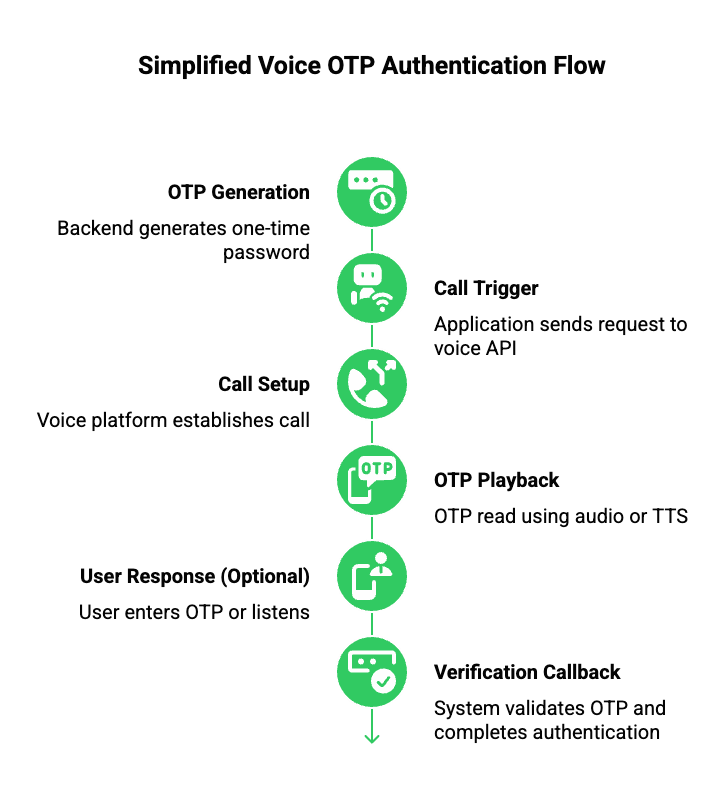
To understand the value of voice-based authentication, it is important to first understand how a traditional OTP voice API works at a technical level.
Below is a simplified end-to-end flow.
Step-By-Step Voice OTP Flow
- OTP Generation: The backend generates a one-time password linked to the user session.
- Call Trigger: The application sends a request to the voice API with the user’s phone number and OTP.
- Call Setup: The voice platform establishes a call over PSTN or VoIP networks.
- OTP Playback: The OTP is read using:
- Pre-recorded audio files, or
- Text-to-speech (TTS)
- Pre-recorded audio files, or
- User Response (Optional): The user may enter the OTP using keypad (DTMF) or simply listen.
- Verification Callback: The system validates the OTP and completes authentication.
Core Technical Components Involved
| Component | Role |
| Call Orchestration | Initiates and manages calls |
| Audio Playback | Delivers OTP using voice |
| DTMF Handling | Captures user input |
| Retry Logic | Reattempts failed calls |
| Status Webhooks | Reports call success or failure |
While this flow works, it is largely static. The system assumes the user will listen, understand, and act without interruption.
However, real users rarely behave that way.
Why Do Voice-Based OTPs Perform Better Than SMS For Instant Verification Calls?
Even with their limitations, voice OTPs outperform SMS in many real-world conditions.
Key Reasons Voice OTPs Are More Reliable
- Higher Delivery Assurance: Calls are less likely to be blocked compared to SMS.
- Works On Feature Phones: No internet or smartphone required.
- Regulation Friendly: Voice traffic often faces fewer spam restrictions.
- Better Accessibility: Useful for elderly users or low-literacy regions.
Because of these advantages, many businesses now use voice OTP as a primary channel, not just a fallback.
Moreover, voice OTPs enable real-time authentication, which is critical during high-risk actions such as payments or account changes.
What Are The Technical Limitations Of Traditional Voice OTP APIs?
Although voice OTP APIs improve delivery, they introduce a new set of technical challenges.
Common Limitations
- Static Audio Prompts: Messages cannot adapt based on user behavior.
- No Real-Time Audio Streaming: Audio is played as a fixed file, not dynamically generated.
- Rigid Call Flows: IVR trees are hardcoded and difficult to modify.
- Limited Personalization: Same message for every user.
- Poor Interruption Handling: If the user speaks or asks a question, the system ignores it.
- Scaling Bottlenecks: High call volumes increase latency and failures.
As a result, traditional voice APIs solve delivery, but not interaction.
This gap becomes more visible as authentication flows grow complex.
Why Are OTP & Verification Flows Becoming Conversational?
In theory, OTP verification is a single-step process. In practice, it rarely is.
Users often:
- Miss the OTP
- Ask for repetition
- Get confused about the purpose of the call
- Request slower playback
- Question the legitimacy of the call
Because of this, verification flows are no longer transactional. Instead, they are becoming interactive and conversational.
At the same time, businesses need:
- Better fraud checks
- Context-aware verification
- Adaptive flows based on risk
Therefore, OTP systems must respond dynamically rather than follow fixed scripts.
This shift sets the stage for voice agents, not just voice calls.
What Is A Voice Agent And How Does It Change Verification Workflows?
A voice agent is not the same as an IVR.
At a technical level, a voice agent combines multiple components:
- Speech-to-Text (STT) – Converts live speech to text
- Large Language Model (LLM) – Applies logic and decision-making
- Text-to-Speech (TTS) – Generates natural voice responses
- Context Management – Tracks conversation state
- Tool Calling – Triggers OTP verification, retries, or escalation
Together, these components enable systems to listen, understand, and respond in real time.
Unlike traditional systems, voice agents:
- Adapt to user behavior
- Handle interruptions
- Ask clarifying questions
- Verify identity conversationally
As a result, verification becomes smoother and more secure.
However, this also exposes a critical limitation in existing platforms.
Why Can’t Legacy Voice Calling Platforms Support AI-based verification?
Most existing voice platforms were built for call execution, not for real-time conversations.
They lack:
- Bidirectional audio streaming
- Low-latency media pipelines
- Support for conversational state
- AI-friendly integration points
Because of this, while they can place calls, they cannot reliably support AI-driven verification flows.
This architectural gap explains why many teams struggle to move beyond basic OTP voice APIs.
What Does A Modern Voice Infrastructure For OTP Look Like?
As OTP and verification flows become conversational, the underlying voice stack must evolve. A modern system is no longer built around static call execution. Instead, it is designed as a real-time media pipeline.
At a high level, a modern voice infrastructure must support:
- Real-Time Media Streaming: Audio must flow in and out continuously, not as pre-recorded files.
- Low-Latency Processing: Delays between user speech and system response must remain minimal.
- Bidirectional Audio Control: The system must listen and respond during the same call.
- AI-Oriented Architecture: Voice becomes an interface layer, not a decision layer.
Because of these requirements, modern verification systems treat voice as a transport layer, similar to how HTTP transports web data.
How Does Bulk Calling Work In AI-Driven Verification Systems?

Bulk calling in AI-driven systems is not just about scale. Instead, it is about synchronized execution with intelligence.
Traditional Bulk Calling
- Parallel call placement
- Static message delivery
- Retry on failure
AI-Driven Bulk Calling
- Parallel call placement
- Real-time audio streaming
- Dynamic responses per user
- Context-aware retries
As a result, each verification call becomes unique, even at scale.
Key Technical Differences
| Aspect | Traditional Voice OTP | AI-Driven Voice Verification |
| Audio | Pre-recorded | Generated in real time |
| Interaction | One-way | Two-way |
| Logic | Hardcoded | LLM-driven |
| Context | Stateless | Stateful |
| User Handling | Linear | Adaptive |
Because of this, AI-driven bulk calling significantly improves verification success rates.
How Do LLMs, STT, And TTS Work Together In OTP Verification?
Voice agents are built by combining modular components. Each component has a clear responsibility.
Speech-To-Text (STT)
- Converts live caller audio into text
- Enables understanding of user intent
- Handles interruptions and confirmations
Large Language Model (LLM)
- Applies verification rules
- Decides when to repeat OTP
- Determines escalation paths
- Manages conversational flow
Text-To-Speech (TTS)
- Converts responses into natural voice
- Adjusts tone and pacing
- Improves trust and clarity
Because these components operate in real time, verification becomes interactive rather than rigid.
Why Is Real-Time Authentication Critical For High-Risk Actions?
Real-time authentication reduces fraud by minimizing the window between intent and verification.
For example:
- Payment confirmations
- Password resets
- Account recovery
- Profile changes
In these scenarios, delayed or missed OTPs increase risk.
Voice-based real-time authentication offers:
- Immediate delivery
- User presence confirmation
- Lower spoofing risk
As a result, many teams now view voice verification as a security upgrade, not just a usability improvement.
How FreJun Teler Enables Real-Time, AI-Driven OTP & Verification Flows
At this point, the missing piece becomes clear: voice infrastructure designed for AI.
FreJun Teler provides the real-time voice transport layer required to connect AI agents with phone networks.
Instead of acting as a calling utility, Teler is built as global voice infrastructure for AI agents and LLMs.
What Teler Does At A Technical Level
- Streams live call audio with low latency
- Maintains a stable, bidirectional media connection
- Works with any LLM, STT, or TTS provider
- Scales bulk calling without breaking conversational flow
Because of this, engineering teams retain full control over:
- Dialogue logic
- Verification rules
- AI behavior
Teler simply ensures that voice data moves reliably between the user and the AI.
How Does Teler Fit Into A Bulk OTP Verification Architecture?
Below is a simplified architecture flow using Teler.
High-Level Flow
- Verification Trigger
User initiates login or transaction. - Bulk Call Initiation
Application triggers outbound call via Teler. - Real-Time Audio Streaming
Caller audio is streamed instantly. - AI Processing
- STT converts speech
- LLM evaluates logic
- Tools validate OTP
- STT converts speech
- Voice Response Generation
TTS output is streamed back to the caller. - Verification Completion
Success, retry, or escalation.
Why This Matters
Because Teler is AI-agnostic, teams can:
- Switch LLMs without changing voice infrastructure
- Improve TTS quality independently
- Add RAG or compliance logic easily
This modularity is critical for long-term scalability.
How Does Bulk Calling Scale Without Increasing Latency?
Scaling voice systems is hard because latency grows with volume.
Teler addresses this by:
- Using geographically distributed infrastructure
- Optimizing real-time media paths
- Avoiding audio buffering delays
As a result:
- Thousands of verification calls can run in parallel
- Each call maintains conversational quality
- AI response timing remains consistent
This makes Teler suitable for high-volume environments such as:
- Fintech platforms
- Marketplaces
- Telecom-heavy applications
What Are The Business Benefits Of AI-Powered Voice OTP?
From a business perspective, the technical improvements translate directly into outcomes.
Key Benefits
- Higher Verification Success Rates: Users complete flows faster.
- Reduced Fraud: Conversational verification is harder to spoof.
- Lower Support Load: Fewer failed OTP complaints.
- Better User Trust: Natural voice interactions feel legitimate.
- Future-Proof Architecture: Ready for otp voice api 2026 requirements.
Because of these advantages, voice APIs for bulk calling are evolving into core authentication infrastructure.
Is Voice-Based AI Authentication The Future Of OTP In 2026?
Looking ahead, OTP systems are shifting in three clear ways:
- From Messages To Conversations
- From Scripts To Intelligence
- From Utilities To Infrastructure
By 2026, OTP voice APIs will no longer be simple call triggers. Instead, they will power real-time, AI-driven authentication experiences.
Voice agents will:
- Verify identity
- Explain actions
- Reduce friction
- Increase security
How Should Teams Start Building Scalable Voice Verification Today?
To prepare for the future, teams should:
- Treat voice as an interface layer
- Separate AI logic from voice transport
- Choose infrastructure built for real-time streaming
- Avoid vendor lock-in
Most importantly, they should design systems that can evolve as authentication requirements change.
Final Thought
OTP verification is evolving from a static, message-based step into a real-time, conversational security layer. Voice APIs for bulk calling improve OTP delivery reliability, reduce delays, and enable instant verification across diverse user environments. However, as authentication flows become more complex, traditional voice APIs reach their limits. AI-driven verification requires real-time audio streaming, low latency, and full control over conversational logic. This is where FreJun Teler fits naturally. Teler acts as the global voice infrastructure layer that connects AI agents, LLMs, and STT/TTS systems directly to phone networks. By separating voice transport from intelligence, Teler enables teams to build future-proof, scalable, and secure authentication flows.
Schedule a demo to see how FreJun Teler powers real-time, AI-driven voice verification at scale.
FAQs –
1. What is a voice API for bulk calling?
A voice API for bulk calling allows applications to place and manage large volumes of automated voice calls programmatically.
2. How does voice OTP improve verification success?
Voice OTP improves delivery reliability, avoids SMS filtering, and ensures users receive verification codes instantly via calls.
3. Is voice-based OTP more secure than SMS?
Yes, voice OTP reduces interception risks and supports real-time user presence validation during authentication.
4. Can voice OTP work on feature phones?
Yes, voice-based verification works on feature phones and does not require internet or smartphone capabilities.
5. What is real-time authentication in voice systems?
Real-time authentication verifies users instantly during live calls, minimizing delays between intent and confirmation.
6. Why do traditional voice APIs struggle with AI verification?
They lack real-time media streaming, conversational state handling, and low-latency bidirectional audio support.
7. What role do LLMs play in voice verification?
LLMs manage verification logic, user responses, retries, and contextual decisions during live voice interactions.
8. How does bulk calling scale without increasing latency?
Scalable systems use distributed infrastructure and optimized media paths to maintain low latency during high call volumes.
9. Is voice verification suitable for fintech and payments?
Yes, voice verification is widely used in fintech for high-risk transactions and regulatory-compliant authentication flows.
10. How does FreJun Teler support AI-driven voice OTP?
Teler provides a real-time voice infrastructure that streams audio between AI systems and phone networks reliably.