
Bulk calling has evolved from simple dialing systems into a critical layer of modern lead follow-up automation. However, most teams still struggle to connect scale with meaningful conversations. Emails and SMS lack urgency, while traditional call automation fails to adapt in real time. As businesses move into 2026, the challenge is no longer whether to use voice, but how to use it intelligently. This is where modern voice APIs, AI-driven workflows, and real-time media streaming change the equation.
In this guide, we explore how a voice API for bulk calling can enhance lead follow-up journeys by enabling context-aware conversations, adaptive workflows, and post-call intelligence, without locking teams into rigid systems.
Why Is Lead Follow-Up Still Broken Despite Automation Tools In 2026?
Lead follow-up has more tools than ever. CRMs, marketing automation platforms, SMS tools, and email workflows promise speed and scale. However, despite this progress, most teams still struggle to convert interested leads into conversations.
The reason is simple.
Most follow-up systems optimize messages, not conversations.
As a result:
- Emails remain unopened
- SMS messages are ignored
- Sales calls happen too late or without context
Meanwhile, leads move on.
Voice follow-ups still work, but only when they are timely, relevant, and personal. Unfortunately, traditional calling methods cannot scale this experience. Manual calls break under volume, while automated calls lack understanding.
Because of this gap, teams need a better approach—one that combines bulk calling with intelligence, context, and control.
This is where modern lead follow-up journeys begin.
Why Does Voice Still Outperform Other Channels For High-Intent Leads?
Despite the rise of digital channels, voice remains unmatched for high-intent interactions. When a lead is evaluating, questioning, or deciding, voice delivers clarity that text-based channels cannot.
Voice works because:
- Questions can be resolved instantly
- Objections surface naturally
- Tone builds trust
- Decisions happen faster
In contrast:
- Emails delay feedback
- SMS lacks depth
- Chatbots struggle with complex intent
Therefore, voice is not outdated. Instead, outdated voice systems are the problem.
Modern bulk calling is no longer about blasting scripts. Rather, it is about enabling real conversations at scale, driven by logic, timing, and context.
According to recent industry research, over 53% of all contact center interactions are still handled through voice calls, confirming that voice remains the dominant channel for real-time resolution and complex lead engagement.
This shift requires a programmable voice API for bulk calling, not a simple dialer.
What Is A Voice API For Bulk Calling And How Does It Actually Work?
A voice API allows software systems to programmatically place and manage phone calls. At a basic level, it connects applications to telecom networks like PSTN, SIP, or VoIP.
However, bulk calling APIs go further.
They enable:
- Automated outbound call initiation
- Call state management (ringing, answered, failed)
- Audio streaming during live calls
- Event-based triggers and callbacks
From a technical view, a voice API typically handles:
| Layer | Responsibility |
| Signaling | Call setup, routing, teardown |
| Media | Audio capture and playback |
| Control | Call events and states |
| Integration | APIs and webhooks |
Because of this structure, developers can embed calling into sales, support, or follow-up systems without managing telecom infrastructure directly.
Yet, traditional voice APIs stop here. They manage calls, but they do not manage conversations.
That limitation becomes clear at scale.
Why Do Traditional Bulk Calling Systems Fail To Improve Follow-Up Journeys?
Legacy bulk calling platforms were designed for reach, not intelligence. As a result, they struggle in modern follow-up workflows.
Common limitations include:
- Static IVR trees with fixed paths
- Scripted messages that cannot adapt
- No understanding of caller intent
- No memory of previous interactions
- Poor CRM and data integration
Technically, these systems treat each call as an isolated event. Once the call ends, the context disappears.
Because of this:
- Follow-ups feel repetitive
- Leads receive irrelevant calls
- Sales teams lack insight into outcomes
In short, bulk calling exists, but voice workflows do not.
This is why lead follow up automation in 2026 must evolve beyond scripts and timers.
What Does An Intelligent Lead Follow-Up Journey Actually Require?
An effective follow-up journey is not a single call. Instead, it is a sequence of interactions that adapt over time.
To work properly, intelligent follow-ups require:
- Context awareness
- Dynamic decision-making
- Memory across interactions
- Real-time response handling
- Tool and data integration
From a system perspective, this means:
- Calls react to what the lead says
- Follow-ups adjust based on outcomes
- Timing changes dynamically
- Escalation happens when needed
Therefore, the goal shifts from “making calls” to orchestrating voice workflows.
To enable this, teams need more than call automation. They need conversational systems.
What Is An AI Voice Agent And How Is It Built?
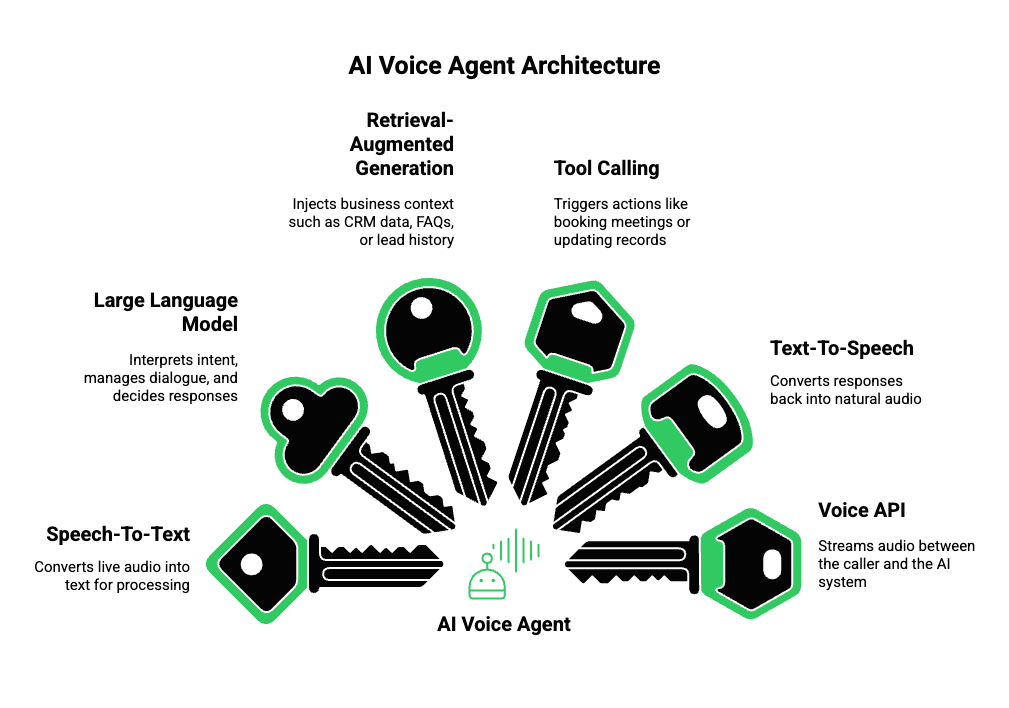
An AI voice agent is not a single tool. It is a system composed of multiple components working together in real time.
At a high level, a voice agent includes:
- Speech-To-Text (STT)
Converts live audio into text for processing - Large Language Model (LLM)
Interprets intent, manages dialogue, and decides responses - Retrieval-Augmented Generation (RAG)
Injects business context such as CRM data, FAQs, or lead history - Tool Calling
Triggers actions like booking meetings or updating records - Text-To-Speech (TTS)
Converts responses back into natural audio - Voice API
Streams audio between the caller and the AI system
Each component solves a specific problem. However, the voice API connects everything together.
Without reliable voice infrastructure:
- Audio arrives late
- Conversations break
- Interruptions are mishandled
Because of this, voice infrastructure becomes critical for real-world performance.
Why Is Bulk AI Calling Technically Hard At Scale?
Running one AI call is simple. Running thousands simultaneously is not.
Bulk AI calling introduces challenges that many teams underestimate.
Key technical difficulties include:
- Managing concurrent real-time audio streams
- Maintaining low latency across regions
- Handling interruptions and barge-ins
- Synchronizing AI responses with live speech
- Recovering from call drops or network issues
Additionally:
- Telecom networks vary by geography
- Audio quality fluctuates
- Call states change rapidly
As volume grows, even small delays create broken conversations. Therefore, AI logic alone cannot solve this problem.
A stable and scalable voice infrastructure layer is required to handle these challenges reliably.
What Role Does A Voice Infrastructure Layer Play In AI Calling Systems?
Voice infrastructure acts as the transport layer between humans and AI systems.
While AI handles reasoning, the infrastructure handles:
- Call setup and teardown
- Real-time media streaming
- Latency optimization
- Failover and reliability
- Global call routing
In simple terms:
- AI decides what to say
- Voice infrastructure ensures it is heard correctly and on time
This separation allows teams to innovate on AI without rebuilding telecom systems.
As a result, developers gain flexibility, reliability, and control—essential for modern bulk calling use cases.
How Does A Voice API Enable Scalable And Intelligent Voice Workflows?
Once AI logic and voice infrastructure are separated, teams can design voice workflows instead of fixed call scripts. This shift changes how bulk calling operates at scale.
A voice workflow is a state-driven sequence of actions that adapts based on:
- What the lead says
- What happened in earlier calls
- What data exists in external systems
Instead of following a rigid path, workflows react in real time.
For example:
- If a lead asks a pricing question, the flow continues
- If a lead is unavailable, the workflow reschedules
- If interest is high, the call escalates
Technically, this requires:
- Event-based call control
- Real-time audio streaming
- External decision-making via APIs
Therefore, voice workflows depend heavily on the capabilities of the underlying voice API.
How Do Voice Workflows Improve Bulk Lead Follow-Up Quality?
Traditional follow-ups rely on timing rules. In contrast, voice workflows rely on context and outcomes.
This improvement happens in several ways.
First, workflows adapt during the call.
If the lead interrupts, the system responds naturally.
Second, workflows evolve after the call.
Each interaction influences the next step.
Third, workflows integrate deeply with data systems.
CRM updates, notes, and outcomes flow automatically.
As a result:
- Calls feel less repetitive
- Leads receive relevant follow-ups
- Sales teams gain clearer signals
Because of this, voice workflows become the foundation for lead follow up automation in 2026.
What Is Post-Call Intelligence And Why Does It Matter For Follow-Ups?
A call does not end when the line disconnects. In fact, the most valuable insights often come after the call.
Post-call intelligence refers to the analysis and actions generated once a call finishes.
This includes:
- Call outcome classification
- Intent detection
- Sentiment analysis
- Key topic extraction
- CRM enrichment
From a technical view, post-call intelligence depends on:
- Accurate transcripts
- Structured call events
- Reliable metadata capture
Once processed, these insights drive:
- Smarter next-step decisions
- Better prioritization
- Improved conversion rates
Therefore, post-call intelligence closes the feedback loop in voice workflows.
Without it, bulk calling remains blind.
How Can Engineering Teams Design A Complete AI Calling Stack?
To build intelligent bulk calling systems, teams typically assemble a modular stack.
A common architecture includes:
- LLM for dialogue and reasoning
- STT for converting speech to text
- TTS for voice responses
- RAG for business and lead context
- Tool APIs for actions and updates
- Voice API for call handling and streaming
Each layer solves a specific problem.
However, reliability depends on how well these layers communicate in real time.
Because of this, the voice API must:
- Support bidirectional streaming
- Handle call state transitions
- Maintain low latency
- Scale across regions
This requirement brings us to the role of FreJun Teler.
How Does FreJun Teler Act As A Voice API For AI-Driven Bulk Calling?
FreJun Teler is a voice infrastructure platform designed specifically for AI-powered calling systems.
It does not provide AI models or scripts. Instead, it focuses on the voice layer that connects AI systems to real phone calls.
Teler enables:
- Real-time audio streaming for inbound and outbound calls
- Programmable call control via APIs
- Model-agnostic integration with any LLM
- Compatibility with any STT and TTS provider
- Global telephony and VoIP connectivity
From a system view, Teler acts as the transport layer for AI conversations.
This means:
- Developers control dialogue logic
- AI teams choose their models
- Teler handles call reliability and media delivery
As a result, teams avoid vendor lock-in while maintaining full flexibility.
How Can Teams Implement Teler With Any LLM, STT, And TTS Stack?
Implementing Teler follows a clear and modular approach.
At a high level, the flow looks like this:
- Your system triggers an outbound call using Teler’s API
- Teler establishes the call and streams audio in real time
- Audio is sent to an STT engine
- The LLM processes text and context
- The response is generated
- TTS converts text to audio
- Teler streams audio back to the caller
Throughout the call:
- Events are tracked
- Interruptions are handled
- State is maintained externally
Because Teler stays model-agnostic, teams can:
- Switch LLMs easily
- Upgrade STT or TTS providers
- Evolve logic without changing infrastructure
This design supports experimentation and long-term scalability.
How Does This Architecture Improve Bulk Calling Reliability?
Bulk calling introduces failure points that traditional systems cannot handle well.
With a dedicated voice API layer:
- Call retries are controlled programmatically
- Audio quality is monitored in real time
- Failures are isolated and handled gracefully
Additionally:
- Calls scale horizontally
- Regional latency is minimized
- Infrastructure adapts to load
As a result, systems remain stable even during high-volume campaigns.
This reliability is critical when voice becomes a core growth channel.
What Are Practical Use Cases For AI-Powered Bulk Calling?
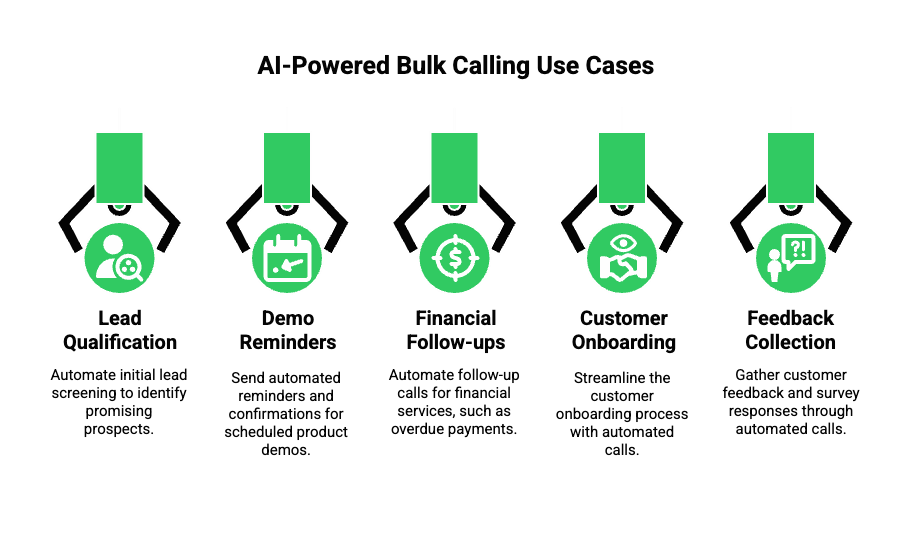
AI-driven bulk calling applies across many industries.
Common use cases include:
- Lead qualification calls
- Demo reminders and confirmations
- Financial services follow-ups
- Customer onboarding calls
- Feedback and survey collection
In each case, success depends on:
- Context awareness
- Natural conversation flow
- Accurate outcome tracking
Because Teler focuses on voice infrastructure, it supports all these scenarios without forcing specific logic.
How Does This Approach Future-Proof Lead Follow-Up Automation Beyond 2026?
Voice is becoming the primary interface between humans and AI systems.
As AI improves, expectations for voice interactions will rise.
Future-ready systems must:
- Support evolving models
- Handle growing volumes
- Maintain conversation quality
- Integrate with changing tools
By separating AI logic from voice infrastructure, teams build systems that adapt over time.
This separation ensures:
- Faster innovation
- Lower technical debt
- Better long-term performance
Therefore, investing in a robust voice API for bulk calling is not a short-term choice. It is a strategic one.
How Can Teams Start Building Smarter Voice-Based Follow-Up Journeys Today?
The best way to start is small and focused.
Teams can:
- Choose one follow-up workflow
- Integrate existing AI models
- Use a dedicated voice API layer
- Measure outcomes and iterate
Over time, these workflows evolve into complete lead follow-up journeys.
With the right architecture, bulk calling transforms from a volume tool into a conversation engine.
That is where real value emerges.
Conclusion
Bulk calling works best when it evolves from scripted outreach into intelligent conversation orchestration. As shown throughout this blog, modern lead follow-up journeys require real-time voice workflows, AI-driven decision-making, and reliable voice infrastructure. Instead of treating calls as isolated events, teams can now design systems that learn, adapt, and improve after every interaction. This shift allows founders, product teams, and engineering leaders to build scalable voice systems without compromising flexibility or control.
FreJun Teler supports this approach by acting as the voice API layer for AI-powered bulk calling, handling real-time streaming, call reliability, and global telephony while letting teams bring their own LLMs, STT, and TTS stacks.
FAQs –
1. What is a voice API for bulk calling?
A voice API enables applications to programmatically place, manage, and stream calls at scale using cloud telephony infrastructure.
2. How is bulk calling different from automated calling?
Bulk calling focuses on scale, while modern systems add intelligence, context, and adaptive workflows to each call.
3. Can voice APIs work with AI models?
Yes, voice APIs integrate with LLMs, STT, and TTS systems to enable real-time AI-driven conversations.
4. What are voice workflows?
Voice workflows are event-driven call flows that adapt based on user responses, call outcomes, and external data.
5. Why is low latency important in AI calls?
Low latency ensures natural conversations by reducing delays between user speech, AI processing, and voice responses.
6. What is post-call intelligence?
Post-call intelligence extracts insights like intent, sentiment, and outcomes to improve future follow-ups and automation.
7. Can I use my existing AI stack with voice APIs?
Yes, modern voice APIs are model-agnostic and work with any LLM, STT, or TTS provider.
8. Are voice APIs suitable for outbound sales calls?
They are ideal for outbound follow-ups, lead qualification, reminders, and time-sensitive customer engagement.
9. How do voice APIs improve lead follow-up automation in 2026?
They enable adaptive conversations, better timing, contextual memory, and automated insights at scale.
10. Is a voice API only for large enterprises?
No, startups and mid-sized teams also benefit from scalable voice infrastructure without managing telecom complexity.