
Modern businesses no longer see voice as just a support channel. Instead, it has become a critical interface between customers, systems, and intelligence. As organizations scale, communication flow often breaks due to rigid telephony systems, disconnected tools, and lack of real-time context. This is where Voice APIs play a defining role. By making voice programmable, businesses can unify inbound and outbound communication, improve routing efficiency, and integrate voice directly into their AI and application stack.
This article explores how Voice API benefits for businesses go far beyond calling, strengthening communication flow through scalable infrastructure, intelligent routing, and AI-ready design principles.
Why Is Business Communication Breaking At Scale?
Business communication has changed faster than most calling systems can handle. Customers now expect real-time responses, contextual conversations, and natural interactions across voice channels. However, many businesses still rely on legacy telephony setups that were never designed for dynamic workflows or AI-driven interactions.
According to industry research, the cloud telephony services market is expected to grow from approximately USD 26.69 billion in 2025 to USD 42.60 billion by 2030 at a near 9.8% CAGR, signaling businesses’ growing reliance on programmable voice infrastructure.
As companies scale, communication starts to break in predictable ways:
- Calls become disconnected from customer context
- Routing rules remain static while customer needs change
- IVRs feel rigid and frustrating
- Engineering teams struggle to customize call flows
As a result, voice becomes a bottleneck instead of an advantage.
Therefore, businesses are now rethinking voice as part of a business communication stack, not just a support channel. This shift is exactly where Voice APIs come into play.
What Is A Voice API And Why Is It Becoming Core To Modern Business Communication?
A Voice API allows businesses to programmatically control voice communication using software instead of physical or static systems. In simple terms, it turns phone calls into code-driven workflows.
Instead of configuring calls through hardware or fixed IVR trees, developers can:
- Initiate and receive calls using APIs
- Stream live audio in real time
- Apply logic to routing, retries, and fallbacks
- Connect calls to internal systems like CRMs or ticketing tools
Because of this flexibility, Voice APIs are now a core part of modern enterprise telephony APIs.
How Voice APIs Differ From Traditional Telephony
| Traditional Telephony | Voice API |
| Hardware-based | Cloud-native |
| Static routing | Logic-driven routing |
| Limited customization | Fully programmable |
| Manual scaling | Elastic scaling |
| Siloed systems | Unified workflows |
As a result, Voice APIs make communication adaptable, scalable, and deeply integrated with business logic.
How Does A Voice API Strengthen Communication Flow Across Teams And Systems?
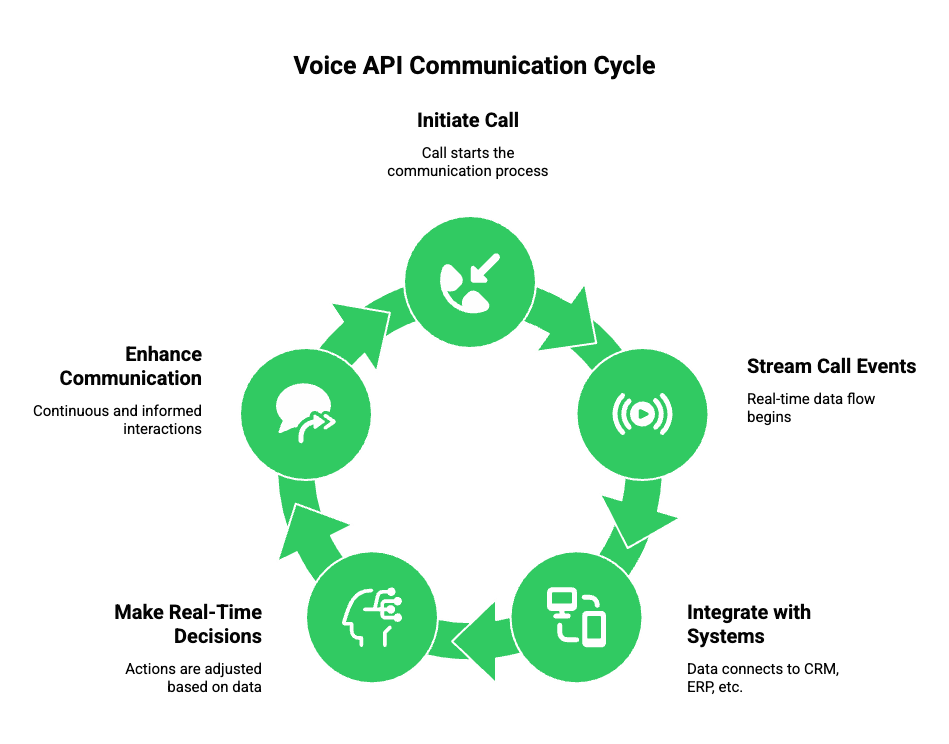
Communication flow breaks when voice systems operate in isolation. However, Voice APIs eliminate this gap by acting as a unifying layer between calls, applications, and data.
Key Ways Voice APIs Improve Flow
- Unified Voice Workflow: Calls are no longer standalone events. Instead, they become part of an end-to-end workflow that includes context, decisions, and outcomes.
- System-Level Integration: Voice APIs connect with CRMs, ERPs, and analytics tools. Therefore, every call can read from and write to business systems.
- Real-Time Decision Making: Since call events are streamed in real time, businesses can adapt routing, responses, or actions instantly.
Because of this, communication becomes continuous rather than fragmented. Moreover, teams across sales, support, and operations work from the same voice-driven data.
What Role Does Scalable Voice Infrastructure Play In Business Growth?
Voice traffic behaves differently from web traffic. Latency, packet loss, and regional connectivity directly impact user experience. Therefore, scalability in voice is not only about volume but also about performance consistency.
What Makes Voice Infrastructure Scalable?
- Global PSTN and VoIP connectivity
- SIP-based call handling
- Geo-distributed media servers
- Real-time failover mechanisms
When these components are missing, call quality drops as traffic increases. As a result, customer trust erodes quickly.
A scalable voice infra ensures that:
- Call quality remains stable during peak loads
- Latency stays low across regions
- Infrastructure adapts automatically to demand
Therefore, businesses can grow without redesigning their communication layer every time volumes increase.
How Do Voice APIs Improve Voice Routing Efficiency In Real-Time Scenarios?
Routing is where most traditional systems fail. Static routing rules cannot respond to real-world variables like agent availability, customer intent, or system health.
Voice APIs solve this by enabling dynamic routing logic.
Examples Of Improved Voice Routing Efficiency
- Route calls based on caller history
- Shift traffic during outages automatically
- Escalate calls when confidence drops
- Prioritize high-value customers
Because routing logic runs in software, it can change instantly. Moreover, businesses gain visibility into routing decisions through events and logs.
As a result, voice routing efficiency improves both customer experience and operational cost.
How Are Modern Voice Agents Built Using Voice APIs?
Voice agents today are not simple bots. Instead, they are composed systems that rely on multiple technologies working together.
A modern voice agent typically includes:
- LLM for reasoning and responses
- STT (Speech-to-Text) to understand speech
- TTS (Text-to-Speech) to generate voice
- RAG for knowledge retrieval
- Tool calling for actions
However, none of these components handle telephony on their own.
Where The Voice API Fits Technically
The Voice API acts as the real-time transport layer:
- Streams inbound audio to STT systems
- Maintains low-latency sessions
- Sends outbound audio back to the caller
- Emits call events for backend logic
Without this layer, AI systems cannot reliably interact with phone networks. Therefore, Voice APIs are essential for turning AI logic into real conversations.
Why Can’t LLMs Or AI Platforms Handle Voice Infrastructure Alone?
LLMs are designed for language understanding and generation. However, telephony introduces challenges that AI platforms are not built to manage.
Telephony Challenges AI Platforms Don’t Solve
- PSTN and SIP protocol handling
- Real-time audio streaming
- Call lifecycle management
- Latency-sensitive playback
- Regulatory and reliability constraints
Because of this, trying to embed voice directly into AI platforms leads to brittle systems.
Therefore, the most reliable architecture separates concerns:
- AI handles intelligence
- Voice APIs handle communication
This separation allows teams to upgrade models without rebuilding voice infrastructure.
How Does A Voice API Enable Full Conversational Context Across Calls?
Context is what turns conversations into meaningful interactions. However, traditional calls are stateless by default.
Voice APIs change this by maintaining stable sessions and emitting structured events.
How Context Is Preserved
- Session IDs persist across interactions
- Call metadata is available in real time
- Backend systems control state explicitly
As a result, businesses can build voice experiences that:
- Remember previous interactions
- Adapt responses mid-call
- Resume logic after interruptions
Therefore, communication feels continuous rather than transactional.
Where Does FreJun Teler Fit In The Modern Voice API Landscape?
At this stage, it becomes important to understand how businesses move from theory to implementation. While many platforms offer calling features, very few focus on voice as infrastructure for AI-driven systems.
This is where FreJun Teler fits.
FreJun Teler is designed as a global voice infrastructure layer for modern applications. Instead of bundling AI logic or prescribing models, it focuses entirely on making voice reliable, real time, and scalable for any AI system.
What FreJun Teler Handles Versus What Your AI Handles
| Layer | Responsibility |
| FreJun Teler | Telephony, real-time audio streaming, call lifecycle, routing, reliability |
| Your AI Stack | LLM reasoning, STT, TTS, RAG, tool execution |
| Your Backend | State, workflows, business rules, integrations |
Because of this separation, teams retain full control over their intelligence layer while relying on a stable enterprise telephony API underneath.
Moreover, this approach avoids vendor lock-in and simplifies long-term system evolution.
How Does FreJun Teler Strengthen End-To-End Communication Flow For Businesses?
Communication flow improves when latency, reliability, and routing logic work together. FreJun Teler is built specifically around these constraints.
Key Technical Capabilities That Enable Flow
- Real-Time Media Streaming: Audio is streamed bidirectionally with minimal delay. Therefore, conversations feel natural rather than segmented.
- Stable Transport Layer: Calls remain connected even when backend systems update context or logic mid-session.
- Unified Inbound And Outbound Handling: The same infrastructure supports support calls, IVRs, and outbound campaigns.
- Backend-Controlled Logic: All routing, decision-making, and escalation logic remains under application control.
As a result, voice interactions behave like part of a unified system rather than an external dependency.
What Business Use Cases Are Enabled By A Strong Voice API Layer?
Once voice becomes programmable and reliable, use cases expand beyond basic calling.
Intelligent Inbound Call Handling
Businesses can build:
- AI-powered receptionists
- Natural-language IVRs
- Context-aware support agents
Because conversational state is preserved, these systems reduce call transfers and resolution time.
Scalable Outbound Communication
Voice APIs enable:
- Appointment reminders
- Lead qualification calls
- Feedback collection
- Proactive notifications
Moreover, outbound workflows can adapt dynamically based on responses, rather than following fixed scripts.
Operational Voice Automation
Internal operations also benefit:
- Status updates
- Compliance calls
- Workflow confirmations
As a result, teams reduce manual effort while maintaining voice-based accountability.
How Should Engineering Teams Evaluate A Voice API For Long-Term Scale?
Choosing a Voice API is a strategic decision. Therefore, evaluation should focus on infrastructure quality, not surface features.
Key Evaluation Criteria
- Latency Guarantees: Low latency directly impacts conversational quality.
- Global Reach: Multi-region connectivity ensures consistent experience.
- Scalability Model: Infrastructure must scale elastically without manual intervention.
- SDK And API Design: Clean abstractions reduce engineering effort.
- AI Compatibility: The platform must support any LLM, STT, or TTS stack.
- Reliability And Uptime: Voice systems are mission critical and cannot fail silently.
FreJun Teler aligns with these criteria by focusing on scalable voice infra rather than bundled application logic.
Why Voice APIs Are Becoming The Backbone Of The Business Communication Stack
Voice is no longer an isolated channel. Instead, it is becoming a programmable interface across the organization.
The Shift In Perspective
- From “calls” → voice workflows
- From “IVRs” → conversational systems
- From “telephony tools” → infrastructure layers
Because Voice APIs sit at the intersection of users, AI, and systems, they naturally become part of the core business communication stack.
Moreover, as AI adoption grows, voice becomes the most natural interface for human interaction.
How Does A Unified Voice Workflow Reduce Operational Complexity?
Fragmentation increases cost and failure points. However, a unified voice workflow simplifies architecture.
Benefits Of Unification
- Fewer integration points
- Centralized observability
- Consistent routing logic
- Easier compliance management
As a result, teams spend less time debugging telephony issues and more time improving customer experience.
This is especially important for engineering leads who must balance speed with reliability.
How Can Businesses Start Building AI-Ready Voice Systems Faster?
Getting started does not require building everything at once. Instead, successful teams follow a layered approach.
Recommended Starting Steps
- Choose a robust Voice API platform
- Decouple voice from AI logic
- Integrate STT, LLM, and TTS incrementally
- Add RAG and tool calling as needed
- Measure latency and routing outcomes
By following this path, businesses avoid rework and scale confidently.
FreJun Teler supports this approach by acting as a neutral, reliable foundation that adapts as AI capabilities evolve.
Final Thoughts
Voice APIs are no longer optional infrastructure for growing businesses. They form the backbone of a modern business communication stack by turning voice into a programmable, scalable, and context-aware channel. When combined with AI systems, Voice APIs enable real-time conversations, intelligent routing, and unified workflows that traditional telephony cannot support. More importantly, they allow engineering teams to decouple voice infrastructure from AI logic, ensuring flexibility as models and use cases evolve.
FreJun Teler helps businesses implement this approach by providing a global, low-latency voice infrastructure designed specifically for AI-driven communication. It allows teams to bring their own LLMs, STT, and TTS while relying on a reliable enterprise telephony layer underneath.
Schedule a demo to see how FreJun Teler can power scalable, AI-ready voice communication.
FAQs –
- What is a Voice API used for in business?
A Voice API enables businesses to programmatically manage calls, routing, and real-time audio as part of their communication stack. - How does a Voice API improve communication flow?
It unifies voice interactions with backend systems, enabling real-time decisions, better routing, and continuous conversational context. - Is a Voice API different from cloud telephony?
Yes. Voice APIs provide programmable control and integration, while cloud telephony often focuses only on call connectivity. - Can Voice APIs work with AI and LLMs?
Yes. Voice APIs act as the transport layer that connects LLMs, STT, and TTS to phone networks. - Do Voice APIs support inbound and outbound calls?
Most modern Voice APIs support both, enabling unified inbound support and scalable outbound automation workflows. - Why is low latency important in voice communication?
Low latency ensures natural conversations by minimizing delays between speech, AI processing, and audio playback. - What makes voice infrastructure scalable?
Global connectivity, elastic capacity, real-time failover, and distributed media streaming make voice infrastructure scalable. - Are Voice APIs suitable for enterprise use cases?
Yes. Enterprise telephony APIs are designed for high availability, security, compliance, and large-scale traffic handling. - How do Voice APIs handle call routing?
Routing logic is defined in software, allowing dynamic decisions based on context, availability, and business rules. - Why should businesses decouple AI from voice infrastructure?
Decoupling allows teams to upgrade AI models without rebuilding telephony systems, improving flexibility and long-term scalability.