
Communication speed and accuracy define success. Traditional telephony often fails to meet the dynamic needs of modern teams, resulting in delays, miscommunication, and operational inefficiency. Voice APIs bridge this gap by integrating real-time calling with AI-driven capabilities, enabling intelligent automation, natural interactions, and seamless workflow management. For founders, product managers, and engineering leads, adopting a voice API approach ensures your teams can respond faster, scale without friction, and maintain consistent service quality.
This blog explores how AI-ready telephony, combined with reliable infrastructure, transforms communication into a strategic advantage.
Why Do High-Velocity Teams Need Smarter Voice Communication Today?
Speed and clarity of communication are no longer optional—they are critical. High-velocity teams, whether in customer support, sales, or operations, rely on tools that allow real-time coordination across multiple channels. Traditional telephony systems often struggle to keep up with this pace.
Some common challenges teams face include:
- Latency Issues: Delayed call setups and audio interruptions can disrupt workflows.
- Limited Integration: Conventional phone systems cannot connect easily with modern tools like automated assistants, databases, or analytics dashboards.
- Scalability Concerns: Adding new lines or managing simultaneous calls can be slow and costly.
- Fragmented Experience: Teams must switch between multiple apps for communication, tracking, and automation.
This is where voice APIs provide a clear solution. They act as the backbone for fast-moving business communication, enabling teams to integrate voice directly into applications, automate workflows, and maintain real-time interactions with both customers and internal systems.
Using a voice API, businesses can:
- Embed calling features directly into web or mobile applications.
- Automate routine interactions such as appointment reminders or notifications.
- Streamline inbound and outbound communications without compromising latency.
- Track and analyze calls for better operational insights.
Ultimately, a well-implemented voice API transforms communication from a static tool into a dynamic, high-velocity infrastructure that keeps teams agile and responsive.
What Exactly Is A Voice API And Why Should Businesses Care?
A voice API is essentially a bridge between an application and the public switched telephone network (PSTN) or VoIP systems. It allows developers to programmatically manage calls, control audio streams, and integrate advanced features like automated responses, interactive menus, and call routing.
Voice‑over‑IP infrastructure continues to expand rapidly – the global VoIP market was worth an estimated $132.47 billion in 2023 and is projected to grow to $326.27 billion by 2032, highlighting the increasing demand for cloud‑driven communication platforms that voice APIs feed into.
For high-velocity teams, the benefits are significant:
Key Functions Of A Voice API:
- Real-Time Call Control: Start, end, transfer, or route calls programmatically.
- Media Streaming: Capture and transmit live audio between users and applications with low latency.
- TTS And STT Integration: Convert speech to text and text to speech for automation or analytics.
- Analytics Access: Gather call data and quality metrics for operational insights.
Why Businesses Should Care:
- Speed: Calls can be handled and routed in milliseconds.
- Automation: Reduces dependency on human agents for repetitive tasks.
- Scalability: Handles hundreds or thousands of concurrent calls without manual intervention.
- Integration Ready: Connects with CRMs, databases, and AI systems effortlessly.
By using a voice API, businesses no longer need to maintain expensive, rigid telephony systems. Instead, they get flexible, cloud-based communication infrastructure that scales with growth.
How Can Voice APIs Power AI-Enabled Voice Agents?
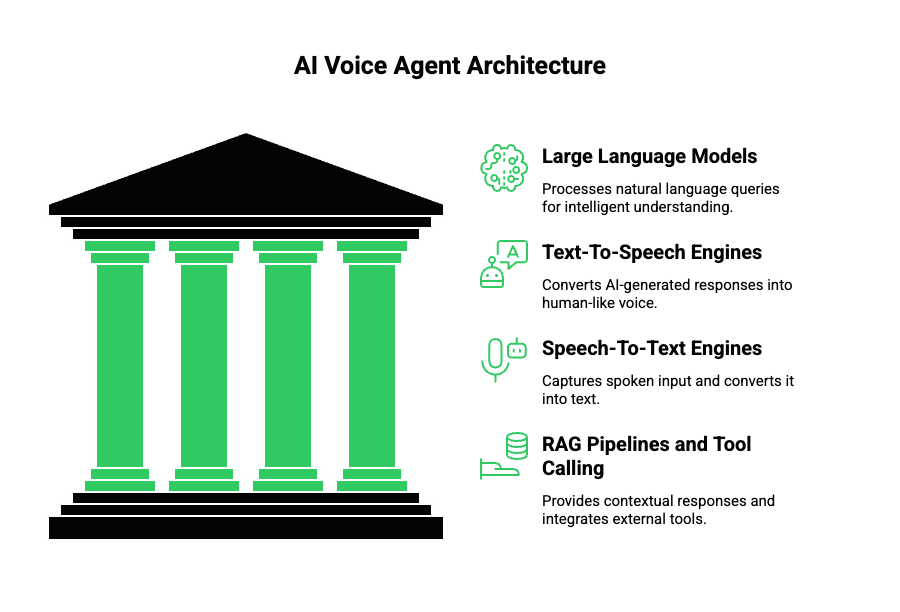
Voice APIs are the technical foundation for AI-powered voice agents. These agents combine multiple components to simulate human-like conversation:
- Large Language Models (LLMs) for processing natural language queries.
- Text-To-Speech (TTS) engines to convert AI-generated responses into voice.
- Speech-To-Text (STT) for capturing spoken input.
- RAG Pipelines and Tool Calling to provide contextual responses and integrate external tools.
Technical Pipeline Overview:
| Step | Function | Benefit For Teams |
| Call Initiation | Voice API connects the user to the system | Immediate, reliable connection |
| Audio Capture | STT converts speech to text | Enables automation and logging |
| Language Processing | LLM interprets query | Intelligent and contextual understanding |
| Response Generation | TTS converts AI output to speech | Human-like interaction |
| Audio Playback | Voice API streams response back | Maintains seamless conversation flow |
This architecture ensures that interactions are fast, reliable, and maintain context throughout the call.
Integration Flexibility
One of the major advantages of modern voice APIs is their compatibility with any AI or TTS/STT engine. Teams can:
- Use OpenAI, Anthropic, or proprietary LLMs.
- Switch between multiple TTS providers based on voice style or language.
- Integrate contextual memory and external databases to enrich conversations.
By combining these components, high-velocity teams can achieve automation at scale without sacrificing personalization or clarity.
What Key Benefits Do Voice APIs Bring To Fast-Moving Businesses?
High-velocity teams benefit from voice APIs across multiple dimensions. Below are the main advantages, structured for clarity:
How Do Voice APIs Improve Operational Speed And Scalability?
- Elastic cloud architecture supports rapid scaling.
- Multiple concurrent calls can be managed programmatically.
- Automated routing ensures calls reach the right agent or system immediately.
- Reduces bottlenecks in high-volume call environments.
How Do Voice APIs Integrate Seamlessly With AI Systems?
- APIs act as the transport layer for LLMs and other AI agents.
- Contextual state can be maintained across sessions.
- Calls can trigger automated tool actions, like updating CRM records or logging requests.
How Can They Enhance The Customer Experience?
- Calls can feel personalized with AI-driven responses.
- Multilingual support ensures global reach.
- Interactive menus and smart routing reduce wait times.
How Do They Help Cut Costs For Startups And Teams?
- Cloud-based systems reduce the need for on-premises telephony hardware.
- Pay-as-you-go pricing aligns with usage, reducing overhead.
- Automation reduces dependency on human agents for repetitive or predictable tasks.
How Do They Provide Analytics And Insights For Decision-Making?
- Track call metrics, agent handoffs, and response times.
- Identify bottlenecks and optimize call flows.
- Capture real-time feedback for AI improvement.
Transitioning from traditional telephony to voice API-driven communication provides a comprehensive upgrade for any high-velocity team.
Why Should Your Team Consider Teler For AI-Ready Voice Infrastructure?
At this point, it is important to introduce Teler, a platform specifically engineered for AI-driven voice agents. While many platforms offer voice APIs, Teler provides the technical foundation necessary for high-speed, AI-ready telephony that meets enterprise standards.
Core Technical Advantages Of Teler:
- Ultra Low-Latency Media Streaming: Audio input and output happens in real-time, reducing pauses and improving conversational flow.
- Reliable Transport Layer: Maintains stable connections even during high call volumes.
- Full Conversational Context: Keeps dialogue state across sessions, enabling AI to respond intelligently.
- Developer-First SDKs: Comprehensive client-side and server-side tools for web, mobile, and backend integration.
- Enterprise-Grade Security And Reliability: End-to-end encryption, role-based access, and distributed architecture ensure uptime and compliance.
How Teler Supports High-Velocity Teams
- Integrates with any LLM, STT, or TTS engine, making it AI-agnostic.
- Supports rapid deployment of AI voice agents for inbound, outbound, and internal communication.
- Reduces latency, ensuring that real-time infra for startups and high-speed operations performs reliably.
- Provides a scalable foundation for teams that need to expand globally or handle large volumes of calls.
With Teler, businesses can implement voice agents that are not just automated, but intelligent, fast, and reliable, providing both technical depth and operational efficiency.
What Real-World Use Cases Can High-Velocity Teams Achieve With Voice APIs?
Voice APIs are more than a technical layer—they are operational enablers. High-velocity teams can implement a range of solutions that save time, reduce errors, and enhance customer experience.
How Can AI Handle Inbound Calls Intelligently?
- Automated Receptionists: Voice APIs combined with AI allow for 24/7 call handling without human intervention. Calls are routed intelligently based on query type.
- Natural Language IVRs: Instead of pressing numbers, callers speak naturally, and AI interprets intent in real time.
- Contextual Responses: AI agents access conversation history or CRM data to provide personalized answers.
- Reduced Wait Times: Immediate routing and automated handling free up human agents for complex queries.
How Can Outbound Campaigns Be Automated And Personalized?
- Lead Qualification Calls: AI voice agents can pre-screen leads before passing them to sales.
- Appointment Reminders & Notifications: Calls can be scheduled and personalized for each recipient.
- Surveys & Feedback Collection: Voice agents can conduct structured surveys and log responses automatically.
- Scale At Speed: Hundreds or thousands of calls can be executed simultaneously without additional staffing.
How Can Internal Teams Leverage Voice Automation?
- Operational Assistance: AI agents can provide internal teams with instant updates, reminders, or workflow instructions.
- Real-Time Collaboration: Voice APIs can integrate with chat platforms or task management tools to provide hands-free updates.
- Error Reduction: Automated voice agents reduce miscommunication and ensure critical information is consistently delivered.
How Can Tool Integrations Like RAG Pipelines And CRMs Be Automated?
- AI voice agents can query databases, fetch records, or trigger actions in connected systems.
- Example: A customer calls, AI fetches order status from ERP, confirms delivery ETA, and updates CRM automatically.
- Supports fast-moving business communication by eliminating manual steps, reducing latency, and providing real-time insights.
How Do Teams Implement Voice APIs Without Disruption?
Even with clear benefits, implementing a voice API requires careful planning to ensure seamless adoption.
Step 1: Define Objectives
- Identify which workflows will benefit most from voice automation.
- Determine desired outcomes: reduced agent load, improved customer satisfaction, or faster response times.
Step 2: Choose The Right Architecture
- Decide on cloud-native or hybrid deployment based on latency and regional needs.
- Ensure the system supports low-latency streaming, context retention, and multiple LLM or TTS/STT options.
Step 3: Integrate With Existing Tools
- Connect the voice API to CRM, ticketing systems, analytics dashboards, and AI models.
- Use SDKs to manage call logic, audio streaming, and session context without rewriting core infrastructure.
Step 4: Implement Security And Compliance
- Ensure end-to-end encryption for all calls.
- Implement role-based access controls.
- Maintain compliance with regional telephony and data regulations (e.g., GDPR, HIPAA).
Step 5: Monitor And Optimize
- Track call metrics: latency, drop rates, conversation success.
- Adjust AI response strategies and routing logic based on analytics.
- Continuously improve conversation quality using real-world feedback.
By following these steps, teams can deploy voice automation at speed while maintaining reliability and operational control.
How Does Investing In AI-Ready Voice APIs Future-Proof Business Communication?
Voice APIs combined with AI create infrastructure that adapts as business needs evolve. High-velocity teams benefit in multiple ways:
Scalability Without Hiring Overhead
- As call volumes increase, AI voice agents can handle growth automatically.
- Eliminates the need to hire additional agents for predictable or repetitive tasks.
Analytics-Driven Decision Making
- Real-time monitoring and reporting provide actionable insights.
- Teams can track conversation efficiency, query resolution, and agent handoffs.
Faster Time-To-Market For Customer Initiatives
- Launch new campaigns, notifications, or operational workflows quickly.
- Voice APIs reduce dependency on IT or telecom teams for every change.
Flexibility Across AI Models And Technologies
- Teams can switch or combine LLMs, TTS/STT engines without disrupting call infrastructure.
- Supports multi-language, multi-region, and multi-platform deployments.
Reliable Real-Time Infrastructure
- Provides a robust backbone for fast-moving startups and high-velocity teams.
- Reduces downtime, latency, and operational risk, ensuring continuous communication.
What Are The Key Metrics To Track For Voice API Success?
To maximize the value of voice APIs, teams should monitor technical and operational metrics:
| Metric | Importance | How It Helps Teams |
| Call Latency | Critical for conversational flow | Identifies delays in streaming and AI processing |
| Call Completion Rate | Measures success of automated calls | Ensures AI agents handle interactions correctly |
| Conversation Duration | Tracks efficiency | Detects unnecessarily long or inefficient calls |
| Routing Accuracy | Evaluates call logic | Confirms callers reach correct agent or AI workflow |
| AI Response Accuracy | Measures LLM/STT/TTS performance | Helps optimize voice agent logic and reduce errors |
| System Uptime | Reliability of voice infrastructure | Ensures uninterrupted business communication |
Tracking these metrics allows founders, product managers, and engineering leads to optimize performance while scaling operations.
How Can Voice APIs Help High-Velocity Teams Stay Competitive?
Voice APIs, when combined with AI and TTS/STT tools, create a strategic advantage:
- Immediate Response: Customers and team members get answers in real-time, reducing friction.
- Automation At Scale: Teams can focus on strategic work rather than repetitive tasks.
- Data-Driven Insights: Every call becomes a source of actionable information for business optimization.
- Global Reach: Multi-region deployment with low-latency voice ensures teams can operate globally without degradation.
By leveraging AI-ready voice infrastructure, businesses stay ahead of competitors relying solely on traditional telephony.
Why Should High-Velocity Teams Adopt AI-Powered Voice Agents Today?
For startups, fast-moving teams, and enterprise units:
- Voice APIs improve communication speed, reliability, and intelligence.
- AI-enabled voice agents reduce operational overhead and improve customer satisfaction.
- Platforms like Teler provide the infrastructure to deploy these solutions quickly and securely, supporting multi-model AI integrations and maintaining context across calls.
Summary Of Benefits:
- Operational Efficiency: Automates repetitive tasks while maintaining personalization.
- Customer Experience: Reduces wait times and improves first-contact resolution.
- Scalability: Handles thousands of calls concurrently without added resources.
- Future-Proof: Adaptable to new AI models, languages, and workflows.
By adopting a voice API strategy, businesses position themselves for long-term agility, data-driven growth, and operational excellence.
Conclusion
Voice APIs are no longer optional, they are the backbone of high-velocity teams aiming for speed, scalability, and operational efficiency. By integrating real-time telephony with AI voice agents, tea-ms can automate repetitive tasks, handle complex queries intelligently, and gain actionable insights through analytics. Platforms like Teler provide the infrastructure to implement AI-ready voice solutions with low latency, secure data handling, and full conversational context, empowering teams to focus on strategy rather than manual operations. For businesses seeking fast-moving, reliable, and scalable communication, adopting Teler ensures consistent performance and seamless integration with any LLM or TTS/STT engine.
FAQs –
- What is a voice API and why is it important for businesses?
Voice APIs enable real-time calling, automation, and AI integration, increasing communication speed and operational efficiency for high-velocity teams. - How do voice APIs work with AI and LLMs?
They capture real-time audio, process it via AI, and respond through TTS, maintaining context and seamless communication flow. - Can I integrate any TTS or STT engine with a voice API?
Yes, modern voice APIs support multiple engines, providing flexibility to match business requirements and language or voice preferences. - How do voice APIs improve customer experience?
By enabling fast, personalized responses, intelligent call routing, and AI-driven conversation management without human intervention. - What are the technical benefits for high-velocity teams?
Low latency, real-time infrastructure, contextual awareness, scalable call handling, and automated workflows enhance team efficiency and speed. - Are voice APIs secure for enterprise use?
Yes, enterprise-grade APIs offer encryption, role-based access, and compliance with global data and telephony regulations. - Can voice APIs handle outbound campaigns automatically?
Absolutely, they enable scalable, personalized outreach for reminders, surveys, notifications, and lead qualification at high volumes. - What metrics should teams track using voice APIs?
Call latency, completion rate, routing accuracy, AI response quality, and conversation duration to optimize operations. - How does Teler support AI voice agent deployment?
Teler offers low-latency streaming, SDKs, secure infrastructure, and contextual conversation handling for seamless AI integration. - Can startups benefit from voice APIs without large budgets?
Yes, cloud-based pay-as-you-go pricing reduces costs while providing scalable, AI-ready communication infrastructure for small teams.