
In the world of emergency response, every second is a matter of life and death. The 911 call center (or any emergency hotline) is the absolute front line, the first point of contact in a citizen’s most desperate moment.
The dispatcher who answers that call is a highly-trained professional who must act with speed, precision, and unflinching calm in the face of immense pressure.
But this critical, human-powered system is under an unprecedented amount of strain. Call volumes are rising, staffing shortages are a chronic problem, and the amount of information a dispatcher needs to process is growing exponentially.
In this high-stakes environment, a new and powerful partner is emerging: the AI voicebot.
This is not about replacing the human dispatcher. It is about augmenting them, about providing them with a “superhuman” set of tools that can handle the administrative burden, process information faster, and allow the human expert to focus on the single most important task: saving lives.
This guide will explore the groundbreaking ways that a specialized AI voicebot is being deployed to create a faster, smarter, and more resilient emergency response system.
Table of contents
Why is the Traditional 911 System at a Breaking Point?
The traditional, human-only 911 call center is a system that is struggling to keep up with the demands of the modern world.
How is the “Information Overload” Affecting Dispatchers?
A modern emergency call is no longer just a simple voice conversation. A dispatcher might need to monitor text messages, process data from a car’s telematics system, and even view a live video stream from a caller’s phone, all while trying to calmly gather the critical information from a panicked person.
This “information overload” can slow down the dispatch process. A recent report highlighted the immense pressure on these centers, noting that the average 911 dispatcher answers around 240 million calls a year in the U.S. alone.
What is the Impact of Non-Emergency Calls Clogging the Lines?
A significant percentage of the calls that come into a 911 or other emergency hotline are not for true emergencies. They are for non-urgent issues like noise complaints or questions about local services.
These non-emergency calls clog the phone lines, creating a “digital busy signal” that can prevent a person with a real, life-threatening emergency from getting through.
Also Read: What to Expect from Enterprise-Grade Voice APIs?
How Can an AI Voicebot Act as a “Guardian Angel” for Dispatchers?
An AI voice agent, when deployed responsibly and ethically, can act as a powerful force multiplier for an emergency response center. It is a tireless, perfectly consistent, and incredibly fast assistant that can handle the “noise” and allow the human experts to focus on the “signal.”
This mission-critical capability is built on a foundation of a modern, ultra-reliable voice infrastructure. A platform like FreJun AI provides the essential, “five nines” reliability and the low-latency, real-time audio streaming that are the non-negotiable prerequisites for any public safety application.
What are the “Life-Saving” Workflows for an Emergency AI Voicebot?
The use of an AI voicebot in this context is not about having a full conversation; it’s about speed, triage, and data extraction.
| Task Area | Traditional Human-Only Process | AI-Augmented Process |
| Initial Call Triage | Dispatcher answers every call, manually determines if it’s an emergency. | AI answers instantly, asks “Is this a life-threatening emergency?”. Non-emergencies are routed to a different line. |
| Real-Time Transcription | Dispatcher must listen and type at the same time, can miss details. | AI provides a live, real-time transcript of the call on the dispatcher’s screen, ensuring a perfect record. |
| Foreign Language Calls | Dispatcher must wait for a human translator service to join the line. | AI can provide instant, real-time, two-way translation between the caller and the dispatcher. |
| Data Extraction | Dispatcher must manually identify and enter key info into the CAD system. | AI can listen for and automatically extract key entities (address, callback number, nature of emergency) and pre-fill the CAD record. |
Also Read: Handling After-Hours Calls with AI Voicebots
How Can You Create an “Emergency/Non-Emergency” Triage Bot?
The Goal: To instantly filter all incoming calls and ensure that true emergencies are prioritized and that non-emergency calls do not clog the critical 911 lines.
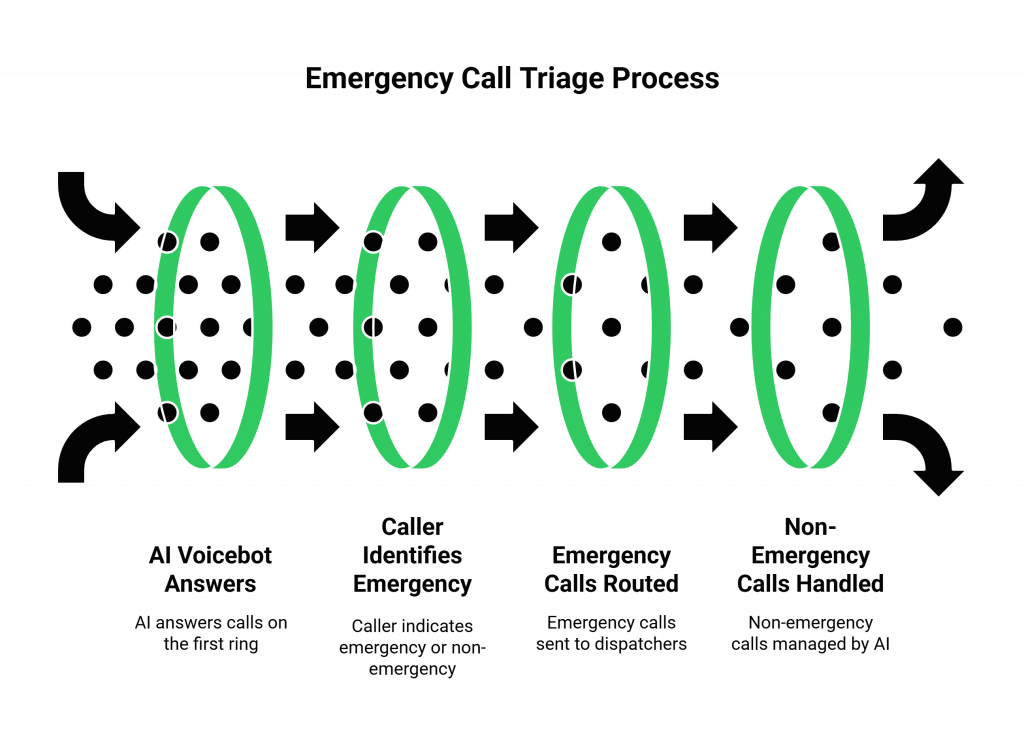
The Workflow:
- The AI voicebot answers every call on the first ring.
- AI: “You have reached the emergency hotline. If this is a life-threatening medical, fire, or police emergency, please say ’emergency’ or press 1 now. If this is not a life-threatening emergency, please say ‘non-emergency’ or press 2.”
- If the caller indicates an emergency, the call is instantly and immediately routed to the front of the queue for the next available human dispatcher.
- If the caller indicates a non-emergency, the AI can then handle their request, for example, by transferring them to the city’s 311 non-emergency line or by providing a recorded message with information.
The Business Impact: This simple, powerful triage can have a massive impact on reducing the “noise” in the emergency queue, ensuring that the human dispatchers’ time is reserved for the calls where seconds truly matter.
Ready to build a more resilient and intelligent emergency response system? Sign up for a FreJun AI account and explore our high-reliability infrastructure.
How Can AI Provide “Real-Time Language Translation”?
The Goal: To break down the language barrier in a critical moment and allow a dispatcher to communicate instantly with a caller who does not speak the same language.
The Workflow:
- A dispatcher receives a call and realizes the caller is speaking a different language.
- The dispatcher can, with a single button press, activate the AI translation feature.
- The AI then acts as a simultaneous, two-way interpreter: it listens to the caller’s foreign language, transcribes and translates it, and speaks the translation to the dispatcher. It then does the reverse for the dispatcher’s words.
The Business Impact: This can save several critical minutes compared to the traditional process of having to conference in a third-party human translation service. In an emergency, those minutes can be the difference between life and death.
Also Read: Benefits of Using OpenAI’s AgentKit with Teler
What is the Technology Stack for a Public Safety Voice AI?
This mission-critical application requires a “best-of-breed” architecture where every component is chosen for its reliability and performance.
- The AI “Brain” (LLM/NLU): The AI model must be incredibly fast and accurate, often fine-tuned for the specific vocabulary of emergency services.
- The Voice Infrastructure: This is the foundational layer, and it must be “carrier-grade.” A platform like FreJun AI is crucial here because it is model-agnostic.
FreJun AI gives a public safety agency the freedom to use a highly specialized, secure, and potentially even a private, self-hosted AI “brain.” Our infrastructure’s fanatical focus on “five nines” reliability and ultra-low latency ensures that this critical communication line is always open and always clear.
Conclusion
The emergency response center is one of the most challenging and important communication environments in our society. The traditional, human-only model is being pushed to its limits. The modern AI voicebot, when deployed thoughtfully and ethically as an augmentation tool, is a powerful new partner for our first responders.
By automating the triage of non-emergency calls, providing real-time data to dispatchers, and breaking down language barriers, a voice AI can help to create a faster, smarter, and more resilient emergency response system. It’s about using the best of technology to empower our human heroes to do what they do best: save lives.
Want to discuss the high-reliability architecture required for a public safety voice application? Schedule a demo for FreJun Teler.
Also read: UK Mobile Code Guide for International Callers
Frequently Asked Questions (FAQs)
No, absolutely not. In the context of emergency response, the AI voicebot is designed as an augmentation tool. Its primary roles are to filter non-emergency calls and to provide real-time assistance (like transcription and translation) to the human dispatcher, who always remains in control of the emergency call.
The biggest benefit is triage. The AI can instantly filter the high volume of non-emergency calls that often clog emergency lines, ensuring that people with true, life-threatening emergencies can get through to a human dispatcher immediately.
A well-designed AI for this purpose is programmed to do one thing when it detects an emergency: instantly and immediately route the call to a human dispatcher. It does not attempt to handle the emergency itself.
The AI uses a high-speed, multi-step process. It uses a streaming STT to transcribe the foreign language, a machine translation API to translate the text, and a streaming TTS to speak the translation to the dispatcher, all in a fraction of a second.
“Five nines” refers to 99.999% uptime. It’s a gold standard for mission-critical systems, translating to no more than 5.26 minutes of downtime over an entire year. This is a non-negotiable requirement for any public safety communication system.
Yes, but the platform must be designed with a security-first, high-availability architecture. This includes end-to-end encryption and a physically redundant, geographically distributed network.