
Imagine you are a developer with a brilliant idea for a real-time voice application. Maybe it is an AI-powered language tutor, a lightning-fast customer service agent, or an interactive game played over the phone. The “brain” of your application is ready. The code is elegant, the AI is smart, and it works perfectly on your laptop.
But now you face the final, monumental hurdle: how do you connect this digital brain to the global telephone network? How do you give it a real phone number and enable it to have thousands of simultaneous, crystal-clear conversations in real time?
This is the fundamental challenge where a modern elastic SIP trunking infrastructure is not just an option; it is the essential and irreplaceable foundation.
The world is rapidly moving toward voice-first interactions. The market for Communication Platform as a Service (CPaaS), the technology that powers these applications, is a testament to this shift, projected to grow to over $45 billion by 2027.
For developers and businesses looking to build the next generation of these real-time voice experiences, understanding the role of elastic SIP trunking is paramount. It is the invisible but powerful engine that turns a clever piece of code into a globally accessible and scalable voice application.
Table of contents
- What is the Core Challenge of Building for Real-Time Voice?
- Why Did Legacy Telecom Infrastructure Fail to Provide This Bridge?
- How Does Elastic SIP Trunking Become the Essential Voice Application Infrastructure?
- How Do These Components Come Together in a Real-World Application?
- Conclusion
- Frequently Asked Questions (FAQs)
What is the Core Challenge of Building for Real-Time Voice?
Building a real-time voice application is not like building a website or a mobile app. The core challenge is that you are dealing with a live, continuous, and incredibly time-sensitive stream of data: the human voice. This creates a set of unique technical demands that traditional web infrastructure was never designed to handle.
The Unforgiving Nature of Real-Time Audio Streaming
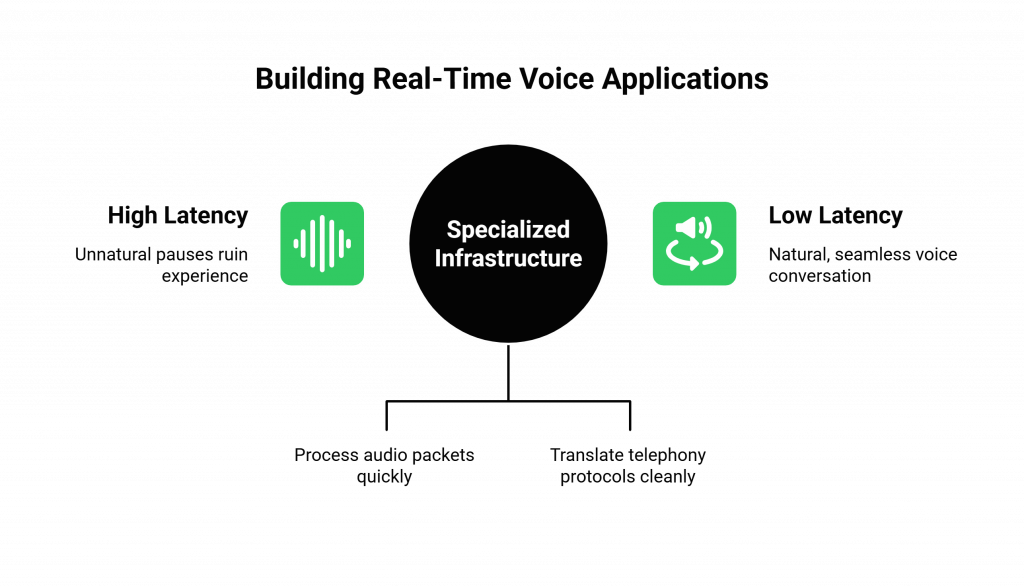
When a user browses a website, a delay of a second or two is often acceptable. In a voice conversation, a delay of even a few hundred milliseconds creates an awkward, unnatural pause that ruins the experience.
- The Problem of Latency: The total time it takes for a user’s voice to travel across the network, be processed by your application, and for a response to travel back is called latency. Minimizing this is the single most important technical challenge.
- The Need for a Specialized Infrastructure: You need a network that is specifically architected for real-time audio streaming, one that can process and transport millions of tiny audio packets every second with minimal delay and perfect reliability.
The Chasm Between Application Logic and Telephony
Your application’s “brain” lives in a world of clean, logical code (your AgentKit). The global telephone network lives in a messy, analog-inspired world of complex protocols like SIP and RTP. There is a massive technical gap between these two worlds.
You need a bridge, a powerful translation layer that can handle the immense complexity of telephony and provide your application with a simple, clean way to interact with the voice stream.
Why Did Legacy Telecom Infrastructure Fail to Provide This Bridge?
For decades, the only way to connect to the phone network was through physical hardware like PRI lines. This model was a complete non-starter for modern application development. It failed because it was:
- Rigid and Unscalable: You had to buy voice capacity in fixed, physical blocks. Scaling up for a sudden spike in users was impossible.
- A “Black Box”: The system was a closed box. It was designed to connect to a traditional desk phone, not to a piece of software. There was no way for a developer to get their hands on the real-time audio stream to process it with an AI.
- Prohibitively Expensive: The hardware, installation, and maintenance costs were astronomical, putting it out of reach for anyone but the largest enterprises.
Also Read: What Is Real-Time Media Streaming and Why It Matters for Voice AI
How Does Elastic SIP Trunking Become the Essential Voice Application Infrastructure?
Elastic SIP trunking is the technology that finally provided the missing bridge. It took the rigid, hardware-based model of the past and transformed it into a flexible, software-defined voice application infrastructure.
A modern, developer-first elastic SIP trunking platform is not just a replacement for the old phone lines; it is a completely new kind of tool designed for software integration.
The Power of Being “Elastic”
The “elastic” nature is what enables a voice application to scale. It means you are not buying a fixed number of call paths. Instead, you have on-demand access to a massive, global pool of capacity.
This allows your application to go from one user to one million users without you ever having to manually provision more “lines.” The infrastructure scales automatically to meet the demand.
The Critical Shift to API-First Programmability
This is the most important evolution. A modern provider is not just selling a connection; they are providing a powerful, API-driven platform. This is the key to a successful SIP trunk integration with your application.
- Programmatic Control: Your application can use an API to control every aspect of the call in real time, making calls, answering calls, playing audio, and more.
- Direct Media Access: This is the game-changer. An API-first platform allows your application to get direct access to the real-time audio streaming of the call. This is the feature that allows you to “pipe” the live conversation into your AI’s brain for processing.
This table clearly illustrates the massive leap from the old world to the new.
| Characteristic | Legacy Voice Infrastructure (PRI) | Modern Voice Application Infrastructure (Elastic SIP Trunking) |
| Foundation | Physical Hardware | Software and APIs |
| Scalability | Rigid, manual, and slow. | Elastic, automatic, and instantaneous. |
| Developer Access | None. It is a closed “black box.” | Deep, programmatic access to call control and real-time media. |
| Cost Model | High upfront capital expense and fixed monthly fees. | Pay-as-you-go, usage-based operational expense. |
| Geographic Reach | Tied to a physical location. | Global and location-independent by design. |
Ready to start building on an infrastructure that was designed for developers? Sign up for FreJun AI to explore our real-time voice platform.
Also Read: Voice AI API: Bringing Intelligence to Voice Communication Systems
How Do These Components Come Together in a Real-World Application?
Let’s imagine you are building an AI conversational platform. The synergy between elastic SIP trunking and your application is a continuous, high-speed loop.
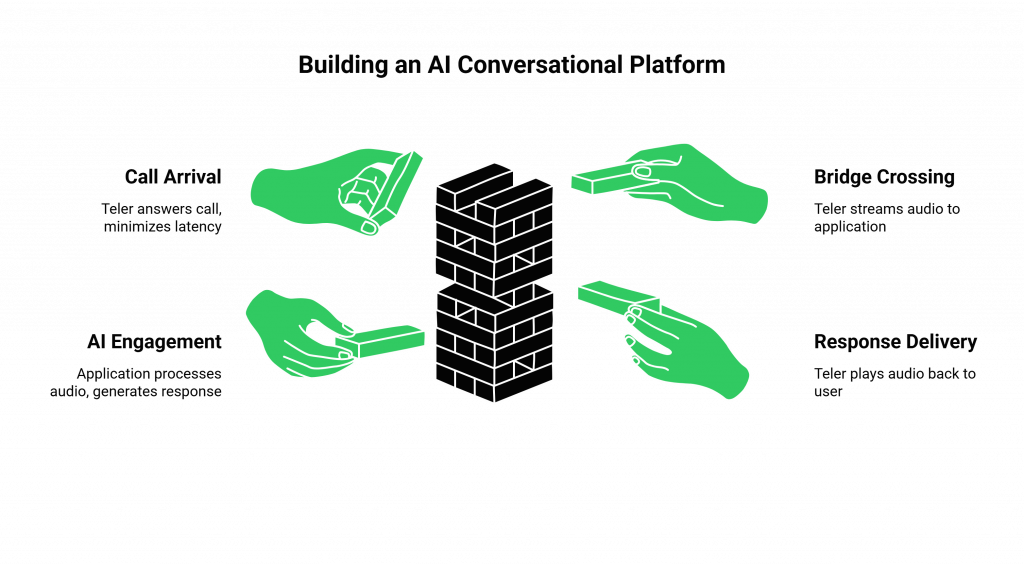
- The Call Arrives: A user calls a number you have provisioned on a platform like FreJun AI. Our Teler engine, the powerful core of our elastic SIP trunking service, answers the call at a data center physically close to the user to minimize latency.
- The Bridge is Crossed: Teler notifies your application of the new call via a webhook and, following your API instructions, begins streaming the live audio directly to your application’s endpoint.
- The AI Engages: Your application receives this audio stream. Your STT engine transcribes it, your LLM processes it, and your TTS engine generates a response. This is your core application logic.
- The Response is Delivered: Your application sends the generated audio response back to the Teler engine via an API command. Teler then plays this audio back to the user on the live call.
This entire round trip happens in a fraction of a second. The elastic SIP trunking layer is not just a passive pipe; it is an active, programmable participant in the real-time workflow.
This is FreJun’s core philosophy: “We handle the complex voice infrastructure so you can focus on building your AI.” The customer expectation for this level of speed is real; a recent study found that 66% of customers expect an immediate response from a company when they have a question, a standard that only a low-latency architecture can meet.
Also Read: How Media Streaming Powers Human-Like Conversations in AI Voice Agents
Conclusion
The dream of building truly interactive, scalable, and intelligent real-time voice applications is now a reality. But the success of these applications does not rest on the brilliance of their AI alone. It rests on the quality of the voice application infrastructure that connects them to the world.
Elastic SIP trunking, when delivered through a modern, developer-first, API-driven platform, provides the essential foundation. It solves the critical challenges of scale, control, and, most importantly, provides the direct, low-latency access to real-time audio streaming that is the lifeblood of any AI conversational platform. It is the invisible but indispensable engine for the future of voice.
Want to do a deep dive into our APIs and see how our elastic SIP trunking infrastructure can power your specific real-time application? Schedule a demo for FreJun Teler.
Also Read: UK Phone Number Formats for UAE Businesses
Frequently Asked Questions (FAQs)
It is a modern, internet-based method for handling business phone calls that replaces traditional phone lines. Its “elastic” nature means it can automatically scale to handle any number of calls, and you only pay for the capacity you use.
It is a software application that involves a live, interactive voice conversation. Examples include AI-powered customer service agents, voice-controlled IVRs, or interactive games played over the phone.
Latency is the delay in the conversation. If the delay between a user speaking and the application responding is too long, the conversation feels unnatural and frustrating, leading to a poor user experience.
It provides on-demand access to a massive, shared pool of call capacity. This means your application can go from handling one call to thousands of simultaneous calls in an instant without any manual changes or new contracts.
This is the ability for a developer’s code to get direct access to the raw, real-time audio stream of a live phone call. This is the key feature that allows a developer to connect a call to an AI for processing.
No. A modern, developer-first provider like FreJun AI abstracts away the low-level telecom complexity. A software developer can interact with the powerful voice network using a simple, well-documented set of web APIs.
Yes. A key benefit of this architecture is being model-agnostic. The job of the elastic SIP trunking platform is to handle the real-time audio streaming. You have complete freedom to use whichever AI models you choose in your application.
A standard VoIP service is a finished product. A platform providing elastic SIP trunking for voice application infrastructure is a set of building blocks for developers. It gives you the power and flexibility to build your own custom, scalable voice applications.
FreJun AI provides the foundational elastic SIP trunking infrastructure (our Teler engine) and the powerful APIs that act as the bridge to your application. We provide the secure, reliable, and low-latency “plumbing” so you can focus on building your application’s intelligence.
With a modern, developer-first platform with clear documentation and SDKs, a developer can get a basic prototype, where a call is answered and the audio is streamed to their application, up and running in a matter of hours.