
In the world of voice communication, the Session Initiation Protocol (SIP) is the undisputed king. It is the foundational protocol that underpins virtually all modern Voice over IP (VoIP) systems, the digital language that allows different phone systems to talk to each other over the internet.
For years, “knowing SIP” meant being a telecom engineer, someone who could configure a PBX, manage a Session Border Controller (SBC), and decipher complex signaling diagrams.
But a profound evolution has taken place. A new paradigm has emerged that takes the raw power of the SIP protocol and wraps it in a developer-friendly layer of abstraction. This is the world of programmable SIP.
For a developer, an IT leader, or a product manager, understanding the sip vs programmable sip distinction is not just a technical nuance; it is a fundamental strategic choice. It is the difference between treating voice as a static, pre-configured utility and treating it as a dynamic, software-driven feature of your application.
This sip protocol comparison will explore the architectural differences between the two models and explain why the advantages of programmable sip are the key to unlocking the next generation of intelligent, automated, and deeply integrated business communications.
Table of contents
What is Traditional SIP? The World of Configuration
Traditional SIP, as it is implemented in most standard SIP trunking and on-premise PBX environments, is a powerful but rigid system. It is a world that is defined by configuration.
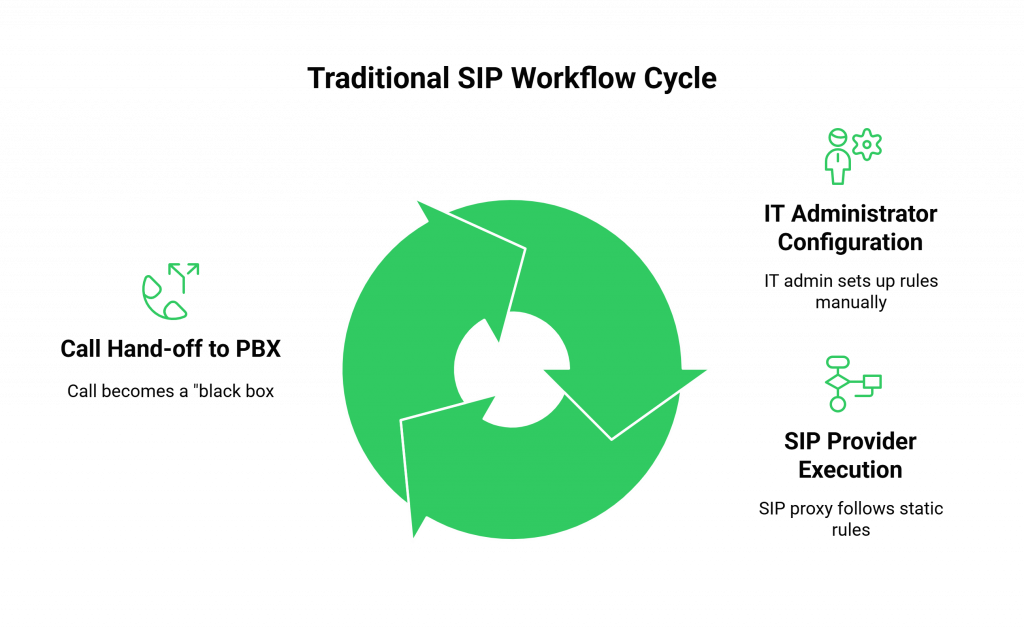
How Does a Traditional SIP Workflow Function?
In a traditional SIP environment, the workflow is static and pre-defined.
- The Setup: An IT administrator logs into a web-based portal or a hardware device’s command line. They manually configure a set of rules. For example, they might create a rule that says, “When a call comes in to the main sales number, route it to the IP address of our on-premise PBX.”
- The Execution: From that point on, the SIP provider’s server (the “SIP proxy”) will follow that static rule for every single call. It is a “set it and forget it” model.
- The “Black Box” Call: Once the call is handed off to the PBX, the SIP provider’s involvement is essentially over. The call becomes a “black box.” The provider has no visibility into what happens inside the PBX (e.g., whether the call is transferred, put on hold, or sent to voicemail).
This model is a direct digital translation of the old telecom world. It is reliable for its specific, pre-configured purpose, but it is incredibly inflexible.
Also Read: Voice AI in Fleet Dispatch Systems
What is Programmable SIP? The World of Orchestration
Programmable SIP is a complete rethinking of the role of the developer in the world of voice. It is a model that is defined by orchestration. Instead of configuring a static set of rules in advance, your application controls the call flow in real-time, step-by-step, using a web API.
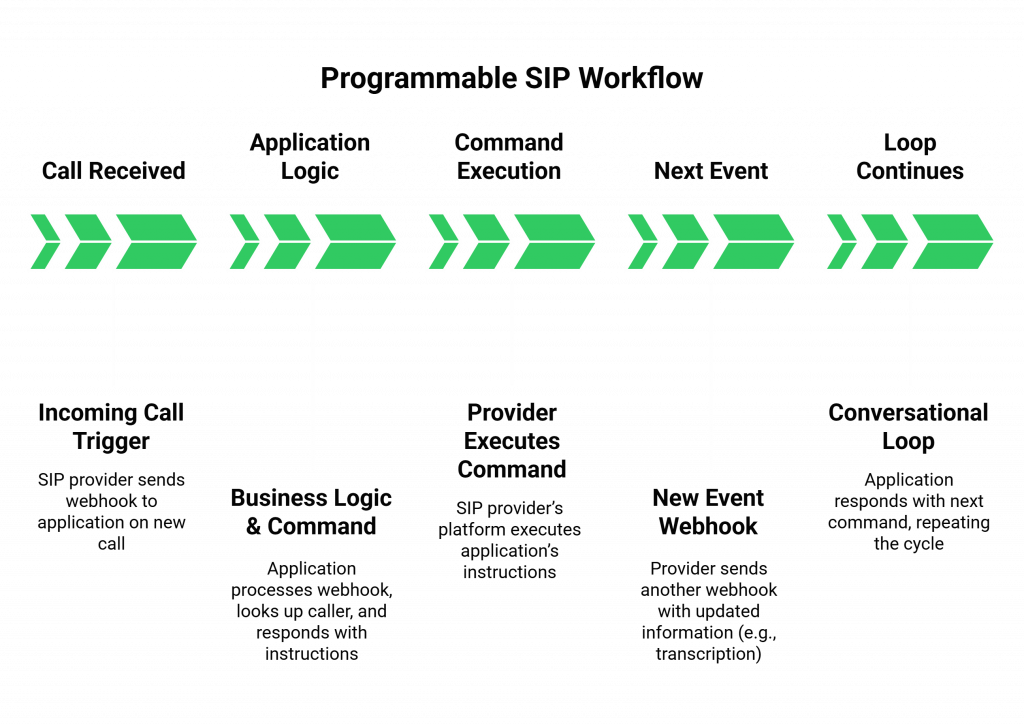
How Does a Programmable SIP Workflow Function?
In a traditional SIP vs API SIP comparison, the difference is night and day. In a programmable model, the SIP provider’s platform becomes a dynamic, real-time media server that is controlled by your application.
- The Trigger: A call comes in. The provider’s platform does not follow a static rule. Instead, it makes an HTTP request (a webhook) to your application’s web server. This is the trigger that says, “A new call has started. What should I do?”
- The Real-Time Command: Your application code receives this webhook. It can then perform any business logic it needs to (e.g., look up the caller’s ID in your CRM). It then responds with a set of instructions, often in a simple XML or JSON format. This instruction might be, “Play a welcome message and then start listening for the caller’s speech.”
- The Conversational Loop: The provider’s platform executes your command. When the next event occurs (e.g., the caller finishes speaking), the platform sends another webhook to your application with the new information (like the transcribed text). Your application then responds with the next command.
Here in this model, your application is the “brain” of the call, and the programmable SIP platform is the powerful, real-time “voice” that is executing your commands.
This table provides a definitive summary of this crucial sip protocol comparison.
| Characteristic | Traditional SIP | Programmable SIP |
| Control Model | Configuration (static, pre-defined rules). | Orchestration (dynamic, real-time control via code). |
| Primary Interface | Web-based GUI for an IT administrator. | REST API for a software developer. |
| Workflow | “Set it and forget it.” | A continuous, event-driven, request-response loop. |
| Flexibility | Rigid and inflexible. | Highly flexible and dynamic. |
| Integration | Limited; the call is a “black box.” | Deep; your application is a core part of the live call flow. |
| Use Case | Connecting a standard PBX to the phone network. | Building custom voice applications, IVRs, and AI agents. |
Ready to move beyond configuration and start orchestrating your business communications? Sign up for FreJun AI.
What Are the Advantages of Programmable SIP for a Developer?
For a developer, the shift from a configured to an orchestrated model is incredibly empowering. It unlocks a new world of possibilities for building intelligent and deeply integrated voice experiences. The advantages of programmable sip are numerous and transformative.
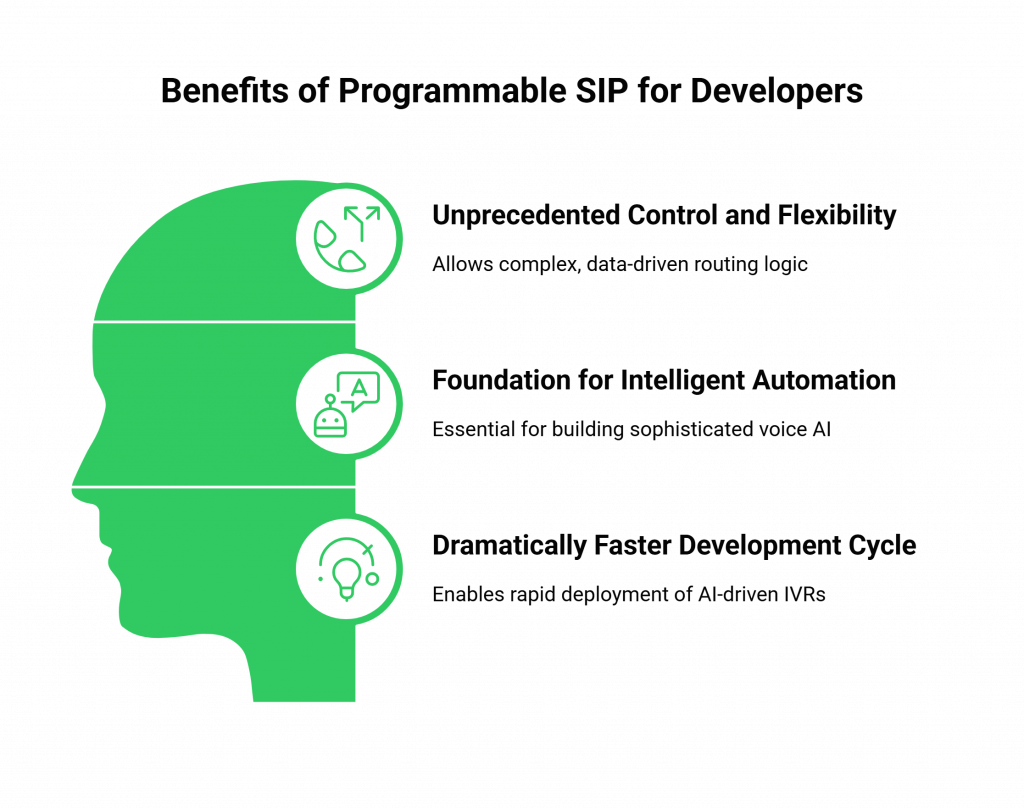
Unprecedented Control and Flexibility
With programmable SIP, you are no longer limited by the pre-packaged features of a PBX. The call flow is a blank canvas, and your code is the paintbrush. You can create complex, data-driven routing logic that would be impossible in a traditional system. For example, you could route a call from a VIP customer directly to their dedicated account manager by doing a real-time lookup in your CRM.
The Foundation for Intelligent Automation
This is the most significant advantage. Programmable SIP is the essential prerequisite for building any kind of sophisticated voice AI. The ability to receive the real-time audio stream, pass it to your AI models (STT, LLM, TTS), and then inject the AI’s response back into the call is a core feature of a programmable platform.
This is a critical point; a recent industry report on automation found that 65% of organizations plan to increase their spending on intelligent automation in the coming year, and voice is a key channel for this.
A Dramatically Faster Development Cycle
Building a custom IVR on a traditional PBX could be a month-long project requiring a specialized consultant. With a programmable SIP platform and its developer-friendly APIs, a software developer can build and deploy a more powerful, AI-driven IVR in a matter of days. This agility is a massive competitive advantage.
Conclusion
The sip vs programmable sip debate is a defining one for the future of business communication. While both technologies are built on the same foundational protocol, their philosophies are worlds apart. Traditional SIP is about configuration; it is about connecting a box.
Programmable SIP is about orchestration; it is about empowering developers to build intelligent, dynamic, and deeply integrated voice experiences. For any business that sees voice not just as a utility, but as a strategic channel for customer engagement and automation, the choice is clear.
The advantages of programmable sip are not just incremental; they are transformative. It is the key that unlocks the full potential of voice in the modern, software-driven world.
Want to see a live demonstration of how our programmable SIP API can be used to build a simple AI agent in just a few minutes? Schedule a personalized demo with our team at FreJun Teler.
Also Read: Telephone Call Logging Software: Keep Every Conversation Organized
Frequently Asked Questions (FAQs)
The fundamental difference is control. With traditional SIP, you configure a static set of routing rules upfront. With programmable SIP, your application controls the call flow dynamically, in real-time, using an API.
Yes, the terms are often used interchangeably. Traditional sip vs api sip is another way of framing the same comparison, where “API SIP” refers to the programmable, developer-first model.
No, and that is its primary advantage. A programmable SIP platform abstracts away the low-level telecom complexity. It allows a software developer who is familiar with standard web APIs to build powerful voice applications without needing to be an expert in the SIP protocol itself.
It is the only way to build a truly sophisticated AI voice agent. You need the real-time, programmatic control over the call’s audio stream that only a programmable platform can provide.
A webhook is a real-time notification that the voice platform sends to your application’s server to inform it of a call event (like a new call or a user speaking). It is the trigger that allows your application to respond with the next command, making it the core of the interactive, event-driven model.
Yes. You can configure a phone number to trigger a webhook to your application for inbound calls. For outbound calls, you can use the provider’s API to initiate the call and provide a webhook URL that the platform will use to orchestrate the call once it is answered.
Yes, many providers, including FreJun AI, can offer both modes. You can use their service as a standard SIP trunk for your PBX, and you can also use their programmable features to build new, custom applications that bypass the PBX entirely.
The main advantages of programmable sip are incredible flexibility to create custom call flows, the ability to deeply integrate voice with other business systems (like your CRM), and the power to build sophisticated AI and automation workflows that can reduce costs and improve customer experience.
Both can be made secure. Security is less about the model (traditional vs. programmable) and more about the provider’s implementation. A high-quality provider will offer robust security features like TLS for signaling encryption and SRTP for media encryption for both their traditional and programmable offerings.