
In the evolution of enterprise technology, we have seen the same powerful story play out time and again: a shift from rigid, on-premise hardware to flexible, on-demand cloud services. We saw it with computing when physical servers gave way to virtual machines in the cloud.
We saw this shift in storage when services like Amazon S3 replaced traditional data centers. In voice communication, the same transformation happens as organizations move from traditional, channelized SIP trunking to its far more powerful and agile successor: elastic SIP trunking.
While both technologies fall under the broad umbrella of “SIP trunking,” the architectural and commercial differences between them are as profound as the difference between owning a physical server and spinning up an EC2 instance.
For a business leader, CTO, or telecom professional, understanding this distinction is not merely a technical nuance; it is a critical strategic decision that will directly impact your company’s financial efficiency, operational agility, and capacity for future innovation.
This guide will provide a definitive breakdown of the two models and explain why embracing an elastic model is a non-negotiable step in modernizing your voice systems.
Table of contents
What is Traditional (Channelized) SIP Trunking?
The first wave of SIP trunking was a revolutionary step, but its design was heavily influenced by the world it was replacing. It was, in essence, a digital re-imagining of the old, physical PRI lines from the Public Switched Telephone Network (PSTN). Its core unit of measurement and sale was the “channel.”
How is Capacity Defined by “Channels”?
The defining characteristic of traditional SIP trunking is the concept of the concurrent call channel.
- A Fixed Capacity Model: When a business purchased a traditional SIP trunk, they were contracting for a fixed number of simultaneous call paths. For example, a company might sign a one-year contract for a 100-channel trunk. This meant they had a hard, inflexible ceiling of 100 active calls at any given moment.
- The “101st Caller” Problem: If the company’s call volume ever exceeded this limit, if a 101st person tried to call in or an employee tried to make a 101st outbound call, that call would fail. The customer hears a busy signal, a jarring and unprofessional experience that tells them your business is overwhelm.
- Manual, Slow Scaling: An administrator must contact their provider’s sales team, renegotiate their contract, and wait for the provider to provision the new capacity to increase channels from 100 to 120. This process could take days or even weeks.
What Are the Economic and Operational Implications of a Channelized Model?
This rigid, channel-based model forces businesses into a wasteful and inefficient economic corner known as the “pay for peak” model. You have to analyze your historical data, predict your absolute busiest moment of the coming year, perhaps the Monday after a major product launch or the peak of your holiday season, and then purchase and pay for that peak capacity for the entire duration of your contract.
The result is a massive amount of paid-for but completely idle infrastructure. For 364 days of the year, you might only use 30 of your 100 channels, but you are paying for all 100.
This overprovisioning is a significant financial drain. It’s a major issue in all forms of IT infrastructure, with recent reports on cloud spending indicating that cloud waste is estimated to be as high as 32%, a problem that the “pay for peak” model directly creates in the world of voice.
Also Read: How Are Elastic SIP Trunking and LLMs Reshaping Business Communication?
What Makes Elastic SIP Trunking a Fundamentally Different Architecture?
Elastic SIP trunking is not just a new pricing plan for the old model; it is a complete architectural and philosophical rethinking of how voice capacity should be deliver. It is a true, cloud-native service.
How Does the “Elastic” Model Redefine Capacity?
The core innovation of elastic SIP trunking is the complete abandonment of the dedicated, purchased channel.
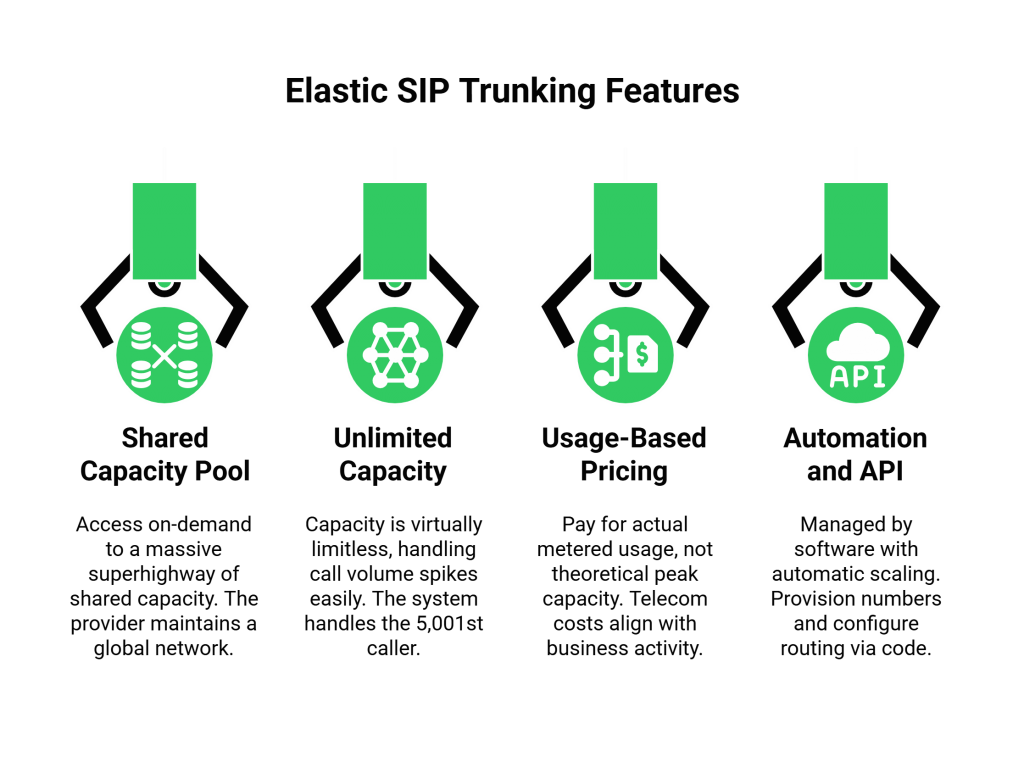
- Access to a Shared Pool: Instead of buying your own private, 100-channel “road,” you get on-demand access to a massive, multi-lane “superhighway” of shared capacity that the provider maintains. The provider, like FreJun AI, builds out a global network with enough capacity to handle the combined peak traffic of all its customers.
- Virtually Unlimited Capacity: From your perspective as a customer, the capacity is virtually limitless. There is no hard ceiling. If your call volume suddenly spikes from 50 to 5,000 simultaneous calls due to a viral marketing campaign, the system simply handles it. The 5,001st caller connects just as easily as the first.
How Does a Usage-Based Pricing Model Create Alignment?
This new architectural model enables a far more logical and efficient pricing model: “pay for use.” You are no longer paying for theoretical peak capacity. Instead, you are billed based on your actual, metered usage.
This can take a few forms, but it is typically a combination of per-minute rates for calls and sometimes a small charge based on the highest number of concurrent calls you actually used in a given billing period.
This aligns your telecom costs directly with your business activity, eliminating waste and providing perfect cost transparency.
What Role Does Automation and API-First Design Play?
True elastic SIP trunking is managed by software, not sales reps. The scaling is automatic and instantaneous. Furthermore, a modern provider builds their entire service around a developer-first, API-driven model.
This means your technical team can provision numbers, configure routing, and even build complex voice applications by writing code, managing their voice infrastructure with the same tools and agility they use for their other cloud services.
Also Read:Real-World Examples of Elastic SIP Trunking in AI Call Automation
This table provides a definitive, at-a-glance comparison of the two models:
| Feature | Traditional (Channelized) SIP Trunking | Elastic SIP Trunking |
| Capacity Model | Fixed number of pre-purchased, dedicated channels. | On-demand access to a massive, shared capacity pool. |
| Scalability | Manual, slow, and requires contract renegotiation. | Automatic, real-time, and instantaneous. |
| Pricing Model | Fixed monthly fee based on peak capacity (“Pay for Peak”). | Usage-based (per-minute or peak concurrent calls) (“Pay for Use”). |
| Handling Spikes | Fails with a busy signal if the channel limit is exceeded. | Seamlessly handles any call volume spike without failure. |
| Efficiency | Highly inefficient; you pay for a large number of idle channels. | Highly efficient; you never pay for unused capacity. |
| Management Interface | Typically a web-based GUI for static configuration. | Primarily API-driven for dynamic, programmatic control. |
Ready to build a voice infrastructure that can keep pace with your business’s ambition? Sign up for FreJun AI and explore our powerful API.
Why Does This Architectural Distinction Matter to Your Business Strategy?
The choice between a channelized and an elastic model is not just a technical detail for the IT department; it has profound, strategic implications for the entire business.
For the Chief Financial Officer (CFO): A Shift from CapEx to OpEx
The financial argument for elastic SIP trunking is overwhelming. By completely eliminating the cost of overprovisioning, businesses can dramatically lower their total cost of ownership for voice. It transforms what was once a large, fixed operational expense into a lean, predictable, and variable cost that scales directly with revenue-generating activities. This provides greater control over cash flow and improves financial forecasting.
For the Chief Technology Officer (CTO): A Foundation for Agility and Innovation
For the technology leader, the API-first nature of elastic SIP trunking is its most powerful feature. It is the key to unlocking true VoIP infrastructure upgrades and modernizing voice systems.
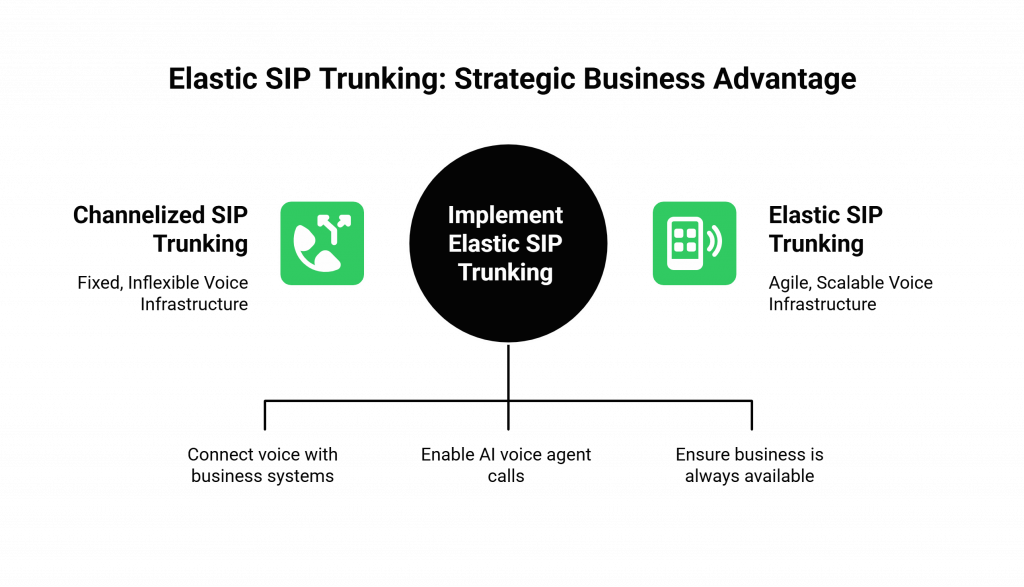
- Enabling AI and Automation: It is impossible to build a scalable AI voice agent that can make thousands of simultaneous outbound calls on a rigid, channelized trunk. The elastic, API-driven model is a non-negotiable prerequisite for any serious AI call automation strategy.
- Integration with Business Systems: The API allows for deep integration between your voice platform and your other core business systems, like your CRM or ERP.
This enables the creation of powerful, automated workflows that can increase efficiency across the entire organization. This API-driven approach is the heart of the Communication Platform as a Service (CPaaS) market, which is projected to grow to over $29 billion by 2025.
For the Head of Customer Experience: Ensuring You’re Always Available
From a customer’s perspective, the worst possible experience is a busy signal. It communicates that you are either unavailable or unprepared. With elastic SIP trunking, you can ensure that your business is always on and always available, no matter how successful your new product launch is or how many customers are calling. This builds a foundation of reliability and trust that is a cornerstone of a positive customer experience.
Also Read: Voice API for Warehouse Automation
Conclusion
The evolution from traditional, channelized SIP trunking to elastic SIP trunking is a perfect reflection of the broader shift in the technology world from on-premise, fixed-capacity models to on-demand, cloud-native services.
While both use the same core protocol, the difference in their architectural philosophy is profound. Traditional SIP trunking solved the problem of physical wires. Elastic SIP trunking solves the far more important business problems of cost, agility, and scale.
For any modern business looking to build a communication infrastructure that is as dynamic and efficient as they are, the choice is clear. The future of business voice is not just in the cloud; it is elastic.
Want to see how an elastic, pay-as-you-go model could impact your specific business’s bottom line? Schedule a personalized demo for FreJun Teler.
Also Read: United Kingdom Country Code Explained
Frequently Asked Questions (FAQs)
The main difference is the capacity model. Traditional SIP trunking is “channelized,” meaning you buy a fixed number of call paths and pay for them whether you use them or not. Elastic SIP trunking is “on-demand,” giving you access to a massive pool of capacity and billing you only for your actual usage.
Yes, the terms are often used interchangeably. They both refer to a usage-based pricing model that eliminates the need for fixed, monthly channel commitments.
No. The capacity is available on demand, but you are billed for what you use. The pricing is typically a combination of a per-minute rate for the calls and sometimes a small fee based on the peak number of concurrent calls you used.
Yes. A high-quality, carrier-grade provider engineers their shared network to have more than enough capacity to handle all of their customers’ peak loads combined. The call quality is crystal clear and highly reliable.
This is where elastic SIP trunking shines. The system is design to handle this automatically. Your calls will continue to connect without any issue, and you will simply be billed for the high usage. With a traditional trunk, your calls would start failing with a busy signal.
Not at all. It is actually an ideal solution for businesses of all sizes, especially small to medium-sized businesses and high-growth startups, because it gives them access to enterprise-grade scalability without the enterprise-grade cost or long-term commitments.
Yes. You can connect an elastic SIP trunk to any modern IP-PBX. This is often the first step for a business that wants to gain the cost and scalability benefits without replacing their entire phone system at once.
Our Teler engine is our core voice infrastructure, which is a powerful, globally distributed elastic SIP trunking platform. We offer it to our customers through a simple, developer-first, API-driven model with a transparent, pay-as-you-go pricing structure.
It is not just suitable; it is essential. The ability to scale to thousands of simultaneous calls for an AI-driven campaign is a core requirement that only a truly elastic platform can provide.
A modern provider will offer a detailed, real-time analytics dashboard. You can see your call volume, your peak concurrent call usage, and your spending at any given moment, giving you complete visibility and control over your communications.