
Imagine you own a shipping company. In the old days you had to own every single truck in your fleet. If you had a busy month you ran out of trucks and lost customers. If you had a quiet month you still had to pay for the trucks to sit in the parking lot. It was expensive and rigid.
Now imagine a new model. You have access to an infinite fleet of trucks. You call for one when you need it and you pay for the miles it drives. When you are done it disappears. You never pay for parking and you never run out of capacity.
This is the exact difference between traditional SIP Trunking and modern voice API integration.
For decades businesses have relied on SIP (Session Initiation Protocol) Trunks to connect their office phone systems (PBX) to the outside world. It worked well enough. But in the era of Artificial Intelligence and remote work and global scalability the old “fixed capacity” model is breaking down.
Businesses are asking a critical question. Is it time to cut the cord on traditional trunks and move fully to a software defined voice model?
In this guide we will explore the pros and cons of both systems. We will look at cost and scalability and feature sets. We will also explain how infrastructure platforms like FreJun AI are bridging the gap by offering the best of both worlds through elastic connectivity and powerful developer tools.
Table of contents
- What Is the Core Difference Between SIP Trunks and APIs?
- Why Are Traditional SIP Trunks Becoming Obsolete?
- What Does Voice API Integration Offer?
- Comparison: Traditional SIP vs Voice API
- Is Voice API Integration More Expensive?
- How Does Infrastructure Play a Role in This Decision?
- Can You Integrate AI with Standard SIP Trunks?
- Who Should Stick with SIP Trunks?
- How to Migrate from SIP to API?
- What About Security and Reliability?
- The Developer Advantage
- Conclusion
- Frequently Asked Questions (FAQs)
What Is the Core Difference Between SIP Trunks and APIs?
To make a decision you need to understand what you are buying.
A SIP Trunk is a digital version of a phone line. It is a virtual wire that connects your on premise phone system to the internet service provider (ISP). You typically buy “channels.” If you buy 20 channels you can have 20 simultaneous calls. If the 21st person calls they get a busy signal. It is a connection method.
Voice API integration is different. It is an application layer. It is a set of code commands that allows your software to initiate calls directly. You do not buy channels. You just make requests. The provider handles the capacity in the background.
Think of SIP as the raw plumbing pipe. Think of the Voice API as a smart faucet that controls the water temperature and flow and even tells you how much water you used.
Why Are Traditional SIP Trunks Becoming Obsolete?
The traditional SIP model served us well but it has limitations that are becoming painful in a modern digital economy.
The Capacity Trap
With traditional SIP you have to guess your future needs. This is called “capacity planning.”
- If you buy too few channels you block customers during peak times.
- If you buy too many channels you waste money on unused lines.
The Hardware Dependency
SIP trunks usually connect to a PBX (Private Branch Exchange). This is often a physical box in a server room. It requires maintenance. It requires electricity and a technician to fix it when it breaks.
The Lack of Intelligence
A SIP trunk is dumb. It just passes audio and does not transcribe the call. SIP trunk does not analyze sentiment. It does not integrate with your CRM. To do those things you need to buy expensive add on hardware or software.
Also Read: Why Is Low Latency Essential for Modern Voice Bot Solutions?
What Does Voice API Integration Offer?
Moving to an API driven model changes voice from a utility into a feature of your software.
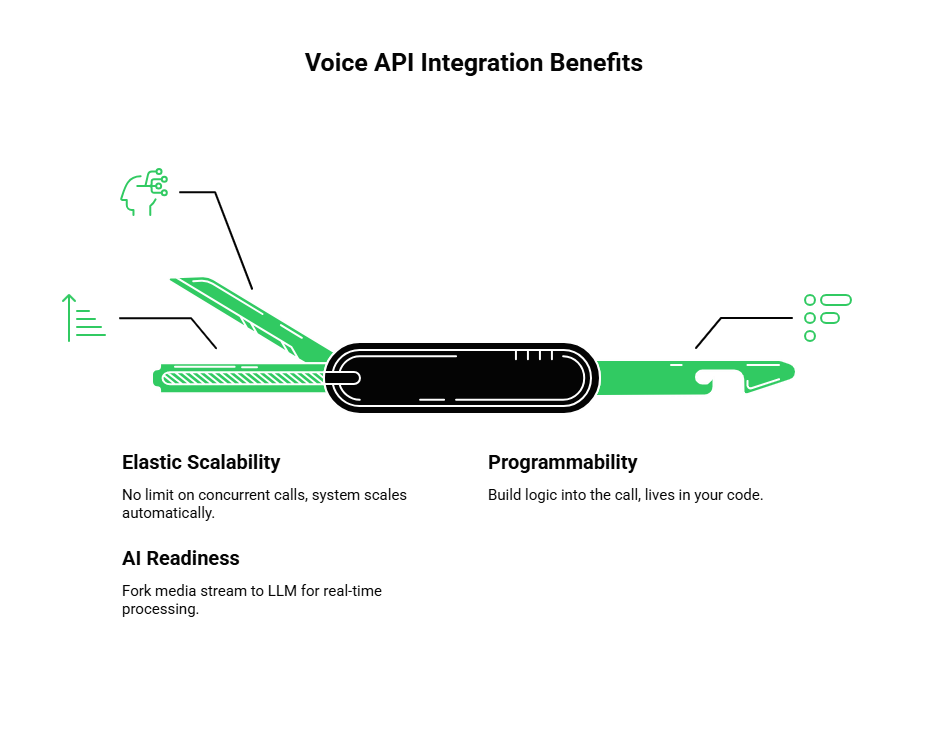
Elastic Scalability
This is the biggest advantage. With voice API integration there is no limit on concurrent calls.
- Monday morning: 10 calls.
- Black Friday: 10,000 calls.
The system scales automatically. You do not need to call your provider to add lines. You do not need to upgrade your server. Platforms like FreJun AI handle this elasticity invisibly. Our FreJun Teler infrastructure is built to absorb massive spikes in traffic without breaking a sweat.
Programmability
APIs allow you to build logic into the call.
- “If the caller is from France route to Pierre.”
- “If the caller is a VIP play a special greeting.”
- “If the call is missed send an SMS automatically.”
This logic lives in your code not in a clunky hardware menu.
AI Readiness
This is crucial for the future. Modern APIs allow you to fork the media stream. You can send the audio to a Large Language Model (LLM) for real time processing. Trying to do this with a legacy SIP trunk is incredibly difficult and requires complex gateways.
Comparison: Traditional SIP vs Voice API
Here is a breakdown of how the two approaches stack up against each other.
| Feature | Traditional SIP Trunking | Cloud-Based Voice API |
| Setup Time | Days or Weeks | Minutes |
| Capacity | Fixed (Pay per channel) | Infinite (Pay per minute) |
| Hardware | Requires PBX/SBC | No hardware required |
| Scalability | Manual upgrades needed | Automatic / Elastic |
| Maintenance | High (IT staff needed) | Low (Provider managed) |
| Features | Basic calling | Recording, AI, Analytics |
| Global Reach | Hard (Need local carriers) | Easy (Global network) |
Is Voice API Integration More Expensive?
This is the most common objection. “Don’t APIs cost more per minute?”
On paper a per minute rate for an API might look higher than a flat rate SIP trunk. But you have to look at the Total Cost of Ownership (TCO).
With a SIP trunk you pay for:
- The flat monthly fee (even if you don’t use it).
- The PBX hardware maintenance.
- The electricity and cooling for the server room.
- The salary of the IT person who manages it.
With voice API integration you pay:
- For the minutes you actually use.
For many businesses especially those with fluctuating call volumes the API model is significantly cheaper. It turns CapEx (Capital Expenditure) into OpEx (Operational Expenditure).
How Does Infrastructure Play a Role in This Decision?
Switching to an API means trusting a third party with your voice quality. If the internet goes down your phones go down.
This is why choosing the right infrastructure partner is non negotiable.
You need a provider that offers “Elastic SIP Trunking” as a service. This is what FreJun Teler provides. We give you the reliability of a carrier grade SIP trunk but we wrap it in a modern API layer.
We ensure:
- Low Latency: We route calls through the fastest internet paths to prevent delay.
- Redundancy: If one data center fails traffic moves to another instantly.
- Quality: We use high definition codecs to ensure voice clarity.
By using FreJun you are not just getting an API. You are getting a global telecommunications network that acts like software.
Also Read: What Makes Voicebot Solutions Suitable for Multilingual Customers?
Can You Integrate AI with Standard SIP Trunks?
Technically yes but it is painful.
To get AI data from a standard trunk you usually have to use a “port mirroring” port on your switch to copy the audio packets. Then you have to decode them. Then you have to stream them to the cloud.
It is a mess of wires and configuration.
With voice API integration media streaming is a built in feature. You simply tell the API “Stream this call to this WebSocket URL” and FreJun handles the rest. This makes building AI Agents, automated transcription, and real time coaching tools incredibly easy.
Who Should Stick with SIP Trunks?
Is the API model right for everyone? Not necessarily.
If you have a massive office with 5,000 employees sitting at desks and they only make internal calls to each other a traditional PBX with a SIP trunk might still be cost effective. Internal extension dialing is free on a PBX.
However most modern companies are hybrid. Employees are at home. They use Slack and Zoom. They need to talk to customers globally. For these companies the flexibility of the API wins every time.
Even if you have an on premise PBX you can upgrade it. You can replace your “Static SIP Trunk” with FreJun Teler’s Elastic SIP Trunk. This gives your old PBX the ability to scale infinitely without buying new hardware. It is a great middle ground.
How to Migrate from SIP to API?
You do not have to rip and replace everything overnight. A phased migration is often best.
Step 1 Hybrid Approach
Keep your existing desk phones on the old system. Move your customer support team or sales team to a new API driven software platform.
Step 2 Port Numbers
Move your main business phone numbers to the cloud provider. Sign up for FreJun AI and initiate a port request. This moves the control of the number from the old carrier to the new API platform.
Step 3 Decommission Hardware
Once your traffic is moving through the API you can start unplugging the old servers. You will see your electricity bill drop and your office quiet down.
What About Security and Reliability?
Security managers often love physical wires because they can see them. The cloud feels scary.
But modern voice API integration is often more secure than legacy systems.
- Encryption: FreJun encrypts voice traffic (SRTP) and signaling (TLS). Old SIP trunks often send audio in plain text.
- Fraud Protection: We monitor for toll fraud patterns (like hacking a PBX to call premium numbers) and block them automatically.
- Uptime: A physical wire can be cut by a construction crew. The cloud has multiple redundant paths.
The Developer Advantage
The final argument for APIs is innovation.
If you want to add a new feature to a SIP system you have to wait for the vendor to release it. It might take years.
With an API your developers can build it this afternoon.
- Want to add a “click to call” button on your website?
- Want to automatically log calls in Salesforce?
- Want to build a custom IVR that checks inventory?
Your team can build these features using standard web languages. This speed of innovation gives you a competitive advantage.
Also Read: How Can Voice bot Solution Scale Across Global Voice Operations?
Conclusion
The question “Should we replace SIP trunks?” is actually a question about the future of your business.
If you view voice as a utility like electricity that just needs to be “on,” then a traditional SIP trunk is fine.
But if you view voice as a strategic asset, a way to gather data, improve customer experience, and integrate with AI, then voice API integration is the only logical choice.
It removes the physical limits on your growth, allowing you to pay only for what you use. It opens the door to the world of Artificial Intelligence.
Platforms like FreJun AI make this transition easy. We provide the infrastructure that gives you the elasticity of the cloud with the reliability of a carrier. With FreJun Teler, you can modernize your voice stack without sacrificing quality. We handle the complex voice infrastructure so you can focus on building the intelligent communication flows that will drive your business forward.
Ready to modernize your voice infrastructure? Schedule a demo with our team at FreJun Teler and let us help you build a scalable, future proof communication strategy.
Also Read: Failover Call Routing: Ensure 100% Call Continuity During Downtime
Frequently Asked Questions (FAQs)
Yes. You can often configure your SIP phones to register directly with the cloud platform. Alternatively you can use a “SIP Gateway” feature provided by platforms like FreJun.
It is a modern version of a SIP trunk that lives in the cloud. Unlike a traditional trunk with a fixed number of channels an elastic trunk automatically scales up to handle as many calls as you need instantly.
Not anymore. Years ago internet connections were slow. Today with high speed fiber and optimized routing from providers like FreJun cloud voice quality is often superior to traditional landlines.
Since the “brain” of the system is in the cloud calls can still be answered even if your office internet is down. You can route calls to mobile phones or take voicemails automatically ensuring business continuity.
It is a regulated process so it takes a few days or weeks depending on the country. However your provider (FreJun) handles the paperwork. You just provide a bill proving you own the number.
Yes to get the most out of it. However many platforms offer “low code” or “no code” visual builders that allow non technical staff to design simple call flows.
Yes. This is common. You might use a SIP trunk for the office phones and an API for your website’s chatbot voice feature. They can coexist on the same network infrastructure.
FreJun Teler offers competitive per minute rates and eliminates the monthly rental fees associated with traditional channel based trunks. You stop paying for idle capacity.