
For years, the conversation around Elastic SIP Trunking has been dominated by its foundational benefits: cost reduction, geographic flexibility, and freedom from the PSTN. It was, and still is, the essential plumbing of modern enterprise voice.
But a quiet revolution has been happening. The traffic flowing through these virtual pipes is no longer just human-to-human. It is increasingly human-to-machine and machine-to-machine.
The abstract concept of “AI call automation” has left the lab and is now a powerful, real-world force, actively reshaping industries from finance to healthcare. The invisible engine making this all possible at scale is a sophisticated, API-driven Elastic SIP Trunking infrastructure.
This is not a future-gazing exercise. Leading enterprises and disruptive startups are already deploying sophisticated voice AI agents to automate everything from routine customer service to complex sales outreach.
These applications, handling thousands of simultaneous, low-latency conversations, would be technically impossible and financially unviable on legacy telecom infrastructure. They demand a new kind of voice network, one that is programmable, globally scalable, and built for the real-time data demands of artificial intelligence.
This article will explore real-world examples of how businesses are leveraging Elastic SIP Trunking as the critical foundation for their AI call automation strategies.
Table of contents
Why is Elastic SIP Trunking the Unsung Hero of AI Voice Automation?
Before diving into the examples, it is crucial to understand why Elastic SIP Trunking is the indispensable enabler of this revolution. An AI conversation is not just a phone call; it is a high-frequency data exchange. The success of this exchange hinges on three capabilities that are native to a modern voice infrastructure.
- Hyper-Scalability on Demand: An AI-powered system can trigger thousands of outbound calls for a marketing campaign or need to handle a massive inbound spike during a service alert. Elastic SIP Trunking provides the ability to scale from one to thousands of concurrent call paths in seconds, ensuring capacity is always perfectly matched to demand.
- Programmable Media Access: An AI needs to “hear.” This requires direct, real-time access to the call’s raw audio stream (RTP). A modern, API-first provider allows developers to programmatically fork this media stream and send it directly to a Speech-to-Text engine, which is the first step in any AI conversation.
- Low-Latency Global Connectivity: A natural conversation is a fast one. The infrastructure must be architected to minimize delay. This means having a globally distributed network of Points of Presence (PoPs) that can handle the call at the edge, physically closer to the end-user, ensuring the round-trip time for the AI’s response is imperceptible.
Also Read: How MCP Servers Bridge AgentKit and Teler for AI Workflow Automation?
How Are Enterprises Leveraging This Technology for Customer Service?
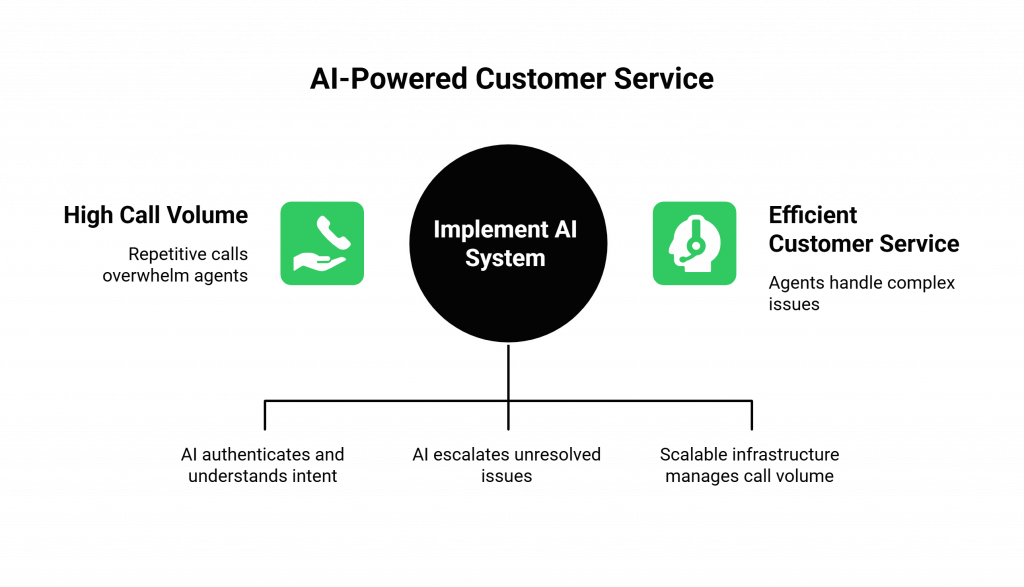
Large enterprises are at the forefront of using AI to deflect high-volume, repetitive inbound calls, freeing up their human agents to handle more complex issues.
Example 1: The Modernized Contact Center – ING and Lyft
Global brands across finance and technology rely on scalable voice infrastructure to power their customer interactions. For instance, banking giant ING and ride-hailing leader Lyft both utilize Twilio’s communications platform, which is built upon a global Elastic SIP Trunking infrastructure.
- The Workflow: When a customer calls, the call is first handled by an intelligent virtual agent. This AI can authenticate the user, understand their intent (“I need to report a lost card,” “Where is my driver?”), and handle the request automatically. This self-service channel is crucial; a recent report indicated that 81% of customers across all industries attempt to take care of matters themselves before reaching out to a live agent. The system seamlessly escalates the call to a human agent only when the AI cannot resolve the issue and provides the agent with the full context of the conversation so far.
- How Elastic SIP Trunking Enables This:
- Massive Scalability: A company like Lyft needs to handle millions of calls from riders and drivers, with unpredictable spikes. Only a truly elastic infrastructure can manage this scale globally.
- Deep Integration: The API-driven nature of the trunking allows for tight integration with the company’s CRM and internal tools, enabling the AI to pull customer data in real time.
Also Read: How to Integrate Teler with AgentKit? Real-time Voice Agents through the MCP Server
What Role Does it Play in Proactive Outbound Communication?
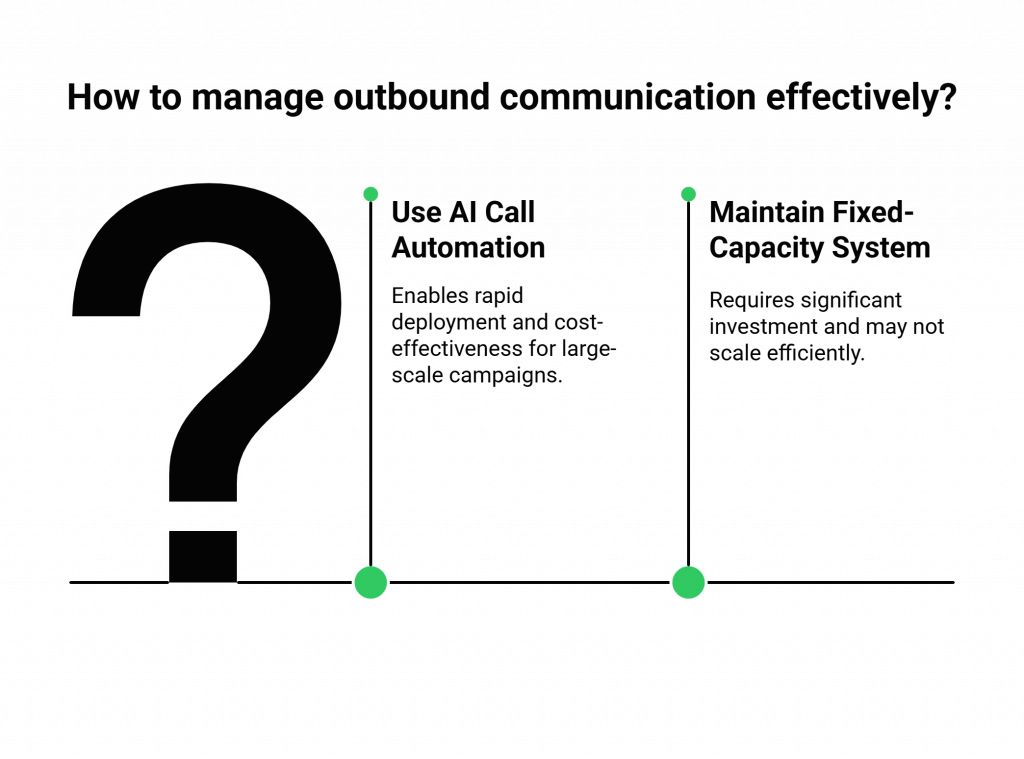
AI call automation is not just for inbound calls. It is a powerful tool for proactive, large-scale outbound campaigns that require a personal touch.
Example 2: The Proactive Notification – The American Red Cross
Humanitarian organizations with massive volunteer and donor bases, like The American Red Cross, use this technology for critical outreach. They leverage a CPaaS provider’s Elastic SIP Trunking to power their communication for everything from disaster response coordination to blood drive reminders.
- The Workflow: In the event of a local disaster, the system can automatically trigger thousands of outbound calls to registered volunteers in the affected area with crucial information. For blood drives, an AI agent can call potential donors, remind them of an upcoming drive, and even help them schedule an appointment to donate.
- Why Elastic SIP Trunking is Critical Here:
- Rapid Deployment & Scale: The ability to instantly make thousands of simultaneous outbound calls is essential for time-sensitive alerts.
- Cost-Effectiveness: For a non-profit, the pay-as-you-go model of Elastic SIP Trunking is far more financially sustainable than maintaining a massive, fixed-capacity phone system.
Ready to build the next generation of voice automation? Sign up for FreJun AI and explore our API-driven voice infrastructure.
Also Read: Step-by-Step Guide to Building Voice-Enabled AI Agents Using Teler and OpenAI’s AgentKit
How Are Startups Disrupting Sales with AI Call Automation?
Perhaps the most cutting-edge application is in the world of sales. Disruptive startups are building AI agents that can perform the role of a human Sales Development Representative (SDR).
Example 3: The AI Sales Development Representative (SDR)
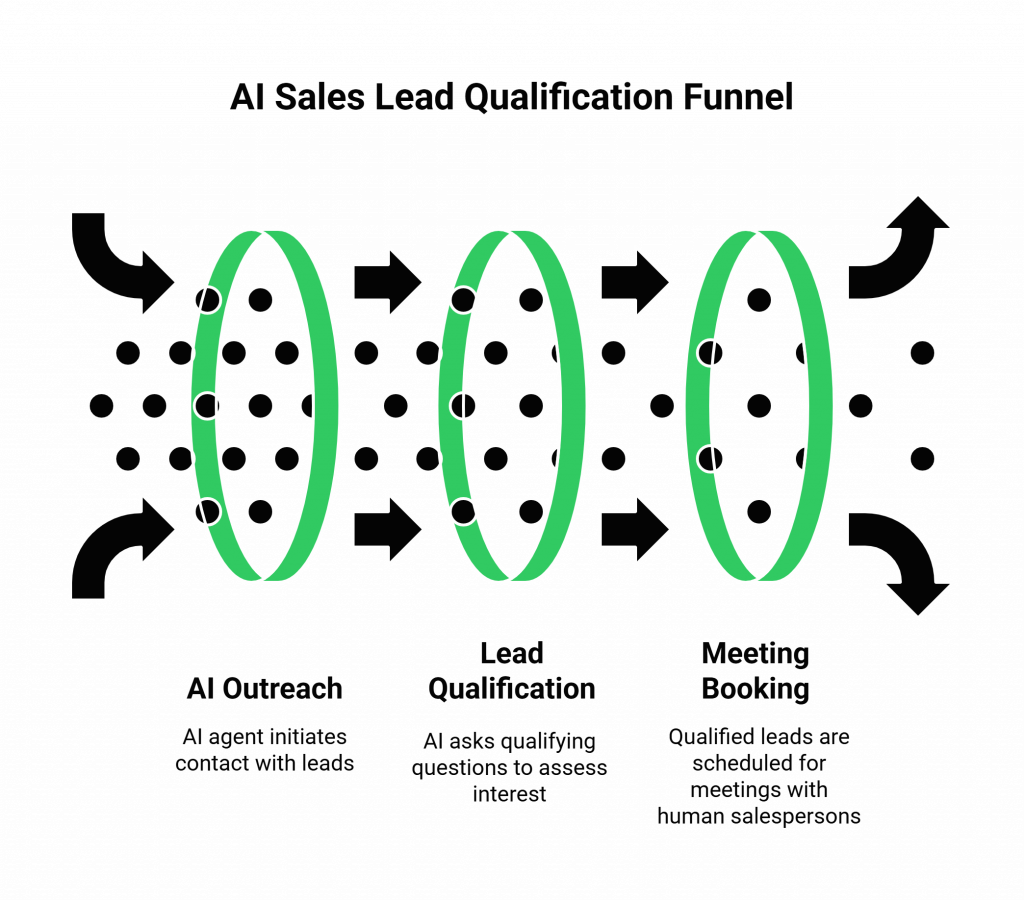
Startups like Air AI have demonstrated the power of using hyper-realistic voice agents to conduct initial sales outreach and lead qualification at a massive scale.
- The Workflow: The system is given a list of leads from a CRM. The AI agent calls each lead, introduces itself, asks a series of pre-programmed qualifying questions, and can even navigate complex conversational tangents. If a lead is qualified and shows interest, the AI’s ultimate goal is to book a meeting on a human salesperson’s calendar.
- What is the role of the underlying voice infrastructure?
- Ultra-Low Latency: For a sales conversation to be effective, it cannot have any awkward pauses. The AI’s response must be nearly instantaneous. This requires an Elastic SIP Trunking provider that is architected from the ground up for low-latency media processing, like the FreJun AI platform.
- API-Driven Agility: This entire workflow is code. The startup’s application is using an API to tell the voice infrastructure to make a call, to listen, to respond. This tight, programmatic integration is essential and is only possible with a developer-first platform.
This table provides a summary of these real-world applications:
| Company Example | Industry | Use Case | Critical Role of Elastic SIP Trunking |
| ING / Lyft | Finance / Tech | AI-Powered Contact Center | Handles massive, unpredictable call spikes; enables deep CRM integration. |
| American Red Cross | Non-Profit | Proactive Volunteer/Donor Outreach | Rapid, large-scale outbound calling; cost-effective pay-as-you-go model. |
| Air AI | Sales Tech | AI Sales Development Rep | Ultra-low latency for realistic dialogue; deep API integration for automation. |
Note: The use cases of elastic SIP trunking is not only limited to the above industry. No matter what your industry is, if you want to give better experience to your customers or audience, elastic SIP trunking can help you.
Conclusion
The theoretical promise of AI call automation is now a practical reality, and the evidence is all around us. From the way global brands like ING manage customer service to how non-profits like the American Red Cross coordinate volunteers, intelligent voice agents are seamlessly integrating into critical business operations.
These applications, while diverse in their purpose, all share a common, invisible foundation: a powerful, scalable, and developer-friendly Elastic SIP Trunking infrastructure. The technology has evolved far beyond its origins as a cost-saving measure.
Today, it is a strategic enabler, providing the essential, low-latency connectivity that allows brilliant AI to finally find its voice. For any business looking to innovate in the world of customer communication, mastering this foundational layer is the first and most important step.
Want to discuss how our Elastic SIP Trunking infrastructure can power your specific AI call automation project? Schedule a demo with our team at FreJun Teler.
You May Read: How to Log a Call in Salesforce? A Complete Setup Guide
Frequently Asked Questions (FAQs)
It is a modern, IP-based method for connecting a business’s phone system to the public telephone network. Its “elastic” nature allows a business to instantly scale its call capacity up or down and only pay for the capacity it uses.
AI voice applications require three things that traditional telecom cannot provide: massive scalability to handle call spikes, direct API access to the real-time audio stream, and an ultra-low-latency connection to ensure conversations sound natural. Elastic SIP Trunking is the technology that provides all three.
Global brands like ING and Lyft, as well as non-profits like the American Red Cross, use communications platforms that are built on top of a core Elastic SIP Trunking infrastructure to power their customer and volunteer interactions.
Yes. As the examples show, it is the foundation for both inbound customer service bots (like in banking) and proactive outbound campaigns (like in healthcare and sales).
It saves money in two main ways. First, the pay-as-you-go model is far cheaper than paying for fixed-capacity traditional phone lines. Second, by automating calls that would otherwise be handled by a human agent, it dramatically reduces labor costs in a contact center.
No. A modern, developer-first provider like FreJun AI abstracts away the low-level telecom complexity. A software developer can interact with the powerful voice network using a simple, well-documented set of APIs.
Latency is the delay between when a user stops speaking and when they hear the AI’s response. If this delay is too long, the conversation feels unnatural and awkward. Low latency is the key to making an AI agent sound realistic and professional.
FreJun AI provides the foundational Elastic SIP Trunking infrastructure, which we call our Teler engine. We handle all the complex, behind-the-scenes work of managing the global voice network. We ensure low-latency connectivity, and providing the powerful APIs that allow developers to connect their AI applications to it.
Consumer VoIP is a finished product for making calls. Elastic SIP Trunking is an infrastructure-level component. It is a raw material that gives developers power and control they need to build their own custom voice applications.