
A lone driver is navigating a complex delivery route, facing a sudden road closure. A ride-hail operator is trying to find their passenger in a chaotic airport pickup zone. A long-haul trucker needs to report an unexpected mechanical issue from the middle of nowhere.
In these moments, the driver is the most critical and most isolated part of the entire operation. Their only lifeline is the dispatch center, a connection that is often slow, distracting, and inefficient.
This traditional model of support is failing our drivers. The solution is not another app or a better radio; it is a dedicated, in-cab partner: an AI voicebot.
The role of the modern driver, whether in logistics, ride-hailing, or field services, is more demanding than ever. They are expected to be navigators, customer service agents, and logistics experts, all while safely operating a vehicle.
By embedding an intelligent AI voicebot directly into their workflow, companies can provide a “virtual co-pilot” that offers instant, hands-free support, transforming the driver’s cab into a truly connected and intelligent workspace.
Table of contents
Why is Traditional Driver Support Failing on the Road?
The old model of a driver calling a human dispatcher for every minor issue is a system that creates bottlenecks, compromises safety, and frustrates everyone involved. It is a communication strategy that simply cannot keep up with the real-time demands of a modern mobile workforce.
The fundamental flaws are clear:
- Severe Safety Risks: This is the most critical failure. Any communication that requires a driver to take their hands off the wheel or their eyes off the road is a direct threat to their safety and the public’s. A recent study by the Virginia Tech Transportation Institute found that manually using a cell phone increases the risk of a crash by 3.6 times.
- Crippling Communication Delays: The process is painfully slow. A driver calls dispatch, often waits on hold, explains their issue, and then waits again while the dispatcher looks up the information. This lag time is a major drain on driver productivity.
- Overwhelmed Dispatch Centers: Dispatchers are a vital resource, but they are often swamped with a high volume of routine, low-value calls. They spend their day answering the same questions about gate codes or delivery windows, which prevents them from focusing on genuine emergencies or complex logistical problems.
- A Lack of Real-Time Context: When a driver calls, the human dispatcher has to manually pull up their location, route, and order details. This takes time and can lead to errors. The dispatcher does not have the instant, holistic view of the situation that an integrated AI would.
How Does an AI Voicebot Act as a Virtual Co-Pilot?
An AI voicebot integrated into a driver’s mobile app or in-cab device acts as an always-on, intelligent assistant that is deeply connected to the core operational systems. It is designed to provide instant answers and perform routine tasks, all through natural, conversational voice commands.
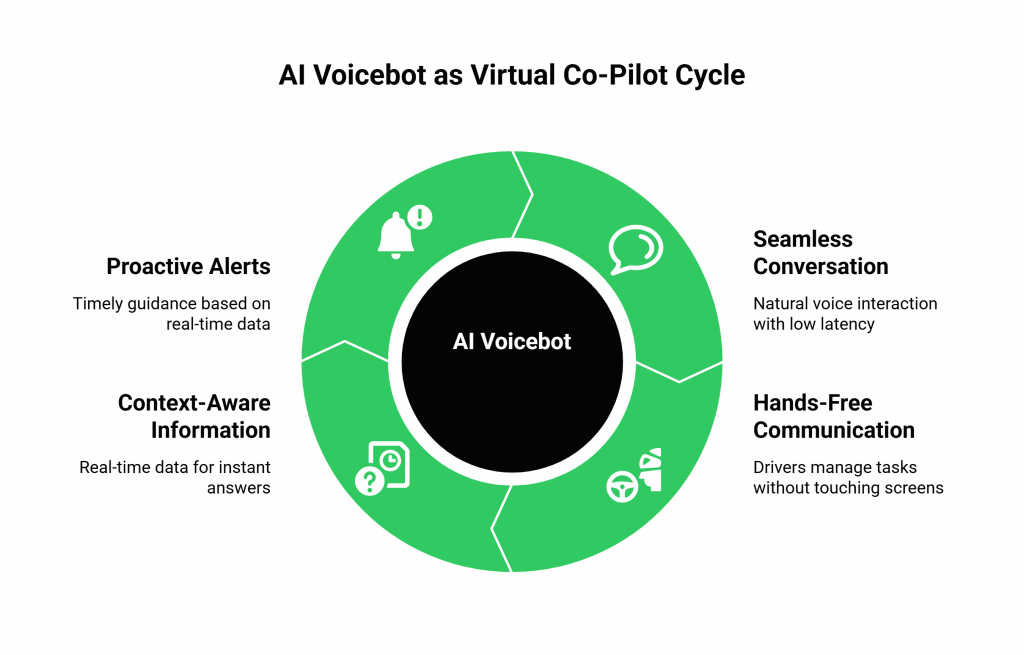
For this to work, the conversation must be seamless and instant. This is where the underlying voice infrastructure from a provider like FreJun AI is the crucial engine.
We handle the real-time, low-latency audio streaming that makes the interaction feel as natural and responsive as talking to a person sitting in the passenger seat.
How Does It Enable Truly Hands-Free Communication?
The primary goal is to keep the driver focused on driving. An AI voicebot allows them to manage their workflow without ever touching a screen.
Using simple voice commands, a driver can:
- Update Their Status: “Mark this delivery as complete.”
- Report an Issue: “Report a delay. I am stuck in heavy traffic.”
- Manage Their Next Stop: “Call the next customer to confirm they are home.”
Also Read: Building Human-Like Voice Conversations with AI
How Does It Provide Instant, Context-Aware Information?
Because the AI voicebot is connected to your core systems (TMS, WMS, CRM), it has a complete, real-time understanding of the driver’s context. This allows it to act as an instant knowledge base. A driver can ask:
- “What is the gate code for this delivery location?”
- “Are there any special instructions for this order?”
- “Confirm the receiving hours for this warehouse.”
The AI pulls this data in milliseconds and provides a clear verbal answer, eliminating a time-consuming call to dispatch.
How Does It Automate Proactive Alerts and Guidance?
A sophisticated AI voicebot is not just a passive tool; it can be a proactive guide. By monitoring real-time data from GPS, traffic feeds, and weather alerts, it can provide critical information before the driver even knows they need it.
For example, the system can detect a major accident on the driver’s planned route and the AI can proactively say, “Alert: There is a multi-car pile-up on the I-5 ahead. A faster, alternative route is available. Say ‘accept’ to be rerouted.”
What Are the Key Benefits for Fleet Operations?
Integrating an AI voicebot for real-time driver support is a strategic investment that delivers powerful, measurable benefits across the entire operation. It creates a safer, more efficient, and more data-driven fleet. Here is a clear comparison of the two support models:
| Feature | Traditional Human Dispatch | AI Voicebot Support |
| Driver Safety | High risk of distracted driving from manual calls. | Significantly enhanced with a 100% hands-free interface. |
| Efficiency | Slow, with communication delays and manual lookups. | Instant, with real-time data retrieval and automated tasks. |
| Data Accuracy | Relies on manual notes; prone to human error. | Perfect accuracy, with every interaction digitally logged. |
| Dispatcher Focus | Overwhelmed by routine, repetitive calls. | Manages true exceptions and solves complex problems. |
Ready to give your drivers the intelligent co-pilot they deserve? Sign up for FreJun AI and get your API keys to start building a safer, smarter fleet.
Also Read: AI Voicebot Platforms Compared: 2025 Review
How Do You Implement an In-Cab AI Voicebot?
Deploying a powerful AI voicebot for your drivers is a more accessible project than it may seem. It involves a logical process of defining your needs and building on a reliable technology stack.
- Define Your Key Use Cases: Start by identifying the top 3-5 most common and time-consuming interactions your drivers have with dispatch. This could be status updates, delay reporting, or information requests. This will be the initial focus of your AI’s capabilities.
- Choose Your AI Stack: You will need the core components of conversational AI: a Speech-to-Text (STT) engine, a Large Language Model (LLM), and a Text-to-Speech (TTS) engine. It is crucial to select an STT model that is specifically trained to perform well in noisy, in-cab environments.
- Integrate with Your Core Systems: The AI needs to be connected to your operational brain. This involves using APIs to link it to your Transportation Management System (TMS), routing software, and order databases.
- Build on a Robust Voice Infrastructure: The intelligence of your AI is only effective if the conversation is clear and instant. This is the essential role of FreJun AI. We provide the enterprise-grade “plumbing” that handles the complex telephony and real-time, low-latency audio streaming. Our model-agnostic platform gives you the freedom to use the best AI models for your specific environment. We handle the complex voice infrastructure so you can focus on building your AI.
Also Read: Choosing the Right Voice API for Your Business
Conclusion
The driver’s seat is the most critical and most exposed part of any mobile operation. For too long, we have relied on outdated, unsafe, and inefficient methods to support our drivers.
An AI voicebot marks a fundamental shift in this paradigm. It provides a dedicated, intelligent, and always-on “virtual co-pilot” that empowers drivers with the information they need, exactly when they need it, all through the safety of their own voice.
By adopting this technology, companies can build a fleet that is not only more efficient and productive but, most importantly, significantly safer.
Want to discuss how a custom AI voicebot can be tailored for your specific fleet and driver application? Schedule a personalized demo with our team at FreJun Teler.
Also Read: 972 Area Code: Country and Region Explained
Frequently Asked Questions (FAQs)
It is a conversational AI program, often integrated into a driver’s mobile app or in-cab device, that acts as a virtual assistant. Drivers can use their voice to perform tasks, get information, and communicate with the dispatch system without taking their hands off the wheel.
No, it is designed to make them more effective. The AI voicebot handles the high volume of routine communications. This frees up your human dispatchers to act as true exception managers, focusing on complex logistical challenges and genuine emergencies.
“This is a critical consideration. A model-agnostic platform like FreJun AI lets you use a specialized Speech-to-Text (STT) model trained with noise-cancellation technology to accurately understand a driver’s voice even with engine and road noise in the background.
Yes. Because the system is 100% hands-free and voice-activated, it complies with regulations governing electronic device use while driving and provides a significantly safer alternative to using a traditional radio or handheld phone.
The system follows an emergency protocol: when a driver says a predefined safe word or emergency phrase, the AI voicebot recognizes it, immediately opens a live, priority call channel to a human supervisor, and transmits the driver’s GPS location.
It integrates directly with your TMS and other logistics software via an API. This allows it to get real-time data on routes and schedules and to automatically update the system based on the driver’s voice commands.
Absolutely. You can train the Large Language Model (LLM) you integrate with the system on your specific terminology to ensure it understands the unique language of your operation.
FreJun AI is not the AI model. We provide the foundational voice infrastructure—the “plumbing.” We are the experts in telephony and real-time, low-latency audio streaming. Our reliable and scalable platform ensures that the critical conversations between your drivers and your AI are always crystal clear.
Yes, it can be integrated with your navigation or mapping software. For example, after a driver accepts a reroute, the AI can seamlessly pass the new destination to the navigation app to begin providing audible turn-by-turn directions.
With a modern, developer-first platform like FreJun AI, the implementation time is significantly faster than traditional telecom projects. A powerful and effective AI voicebot for your key driver support tasks can often be developed and deployed in a matter of weeks.