
As businesses strive for faster, more efficient communication, real-time AI voice agents are transforming customer engagement. Unlike traditional telephony systems, these agents combine AI reasoning, speech recognition, and natural voice generation, enabling conversations that feel intuitive and human. Developers face challenges like latency, context management, and scalable infrastructure, but the right voice API can streamline implementation and performance.
This blog explores how a developer-focused voice API, integrated with LLMs and STT/TTS engines, empowers real-time AI calling. From inbound customer service to outbound campaigns, enterprises can now deploy intelligent voice agents at scale while maintaining full control over AI logic and conversational context.
What Is Real-Time AI Calling And Why Does It Matter?
Conversations are no longer limited to humans. Businesses are increasingly leveraging automated voice systems that can understand, process, and respond to callers in real-time. Real-time AI calling represents the ability to conduct voice interactions powered by AI without perceptible delay, making the communication feel natural and continuous.
According to authoritative industry forecasts, the global Voice AI Agents market is expected to grow from roughly $2.4 billion in 2024 to $47.5 billion by 2034, reflecting a strong 34.8% compound annual growth rate – a trend driven by enterprise demand for real‑time conversational automation.
Traditional voice systems often require multiple steps: a caller speaks, the audio is converted into text, processed by an AI model, converted back to speech, and then played back. Each of these steps introduces latency, causing awkward pauses that reduce engagement. Furthermore, maintaining conversation context becomes challenging, especially in long or complex interactions.
Real-time AI calling overcomes these challenges by combining low-latency streaming, AI processing, and voice generation into a unified pipeline. This ensures that responses are delivered almost instantly, maintaining the flow of conversation. For developers, this means they can integrate advanced AI into telephony without rebuilding infrastructure from scratch.
Key benefits include:
- Minimal delays between user speech and AI response
- Higher user satisfaction and engagement
- The ability to handle multiple simultaneous calls efficiently
- Seamless integration with existing business workflows
How Do AI Voice Agents Work Under The Hood?
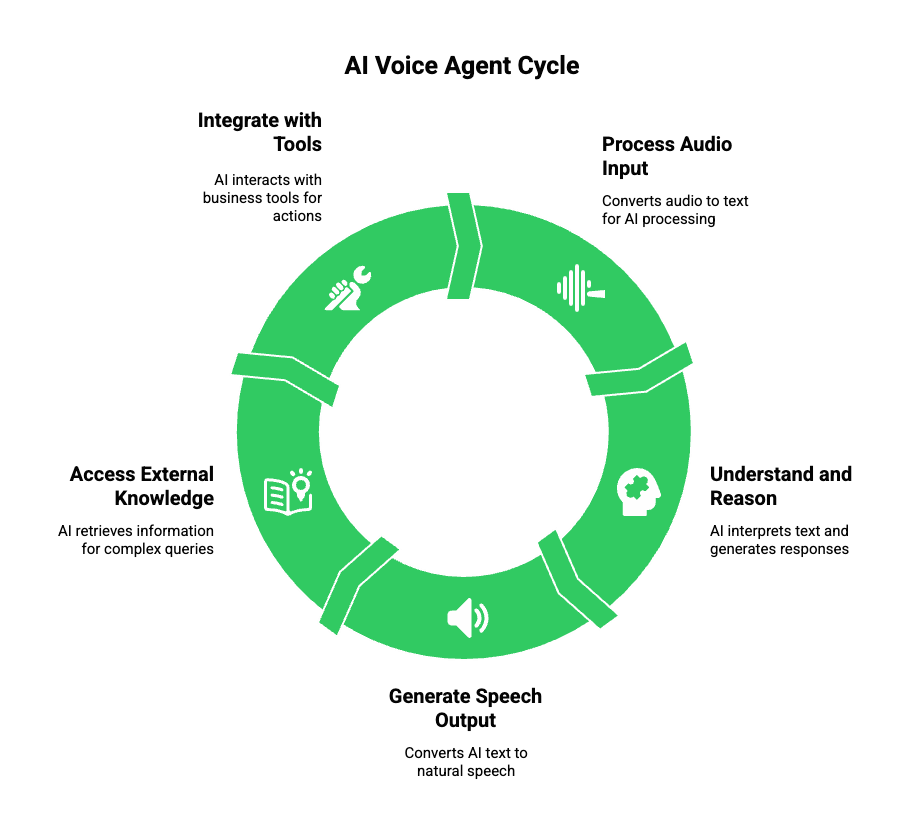
Understanding how real-time AI calling functions requires breaking down its core components. Each part plays a crucial role in ensuring smooth, human-like conversations.
1. Large Language Model (LLM) or AI Engine
- Responsible for reasoning, understanding queries, and generating appropriate responses
- Can be any model: OpenAI, Anthropic, HuggingFace, or custom-built
- Maintains conversation logic while ensuring contextual continuity
2. Speech-to-Text (STT) Engine
- Converts incoming audio into text for processing
- Must operate in real-time to avoid delays
- Examples: Google Cloud Speech-to-Text, OpenAI Whisper, custom streaming STT
3. Text-to-Speech (TTS) Engine
- Converts AI-generated text back into speech
- Needs to be natural, expressive, and responsive
- Examples: ElevenLabs, Google Cloud TTS, Amazon Polly
4. Retrieval-Augmented Generation (RAG)
- Allows AI to access external knowledge sources
- Provides real-time responses to complex queries that go beyond pre-trained knowledge
- Essential for enterprise applications like support, sales, and information retrieval
5. Tool Calling / Workflow Integration
- Enables AI to interact with business tools or APIs
- Can automate actions like creating tickets, updating CRM, sending notifications
- Ensures conversations are not only informative but also actionable
Illustrative Flow:
Caller speaks → STT converts audio → LLM processes text → RAG fetches external data → TTS converts response → Caller hears reply
By separating these components, developers can choose the best-in-class AI, STT, and TTS solutions without being locked into a single vendor. This modular approach provides flexibility, allowing for tailored solutions for different industries and workflows.
What Challenges Do Developers Face In Real-Time AI Calling?
Despite the potential of AI voice agents, developers face several technical challenges when implementing real-time calling solutions:
1. Latency And Streaming
- Audio data must flow continuously between the caller and the AI engine
- Any buffering or delay can break the conversational flow
- Developers need a streaming protocol optimized for low latency, such as WebRTC or RTP
2. Maintaining Context
- Conversations can be complex with multiple topics or follow-up questions
- AI needs access to previous interactions without reprocessing the entire conversation
- Context management becomes critical for meaningful and accurate responses
3. Audio Quality
- Poor audio quality can affect STT accuracy, leading to incorrect responses
- Noise suppression, echo cancellation, and bandwidth management are important considerations
4. Scaling Multiple Calls
- Handling thousands of simultaneous calls requires robust infrastructure
- Developers must ensure high availability and load balancing to avoid dropped calls
5. Security And Compliance
- Audio streams often contain sensitive information
- Data encryption, secure authentication, and compliance with local regulations (like GDPR or HIPAA) are essential
Addressing these challenges requires more than just connecting an AI engine to a phone line. Developers need a reliable real-time voice API that handles audio streaming, context, and call orchestration efficiently.
How Can A Developer-Focused Voice API Solve These Challenges?
A modern voice API for developers provides the necessary infrastructure to simplify and accelerate real-time AI calling. By abstracting the complexity of audio transport, developers can focus on building AI logic instead of managing telephony systems.
Key capabilities of a developer-focused voice API include:
1. Real-Time Audio Streaming
- Ensures audio flows bidirectionally with minimal latency
- Supports both inbound and outbound calls
- Optimized for WebRTC or SIP connections
2. Flexible AI Integration
- Model-agnostic: Connect any LLM or AI engine
- Compatible with multiple TTS and STT providers
- Allows experimentation and selection of the best models for your use case
3. Context-Aware Transport Layer
- Maintains stable call connections
- Tracks conversational state for seamless follow-ups
- Eliminates common issues like dropped packets and audio interruptions
4. Call Orchestration And Routing
- Manage inbound and outbound calls programmatically
- Supports intelligent IVRs, multi-agent sessions, and retries
- Enables integration with CRM and workflow tools
5. Developer Tools And SDKs
- Client-side SDKs for web and mobile apps
- Server-side SDKs for backend orchestration
- Event-driven architecture with webhooks and triggers for call events
Example Architecture:
| Component | Responsibility | Recommended Approach |
| STT Engine | Convert speech to text | OpenAI Whisper / Google Speech-to-Text |
| LLM / AI Engine | Generate conversational response | GPT-4 / Custom AI Model |
| RAG | Fetch external knowledge | Vector DB + API calls |
| TTS Engine | Convert text to speech | ElevenLabs / Amazon Polly |
| Voice API | Stream audio & manage calls | Developer-focused platform (e.g., Teler) |
Using a robust voice API reduces the engineering overhead of managing audio protocols, context tracking, and scaling, allowing teams to deploy enterprise-grade AI voice agents efficiently.
What Makes FreJun Teler Ideal For AI Voice Integration?
While several voice APIs exist, most focus only on call management without catering to AI integration. FreJun Teler, however, acts as the AI-ready voice infrastructure designed specifically for real-time AI calling.
Key advantages of Teler include:
1. Low-Latency Media Streaming
- Optimized for sub-200ms response time
- Handles bidirectional audio streams reliably, even under high call volumes
2. Model-Agnostic AI Integration
- Works with any LLM, STT, and TTS engine
- Gives developers freedom to experiment with cutting-edge AI
3. Developer-First SDKs
- Comprehensive SDKs for client and server integration
- Event-driven APIs allow full control over call logic
4. Enterprise Reliability
- Geo-distributed infrastructure ensures uptime
- Data encryption and compliance-ready protocols
5. Simplified Architecture
- FreJun Teler removes the complexity of managing media transport
- Developers can focus solely on AI logic and conversation design
By integrating Teler, development teams can implement real-time AI calling faster, maintain high audio fidelity, and scale without rebuilding telephony infrastructure from scratch.
How Can Developers Implement Real-Time AI Voice Applications With Teler?
Implementing real-time AI calling requires integrating several components: the AI engine, STT/TTS services, and a low-latency voice infrastructure. With FreJun Teler, the integration process becomes streamlined, allowing developers to focus on AI logic rather than audio transport and call management.
High-Level Implementation Steps:
1. Select Your AI Model and TTS/STT Engines
- Choose an LLM that suits your application: GPT-4, Claude, or HuggingFace models
- Pair with a high-quality TTS engine for natural, expressive responses
- Optionally integrate a streaming STT model for real-time transcription
2. Connect AI Backend With Teler API
- Teler handles bidirectional audio streaming with minimal latency
- Developers can use SDKs or REST/WebSocket APIs for integration
- Teler acts as a transport layer while the AI maintains conversation logic
3. Manage Conversation Context
- Maintain conversation history in your backend
- Teler ensures uninterrupted audio streams, allowing seamless context flow
- Handle interruptions, multi-turn dialogues, and dynamic branching
4. Test Real-Time Conversations
- Conduct low-latency tests under different network conditions
- Optimize TTS/STT and AI processing for minimal delay
- Use Teler’s event hooks to monitor audio quality, latency, and errors
5. Scale Inbound and Outbound Calls
- Teler supports concurrent call handling with failover mechanisms
- Programmatically manage IVRs, multi-agent sessions, and outbound campaigns
- Ensure consistent voice quality and AI responsiveness across all calls
Implementation Tips:
- Compress audio using Opus or other efficient codecs without losing quality
- Monitor latency metrics to identify bottlenecks
- Pre-fetch relevant knowledge or use RAG to reduce AI processing delays
- Log conversation state for debugging and analytics
What Are The Real-World Applications Of AI Voice Calling?
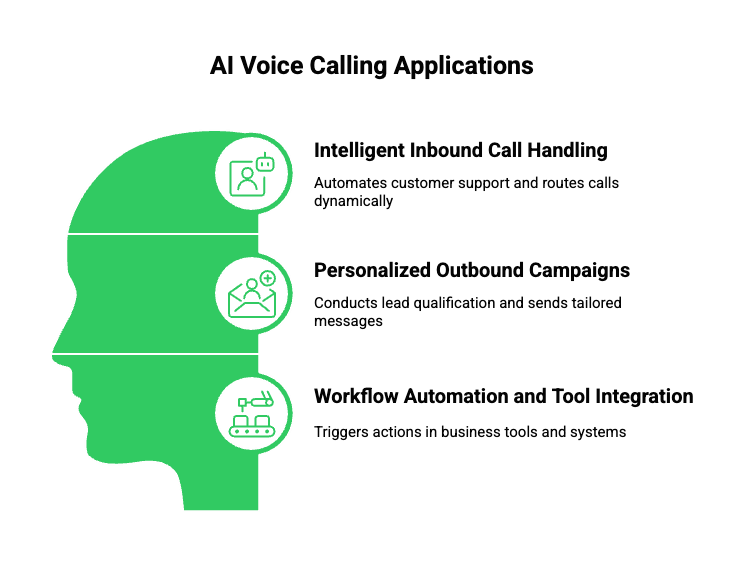
AI voice calling opens opportunities for multiple business applications. Developers can leverage Teler to deploy scalable, low-latency voice agents across industries.
1. Intelligent Inbound Call Handling
- Automate receptionists and front-line customer support
- Handle complex natural-language queries without human intervention
- Implement smart IVRs that route calls dynamically based on AI understanding
2. Personalized Outbound Campaigns
- Conduct lead qualification calls at scale
- Send reminders, notifications, and surveys using AI-generated voice
- Tailor messages dynamically based on CRM data or user behavior
3. Workflow Automation and Tool Integration
- AI agents can trigger actions in business tools, CRMs, or ticketing systems
- Example: AI schedules appointments in Google Calendar or updates Salesforce records
- Reduces operational workload and accelerates response times
4. Industry-Specific Use Cases
| Industry | AI Voice Application | Benefit |
| Healthcare | Appointment reminders, telemedicine support | Reduced staff burden, improved patient engagement |
| FinTech | Customer support, fraud alerts | Quick response with compliance logging |
| Logistics | Shipment notifications, status updates | Real-time proactive communication |
| SaaS / Tech | Lead qualification, support triaging | Efficient sales cycles, higher conversion |
How Can Developers Optimize Performance And Scale AI Voice Agents?
Building real-time AI calling at scale requires attention to both infrastructure and AI design. Teler provides the foundational infrastructure, but developers must optimize their AI and workflows for large-scale deployment.
Performance Optimization Tips:
- Use streaming APIs to avoid batch processing of audio
- Optimize STT/TTS models for low-latency responses
- Preload frequently accessed knowledge for RAG to reduce query time
- Monitor network performance to prevent jitter or packet loss
Scaling Considerations:
- Horizontal scaling: Add servers to handle more simultaneous calls
- Auto-scaling: Dynamically adjust based on peak traffic
- Failover: Ensure backup audio streams for high availability
- Logging and analytics: Track call quality, latency, and AI accuracy
With these strategies, businesses can deploy thousands of concurrent AI voice agents while maintaining high-quality, natural interactions.
How Will Real-Time AI Calling Evolve In 2026 And Beyond?
The future of AI voice calling will emphasize audio-to-audio, multi-modal, and highly personalized interactions. Key trends include:
1. Fully Conversational AI
- AI agents capable of seamless multi-turn dialogue
- Less reliance on text intermediaries, enabling pure voice pipelines
2. Multi-Modal Interactions
- Integration with video, chat, and data interfaces
- Voice agents can provide context-sensitive suggestions or display dynamic content
3. Increased Developer Control
- APIs will expose more granular control over audio, context, and integration
- Developers can fine-tune AI responses, voice tonality, and call routing
4. Enterprise Adoption and Standards
- Standardization around low-latency voice APIs
- Security and compliance will remain a top priority
- Platforms like Teler will become essential infrastructure for AI-powered calling
What Are The Key Advantages Of Using Teler For AI Voice Agents?
By now, it’s clear that implementing AI voice calling is not just about connecting an AI engine to a phone line. Teler provides enterprise-ready infrastructure, giving developers:
- Speed: Sub-200ms audio streaming for real-time conversations
- Flexibility: Connect any AI, TTS, or STT engine
- Scalability: Support for thousands of concurrent calls without downtime
- Reliability: Geo-distributed architecture and failover mechanisms
- Security: End-to-end encryption and compliance-ready protocols
This combination allows Founders, Product Managers, and Engineering Leads to deploy AI voice solutions quickly, while maintaining control over AI logic and conversational design.
How Can Teams Get Started With Real-Time AI Calling?
To implement AI voice agents today, teams should follow a structured approach:
1. Define Objectives
- Determine whether the AI will handle inbound calls, outbound campaigns, or both
- Identify KPIs like response time, engagement, or automation impact
2. Choose AI Components
- Select LLM, STT, and TTS engines
- Optionally integrate RAG for knowledge access and tool-calling for workflows
3. Integrate With Teler API
- Use Teler’s SDKs for client or server-side integration
- Configure call routing, streaming, and context management
4. Test Thoroughly
- Run simulations under varying network conditions
- Evaluate latency, transcription accuracy, and voice quality
5. Deploy and Monitor
- Scale using Teler’s infrastructure
- Monitor performance metrics and optimize AI models continuously
By following these steps, development teams can deploy production-ready AI voice agents in a fraction of the time it would take to build from scratch.
Conclusion
Real-time AI calling is no longer optional; it is essential for delivering seamless, human-like customer interactions. By combining LLMs, low-latency STT/TTS, and reliable media streaming, developers can create intelligent voice agents capable of handling complex conversations at scale.
FreJun Teler simplifies this implementation by providing a robust, developer-first API, managing the infrastructure, streaming, and call orchestration, allowing teams to focus on AI logic and business workflows. For Founders, Product Managers, and Engineering Leads, adopting Teler accelerates deployment, ensures high-quality interactions, and reduces operational overhead.
Start building your AI-powered voice agents today.
Schedule a demo to experience real-time AI calling.
FAQs –
- What is a real-time AI voice agent?
It is a system that uses AI, STT, TTS, and context management to converse instantly with users. - Why is low-latency important for AI calls?
Low-latency ensures natural, uninterrupted conversations, minimizing delays between user speech, AI processing, and voice responses. - Can I integrate any AI model with Teler?
Yes, Teler is model-agnostic, supporting LLMs like GPT, Anthropic, or custom AI engines for flexible integrations. - Do I need coding expertise to use Teler API?
Basic programming knowledge is needed, but Teler’s SDKs simplify integration for web, mobile, or backend applications. - How does Teler maintain conversation context?
Teler streams audio reliably, while your backend tracks context, enabling multi-turn dialogues and dynamic conversation branching. - Can Teler handle thousands of concurrent calls?
Yes, its geo-distributed infrastructure and low-latency streaming ensure high availability for enterprise-scale deployments. - Is Teler secure for enterprise use?
Teler uses end-to-end encryption, secure protocols, and a compliance-ready design to protect sensitive data during calls. - What are common use cases for AI voice agents?
Customer support, IVR automation, lead qualification, reminders, notifications, and workflow automation across multiple industries. - How fast can I deploy AI voice agents with Teler?
Development cycles are shortened to days, not months, thanks to ready-to-use APIs, SDKs, and infrastructure.
Does Teler support outbound call campaigns?
Yes, Teler can automate outbound campaigns, delivering personalized messages with natural AI-generated speech at scale.