
That feeling of excitement when a new package arrives is universal. But so is the sinking feeling when you open the box and realize the item is the wrong size, the wrong color, or simply not what you expected. What happens next is a critical moment of truth for the brand.
The journey to return the product is often a frustrating maze of navigating website FAQs, filling out complex forms, and, most painfully, waiting on hold to speak with a customer service agent.
This flood of inquiries puts an immense strain on a company’s inbound call handling capabilities, turning a potential moment of customer recovery into a source of frustration and brand damage.
The scale of this challenge is enormous. In the world of e-commerce, the cost of returns is projected to reach over $1 trillion globally. This is not just a financial drain; it is a massive operational headache.
By embracing the power of AI voice support, businesses can transform their returns process from a costly, manual bottleneck into a streamlined, automated, and customer-pleasing experience.
Table of contents
- Why is Managing Returns Such a Headache?
- How Does an AI Voice Agent Streamline the Returns Process?
- What Are the Key Benefits for E-commerce and Retail Businesses?
- How Can a Business Implement an AI-Powered Returns System?
- Can an AI Handle Complex or Emotional Return Scenarios?
- Conclusion
- Frequently Asked Questions (FAQs)
Why is Managing Returns Such a Headache?
The product returns process, often called “reverse logistics,” is inherently more complex and less structured than the process of selling a product. For businesses, it is a significant operational and financial burden that directly impacts their inbound call handling resources. For customers, it is often the most frustrating interaction they will have with a brand.
What Are the Pain Points for Businesses?
- High Call Volume: A significant percentage of all customer service calls are related to returns. Customers call to ask about the return policy, to initiate a return, or to check the status of a refund. This high volume of repetitive calls can easily overwhelm a contact center.
- Intense Labor Costs: Each of these calls requires a human agent’s time. They must manually look up the order, verify the customer’s identity, explain the process, and log the interaction. This is a huge labor cost dedicated to a process that generates no revenue.
- Risk of Inconsistency: Different agents might provide slightly different information or follow slightly different procedures, leading to a confusing and inconsistent experience for the customer.
- Lack of 24/7 Availability: A customer who opens their package at 10 PM on a Friday and discovers a problem has to wait until Monday morning to even begin the return process, leading to a weekend of simmering frustration.
What Are the Frustrations for Customers?
- Long Wait Times: The most common complaint is being stuck on hold. When a customer is already disappointed with a product, a long wait time adds insult to injury.
- The Effort of the “Ask”: The customer often has to repeat their order number, name, and address multiple times. It feels like a chore, not a service.
- Inconvenient Hours: Being forced to call during a limited 9-to-5 window is a major inconvenience for people with their own work schedules.
Also Read: Why Choose Inbound Call Handling Solutions?
How Does an AI Voice Agent Streamline the Returns Process?
An AI voice agent, or AI voicebot, acts as a virtual, dedicated returns specialist that is always on, instantly available, and perfectly consistent. It automates the entire front-end of the returns process, creating a seamless, self-service experience for the customer. This fundamentally improves your inbound call handling by deflecting the vast majority of routine return-related calls.
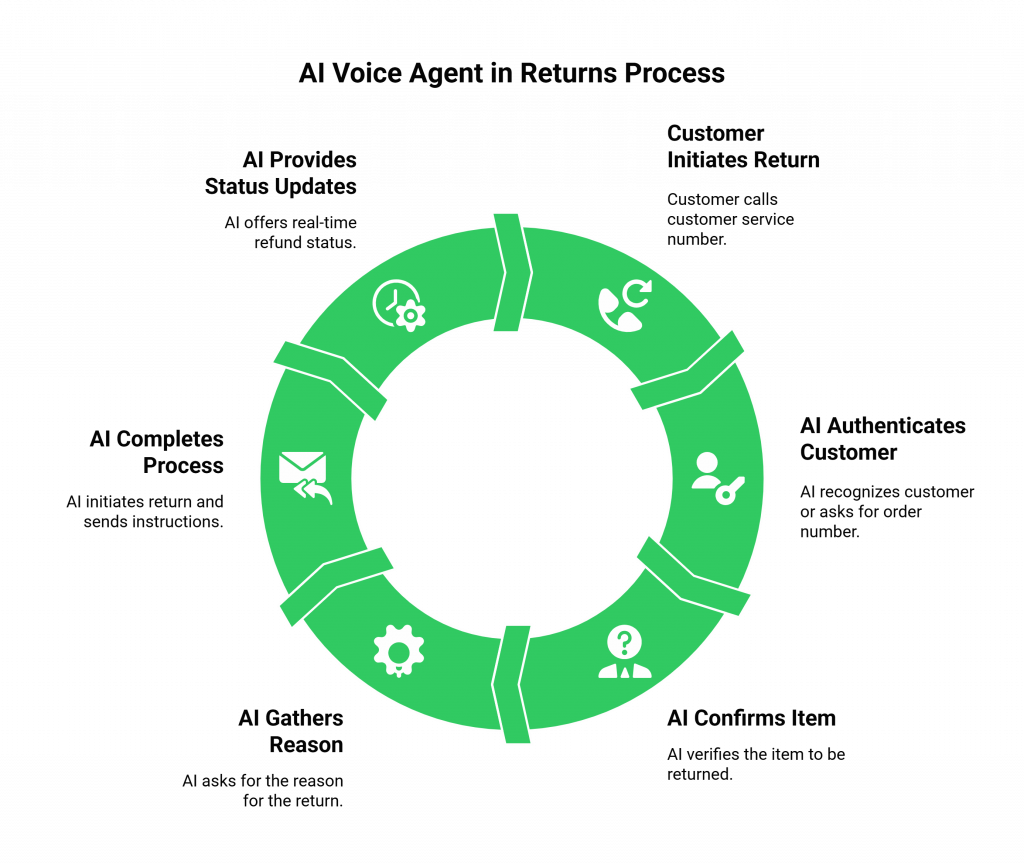
How Does It Initiate the Return?
Imagine a customer wants to return a shirt. Instead of waiting on hold, they call your customer service number and are immediately greeted by a friendly, conversational AI.
- Authentication: The AI can recognize their phone number and say, “Hi, Sarah. I see you recently received an order. Are you calling about that?” or it can ask for the order number.
- Item Confirmation: The AI can then ask, “I see your order included a blue V-neck shirt and a pair of jeans. Which item would you like to return?”
- Reason for Return: It can ask for the reason, “Could you tell me why you’re returning the shirt? Is it the wrong size, color, or something else?” This data is incredibly valuable for your business.
- Process Completion: Once the information is gathered, the AI can say, “Thank you. I have initiated the return for you. I’ve just sent a return shipping label and instructions to your email address on file. Is there anything else I can help you with today?”
This entire interaction is completed in under a minute, with zero wait time. For this to feel natural and not clunky, the conversation must flow in real-time. This is where the underlying voice infrastructure from a provider like FreJun AI is the crucial engine.
FreJun AI handles the real-time, low-latency audio streaming, ensuring there are no awkward pauses, which makes the AI voicebot a truly effective and pleasant conversational partner.
How Does It Provide Status Updates?
The other major reason customers call is to ask, “Where is my refund?” An AI voice agent can handle this 24/7. A customer can call in, and the AI can provide an instant, real-time status update by checking the integrated logistics and payment systems, completely automating another major category of inbound call handling.
What Are the Key Benefits for E-commerce and Retail Businesses?
Deploying an AI-powered voice solution for returns is a strategic move that delivers powerful benefits across the organization. It’s not just about reducing costs; it’s about creating a better experience that drives loyalty. The importance of a smooth returns process cannot be overstated; a survey by Klarna revealed that 84% of online shoppers would turn their back on a retailer after a bad returns experience.
Here is a clear comparison of the two approaches:
| Feature | Manual Returns Process | AI-Powered Returns Process |
| Availability | Limited to agent work hours. | 24/7/365, always on. |
| Customer Wait Time | Often long, especially during peak seasons. | Zero wait time, instant connection. |
| Process Speed | Several minutes per call with manual data lookup. | The entire process is completed in under 60 seconds. |
| Cost Per Interaction | High, based on agent’s salary and time. | Extremely low, a fraction of a human-handled call. |
| Data Collection | Relies on manual notes, can be inconsistent. | Structured, consistent data is captured on every call. |
Also Read: Building a Voice Agent with OpenAI or Claude
How Can a Business Implement an AI-Powered Returns System?
Implementing a voice AI solution for your returns inbound call handling is a more accessible project than it might seem. It involves a clear, logical process built on modern, developer-friendly technology.
- Integrate Your Core Systems: The first and most critical step is to connect the AI to your e-commerce platform (like Shopify or Magento) and your inventory management system via APIs. This is what allows the AI to access order details and initiate the return process.
- Design the Conversation Flow: This is where you map out the “brain” of your AI. You will create the scripts and logic for the entire returns conversation, including how it authenticates customers, confirms items, and handles different return reasons.
- Build on a Reliable Voice Infrastructure: The intelligence of your AI is only effective if the conversation is clear and instant. You need a robust voice platform to act as the engine. This is the role of FreJun AI. We provide the enterprise-grade voice infrastructure that handles the complex telephony and real-time, low-latency audio streaming. Our model-agnostic platform gives you the freedom to choose the best AI models (STT, LLM, TTS) for your needs. We handle the complex voice infrastructure so you can focus on building your AI.
Ready to transform your returns process from a cost center to a customer-pleaser? Sign up for FreJun AI and get your API keys to start building.
Can an AI Handle Complex or Emotional Return Scenarios?
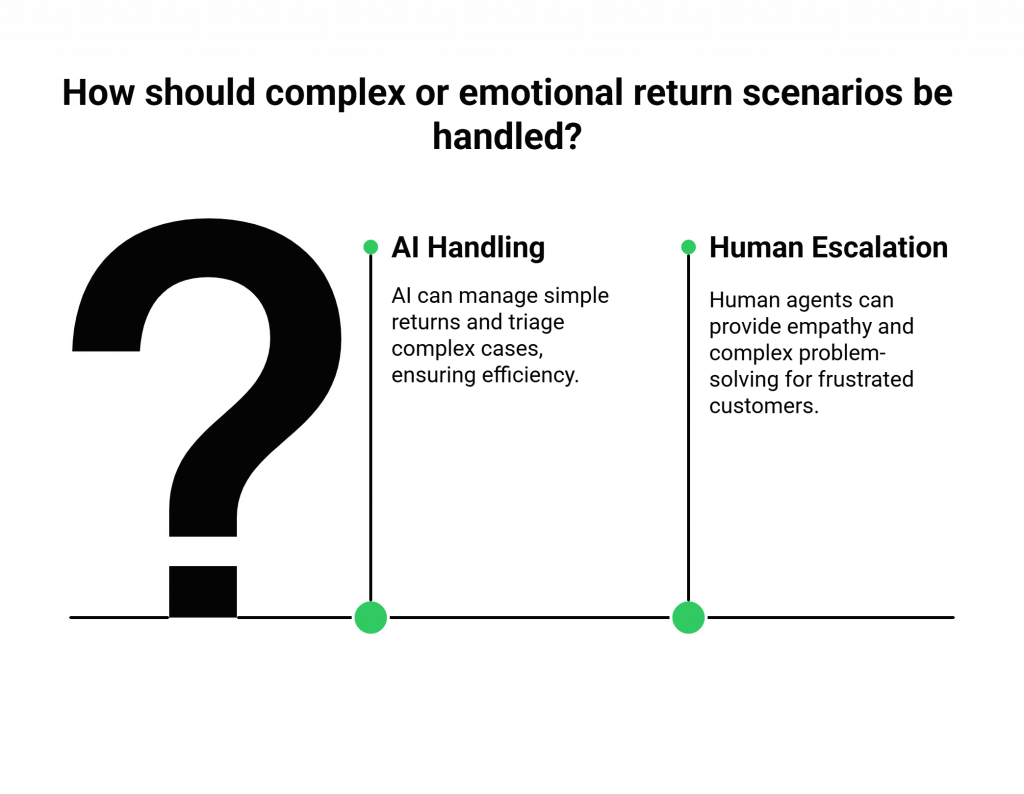
This is a common and important question. The AI voice agent is a tool for automation, but it is also a tool for intelligent triage. It is designed to handle the 80-90% of returns that are simple and straightforward.
However, it is also programmed to recognize signs of complexity or customer frustration.
For example, if a customer says “The item arrived broken” or “I’m very unhappy with the quality,” the AI can be programmed with an escalation path. It can say, “I understand your frustration, and I want to make sure this is handled with care. I am connecting you to one of our human support specialists right now.”
It then seamlessly transfers the call, along with the customer’s information, to a live agent. This ensures that your human team is reserved for the situations where empathy and complex problem-solving are most needed, making your overall inbound call handling strategy much more effective.
Also Read: Secure Ways to Stream Call Audio to AI
Conclusion
The product returns process is an unavoidable and critically important part of the customer journey. A slow, frustrating, and inefficient system can do lasting damage to your brand and your bottom line.
By leveraging the power of AI voice support, you can completely transform this experience. This technology provides a 24/7, instant, and effortless self-service channel for your customers, while drastically reducing the operational load on your business.
It is the key to improving your inbound call handling, cutting costs, and turning a moment of potential disappointment into an opportunity to build even stronger customer loyalty.
Want to see how a custom voice solution can handle your specific returns workflow and integrate with your e-commerce platform? Schedule a demo with our team at FreJun Teler.
Also Read: Call Log and Call Details: How to Monitor Business Communication
Frequently Asked Questions (FAQs)
It is a system that uses a conversational AI voicebot to automate the process of handling product returns over the phone. A customer can call in, and the AI can understand their request, initiate the return, and provide them with a shipping label, all without speaking to a human.
No, it is designed to augment them. The AI handles the high volume of simple, repetitive return requests. This frees up your human agents to focus on more complex customer issues, such as handling damaged goods, dealing with escalations, or providing product expertise.
It can be integrated with your CRM and e-commerce platform. It can recognize the customer’s phone number or ask for their order number to instantly pull up all the relevant details for a personalized conversation.
Yes. This is a perfect use case. A customer can call at any time, and the AI can check the integrated financial and logistics systems to provide a real-time update on when a return was received and when a refund was processed.
The AI’s conversation flow can be designed to handle exchanges. It can check inventory levels for the new item in real time and guide the customer through the exchange process.