
Companies are grappling with high call volumes, repetitive inquiries, and rising expectations for instant resolutions. Intelligent Voice APIs offer a transformative solution by bridging human conversations with AI-powered decision-making. From automating routine tasks to enabling context-aware interactions, these systems empower support teams to operate more efficiently while enhancing the customer experience.
This blog explores how implementing advanced voice APIs, particularly with robust infrastructure like FreJun Teler, can streamline daily support operations, reduce operational costs, and deliver measurable business impact.
What Is An Intelligent Voice API And Why Does It Matter For My Business?
Businesses today face growing pressure to deliver efficient and consistent customer support. With rising call volumes, repeated inquiries, and high expectations for immediate responses, traditional support systems often struggle to keep up. This is where Intelligent Voice APIs come in.
According to industry research, 70% of contact centers have already implemented AI technologies to elevate customer interactions and operational outcomes.
At its core, an Intelligent Voice API is a communication bridge between human voice interactions and complex business logic, allowing companies to process calls, understand customer intent, and provide accurate responses—all automatically. Unlike standard IVR systems, which rely on fixed menus and static responses, intelligent voice systems can adapt to conversational flow, understand context, and execute actions programmatically.
Key Components of an Intelligent Voice API:
- Speech-to-Text (STT): Converts live audio into text for processing by AI agents. It supports multiple languages and accents, ensuring accurate transcription.
- AI / Large Language Model (LLM): Processes text, interprets user intent, retrieves relevant information, and can trigger tool-based actions such as CRM updates or ticket creation.
- Text-to-Speech (TTS): Converts AI responses back into a natural, human-like voice, providing a seamless conversational experience.
- RAG (Retrieval-Augmented Generation): Enhances response accuracy by accessing a knowledge base or database dynamically during the conversation.
- Tool Integrations: Allows voice agents to interact with backend systems such as support tickets, databases, scheduling tools, or third-party APIs.
By combining these components, businesses can deliver automated, context-aware, and intelligent support, dramatically improving customer satisfaction and operational efficiency.
How Can Intelligent Voice APIs Automate Daily Support Tasks?
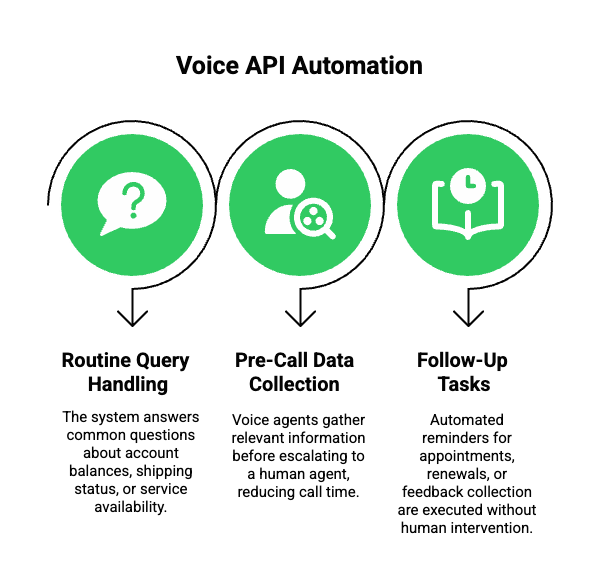
Automation of daily support tasks is one of the most immediate benefits of using a voice API. Many businesses spend significant resources handling repetitive queries, like password resets, appointment confirmations, or account status inquiries. An Intelligent Voice API can offload these routine tasks, enabling support teams to focus on more complex issues.
Practical Automation Examples:
- Routine Query Handling: The system can answer common questions about account balances, shipping status, or service availability.
- Pre-Call Data Collection: Voice agents can ask for relevant information before escalating to a human agent, reducing call time.
- Follow-Up Tasks: Automated reminders for appointments, renewals, or feedback collection can be executed without human intervention.
These automations not only save time but also improve accuracy by reducing manual errors. For instance, by automatically confirming user identity and capturing relevant inputs, businesses ensure that human agents receive fully-prepared cases, enhancing overall support quality.
By automating routine tasks, companies do not just save time – they also create a scalable support framework, capable of handling spikes in customer inquiries without additional headcount.
How Do AI-Powered Voice Agents Improve Support Team Efficiency?
Beyond simple automation, intelligent voice agents enhance support team efficiency by acting as a first line of engagement. They handle the majority of repetitive or simple interactions while retaining conversational context, which ensures smooth handoffs to human agents when required.
Efficiency Benefits Include:
- 24/7 Availability: Voice agents can handle calls anytime, reducing customer wait times and ensuring no query goes unanswered.
- Context-Aware Conversations: Using RAG and session memory, voice agents maintain the flow of a conversation across multiple interactions, preventing customers from repeating themselves.
- Prioritized Escalation: AI systems can detect urgency or sentiment, prioritizing critical cases for human intervention.
- Reduced Agent Workload: By automating repetitive queries, human agents can focus on higher-value tasks, improving productivity and satisfaction.
A retail support team receives hundreds of shipping queries daily. An intelligent voice agent collects order numbers, verifies shipping addresses, and provides updates automatically. Only complex issues—like delivery disputes—are routed to human agents. The result is faster resolution times and happier customers.
What Technical Components Make Intelligent Voice APIs Effective?
Understanding the technical architecture is essential for implementing an Intelligent Voice API successfully. While the system may appear as a simple call interface, several sophisticated processes occur in real time to deliver seamless interactions.
Step-By-Step Conversation Flow:
| Step | Component | Description | Technical Advantage |
| 1 | Call Initiation | Captures user audio over SIP, PSTN, or VoIP | Low-latency streaming ensures minimal delays |
| 2 | Speech-to-Text (STT) | Converts spoken words into machine-readable text | Supports multi-language and multi-accent input, enabling global use |
| 3 | LLM / AI Agent | Processes the text, determines intent, retrieves context | Can trigger automated tasks, tool integrations, or follow-ups |
| 4 | Retrieval-Augmented Generation (RAG) | Pulls relevant knowledge from databases or knowledge bases | Improves response accuracy and relevance |
| 5 | Text-to-Speech (TTS) | Converts AI-generated text back into natural-sounding voice | Ensures human-like interaction with expressive tone |
| 6 | Action Execution | Calls APIs, updates CRM, triggers tickets | Completes the loop, providing end-to-end automation |
This architecture ensures that conversations are low-latency, contextually aware, and reliable, even under high call volumes.
By understanding this flow, product managers and engineering leads can design support workflows that maximize automation while maintaining quality, ensuring that every interaction adds value.
How Does FreJun Teler Simplify Building AI-Powered Voice Agents?
When it comes to implementing intelligent voice APIs at scale, infrastructure complexity can be a major hurdle. This is where FreJun Teler plays a critical role. Unlike platforms that focus solely on traditional telephony, Teler provides a robust, low-latency voice infrastructure specifically designed for AI agents and LLMs.
Key Advantages of Using Teler:
- Model-Agnostic Integration: Works with any LLM or AI agent, allowing businesses to use preferred AI models without vendor lock-in.
- Real-Time Voice Streaming: Optimized for minimal latency, ensuring that STT and TTS processes remain seamless during live conversations.
- Full Conversation Control: Maintains session state, supports RAG, and integrates with backend tools for task execution.
- Developer-First SDKs: Simplifies embedding voice capabilities into web, mobile, or backend systems.
- Enterprise-Grade Reliability: Distributed architecture, encryption, and failover mechanisms ensure high availability and security.
Practical Implementation Example:
Imagine a SaaS company that receives daily support requests about subscription issues. Using Teler, they can:
- Capture incoming calls via SIP or VoIP.
- Stream the audio in real time to their chosen LLM.
- Generate responses and execute automated tasks, such as account verification or billing updates.
- Route complex cases to human agents with full context intact.
The result is faster resolutions, improved agent productivity, and a seamless customer experience.
How Can Businesses Measure The Impact Of Intelligent Voice APIs?
It is crucial to understand how AI-driven voice solutions translate into business value. Metrics can provide actionable insights for continuous improvement:
- Call Resolution Time: Track how automated handling reduces average call duration.
- Agent Utilization: Measure the percentage of calls managed by AI versus human agents.
- Customer Satisfaction (CSAT): Collect feedback post-call to gauge the effectiveness of automated interactions.
- Operational Costs: Compare resource savings from task automation and reduced agent dependency.
By measuring these parameters, businesses can quantify ROI and optimize workflows, making intelligent voice APIs an essential tool for scaling daily support operations.
What Are The Business Benefits Of Using Teler + AI Voice Agents?
Implementing intelligent voice agents with a robust infrastructure like FreJun Teler provides measurable advantages for businesses supporting daily operations. These benefits are not just technical—they directly impact efficiency, customer experience, and cost management.
1. Faster Resolution Times
- Automated first-line interactions reduce human intervention for routine queries.
- Voice agents can pre-collect relevant information, verify customer identity, and fetch account details in real time.
- Human agents handle only escalated or complex cases, significantly shortening overall call duration.
Example Metric: Businesses using AI voice agents report up to 40% reduction in average handling time for repetitive support tasks.
2. 24/7 Support Availability
- AI voice agents operate continuously, handling calls at any time without fatigue.
- Customers get instant responses, regardless of time zones or peak call volumes.
- This improves customer satisfaction and reduces the pressure on human teams during high-demand periods.
By providing round-the-clock support, companies can maintain consistent service quality while freeing up human resources for strategic tasks.
3. Cost Efficiency And Operational Scalability
- Automation lowers dependency on a large support staff.
- AI agents handle high call volumes without proportional increases in operational costs.
- Teler’s infrastructure ensures reliable scaling, enabling businesses to expand support capabilities without additional hardware or network resources.
Example Scenario: A global eCommerce platform manages seasonal spikes in customer calls through AI voice agents, avoiding temporary hires while maintaining service levels.
4. Personalized And Proactive Customer Interactions
- Intelligent voice agents can access RAG-enabled knowledge bases to deliver context-aware responses.
- AI can personalize conversations based on customer history, preferences, and prior interactions.
- Proactive notifications such as appointment reminders, payment alerts, or follow-ups enhance engagement and reduce missed interactions.
5. Multi-Language Global Reach
- STT and TTS components allow voice agents to converse in multiple languages and accents.
- Businesses can support diverse customer bases without hiring specialized agents for every region.
- Reduces language barriers while maintaining consistency in support quality.
How Can Businesses Apply Intelligent Voice APIs In Daily Support?
To understand the practical impact, consider real-world applications across different industries. Each scenario shows how AI voice agents streamline operations and improve customer satisfaction.
Customer Service & Banking
- Tasks Handled: Balance inquiries, transaction history, account verification, loan status.
- Technical Flow: Incoming call → STT converts speech → LLM interprets intent → RAG fetches data → TTS response → optional tool calls for CRM updates.
- Impact: Reduces call resolution time, ensures accurate responses, and frees human agents for high-value interactions.
Retail & eCommerce
- Tasks Handled: Order tracking, delivery updates, returns processing, product inquiries.
- Automation Benefits: AI voice agents confirm order numbers, fetch shipping data, and proactively notify customers about delays or delivery windows.
- Customer Outcome: Faster resolution, reduced frustration, and increased repeat purchases.
Healthcare & Telemedicine
- Tasks Handled: Appointment scheduling, patient reminders, symptom triage, insurance queries.
- Technical Advantage: Voice agents maintain session context, access patient records securely, and provide human-like interactions.
- Compliance Note: Infrastructure like Teler ensures HIPAA-compliant secure voice streaming.
SaaS & Enterprise IT
- Tasks Handled: Password resets, onboarding guidance, ticket status updates, software troubleshooting.
- Technical Flow: Integration with backend ITSM tools allows automated resolution for common tasks.
- Business Impact: Reduces human intervention, accelerates problem-solving, and improves operational efficiency.
What Challenges Should Businesses Expect And How Can Intelligent Voice APIs Solve Them?
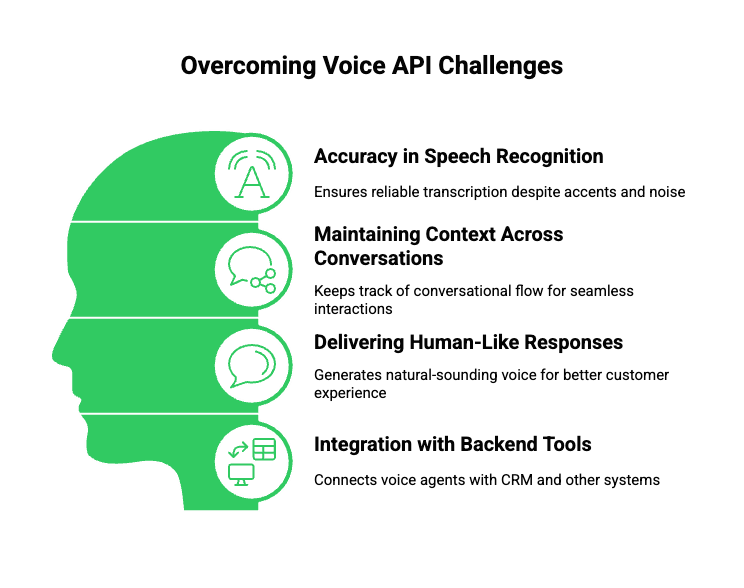
Even with powerful voice APIs, businesses may face certain challenges. However, advanced infrastructure and intelligent design can mitigate these issues effectively.
1. Accuracy In Speech Recognition
- Problem: Accents, dialects, and noisy environments can reduce transcription accuracy.
- Solution: Modern STT engines combined with noise suppression and real-time audio processing ensure reliable transcription.
- Teler Advantage: Handles audio buffering and streaming optimization to reduce lag or misinterpretation.
2. Maintaining Context Across Conversations
- Problem: Long or multi-turn conversations may lose context, frustrating customers.
- Solution: Using session memory and RAG integration, AI agents maintain conversational continuity.
- Business Outcome: Customers do not need to repeat information, improving satisfaction and reducing resolution time.
3. Delivering Human-Like Responses
- Problem: Robotic or monotonous TTS can reduce perceived quality of interactions.
- Solution: Advanced TTS engines generate expressive, natural-sounding voice capable of emphasis, tone, and clarity.
- Teler Advantage: Optimized streaming ensures smooth playback with minimal latency, creating a near-human conversational experience.
4. Integration With Backend Tools
- Problem: Voice agents must interact with CRMs, ticketing systems, or databases seamlessly.
- Solution: Intelligent voice APIs support tool calls and API integrations without breaking conversational flow.
- Benefit: Provides end-to-end automation, reducing manual agent intervention.
How To Get Started With Intelligent Voice APIs For Your Business?
Implementing intelligent voice agents requires a structured approach to maximize benefits while avoiding common pitfalls.
Step 1: Define Support Workflows
- Identify repetitive and high-volume tasks suitable for automation.
- Map the conversation flow, including potential handoffs to human agents.
Step 2: Choose Your AI Model And STT/TTS Tools
- Select the LLM or AI agent based on your business needs (e.g., knowledge-intensive tasks, multilingual support).
- Pair with STT and TTS engines capable of low-latency, high-accuracy processing.
Step 3: Integrate With Infrastructure
- Use a platform like FreJun Teler to handle voice transport, SIP/PSTN connections, and real-time streaming.
- Teler ensures enterprise-grade reliability, secure data handling, and developer-first SDKs for backend or client-side integration.
Step 4: Monitor Metrics And Optimize
- Track call resolution times, agent utilization, CSAT scores, and operational costs.
- Continuously refine conversational logic, RAG knowledge bases, and AI responses based on feedback.
Following a structured implementation approach ensures that your business realizes maximum efficiency, cost savings, and improved customer satisfaction.
What Makes Intelligent Voice APIs A Strategic Advantage Over Traditional Systems?
- Unlike legacy IVRs or standard calling platforms, intelligent voice APIs combine AI, real-time processing, and automation.
- Businesses can scale support operations without proportional increases in staff or infrastructure.
- Voice agents are capable of handling multiple languages, understanding context, and integrating with business tools, delivering a true end-to-end support solution.
Conclusion
Intelligent Voice APIs are reshaping how businesses support daily customer interactions by automating routine tasks, reducing dependency on human agents, and enhancing support team efficiency. By integrating advanced speech processing, AI logic, and real‑time context management, organizations can deliver faster, personalized, and scalable support. This blog highlighted how automation improves resolution times, increases CSAT, and enables support teams to focus on strategic priorities. As AI becomes integral to customer engagement, selecting infrastructure that reliably powers low‑latency voice experiences is critical.
For companies looking to implement high‑performance voice agents, FreJun Teler provides the infrastructure backbone to connect any LLM, STT, and TTS stack with carrier networks securely.
Schedule a demo to see how Teler accelerates intelligent voice automation.
FAQs –
- What are Intelligent Voice APIs?
APIs that convert speech to text, process intent with AI, then generate voice responses for real‑time conversational support. - How do voice APIs automate support tasks?
They transcribe calls, understand intent, fetch data, and respond without human intervention for routine support workflows. - Can voice APIs integrate with existing AI models?
Yes – they work with any LLM, STT, and TTS to deliver real‑time support experiences. - Do voice APIs improve support team efficiency?
Yes – by handling repetitive queries, freeing human agents for complex tasks. - Can voice APIs work across languages?
Modern APIs support multiple languages and accents for global customer support. - Will voice automation reduce support costs?
Yes – it lowers agent workload and enables 24/7 self‑service without proportional resource increases. - Is data secure with AI voice solutions?
Enterprise voice platforms enforce encryption, compliance, and secure audio transmission. - Do voice APIs need backend integrations?
To automate tasks fully, integrations with CRM, ticketing, and databases are recommended. - Can voice APIs track conversational context?
Yes – persistent context and RAG improve continuity across multi‑turn conversations.
How soon can businesses implement voice automation?
With a platform like Teler, voice agents can go live in days, not months.