
For a public utility, whether it’s providing electricity, water, or gas, the inbound phone line is more than just a customer service channel; it is a critical piece of public infrastructure. When a winter storm knocks out power to ten thousand homes, the call center is the central hub for information, the front line for public safety, and the voice of the company in a moment of crisis.
The traditional, human-powered model for inbound call handling solutions is fundamentally broken in the face of this immense responsibility. A team of human agents, no matter how large or dedicated, can be instantly and completely overwhelmed by the tsunami of calls that occurs during a large-scale service outage. This leads to jammed phone lines, frustrated customers left in the dark, and a massive public relations failure.
This is why the public utility sector is undergoing a profound transformation, moving towards a new, more resilient, and more intelligent model powered by AI voice agents.
This guide will explore the unique challenges that utilities face and showcase the innovative ways they are using modern voice technology to create inbound call handling solutions that are not just more efficient, but are a vital part of their emergency response infrastructure.
Table of contents
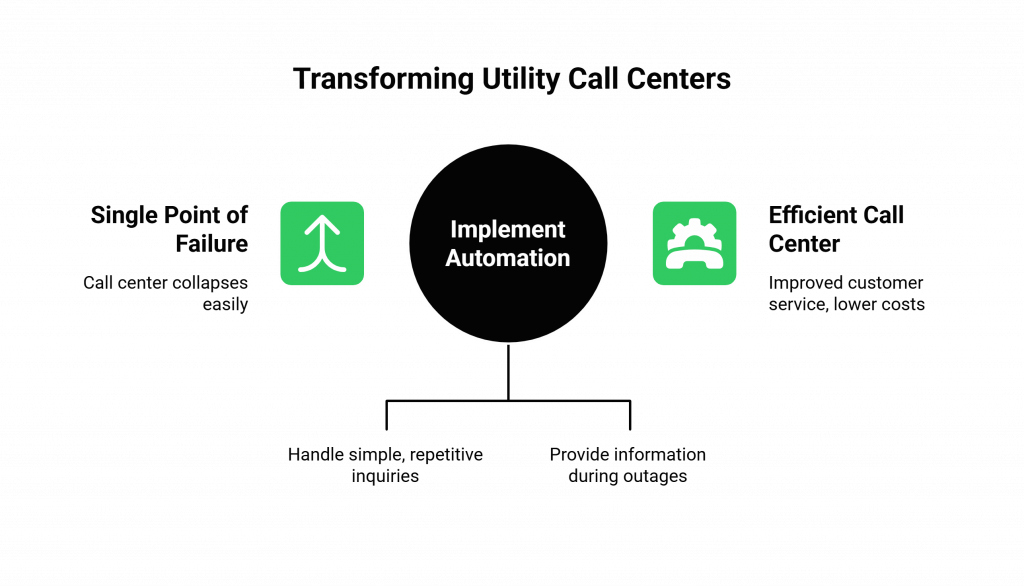
Why is the Traditional Utility Call Center a “Single Point of Failure”?
A utility must design its call center for the worst-case scenario. The traditional human-powered model creates a single point of failure that collapses exactly when it’s needed most.
What Happens During a “Mass Outage” Event?
A major weather event or a piece of failed equipment can trigger a mass service outage. When this happens, thousands or even tens of thousands of customers all pick up the phone at the same time to report the same issue. A human-only call center is instantly flooded.
The system is completely paralyzed, no one can get through, and customers are left with no information, which breeds fear and anger. The cost of failing to communicate effectively during a crisis is enormous.
A study on corporate crisis management found that a company’s response in the first few hours of a crisis has a disproportionately large impact on its long-term brand reputation and customer trust.
What is the “Efficiency Drain” of Routine Inquiries?
Even on a perfect “blue sky” day, a huge percentage of a utility’s call volume is for simple, repetitive, and transactional inquiries:
- “I need to report a power outage at my address.”
- “What is my current account balance?”
- “I need to set up a payment plan.”
When your trained human agents are spending their day handling these routine tasks, you are not only incurring a massive operational cost, but you are also failing to use their expertise for the more complex, high-value customer interactions.
Also Read: What to Expect from Enterprise-Grade Voice APIs?
How Does an AI-Powered Solution Create a “Resilient” Front Line?
An “AI-first” approach to inbound call handling solutions is not about replacing humans; it’s about building a system that is architecturally resilient to massive, sudden spikes in demand.
This system is built on a foundation of a modern, API-driven voice infrastructure. A platform like FreJun AI provides the essential, “always-on,” and infinitely scalable telephony layer that a mission-critical utility demands.
This is the high-performance “nervous system” that connects your customers to your AI’s calm, intelligent, and perfectly informed “brain,” even in the middle of a storm.
What are the “Mission-Critical” AI Workflows for a Public Utility?
A well-architected AI voice agent serves as a complete self-service portal and a powerful crisis communication tool.
| Customer Need | Traditional Human-Powered Process | AI-Powered Automated Process |
| Report a Service Outage | Wait in a long queue, agent manually creates a ticket. | AI answers instantly, authenticates via phone number, checks for known outages, and logs a new outage report if needed. |
| Get an Outage Status Update | Wait in a long queue, agent looks up the latest update from the operations team. | AI answers instantly, uses an API to get the latest Estimated Time of Restoration (ETR) and provides a clear, consistent update. |
| Pay a Bill | Wait in queue, get transferred, provide card info to an agent. | AI answers instantly, authenticates, and securely captures payment info via DTMF keypad entry, 24/7. |
| Start/Stop Service | Wait in queue, agent manually fills out a long form with the customer. | AI has a conversational workflow to gather all the necessary information and automatically submits the service request. |
Also Read: Handling After-Hours Calls with AI Voicebots
How Can You Create a “Proactive Outage” Communication Hub?
The Goal: During a major outage, you should shift from a reactive to a proactive communication strategy and provide a single, authoritative source of information to prevent the call center from becoming overwhelmed.
The Workflow: When the operations team identifies a major outage, they can, with a single API call, instantly update the AI voicebot’s primary greeting.
- AI: “Thank you for calling City Power & Light. We are currently experiencing a major service outage in the Northwood and Oakdale neighborhoods due to severe weather. Our crews are on-site and are working to restore service as quickly and safely as possible. The current estimated time of restoration is 8 PM. There is no need to report an outage in this area at this time. If you are calling about a different issue, please stay on the line.”
The Business Impact: This simple, proactive message can instantly deflect 99% of the calls related to the outage. It keeps the phone lines clear for true emergencies (like a downed power line) and provides a calming, authoritative source of information to the public.
Ready to build a utility support system that is as reliable as the power you provide? Sign up for FreJun AI and start building your solution.
How Can You Automate the “Outage Reporting” and “Status Check” Process?
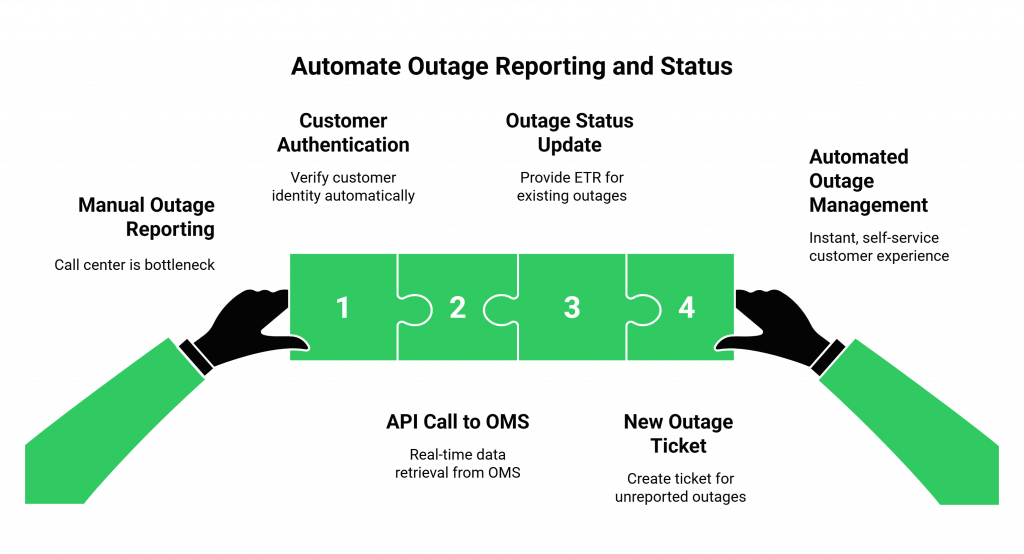
The Goal: To provide a 24/7, self-service channel for customers to report a new outage or to get a status update on an existing one.
The Workflow:
- The AI authenticates the customer, often automatically via their caller ID.
- It then makes a real-time API call to the utility’s Outage Management System (OMS).
- If there is already a known outage at that location, it provides the latest Estimated Time of Restoration (ETR).
- If no outage exists, the AI confirms the details through conversation and automatically creates a new outage ticket in the OMS, which then dispatches it to a crew.
The Business Impact: This provides an instant, self-service experience for the customer and ensures that the operations team gets fast, accurate outage data without the call center acting as a manual bottleneck.
Also Read: Benefits of Using OpenAI’s AgentKit with Teler
Conclusion
For a public utility, the inbound phone line is a mission-critical service. The traditional human-powered model for inbound call handling solutions creates a fragile system that inevitably fails when it’s needed most.
The modern AI voice agent is a powerful and strategic solution. By automating the front line, a utility can create an inbound call handling solutions that is not just more cost-effective, but is fundamentally more resilient, more scalable, and more responsive to the needs of the community, both on a calm, blue-sky day and in the middle of a storm.
Want to see a live demo of an AI voicebot handling a mass outage event? Schedule a demo with our team at FreJun Teler.
Also Read: UK Phone Number Formats for UAE Businesses
Frequently Asked Questions (FAQs)
It is the technology and processes a utility company uses to manage incoming phone calls from its customers. A modern solution uses an AI voicebot to automate a large portion of these calls, especially during high-volume events like a service outage.
The biggest benefit is scalability. An AI voicebot can handle a virtually unlimited number of concurrent calls, which is essential for managing the massive spike in call volume that occurs during a widespread service outage.
This is done through a real-time API integration with the utility’s Outage Management System (OMS). The AI’s backend application can make an API call to the OMS to get the latest information, such as the affected area and the Estimated Time of Restoration (ETR).
A well-designed AI identifies emergency keywords and immediately transfers the call to a dedicated human emergency operator when a caller says “downed power line” or “I smell gas.”
The goal is to create a human-AI partnership. The AI is design to handle high volumes of repetitive, informational calls, freeing skilled human agents to focus on complex customer issues and true emergencies.
Yes. A secure AI can use DTMF (keypad tone) capture to handle payments in a PCI-compliant way. The customer enters their credit card or bank account information using their phone’s keypad, and the system sends the data directly to a payment processor.
Yes. This is a major advantage for a utility that serves a diverse community. By integrating with AI models that support multiple languages, the voicebot can provide critical information to all residents in their native language, 24/7.
A model-agnostic voice infrastructure, like FreJun AI, allows you to choose the best AI “brain” (LLM) and “voice” (TTS). This is important for a utility because you can choose a TTS voice that is extremely clear, calm, and authoritative. It is essential when delivering critical information during a crisis.
FreJun AI provides the essential, high-performance, and ultra-reliable voice infrastructure. We provide the carrier-grade reliability and the infinite scalability that are the necessary foundation for an inbound call handling solutions.
The best first step is to design the “mass outage” workflow. This is your highest-risk scenario. Building a simple, proactive AI that can answer every call with a pre-recorded or dynamically updated status message is a high-impact first project that can deliver immediate and significant value.