
For a travel and tourism company, the phone call is a moment of immense opportunity and immense pressure. The person on the other end of the line is not just a “caller”; they are a traveler with a dream, a family planning a precious vacation, or a business professional with an urgent, time-sensitive itinerary. The quality of this single interaction can be the difference between a high-value booking and a customer lost forever.
In this high-touch, high-stakes industry, the traditional, queue-based model of inbound call handling solutions is a recipe for failure. A traveler with a complex, multi-leg flight inquiry will not wait on hold for twenty minutes. A family excited to book a cruise package will not be inspired by a cold, impersonal phone menu.
This is why the travel industry is at the forefront of a major shift towards intelligent, AI-powered, and deeply personalized inbound call handling solutions.
This guide will explore the unique challenges that travel firms face and showcase the innovative ways they are using modern voice technology to create a faster, smarter, and more profitable customer experience.
Table of contents
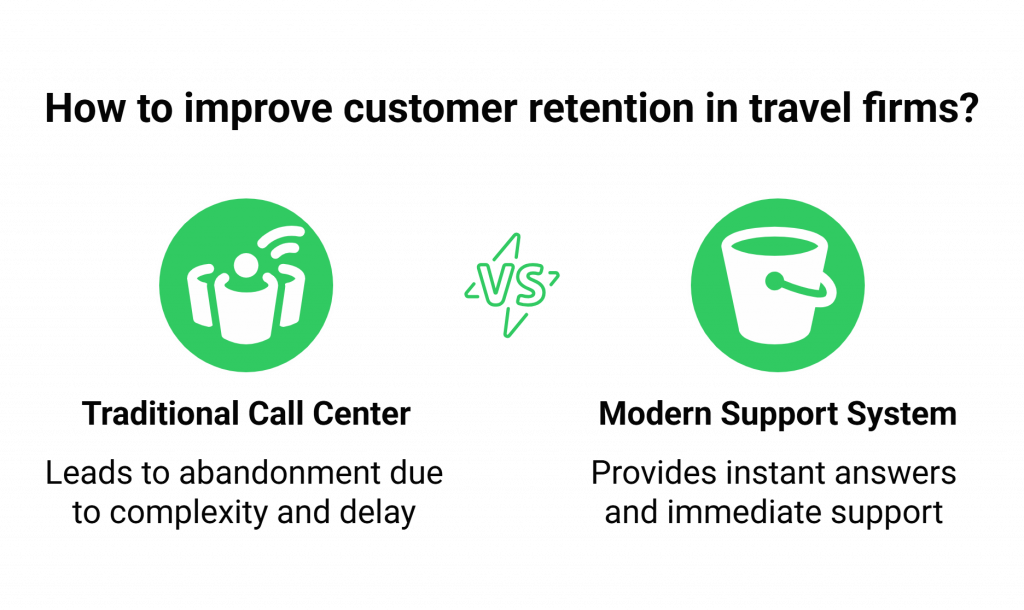
Why is the Traditional Call Center a “Leaky Bucket” for Travel Firms?
The traditional, human-only call center is a “leaky bucket” that is constantly losing a travel firm’s most valuable asset: qualified, high-intent customers.
How Does the “Complexity Barrier” Lead to Abandonment?
Booking travel is often a complex, research-intensive process. A potential customer might have a dozen small questions about a tour package, a specific flight’s baggage allowance, or a hotel’s cancellation policy.
If they can’t get an instant answer to these questions, they experience “decision paralysis” and abandon the booking.
A recent report on the travel industry found that the average booking abandonment rate for travel websites can be a staggering 85%. A significant portion of this is due to unanswered questions and a lack of immediate support.
What is the “Perishability” of a Travel Lead?
A travel inquiry is a “perishable” lead. A person’s desire to book a vacation is often an impulse, driven by excitement. If that initial call is met with a long hold time or a voicemail box, that excitement quickly turns to frustration.
By the time an agent calls them back hours later, they may have already booked with a competitor or abandoned their plans entirely.
Also Read: How Teler and OpenAI’s AgentKit Are Powering the Next Generation of Voice AI Agents
What Does a “Next-Generation” Inbound Call Solution Look Like?
To solve these challenges, innovative travel firms are moving to a “human-AI partnership” model. This is an “AI-first” approach where an intelligent voice agent acts as the 24/7 front line, and the highly-skilled human agents are elevated to the role of expert travel consultants.
This system is built on a foundation of a modern, API-driven voice infrastructure. A platform like FreJun AI provides the essential, “always-on,” and globally reliable telephony layer that a travel business with an international clientele demands. It is the high-performance “nervous system” that connects the customer to the right resource, whether that’s an AI or a human, instantly and with crystal-clear quality.
What are the High-Impact AI Workflows for Travel Firms?
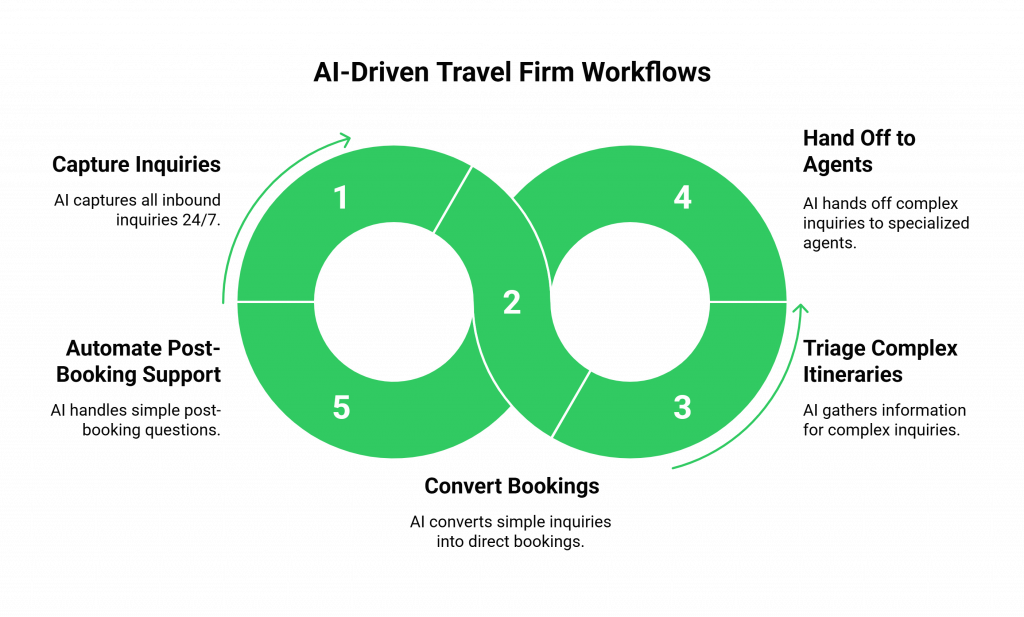
Let’s explore the specific, practical workflows that are transforming inbound call handling solutions in the travel industry.
How Can You Create a 24/7 “Travel Inquiry” and Booking Bot?
The Goal: To capture every single inbound inquiry, 24/7, and convert the simple ones into direct bookings without any human intervention.
The Workflow:
- AI: “Thank you for calling Vista Travels. I’m an AI travel assistant. I can help you book a new trip, check on an existing reservation, or answer questions about our travel packages. How can I help?”
- Traveler: “I’m interested in your 10-day tour of Italy.”
- AI (after a RAG query to its knowledge base): “The ‘Wonders of Italy’ tour is a fantastic choice! I can tell you about the itinerary, the available dates, and the pricing. What would you like to know first?”
- Traveler: “What’s the price for two adults in September?”
- AI (after an API call to the booking engine): “For two adults in September, the price is $4,500 per person. We do have an early booking discount of 10% if you book today. I can help you complete that reservation right now if you’d like.”
The Business Impact: This workflow captures the high-value leads that would have been lost after hours. It provides instant answers to a traveler’s initial questions, keeping their excitement high, and can even convert simple bookings on the spot.
Also Read: How Developers Can Use Teler and AgentKit to Build Human-Like Voice Agents
How Can You Build an “Intelligent Triage” for Complex Itineraries?
The Goal: For complex, high-value inquiries (like a multi-country trip or a luxury cruise), the AI acts as a perfect “intake specialist,” gathering all the necessary information before handing the call off to a specialized human agent.
The Workflow:
- AI: “Okay, it sounds like you’re planning a truly amazing honeymoon trip to Southeast Asia! To make sure I connect you with the right specialist, could you tell me a little more about your ideal budget and the types of activities you enjoy?”
The AI has a short, consultative conversation to gather the key qualifying details. It then performs a “contextual handoff.” It transfers the call to a human agent who specializes in luxury Asian travel and simultaneously “pops” a neat summary of the conversation onto their screen.
The Business Impact: This is the best of both worlds. The customer gets an instant, intelligent response, and the human agent starts the conversation fully informed and prepared to act as a high-value consultant, not a simple order-taker. This dramatically improves both the agent’s efficiency and the customer’s experience.
Ready to build a travel agency that never closes? Sign up for FreJun Teler and start building your 24/7 travel assistant.
How Can You Automate Post-Booking Support?
The Goal: To deflect the high volume of simple, repetitive questions that customers have after they have already booked a trip.
The Workflow:
The same AI can be trained to be an expert on post-booking inquiries.
- “I need to make a payment on my upcoming cruise.” (The AI can handle this securely with DTMF capture).
- “What is the baggage allowance for my flight to Paris?”
- “I need a copy of my travel itinerary emailed to me.”
The Business Impact: This frees up your human agents from these low-complexity tasks, allowing them to focus on selling new trips and managing complex customer issues.
Also Read: Why Are Businesses Shifting to AI Voice Agents?
Conclusion
In the travel industry, the customer experience is your most valuable asset. The traditional, queue-based model of inbound call handling solutions is a relic of the past, a source of friction that is actively costing you bookings and damaging your brand.
By embracing an AI-first approach, you can create a system that is not only dramatically more efficient and cost-effective but also provides the instant, intelligent, and personalized service that modern travelers demand. It is about meeting your customers in their moment of excitement and providing a seamless, conversational path from their travel dream to a booked reality.
Want to see a live demo of an AI voicebot handling a complex travel inquiry? Schedule a demo with our team at FreJun Teler.
Also Read: 020 Country Code: Which Area Does It Represent?
Frequently Asked Questions (FAQs)
These are the technologies and processes a travel company uses to manage incoming phone calls from customers. In 2025, the best solutions are “AI-first,” using an intelligent voicebot to automate a large portion of the calls.
A traditional IVR is a rigid menu (“Press 1 for cruises…”). An AI voicebot is conversational. It allows a traveler to state their needs in their own words (“I’m thinking about a trip to Italy in the fall”), creating a much more natural and user-friendly experience.
Yes. Through a secure API integration with a Global Distribution System (GDS) or your own booking engine, the AI can check real-time availability and pricing and complete a full booking, including taking a payment.
You “teach” the AI by connecting it to your knowledge base using a technique called RAG (Retrieval-Augmented Generation). The AI can “read” your tour brochures and website content and use that information to answer specific customer questions.
The goal is augmentation, not replacement. The AI is designed to handle the initial inquiries and simple bookings, which frees up your expert human agents to focus on designing complex, high-value, bespoke travel itineraries that require their unique expertise and creativity.
A contextual handoff is when the AI transfers a call to a human agent and simultaneously passes along all the data from its conversation. This allows the human agent to start their conversation fully informed about the traveler’s needs and preferences.
Yes. This is a major advantage for a global travel firm. By integrating with AI models that support multiple languages, the voicebot can provide 24/7 service to your international clientele in their native language.
A model-agnostic voice platform like FreJun AI allows you to choose the best AI “brain” (LLM) and “voice” (TTS). This is important for a travel bot because you can choose a voice that sounds adventurous, luxurious, or friendly, to perfectly match your brand’s niche.
FreJun AI provides a globally distributed voice network with local phone numbers available in countries all over the world. Our multiple Points of Presence ensure that your international customers always have a crystal-clear, low-latency connection.
The best first step is to analyze your current call data to identify the single, most frequent, and most time-consuming simple query (like “What’s the status of my visa application?” or “What’s the baggage allowance for this airline?”). Then, design and build an AI workflow to automate that one specific use case to prove the technology’s value.