
Have you ever been on a phone call with a customer support person and felt like they were not really listening to you? Or perhaps you have managed a team of callers and wondered if they were following the right script? Monitoring the quality of thousands of phone calls used to be an impossible task for a human.
You would have to listen to every single recording one by one, which would take years. Today, smart businesses use a voice recognition software API to do this work in seconds. This technology acts like a super powered ear that listens to every word, finds mistakes, and helps teams get better.
By using the right tools, you can ensure that every conversation your business has is helpful, polite, and accurate. In this guide, we will show you how to set up speech quality monitoring and keep your business running smoothly.
Table of contents
- What is Quality Monitoring with a Voice Recognition Software API?
- Why is Speech Quality Monitoring Important for Your Business?
- How Does a Voice Recognition Software API Measure Accuracy?
- What are the Key Accuracy Metrics You Should Follow?
- How Do You Set Up a Quality Monitoring Workflow?
- How Does FreJun AI Improve Transcription Accuracy?
- What are the Best Use Cases for Voice Quality Monitoring?
- How Can You Scale Your Quality Monitoring with FreJun Teler?
- What are the Challenges of Real-Time Voice Monitoring?
- How to Get the Most Out of Your Transcription Data?
- Conclusion
- Frequently Asked Questions (FAQs)
What is Quality Monitoring with a Voice Recognition Software API?
Quality monitoring is the process of checking if your phone calls meet certain standards. When we use a voice recognition software API, we turn those spoken words into written text. Once the words are in text format, we can use computer programs to analyze them. This allows a business to see if a caller said “hello” correctly or if they answered a customer’s question accurately.
This process relies on a strong foundation. FreJun AI provides the voice infrastructure that makes this monitoring possible. While you focus on the rules of your quality checks, FreJun handles the complex voice infrastructure so you can focus on building your AI.
It captures the raw audio from your calls and streams it to your chosen API with perfect clarity. This ensures that the “ear” of the AI hears every sound clearly, which is the first step toward high quality monitoring.
The Shift from Manual to Automated Checking
In the past, managers would listen to maybe two percent of all calls. This meant they missed 98% of what was happening. Now, with a voice recognition software API, you can monitor 100% of your calls. This shift gives you a complete picture of your transcription health and helps you find patterns that a human would never notice. It turns a guessing game into a precise science.
Why is Speech Quality Monitoring Important for Your Business?
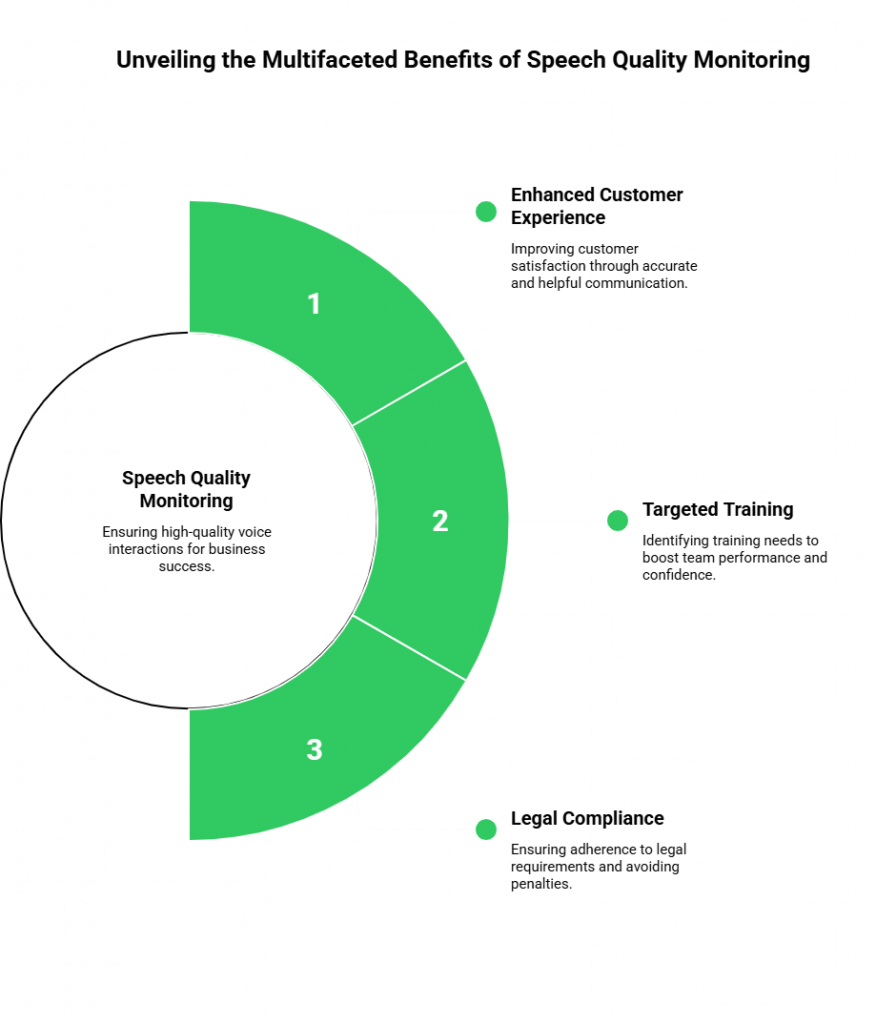
Every conversation is an opportunity to make a customer happy or lose them forever. If your team is giving out wrong information, it can lead to big problems. High quality monitoring helps you catch these errors before they cause damage. According to Salesforce, 80% of customers say the experience a company provides is just as important as its products or services. This means the quality of your voice interactions is a major part of your brand value.
Another reason is training. When you use speech quality monitoring, you can see exactly where your team needs help. If many agents are struggling with a specific question, you can create a training session for that exact topic. This makes your team smarter and more confident.
Finally, monitoring helps with legal rules. In many industries, you must say certain things during a call to stay within the law. A voice recognition software API can automatically flag any call where these legal phrases were missed. This protects your business from fines and legal trouble.
Also Read: How to Connect AgentKit Agents to Realtime Voice Calls Using Teler?
How Does a Voice Recognition Software API Measure Accuracy?
Accuracy is the most important part of any voice system. If the API writes down the wrong words, your quality monitoring will be wrong too. To prevent this, developers look at accuracy metrics. The most common metric is called the Word Error Rate or WER. This tells you what percentage of words the AI got wrong.
To keep your transcription health high, you need to provide the AI with clean audio. This is where FreJun AI shines. FreJun captures low latency audio from both inbound and outbound calls. Because the audio is transmitted clearly without delay, the voice recognition software API can do its job much better. Think of it like a pair of glasses. If the glasses are dirty, you cannot read. FreJun keeps the “audio glasses” clean so the AI can read every word.
Tracking Transcription Health Over Time
Monitoring is not a one time job. You need to look at your transcription health every day. If you notice that the accuracy is dropping, it might mean there is a problem with the microphone or the internet connection. By watching these metrics closely, you can fix technical issues before they ruin your data.
What are the Key Accuracy Metrics You Should Follow?
When you start monitoring, you might feel overwhelmed by all the data. It is best to focus on a few key numbers that tell the real story of your call quality. The table below shows the most important metrics for speech quality monitoring.
| Metric Name | What it Measures | Why it Matters |
| Word Error Rate (WER) | Percentage of incorrect words | Tells you if the AI understands the speakers. |
| Sentiment Score | The mood of the caller (happy or sad) | Helps you find angry customers quickly. |
| Silence Duration | How long the call was quiet | High silence might mean the agent is confused. |
| Keyword Hit Rate | If specific words were used | Ensures your team is following the script. |
| Interruption Frequency | How often people talked over each other | Shows if the conversation was polite or rude. |
| Transcription Latency | How fast the text was created | Essential for real time monitoring. |
By tracking these numbers through your voice recognition software API, you can create a scorecard for every single call. This allows you to reward your best agents and help those who are struggling.
Ready to start building a better way to monitor your calls? Sign up for FreJun AI and get your API keys to see how clear your audio can be.
How Do You Set Up a Quality Monitoring Workflow?
Setting up a monitoring system is a step by step process. You do not have to do everything at once. You can start small and grow as you get more comfortable with the technology.
Step 1: Define Your Standards
First, decide what a “good” call looks like for your business. Does it start with a specific greeting? Does the agent need to ask for an email address? You will feed these rules into your system so the voice recognition software API knows what to look for. This forms the basis of your speech quality monitoring strategy.
Step 2: Integrate with Voice Infrastructure
Next, you need a way to get the audio from the phone line to the AI. This is where FreJun AI comes in. FreJun provides a developer first toolkit with SDKs for both client and server side development. You can easily embed these features into your existing apps.
FreJun handles the real time media streaming and ensures that the voice layer runs smoothly. This means you do not have to worry about the “plumbing” of the phone call.
Step 3: Run the Analysis
Once the call is happening, the audio is sent to the voice recognition software API. The API turns the speech into text in real time. Your software then checks that text against your rules. If an agent forgets a required phrase, the system can send a notification to a manager immediately. This is much faster than waiting until the end of the day to check recordings.
How Does FreJun AI Improve Transcription Accuracy?
Many people think that accuracy only depends on the AI model. That is not true. Even the smartest AI will fail if the audio is fuzzy or has lots of background noise. FreJun AI is designed for speed and clarity. By using a geographically distributed infrastructure, FreJun ensures that the audio travels the shortest path possible. This reduces lag and keeps the sound sharp.
Because FreJun is model agnostic, you can use any voice recognition software API you like. You are not locked into one provider. If you find a new AI that is better at understanding your specific industry terms, you can switch to it easily. FreJun continues to handle the voice transport layer, providing the raw audio capture that the new API needs to be successful.
Low Latency for Natural Conversations
When you monitor calls in real time, latency is a big deal. If there is a delay in the audio, the AI might get confused about who is speaking. FreJun’s low latency optimization eliminates awkward pauses and ensures that every word is transmitted clearly. This keeps your transcription health high and your data reliable.
Also Read: AI Voicebot for Power Outage Reporting
What are the Best Use Cases for Voice Quality Monitoring?
There are many ways to use a voice recognition software API to help your business grow. It is not just about catching mistakes; it is about finding opportunities to be better.
Customer Support Centers
In a support center, the goal is to solve problems quickly. Monitoring helps you see which agents are the best at fixing issues. You can study their calls to see what they say and then teach those techniques to everyone else. This raises the quality of the whole team.
Sales and Marketing Teams
For sales teams, every word matters. A voice recognition software API can track which sales pitches lead to a “yes” and which ones lead to a “no.” You can see if agents are mentioning the latest promotion or if they are forgetting to ask for the sale. This directly leads to more revenue for your company.
Compliance and Legal Teams
In some industries, like banking or healthcare, you have to follow strict rules about what you say on the phone. Quality monitoring ensures that every agent is following these rules. It provides a written record of every call, which you can use as proof if there is ever a dispute. This gives your legal team peace of mind.
How Can You Scale Your Quality Monitoring with FreJun Teler?
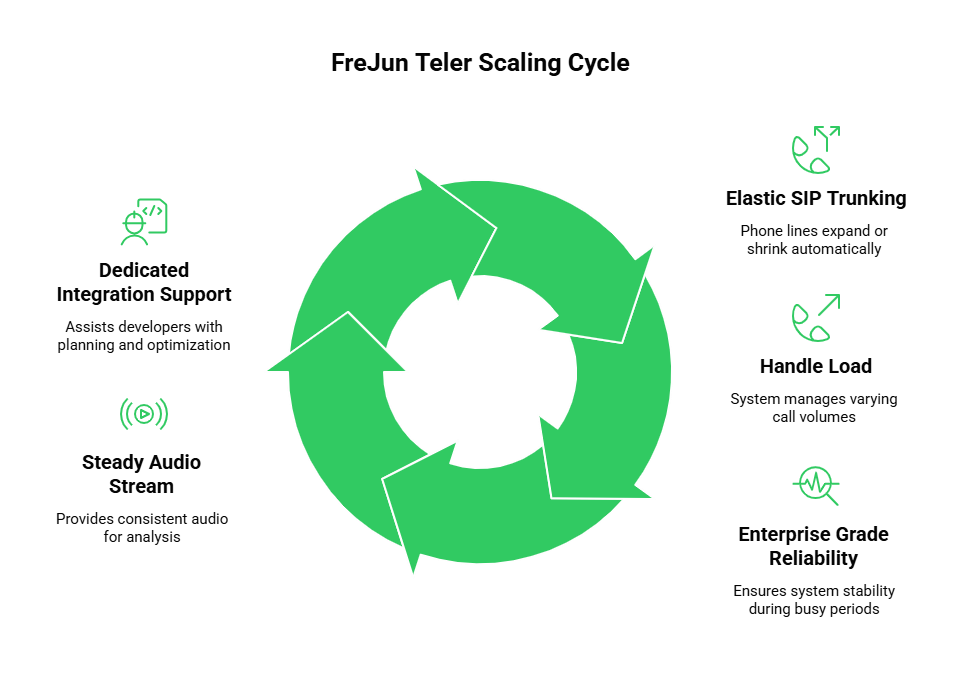
As your business grows, you will have more calls to monitor. You need a system that can grow with you without breaking. FreJun Teler features elastic SIP trunking, which is a fancy way of saying the phone lines can expand or shrink automatically. Whether you have ten calls or ten thousand calls at the same time, FreJun handles the load.
This scalability is essential for enterprise grade reliability. You do not want your monitoring system to crash just because you are having a busy day. FreJun’s infrastructure is built for high availability and guaranteed uptime. This means your voice recognition software API will always have a steady stream of audio to analyze, no matter how much your business scales.
Furthermore, FreJun provides dedicated integration support. If you are a developer building a large system, you can get help with planning and optimization. This ensures a smooth journey from your first test call to a full scale deployment.
What are the Challenges of Real-Time Voice Monitoring?
While the technology is amazing, it does come with some challenges. One challenge is handling multiple people talking at once. This is called speaker diarization. A high quality voice recognition software API must be able to tell the difference between the agent and the customer. If it gets them mixed up, your accuracy metrics will be wrong.
Another challenge is background noise. If an agent is working from a loud home or a busy office, the AI might struggle to hear them. This is why having a strong voice infrastructure is so important. FreJun AI focuses on capturing the best possible audio from the source, which helps the AI filter out the noise and focus on the speech.
Finally, there is the issue of privacy. Voice data is sensitive. FreJun is engineered with security by design. It uses robust protocols to protect the confidentiality of every call. This ensures that your quality monitoring meets the highest standards of data protection and privacy.
How to Get the Most Out of Your Transcription Data?
Once you have all this text from your voice recognition software API, you should use it to make big decisions. Do not just let the data sit there. Look for trends. Are customers asking about a new feature? Are they complaining about a specific bug?
You can feed the transcriptions into other AI models to get even deeper insights. For example, you can use a Large Language Model to summarize every call into a few bullet points. This allows a manager to “read” a hundred calls in just a few minutes. It turns a mountain of audio into a clear map for your business strategy.
By combining the reliable voice transport of FreJun AI with the smart analysis of a voice recognition API, you create a powerful tool for growth. You move from simply making calls to truly understanding your customers. This understanding is what separates successful companies from the rest.
Also Read: Handling Billing Queries with Voice AI
Conclusion
Monitoring quality using a voice recognition software API is no longer a luxury for big companies. It is a necessary tool for any business that wants to provide great service and stay competitive. By automating the checking process, you can ensure that every conversation meets your standards and follows the law.
The success of this system depends on two things: a smart AI model and a rock solid voice infrastructure. FreJun AI provides that foundation, handling the complex telephony layer and real time streaming so your AI can hear every word perfectly.
With high transcription health and clear accuracy metrics, you can build a team that talks better, sells more, and keeps customers coming back. In a world where every word counts, making sure those words are monitored and improved is the smartest move you can make for your business.
Want to discuss your specific use case for call quality monitoring? Schedule a demo with our team at FreJun Teler.
Also Read: Future Trends in Outbound Calling: AI, Analytics & Intelligent Dialing
Frequently Asked Questions (FAQs)
A voice recognition software API is a tool that allows a computer program to turn spoken language into written text. It is used by developers to build applications that can “listen” to phone calls and understand what is being said in real time.
It helps by providing automated feedback on every call. It can catch mistakes, ensure scripts are followed, and identify areas where agents need more training. This leads to better customer service and higher sales.
Transcription health refers to how well your voice to text system is working. It involves looking at accuracy metrics like Word Error Rate and ensuring the audio stream is clear and consistent without any data loss.
Yes, FreJun AI is model agnostic. This means it acts as the voice transport layer and allows you to connect any Speech to Text, Large Language Model, or Text to Speech service you prefer.
Low latency ensures that the audio is sent to the AI without delay. This allows for real time monitoring, so you can be alerted to a problem while a call is still happening, rather than finding out hours later.
FreJun Teler uses elastic SIP trunking. This technology allows the voice infrastructure to scale up or down based on the number of active calls. It ensures that your monitoring system remains stable even during peak hours.
Accuracy metrics are numbers used to measure how well the AI is performing. The most common one is Word Error Rate (WER), which tracks the percentage of words the AI failed to transcribe correctly.
Yes, when you use a professional platform like FreJun AI. FreJun is built with security by design and uses robust protocols to protect call data and maintain confidentiality for your business and your customers.
You will need someone with basic development skills. FreJun provides comprehensive SDKs and a developer first toolkit that makes it much easier to integrate voice features into your existing software without being a telephony expert.
Yes, most modern voice recognition software APIs support a wide variety of languages. Since FreJun is model agnostic, you can choose an AI provider that specializes in the specific languages your customers and agents speak.