
Imagine you have a problem with your internet connection. You pick up the phone and call customer support. You wait on hold for ten minutes listening to elevator music. Finally a human answers. You explain the problem. They ask you to hold again while they check something. The line disconnects.
You have to call back and you have to explain the story all over again to a new person. You are frustrated and angry and you are thinking about switching providers.
This is a failure of First Call Resolution or FCR. It is the single most important metric in customer support. It measures the percentage of calls where the customer’s issue is solved completely during the very first interaction without any callbacks or transfers.
For years businesses have struggled to improve this number. Humans get tired. They lack information. They get overwhelmed by call volume.
But there is a new solution. By integrating an AI voice agent API into your support stack you can build intelligent virtual agents that never sleep and never forget a detail and never put customers on hold.
In this guide we will explore how AI dramatically boosts first call resolution AI strategies. We will look at the technology behind it and how to measure success and how robust infrastructure platforms like FreJun AI provide the reliability needed to make it work.
Table of contents
- What Is First Call Resolution and Why Does It Matter?
- How Does an AI Voice Agent API Work?
- What Are the Common Barriers to High FCR?
- How Does AI Improve First Call Resolution AI?
- How Do You Measure Call Success Rates?
- What Is the Role of Speed in AI Voice Efficiency?
- How Does Context Integration Solve Problems Faster?
- What Steps Should Developers Take to Implement This?
- How Does FreJun Teler Ensure Reliability?
- Conclusion
- Frequently Asked Questions (FAQs)
What Is First Call Resolution and Why Does It Matter?
First Call Resolution (FCR) is exactly what it sounds like. It asks a simple question. Did we fix the problem the first time the customer called?
If the answer is yes the customer is happy. If the answer is no the customer is frustrated.
FCR is directly linked to customer loyalty. When you solve a problem quickly you build trust. When you fail you erode that trust.
According to research by the SQM Group, for every 1% improvement in FCR there is a 1% improvement in Customer Satisfaction or CSAT. This is a one to one relationship. High FCR means happy customers. Low FCR means churn.
Furthermore low FCR is expensive. Every time a customer calls back it costs you money. You pay for the phone charges and the agent’s time and the infrastructure. Improving FCR using an AI voice agent API is not just about being nice. It is about saving massive amounts of operational budget.
How Does an AI Voice Agent API Work?
To improve FCR we first need to understand the tool we are using. An AI voice agent API is a bridge. It connects your telephone system to a brain.
Here is the typical workflow of an AI call.
- The Ear: The customer speaks. The system captures the audio.
- The Transcription: A Speech to Text (STT) engine turns audio into words.
- The Brain: A Large Language Model (LLM) reads the words. It understands the problem. It searches the database for the answer. It creates a response.
- The Voice: A Text to Speech (TTS) engine turns the response back into audio.
- The Mouth: The system streams the audio back to the customer.
This happens in milliseconds. Because the AI has instant access to your entire knowledge base it can answer complex questions that might stump a human agent.
However this process relies heavily on the quality of the connection. If the audio is fuzzy the AI cannot understand the words. This is where FreJun AI comes in. We handle the complex voice infrastructure so you can focus on building your AI. FreJun ensures that the audio stream is crystal clear and ultra fast so the “Brain” gets the right information every time.
Also Read: Carrier Coordination Through Voice APIs
What Are the Common Barriers to High FCR?
Why is FCR so hard to achieve with human agents alone? There are several structural reasons.
Lack of Knowledge
A new agent might not know how to fix a rare billing error. They have to put the customer on hold to ask a manager. This increases time and often leads to transfers.
High Call Volume
When the queue is long agents rush. They might give a quick answer just to get the customer off the phone so they can take the next call. This quick answer is often wrong leading to a callback.
Siloed Data
The agent might not see that the customer emailed about the same issue yesterday. They lack context.
An AI voice agent API removes these barriers. The AI has infinite patience. It has access to all documentation instantly. It can handle infinite concurrent calls.
How Does AI Improve First Call Resolution AI?
Implementing AI is not just about automating the greeting. It is about resolving the core issue. Here is how AI drives call success rates up.
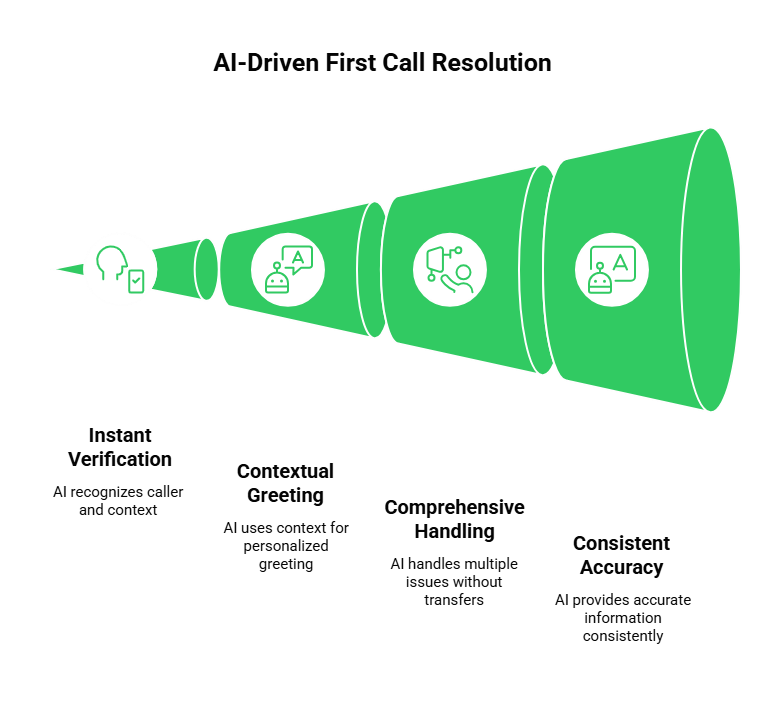
1. Instant Verification and Context
When a call comes in the AI instantly recognizes the phone number. It queries your CRM. It sees that “John” just bought a “Model X Coffee Maker.”
Instead of asking “How can I help you?” the AI asks “Hi John are you calling about your new Coffee Maker?”
This immediate context helps solve the problem faster. FreJun’s infrastructure supports passing this metadata seamlessly ensuring the AI always knows who it is talking to.
2. Eliminating Holds and Transfers
The number one killer of FCR is the transfer. “Please hold while I transfer you to the billing department.”
An AI agent does not need to transfer. It is the billing department and is also technical support. AI agent is also sales. It can handle a payment and then troubleshoot a router in the same conversation without ever switching lines.
3. Consistent Accuracy
Humans forget things. An AI never forgets. If the policy says “Refunds are processed in 5 days” the AI will always say 5 days. It will never accidentally say 3 days. This consistency prevents callbacks caused by misinformation.
How Do You Measure Call Success Rates?
You cannot improve what you do not measure. When using an AI voice agent API you need to track specific metrics to see if your first call resolution AI strategy is working. Here is a simple table comparing how you track humans versus AI.
| Metric | Human Agent | AI Voice Agent |
| Availability | 8 hours a day | 24 hours a day |
| Queue Time | Minutes to Hours | Zero seconds |
| Knowledge Access | Memory or Search Bar | Instant Database Access |
| Consistency | Varies by Agent mood | 100% Consistent |
| Scalability | Hard (Must hire people) | Easy (Software scales up) |
By tracking call success rates you will likely see that AI agents have a higher initial completion rate for standard tasks because they do not get tired or distracted.
What Is the Role of Speed in AI Voice Efficiency?
Speed is critical for resolution. If there is a delay on the line the customer gets confused. They might speak over the bot. This leads to errors.
This is called latency. In the world of AI voice efficiency latency is the enemy.
If you ask “What is my balance?” and the bot takes four seconds to answer you might say “Hello? Are you there?” The bot then hears “Hello” and gets confused. The resolution fails.
FreJun AI is built to solve this. We utilize real time media streaming and low latency optimization. Our platform ensures that the voice data travels from the customer to your AI and back faster than the blink of an eye. This creates a natural conversational flow which is essential for solving problems correctly on the first try.
Also Read: Reducing Missed Deliveries with Voice AI
How Does Context Integration Solve Problems Faster?
We touched on context earlier but let us go deeper. To solve a problem on the first call you need the full picture. Imagine a customer calling about a lost package.
- Without Context: The customer has to provide the tracking number and the address and the order date. This takes time and allows for errors.
- With Context: The system sees the open order. The AI says “I see your package is delayed in Chicago. Would you like me to file a claim?”
To build this you need an AI voice agent API that integrates easily with your backend systems. FreJun provides developer friendly SDKs that make it easy to fetch data from your database and feed it into the call logic in real time.
Ready to boost your resolution rates? Sign up for a FreJun AI to start building smarter voice agents today.
What Steps Should Developers Take to Implement This?
If you are a developer looking to build a high FCR voicebot here is your roadmap.
Step 1 choose Reliable Infrastructure
Do not build your house on sand. Start with FreJun AI. We handle the telephony connections and the carrier negotiations and the audio stability.
Step 2 Define Your Intents
What are the top 10 reasons people call? Password reset? Order status? Billing? Map these out. These are your “intents.”
Step 3 Connect Your Intelligence
Use our API to stream the audio to your chosen LLM (like OpenAI or Anthropic). Train the LLM on your specific support documents.
Step 4 Enable Barge In
“Barge in” allows the customer to interrupt the bot. If the bot is explaining a policy and the customer says “I know that just tell me the price” the bot needs to stop and pivot. FreJun’s real time streaming supports this capability which is vital for a natural feel.
Step 5 Test and Iterate
Launch the bot. Monitor the transcripts. Where did it fail? Did it misunderstand an accent? Did it give a wrong answer? Tweak the prompt and try again.
How Does FreJun Teler Ensure Reliability?
You cannot resolve a call if the call drops. Reliability is the foundation of FCR.
FreJun Teler offers elastic SIP trunking. This is a fancy way of saying our phone lines are flexible and strong.
Imagine your business runs a Super Bowl ad. Suddenly 10000 people call at once. A normal phone system would crash. Callers would get a busy signal. FCR would drop to zero.
With FreJun Teler the system automatically scales up. It creates new pathways for those calls instantly. Every customer gets through. Every customer gets a chance to have their issue resolved.
Also Read: AI Voicebots for Hotel Reservations Made Easy
Conclusion
The goal of every customer support team should be to respect the customer’s time. First Call Resolution is the ultimate measure of that respect.
By deploying an AI voice agent API you are giving your customers a gift. You are giving them instant answers and accurate information and a hassle free experience. You are removing the friction of holds and transfers and callbacks.
But remember that an AI is only as good as its connection. To achieve high FCR you need a voice infrastructure that is fast and clear and reliable. FreJun AI provides the sturdy foundation your voice agents need to succeed.
With features like low latency routing and FreJun Teler for elastic scaling we ensure that your AI can hear, understand, and help your customers every single time they call.
Want to discuss how to optimize your support for First Call Resolution? Schedule a demo with our team at FreJun Teler and let us show you the future of voice.
Also Read: Cold Calling Techniques That Actually Work for Outbound Teams
Frequently Asked Questions (FAQs)
An AI voice agent API is a set of programming tools that allows developers to integrate artificial intelligence into telephone systems. It enables software to make and receive calls and understand speech and generate spoken responses.
AI improves FCR by answering calls instantly and accessing vast databases to provide accurate answers and eliminating the need for transfers between departments. It ensures the customer gets the right answer immediately.
Yes. Modern Large Language Models (LLMs) are incredibly smart. They can troubleshoot complex technical issues or handle intricate billing queries as long as they have access to the right documentation.
A well designed system will detect when it is stuck. It will then perform a “warm handoff” to a human agent passing along the transcript so the human knows exactly what happened. This still helps the human solve it faster.
If the audio is bad the AI cannot understand the customer’s request. It will ask them to repeat themselves which causes frustration. FreJun AI ensures high quality audio streaming to prevent this.
Latency is the delay between speaking and hearing a response. High latency makes the AI feel slow and stupid. FreJun minimizes latency to ensure the conversation flows naturally which helps in resolving issues quickly.
No. FreJun provides the infrastructure and the “ears” and “mouth.” We are model agnostic. You can bring your own AI model like OpenAI or Google Gemini and we connect it to the phone network.
It is often cheaper than hiring more staff. AI agents cost a fraction of a human agent per minute. Plus improving FCR saves money by reducing the total number of calls you receive.
FreJun Teler uses elastic SIP trunking. This allows your phone system to expand automatically when call volume spikes ensuring that no customer receives a busy signal.
Yes. FreJun is built with enterprise grade security protocols. We encrypt voice data during transmission to ensure that sensitive customer information remains private.