
Imagine a scenario where a stockbroker receives a call from a client. The client shouts “Buy a thousand shares of Apple right now!” The broker executes the trade. Two days later the stock price crashes. The client calls back furious and claims “I never told you to buy that! You made a mistake and I want my money back.”
It is a classic case of he said she said. Without proof the brokerage firm is in trouble. They could face a lawsuit or a massive fine from regulators. They could lose their license.
Now imagine a different ending. The compliance officer opens a dashboard. They type in the client’s name. Instantly they pull up a digital record of the call. They have the exact time the call started. They have the duration. Most importantly they have a crystal clear recording of the client shouting “Buy a thousand shares!”
The dispute is over in seconds. The firm is safe.
This is the power of compliance logging. In highly regulated industries like finance and healthcare and insurance voice calls are not just conversations. They are legal records. Managing these records manually is impossible when you handle thousands of calls a day.
This is where technology steps in. By utilizing voice API integration developers can build systems that automatically capture and catalog every single interaction. These systems create unalterable call audit trails that protect the business and satisfy the regulators.
In this guide we will explore how to use voice APIs to ensure compliance. We will look at the data you need to capture and how to secure it and how robust infrastructure platforms like FreJun AI provide the reliability needed to keep your records safe.
Table of contents
- Why Is Compliance So Hard for Voice Channels?
- What Are Voice API Integration Logs?
- Which Regulations Require Call Audit Trails?
- How Does Automation Fix the Human Error Problem?
- How Do You Secure the Logs?
- How Does FreJun AI Support Compliance?
- What Specific Data Points Must You Capture?
- How to Implement Redaction for Sensitive Data?
- How to Build a Compliance Dashboard?
- Retention Policies: When to Delete?
- Conclusion
- Frequently Asked Questions (FAQs)
Why Is Compliance So Hard for Voice Channels?
Text is easy to track. Emails and chat logs are naturally digital. They are text files stored on a server. You can search them easily.
Voice is different. Voice is ephemeral. Once the words are spoken they vanish into thin air unless you actively catch them. For a long time businesses relied on physical tape recorders or specialized hardware systems wired into desk phones. These were expensive and hard to search.
Today the challenge is even bigger because of strict regulations.
- GDPR (General Data Protection Regulation): You must protect user privacy and delete data if asked.
- MiFID II: Financial firms in Europe must record all communications related to a trade and keep them for years.
- HIPAA: Healthcare providers in the US must protect patient health information spoken over the phone.
- PCI-DSS: You cannot record credit card security codes (CVV) even if you record the rest of the call.
A voice API integration solves this by turning the ephemeral voice call into a structured digital event. It allows you to program the rules of compliance directly into the phone system.
What Are Voice API Integration Logs?
When we talk about logs we are talking about two distinct things.
- The Metadata: This is the data about the call. It includes the “From” number and the “To” number and the timestamp and the duration and the disconnect reason. This proves that a conversation took place.
- The Media: This is the actual recording of the audio.
A robust voice API integration captures both. When a call passes through a platform like FreJun AI the system generates a detailed log entry.
This log is the source of truth. It is machine readable. This means you can feed it into other software systems to spot anomalies. For example if a support agent hangs up on a customer after ten seconds the log captures that “disconnect reason.” Your compliance software can flag that specific log for a manager to review.
Which Regulations Require Call Audit Trails?
Different industries have different rules. However the need for regulatory voice records is growing everywhere.
Here is a breakdown of common regulations and what they require from your voice infrastructure.
| Regulation | Industry | Requirement | How API Helps |
| MiFID II | Finance (EU) | Record all calls leading to a trade. Keep for 5-7 years. | Automates recording for specific departments. |
| HIPAA | Healthcare (USA) | Protect patient privacy. Encrypt data. | Encrypts recordings at rest and in transit. |
| PCI-DSS | Payments (Global) | Do not store CVV codes. | API triggers “pause recording” during payment entry. |
| TCPA | Telemarketing (USA) | Do not call people without consent. | API checks “Do Not Call” lists before dialing. |
| GDPR | General (EU) | Right to be forgotten. | API allows programmatic deletion of specific logs. |
Also Read: Voice API for Smart Meter Platforms
How Does Automation Fix the Human Error Problem?
The biggest enemy of compliance is not malicious intent. It is human error. An agent forgets to press the record button. A manager forgets to save the file to the secure folder. A server runs out of space and deletes the oldest files.
By using voice API integration you remove the human element entirely. You write code that says “If a call comes into this department record it.” The software never forgets. It never gets tired. It never accidentally deletes a file because it thought it was unimportant.
FreJun AI is critical here. We handle the complex voice infrastructure so you can focus on building your AI and compliance logic. Our system acts as the reliable transport layer. When you tell the API to record it records. We handle the media processing in the background ensuring that the file is generated correctly every single time.
How Do You Secure the Logs?
Collecting voice compliance logging data is only half the battle. You also have to protect it. If you record sensitive calls and then leave the recordings on a public server you are in big trouble. Security must be baked into the integration.
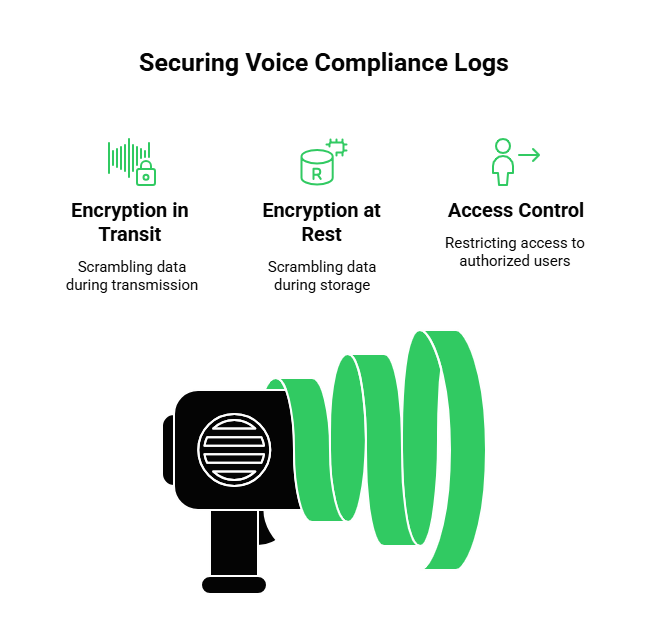
Encryption in Transit
This means scrambling the data while it travels over the internet. FreJun uses secure protocols (TLS/SRTP) to ensure that no one can tap into the line and listen to the call while it is happening.
Encryption at Rest
This means scrambling the file when it is stored on the hard drive. Even if a hacker stole the hard drive they would only see gibberish code not audio files.
Access Control
Not everyone in your company should see the logs. The sales team does not need to hear the HR team’s calls. With an API approach you can build strict access controls. You can verify the user’s identity before allowing them to fetch a recording via the API.
How Does FreJun AI Support Compliance?
FreJun is not a compliance officer but we are the vault. We provide the enterprise grade infrastructure that makes compliance possible.
Reliability via Teler
Imagine if your recording server crashes during a market crash. You lose the records of millions of dollars in trades. That is a disaster.
FreJun Teler offers elastic SIP trunking. This means our system scales automatically. If you suddenly get ten thousand calls our infrastructure expands to handle them. We ensure that every single call is processed and logged regardless of volume. This high availability is essential for maintaining complete call audit trails.
Low Latency for Accurate Timing
In legal disputes timing matters. Did the order come in at 10:00:01 or 10:00:05?
FreJun’s low latency network ensures that the timestamps in your logs match reality. Because we process media in real time without lag the “Start Time” in the log is the exact moment the connection was made.
Ready to build a compliant voice system? Sign up for a FreJun AI to access our secure infrastructure keys.
Also Read: Why Are Voicebot Solutions Replacing Traditional IVR Systems?
What Specific Data Points Must You Capture?
To build a bulletproof voice API integration for compliance you need to capture specific metadata fields. When you query the FreJun API here are the fields you should store in your internal database.
1. The Session ID
This is the unique fingerprint of the call. It links the metadata to the recording.
2. Timestamps (UTC)
Always store time in Coordinated Universal Time (UTC). This avoids confusion if your server is in New York and your agent is in London. You need start_time, answer_time, and end_time.
3. Direction
Was this an inbound call or an outbound call? This matters for regulations like TCPA which have stricter rules for outbound telemarketing.
4. Participants
Who was on the call? Capture the From number and the To number. If you are using SIP headers capture the Agent ID as well.
5. Termination Cause
Why did the call end? Did the customer hang up? Did the agent hang up? This field is vital for proving that you did not maliciously cut off a customer.
How to Implement Redaction for Sensitive Data?
This is a common technical challenge. You need to record the call for quality assurance but the customer is about to read their credit card number aloud. PCI-DSS rules say you cannot record that.
A smart voice API integration handles this with a “toggle” feature.
- The Trigger: The agent clicks “Enter Payment” on their CRM.
- The API Call: The CRM sends a request to the voice API to pause_recording.
- The Action: The infrastructure stops writing audio to the file.
- The Resume: When the payment is done the agent clicks “Done” and the API sends resume_recording.
The result is a single audio file with a few seconds of silence where the credit card number would have been. This keeps you compliant while still retaining the rest of the conversation record.
How to Build a Compliance Dashboard?
The logs are useless if no one reads them. You need to visualize this data.
Step 1 Fetch the Logs
Write a script that pulls call logs from the API every hour.
Step 2 Store Internally
Save these logs into your own secure database. Do not rely solely on the vendor’s storage. You are responsible for your own data retention policy.
Step 3 Visualize
Build a dashboard for your compliance officer. It should allow them to filter by date or agent or “risk score.”
Step 4 Automated Alerts
Program your system to alert you if something looks wrong. For example “Alert me if any call lasts less than 10 seconds” or “Alert me if an agent manually pauses a recording more than 5 times a day.”
Retention Policies: When to Delete?
Keeping data forever is expensive and risky. GDPR says you should not keep data longer than necessary. Regulatory voice records usually have a defined lifespan.
- Finance: Often 5 to 7 years.
- General Business: Often 6 to 12 months.
A good integration automates deletion. You can write a script that checks the created_date of your logs. If a file is older than the retention limit the script calls the API to delete the recording. This ensures you are not holding onto “toxic data” that you no longer need.
Also Read: Why Is a Voice API for Developers the Backbone of AI Voice Systems?
Conclusion
Compliance is often seen as a burden. It is seen as a list of boxes to check. But in reality it is about trust. It is about proving that your business operates with integrity.
Using voice API integration logs changes compliance from a manual headache into an automated asset. It gives you perfect visibility into your operations. It creates undeniable call audit trails that protect your company from disputes and fines.
However the quality of your logs depends on the quality of your infrastructure. If your voice provider drops calls or loses data your compliance strategy fails. FreJun AI provides the robust and secure foundation you need. With FreJun Teler ensuring elastic scale and our developer first APIs ensuring easy integration we help you build a voice system that is both powerful and compliant.
Want to discuss your specific compliance needs? Schedule a demo with our team at FreJun Teler and let us help you secure your voice data.
Also Read: Call Log: Everything You Need to Know About Call Records
Frequently Asked Questions (FAQs)
Voice API integration is the use of code to connect your software applications to a telephony network. It allows you to programmatically control calls and record audio and generate detailed logs of every interaction.
Logs provide proof. In regulated industries you must prove that you followed the rules. Logs show who called whom and when and what was said providing an audit trail that satisfies regulators and resolves disputes.
Call logging captures the metadata (time, date, duration, phone numbers). Call recording captures the actual audio of the conversation. Most compliance regulations require both.
FreJun provides the infrastructure features needed to build HIPAA compliant applications. We offer encryption in transit and at rest. However compliance is a shared responsibility. The developer must also ensure their application logic follows HIPAA rules.
FreJun provides storage for logs but we recommend that developers fetch and store logs in their own databases for long term retention according to their specific industry regulations.
Yes. To comply with privacy laws like GDPR you can use the API to programmatically delete specific call records and recordings when they are no longer needed or if a user requests deletion.
FreJun Teler provides elastic SIP trunking. This ensures high availability. Compliance requires you to log every call. If your system crashes due to high volume you are non compliant. Teler scales to prevent this data loss.
This is the process of removing credit card information from a call recording. You can implement this using the API to pause the recording while the customer speaks their card details and resume it afterwards.