
Imagine sitting in a busy train station trying to listen to an important announcement. The noise is loud and the speakers are fuzzy. You can hear that someone is talking, but you cannot understand the words. This is a common problem for many people every day. Communication is supposed to be a bridge between people, but sometimes that bridge is broken. This is where technology steps in to help.
By using a voice recognition software API, developers can create live captions that appear on a screen the moment someone speaks. These instant subtitles make sure that everyone can follow the conversation, regardless of where they are or how well they can hear.
In this guide, we will learn how this amazing technology works and how you can use it to make the world more inclusive for everyone.
Table of contents
- What is a Voice Recognition Software API?
- Why is Accessibility Crucial in Modern Communication?
- How Does a Live Captions API Process Audio in Real Time?
- What are the Benefits of Using Instant Subtitles for Your Business?
- How Does FreJun AI Support Real-Time Captioning Infrastructure?
- How to Choose the Right Voice Recognition Software API?
- What are the Common Challenges in Enabling Live Captions?
- How Can Developers Implement a Live Captions API Quickly?
- What is the Future of Accessibility Speech Tools?
- How Does Security Protect Voice Data?
- Conclusion
- Frequently Asked Questions (FAQs)
What is a Voice Recognition Software API?
A voice recognition software API is a special set of digital tools that allows different computer programs to talk to each other. Think of it as a very smart translator that lives inside a computer. Its main job is to listen to the sound of a human voice and turn those sounds into written text. When you talk into a microphone, the API looks at the patterns in your speech. It identifies the vowels and consonants and matches them to words in its dictionary.
This process happens very fast. In the past, computers had to wait for a person to finish speaking before they could translate the words. Now, we use something called streaming audio. This means the computer processes the speech as it happens. This is the foundation of live captions. For this to work perfectly, you need a strong system to carry the voice from the speaker to the computer.
FreJun AI provides the essential voice infrastructure platform that handles real time call streaming. While you focus on the part of the AI that understands the words, FreJun handles the complex voice infrastructure so you can focus on building your AI.
Using a voice recognition software API is like giving your application a pair of digital ears. It allows the app to understand the world around it. Whether you are building a tool for a classroom or a business meeting, this API is the key to turning spoken sounds into useful data.
Why is Accessibility Crucial in Modern Communication?
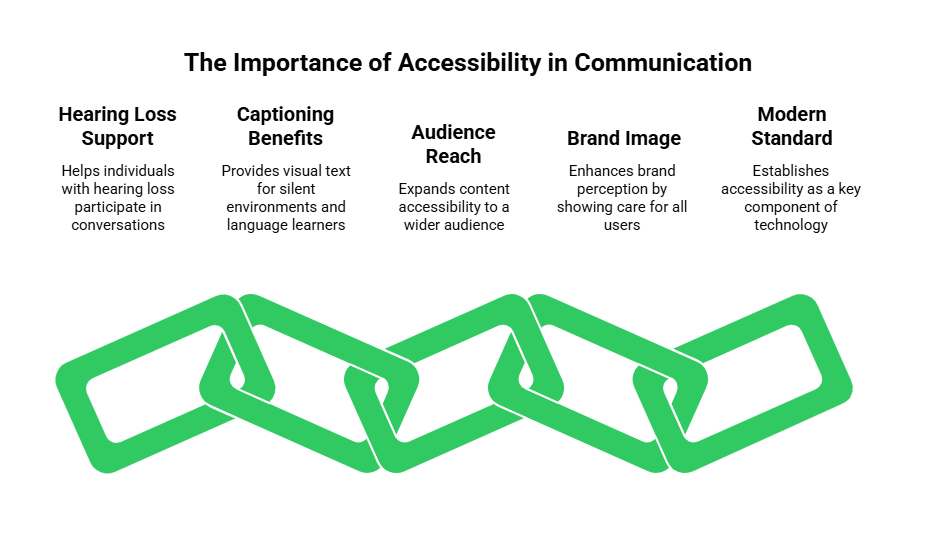
Accessibility is a big word that simply means making sure everyone can use something. In the world of communication, this means making sure people who are deaf or hard of hearing can still participate in conversations. According to the World Health Organization, more than 1.5 billion people across the world live with some degree of hearing loss. This is a huge number of people who might struggle to understand a video or a phone call without help.
When a company uses accessibility speech tools, they are opening their doors to everyone. It is not just about helping people with hearing loss. Many people use captions because they are in a quiet place like a library and do not have headphones. Others use them because they are learning a new language and want to see the words as they hear them.
By enabling instant subtitles through a voice recognition software API, you make your content better for everyone. It shows that you care about your audience and want to make sure your message is clear. Accessibility is no longer just a nice feature to have. It is now a standard part of building modern technology that serves all people equally.
Also Read: AI Voicebots for Hotel Reservations Made Easy
How Does a Live Captions API Process Audio in Real Time?
The journey from a spoken word to a caption on a screen is a fast and exciting one. It happens in four main steps. First, the microphone captures the sound waves of your voice. This sound is turned into digital data. Second, this data is sent through a voice infrastructure. This is where FreJun AI shines.
FreJun captures the audio and streams it to the cloud with very low latency. If the audio takes too long to travel, the captions will appear late, which makes them hard to read.
Third, the voice recognition software API receives the audio stream. It uses complex math and artificial intelligence to figure out what words are being said. It can even understand different accents and languages. Fourth, the API sends the text back to the display. This text appears as live captions on a phone, a laptop, or a television screen.
Because FreJun AI is model agnostic, you can connect it to any voice recognition software API you like. You are not stuck with just one choice. You can pick the one that is most accurate for your specific language or industry. FreJun acts as the plumbing that moves the audio, while the API acts as the brain that understands it. This combination allows for a smooth and natural experience for the user.
What are the Benefits of Using Instant Subtitles for Your Business?
Businesses use instant subtitles to reach more people and work more efficiently. When a company holds a big meeting over the internet, live captions help keep everyone on the same page. This is especially helpful for international companies where employees might speak different languages. Using a voice recognition software API allows for quick and accurate communication across different countries.
There are many other benefits as well. Captions allow you to create a written record of every meeting automatically. You do not need to have a person sit and type notes for hours. The AI does it for you. This saves time and money. Below is a table that compares manual captioning to using an AI driven API.
| Feature | Manual Captioning | AI Voice Recognition API |
| Speed | Slow (requires human typing) | Instant (real time) |
| Cost | High (paying for human labor) | Low (pay per use) |
| Accuracy | High but prone to fatigue | Very high and consistent |
| Availability | Needs to be scheduled | Available all the time |
| Scalability | Hard to do for many meetings | Easy to scale for thousands |
| Data Privacy | Human listens to the call | Private and encrypted stream |
As you can see, using a voice recognition software API is a much more efficient way to handle large amounts of spoken content. It allows a business to grow without needing to hire a huge team of transcribers. It also ensures that the service is always available whenever someone needs it, even in the middle of the night.
How Does FreJun AI Support Real-Time Captioning Infrastructure?
Building a captioning tool is hard because voice data is very sensitive. If the internet connection is weak or the software is slow, the audio can get garbled. FreJun AI is designed to solve these problems. It provides a developer first toolkit that handles the difficult parts of the voice layer. This includes things like raw audio capture and real time media streaming.
One of the most important features of FreJun AI is low latency optimization. Latency is the delay between when you speak and when the audio reaches the server. If the latency is high, the captions will be out of sync with the speaker’s lips. This is very distracting for the viewer. FreJun is engineered to move audio data at lightning speed. This ensures that the voice recognition software API can provide instant subtitles that are perfectly timed.
FreJun also offers enterprise grade reliability. This means the system is built to stay running even if there are technical issues in one part of the world. Its infrastructure is geographically distributed, so you always have a fast connection. Whether you are a small startup or a giant corporation, FreJun provides the stability you need to run high quality accessibility speech tools.
Ready to start building inclusive voice applications? Sign up for FreJun AI and get your API keys to start today.
How to Choose the Right Voice Recognition Software API?
Not all APIs are created equal. Some are better at understanding fast talkers, while others are better at filtering out background noise. When you are choosing a voice recognition software API for your project, you should look at a few key things. First, check the accuracy. You want a tool that gets the words right at least 95 percent of the time. If the captions are full of mistakes, they will not be helpful.
Second, look at the language support. If your business works in many different countries, you need an API that can handle many languages. Third, consider the speed. The API must be able to process streaming audio in real time. Some older systems are too slow for live captions and are better for recorded videos.
Because FreJun AI is model agnostic, it gives you the freedom to experiment. You can connect FreJun to one API today and a different one tomorrow. This allows you to find the perfect match for your needs. You retain full control of the AI logic while FreJun ensures the voice layer runs smoothly. This flexibility is a huge advantage for developers who want to stay at the cutting edge of technology.
Also Read: How Startups Can Launch Voicebots Fast?
What are the Common Challenges in Enabling Live Captions?
Even with the best technology, there are some challenges you might face when setting up a voice recognition software API. The biggest challenge is often background noise. If a person is speaking from a noisy cafe or a windy street, the AI might have a hard time hearing the words clearly. This is why high quality audio capture is so important.
Another challenge is multiple people talking at once. When two or more people speak over each other, the voice recognition software API can get confused. It might mix up the words or miss what one person said. To fix this, some advanced systems use speaker identification to label who is talking. This helps make the captions easier to read because you know exactly who said what.
Technical delays are also a concern. If the voice infrastructure is not set up correctly, the stream might drop or stutter. FreJun AI helps prevent this by using elastic SIP trunking. This technology allows the voice system to expand and handle more data whenever it is needed. It acts like a rubber band that stretches to fit the amount of work it has to do. This ensures that your live captions api stays active even during very busy times.
How Can Developers Implement a Live Captions API Quickly?
Developers today do not want to spend months building a voice system from scratch. They want to use tools that are easy to integrate and scale. FreJun AI provides comprehensive SDKs for both client side and server side development. These SDKs act like a set of building blocks. You can use them to add voice features to a website or a mobile app with just a few lines of code.
The first step for a developer is to set up the audio capture. You use the FreJun SDK to grab the sound from the user’s microphone. Next, you connect that stream to your chosen voice recognition software API. Because FreJun handles the real time media streaming, you do not have to worry about the complicated details of how audio travels over the internet.
Finally, you take the text that the API sends back and display it on the screen. This completes the loop. By using FreJun’s developer first toolkit, you can launch a production grade captioning tool in days instead of months. This speed allows businesses to respond quickly to the needs of their customers and stay ahead of the competition.
What is the Future of Accessibility Speech Tools?
The future of voice technology is very bright. We are moving toward a world where every conversation can be captioned and translated instantly. In the coming years, we can expect the voice recognition software API to become even smarter. It will be able to understand more complex context and even recognize the tone of a person’s voice. This means captions could eventually show if someone is happy, sad, or joking.
We will also see more integration with wearable technology. Imagine wearing a pair of glasses that shows instant subtitles of what the person in front of you is saying. This would be a massive leap forward for accessibility speech tools. These glasses would rely on the same low latency infrastructure and real time processing that we use today.
FreJun AI is committed to being a part of this future. By providing a reliable and secure voice transport layer, FreJun allows innovators to build the next generation of communication tools. Whether it is through phone calls, web apps, or new hardware, the goal remains the same: to make sure that no voice is ever lost and every word is understood.
How Does Security Protect Voice Data?
When you are capturing someone’s voice and turning it into text, security is extremely important. A person’s voice is private, and the things they talk about are often sensitive. Whether it is a doctor talking to a patient or a lawyer talking to a client, that data must stay safe. FreJun AI is engineered with security by design. This means that protecting data is not an afterthought. It is a core part of the system.
FreJun uses robust protocols to encrypt the audio as it travels from the speaker to the voice recognition software API. This prevents hackers from listening in on the conversation. It also ensures that the data integrity is maintained, meaning the audio does not get changed or corrupted along the way.
For businesses, having this level of security is essential for staying compliant with laws like GDPR or HIPAA. When you build with FreJun AI, you are using an enterprise grade platform that takes privacy seriously. This allows you to focus on creating great features for your users while knowing that the underlying infrastructure is safe and reliable.
Also Read: How Travel Firms Use Inbound Call Handling?
Conclusion
Enabling real time captions is one of the most powerful things you can do with modern technology. It breaks down barriers and makes communication possible for everyone. By using a voice recognition software API, you can turn spoken words into text in an instant, providing a vital service for millions of people.
The key to a successful captioning system is a combination of a smart AI brain and a strong voice infrastructure. FreJun AI provides that foundation, handling the complex telephony and streaming layers so that your captions are fast, clear, and reliable.
As we move forward, the demand for accessibility speech tools will only grow. By choosing the right tools today, you can build a more inclusive future where every voice is heard and every word is seen.
Want to see how our voice infrastructure powers accessibility speech tools? Schedule a demo with our team at FreJun Teler.
Also Read: Scaling Customer Communication in Iran with a Centralized WhatsApp Business Interface
Frequently Asked Questions (FAQs)
The main purpose is to transcribe spoken language into written text. It allows computers to “listen” to users and process their speech as data. This is essential for building things like live captions, voice commands, and automated meeting notes.
When using a high quality voice recognition software API and a low latency infrastructure like FreJun AI, captions are generated in real time. This means the text appears on the screen almost the same moment the person finishes saying a word.
No special equipment is usually needed. A standard microphone on a laptop or smartphone is enough to capture the audio. The heavy processing happens in the cloud through the API, so the user’s device does not need to be super powerful.
Yes, most modern APIs support dozens of different languages. Some can even translate the speech as they caption it, allowing someone to speak in Spanish while the captions appear in English.
FreJun focus on raw audio capture and high quality streaming. By providing a stable and clear audio path to the voice recognition software API, FreJun ensures that the AI has the best possible data to work with, which leads to fewer mistakes in the captions.
It is much more affordable than it used to be. Instead of hiring human captioners, you pay for the API and infrastructure based on how much you use them. This makes it possible for even small businesses to offer accessibility features.
Model agnostic means that FreJun AI works with any AI provider. You are not locked into one company’s software. This is important because it allows you to switch to a better or cheaper voice recognition software API whenever you want without rebuilding your whole system.
Yes, the text generated by the API can be easily saved as a transcript. This is very useful for businesses that want to have a written record of their meetings or for students who want to review a lecture later.
Background noise can make it harder for the voice recognition software API to understand the speaker. However, many modern APIs have noise cancellation features, and using a clear infrastructure like FreJun AI helps minimize distortion.
Getting started is easy. You can sign up for a developer account to get your API keys. From there, you can use the SDKs to connect your voice application to the world and start enabling real time captions for your users.