
Your application is a success. It is connecting users, streamlining workflows, and solving real-world problems. Now, it is time to go global. But as you expand into new markets, you hit a wall that is as old as the telephone itself: the immense complexity of the global telecommunications network.
How do you provision a local phone number in Germany? How do you ensure a call from a user in Singapore to a user in Brazil is crystal clear and low-latency?
For a software developer, this is a daunting and unwelcome distraction. The solution is to abstract it all away with a modern voice calling SDK.
The dream of global voice connectivity has long been a holy grail for application developers. The ability to embed high-quality, reliable, worldwide calling directly into your application or service is a massive competitive advantage.
But for too long, this capability was locked behind the gates of the traditional telecom industry, a world of complex carrier negotiations, expensive hardware, and arcane protocols.
A modern, developer-first voice calling SDK shatters these gates, transforming the entire global phone network into a simple, programmable feature that can be integrated into your application in a matter of hours, not years.
Table of contents
What is the “Global Telecom Headache”?
Before we can appreciate the simplicity of the solution, we must first understand the monumental complexity of the problem it solves. Building a truly global voice network from scratch is one of the most difficult engineering and logistical challenges imaginable.
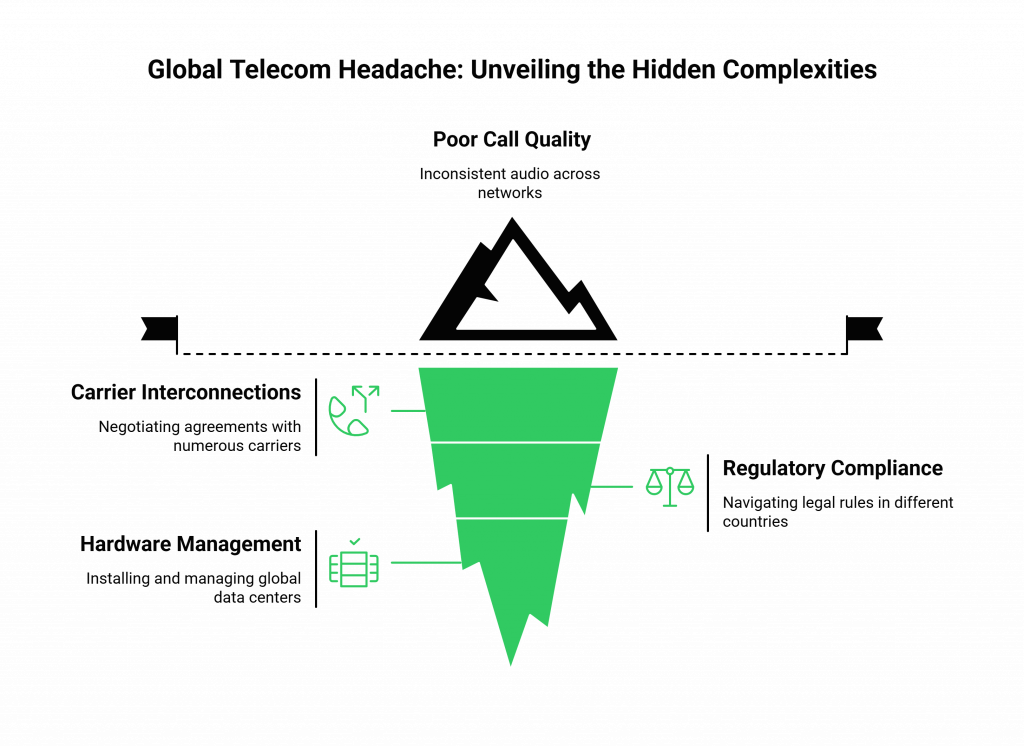
The Nightmare of Carrier Interconnections
The global telephone network is not a single, unified entity. It is a patchwork quilt of thousands of different carriers, each with its own network, its own standards, and its own commercial agreements. To build a global network, you would need to:
- Negotiate complex interconnection agreements with dozens, if not hundreds, of carriers in different countries.
- Physically install and manage expensive hardware (like session border controllers) in data centers all over the world.
- Deal with a dizzying array of different signaling protocols and audio codecs.
The Labyrinth of Regulatory Compliance
Telecom is one of the most heavily regulated industries on the planet. Each country has its own unique and ever-changing set of rules regarding everything from who can own a phone number to what data must be stored and for how long.
For a single company, navigating this legal minefield on a global scale is a full-time, multi-million-dollar job for a team of specialized lawyers.
The Unpredictability of Quality
Even if you could solve the first two problems, ensuring consistent, high-quality call audio across a network of disparate carriers is a constant battle. A call from London to Tokyo might be routed through a dozen different carrier networks, and a problem at any one of those points can result in a garbled, high-latency call.
Also Read: From Chatbots to Callbots: How the Best Voice APIs Are Redefining Business Communication
How Does a Voice Calling SDK Abstract This Complexity?
A modern voice calling SDK, powered by a global Communication Platform as a Service (CPaaS), is a powerful layer of abstraction. It is a software library that does for global voice what a payment gateway like Stripe does for global payments.
It takes an incredibly complex, fragmented, and regulated underlying system and presents it to the developer as a simple, clean, and well-documented set of programming tools.
When you use a voice calling SDK from a provider like FreJun AI, you are not just getting a piece of software; you are getting on-demand access to a pre-built, carrier-grade, global voice network. The provider has already done all the hard work for you. The importance of this abstraction cannot be overstated.
A recent report on developer productivity found that the use of third-party APIs and SDKs can reduce development time for new features by an average of 33%.
The Key Components of a Global Voice Calling SDK
The best voice API for business communications is more than just a single function to “make a call.” It is a comprehensive toolkit for building sophisticated, global voice applications.
Here are the essential components that a developer should look for:
| Component | What It Does | Why It’s Critical for Global Calling |
| Global Number Inventory API | Allows you to programmatically search for and provision local, national, and toll-free numbers in countries around the world. | This is the foundation of a local presence. It allows your app to have a German number for your German users, a Japanese number for your Japanese users, etc. |
| Outbound Calling API | The core function to initiate an outbound call from your application to any phone number on the planet. | A powerful worldwide calling API must handle all the complex carrier routing automatically, ensuring the call is connected reliably and cost-effectively. |
| Call Control and In-Call Actions | A rich set of commands to manage a live call (e.g., mute, hold, transfer, play audio, record). | This is what allows you to build more than just a simple phone call. It is the toolkit for creating interactive voice experiences. |
| Globally Distributed, Low-Latency Infrastructure | The underlying network of data centers (PoPs) that the SDK connects to. | This is the key to high-quality audio. By handling the call at a PoP close to the end-user, the SDK can minimize latency and ensure a clear conversation. |
| Real-Time Media Streaming API | Provides programmatic access to the call’s raw audio stream. | This is the essential component for any advanced VoIP integration and the core of the telecom infrastructure for AI. |
Ready to start building your global voice application without the global headaches? Sign up for FreJun AI and explore our powerful voice calling SDK.
Also Read: The Role of Elastic SIP Trunking in Building Real-Time Voice Applications
How FreJun AI’s Teler Engine Makes Global Calling Simple
At FreJun AI, our Teler engine is the powerful, globally distributed infrastructure that underpins our voice calling SDK. We have spent years building the complex network of carrier interconnections, navigating the global regulatory landscape, and optimizing our network for low-latency performance, so you do not have to.
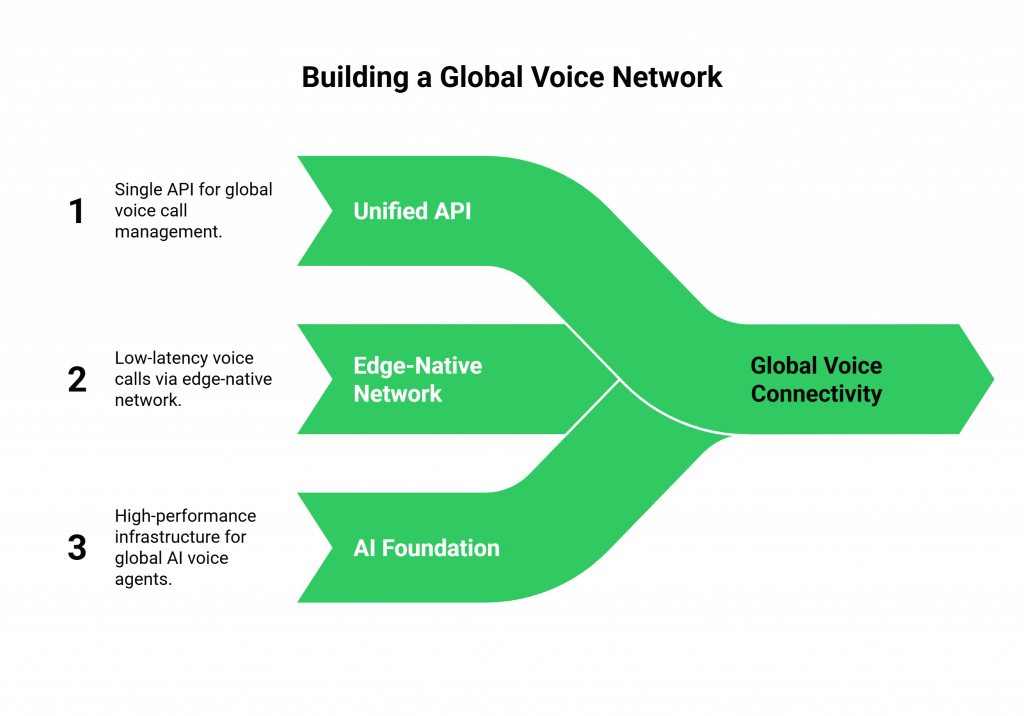
A Single API for the Entire World
Our worldwide calling API provides a single, unified interface for all of your global voice needs. The API call to place a call to a number in Paris is exactly the same as the one to place a call to a number in Perth. Our platform handles all the complex, behind-the-scenes routing and carrier selection automatically.
The Power of an Edge-Native Network
Our Teler engine is a globally distributed network of Points of Presence. When your user in Australia makes a call through our SDK, their connection is handled by our Sydney PoP. This architectural choice is the key to our global voice connectivity.
By keeping the “on-ramp” to our network as close to the user as possible, we drastically reduce the latency and jitter that plague so many other services, ensuring a crystal-clear, real-time conversation, no matter where your users are.
The Foundation for Global AI
For businesses looking to deploy AI voice agents on a global scale, this low-latency infrastructure is a non-negotiable requirement. An AI conversation requires a round-trip of data that must happen in a fraction of a second.
A telecom infrastructure for AI must be designed for this speed. The global, edge-native architecture of Teler provides the perfect, high-performance foundation for your global voice AI deployments.
Also Read: Why a Unified Voice API Matters for Scalable Business Communication?
Putting It All Together: A Simple, Real-World Example
Imagine you are building a collaboration app, and you want to add a “click-to-call” feature that allows a user in the USA to call a colleague in Spain.
The Old Way (Without an SDK)
- Source and contract with a US telecom carrier.
- Source and contract with a Spanish telecom carrier (like Telefonica).
- Set up complex routing rules and hardware to bridge the two.
- Spend months in development and legal review.
The New Way (With the FreJun AI Voice Calling SDK)
- The US user clicks the “call” button in your app.
- Your application’s backend makes a single API call to FreJun AI, specifying the Spanish colleague’s phone number and a US-based FreJun AI number to use as the caller ID.
- Our Teler engine handles the rest. It places the call, manages the routing through our optimized global network, and connects the two parties.
Conclusion
The ability to embed global voice connectivity directly into an application is one of the most powerful tools a developer can have. It unlocks a new world of possibilities for customer engagement, user collaboration, and intelligent automation.
For too long, the immense complexity of the global telecom industry has been a barrier to this innovation. A modern, developer-first voice calling SDK completely demolishes this barrier.
By providing a powerful layer of abstraction that handles all the heavy lifting of carrier management, regulatory compliance, and network optimization, it transforms the entire global telephone network into a simple, programmable, and powerful feature for your next application.
Want to see just how easy it is to make your first global call with our API? Schedule a demo with our team at FreJun Teler.
Also Read: Telephone Call Logging Software: Keep Every Conversation Organized
Frequently Asked Questions (FAQs)
A voice calling SDK (Software Development Kit) is a set of software libraries and tools that allows a developer to easily integrate voice calling features like making and receiving phone calls, directly into their own web or mobile applications.
The SDK is the front-end to a large, global voice network (a CPaaS platform) that the provider has already built. The provider has already done the hard work of interconnecting with carriers all over the world, so when you use the SDK, you are tapping into this pre-existing network.
This is the core of the SDK. It is the specific API that allows your application to programmatically initiate outbound calls to any phone number on the planet through the provider’s network.
No. A key benefit of a modern voice calling SDK is that you can instantly provision a virtual local number in dozens of countries, giving your application a local presence without needing a physical office.
A voice calling SDK is the simplest and most powerful tool for VoIP integration. It abstracts away the low-level VoIP protocols (like SIP and RTP), allowing a developer who is familiar with standard web APIs to build sophisticated voice applications without needing to be a telecom expert.
Yes. For an AI voice agent to have a natural, real-time conversation, it needs a low-latency connection. A global, edge-native platform that you access through a voice calling SDK provides the ideal telecom infrastructure for AI because its design specifically minimizes delay.
A high-quality provider uses a technique called “intelligent routing” or “least cost routing.” Their platform is constantly analyzing the performance of different carrier paths around the world and will automatically route your call through the highest-quality and most cost-effective path at that moment.
FreJun AI provides the complete, end-to-end platform. Our Teler engine is the powerful, globally distributed voice network, and our voice calling SDK is the developer-friendly toolkit that makes it easy for your application to access that network.
It is typically far more cost-effective than using a traditional phone carrier. Because the provider has wholesale agreements with carriers all over the world, they can offer very competitive, per-minute pricing for international calls.
With a modern, self-service platform like FreJun AI, you can sign up for a developer account, get your API keys, and use our SDK to make your first international, API-driven phone call in under an hour.