
Have you ever wondered how big banks or insurance companies keep track of thousands of phone calls every single day? It is not just about recording the audio. They must ensure that every agent follows strict laws and internal rules. If an agent forgets to mention a specific legal disclaimer, the company could face millions of dollars in fines. In the past, managers had to listen to calls manually, which was slow and impossible to do at scale.
Today, smart businesses use a voice recognition software API to automate this entire process. This technology allows computers to “listen” to conversations, understand what is being said, and flag any mistakes the moment they happen. By using the right voice infrastructure, companies can protect themselves and their customers without slowing down their operations.
Table of contents
- Why is Compliance Monitoring Essential for Businesses Today?
- How Does a Voice Recognition Software API Simplify Compliance?
- What are the Key Components of an Effective Compliance System?
- How Do You Implement Compliance Monitoring for Regulated Calls?
- How Can You Use Audit Transcripts to Reduce Legal Risk?
- Why is Low Latency Crucial for Compliance Monitoring Speech?
- How Does FreJun AI Support Secure and Reliable Voice Infrastructure?
- What Best Practices Should You Follow for Voice Compliance?
- Conclusion
- Frequently Asked Questions (FAQs)
Why is Compliance Monitoring Essential for Businesses Today?
Compliance is more than just a boring set of rules. It is about protecting the privacy of customers and making sure that financial or medical advice is given correctly. In industries like finance, the penalties for failing to monitor communication are huge.
For example, in recent years, major regulatory bodies have issued billions of dollars in fines to firms that failed to properly supervise digital and voice communications. You can see how serious these issues are by looking at the actions taken by organizations like FINRA. Without a fast and accurate way to check calls, a business is essentially flying blind.
Using a voice recognition software API changes the game. Instead of checking 1 percent of calls, a business can check 100 percent of them. This ensures that every interaction meets the required standards. It also helps in building trust with customers.
When people know that a company takes its rules seriously, they feel safer sharing their information. Moreover, the global market for speech analytics is growing rapidly as more companies realize they need these tools to stay safe.
Also Read: AI Voicebots for Hotel Reservations Made Easy
How Does a Voice Recognition Software API Simplify Compliance?
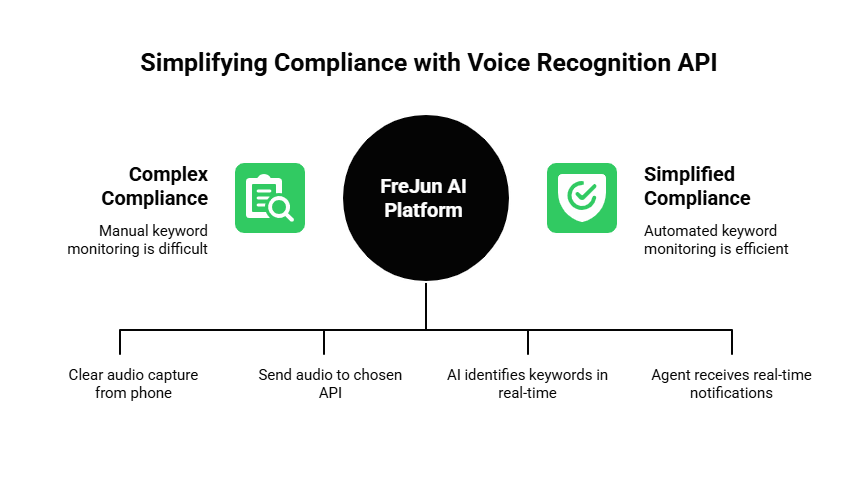
At its core, a voice recognition software API acts as a bridge between a voice call and a computer’s brain. It takes the sound waves from a conversation and turns them into text that an AI can read. Once the audio is turned into text, the AI can look for specific keywords or phrases that must be included or avoided.
However, an API cannot work on its own. It needs a reliable way to get the audio data from the phone line to the software. This is where FreJun AI comes into the picture. FreJun AI is a voice infrastructure platform that handles the complex part of telephony. We handle the complex voice infrastructure so you can focus on building your AI.
FreJun ensures that the audio is captured clearly and sent to your chosen API without any data being lost. By managing the voice transport layer, FreJun allows developers to focus on the logic of their compliance checks rather than the technical details of phone lines and streaming.
The Power of Real Time Analysis
The real magic happens when this analysis occurs in real time. If an agent is on a call and starts to say something that violates a rule, a real time system can send a notification to their screen. This allows the agent to correct themselves before the call even ends. This immediate feedback loop is only possible when you have a low latency voice infrastructure like the one provided by FreJun AI.
Low latency means there is almost no delay between the person speaking and the AI understanding the words.
What are the Key Components of an Effective Compliance System?
To build a strong system for monitoring, you need more than just one piece of software. You need a complete stack of technology that works together seamlessly. The table below shows the differences between old manual methods and modern AI driven systems.
| Feature | Manual Compliance Monitoring | AI Driven Compliance Monitoring |
| Coverage | 1 to 2 percent of calls | 100 percent of calls |
| Speed | Takes days or weeks to review | Real time or near instant |
| Accuracy | Subject to human error and fatigue | Highly consistent and objective |
| Cost | Very high due to labor costs | Low cost per call at scale |
| Proactive Alerts | Not possible | Instant alerts for violations |
| Data Insights | Limited and hard to find | Deep analytics and trend tracking |
To make the AI driven side work, you need a voice recognition software API that is fast and accurate. You also need a way to store audit transcripts so that you have a record of every conversation. These transcripts serve as proof that the company followed the rules if an auditor ever comes to visit.
Finally, you need a voice platform that is model agnostic. This means you can choose any AI model you want, and the infrastructure will support it. FreJun AI is built to be model agnostic, giving you the freedom to use the best AI tools available on the market today.
How Do You Implement Compliance Monitoring for Regulated Calls?
Implementing a system for regulated calls requires a careful step by step approach. You must ensure that the data is handled securely and that the technology is reliable enough to work every time a phone rings.
First, you need to identify the specific regulations that apply to your industry. Once you know the rules, you can program your AI to look for those specific items. Next, you need to set up your voice infrastructure. This is where you use the FreJun AI toolkit. FreJun provides SDKs for both client side and server side development. These tools make it easy to embed voice features into your existing apps or websites.
By using FreJun Teler, you can manage the call logic in the backend while the platform handles the real time media streaming. FreJun captures the raw audio from the call and sends it directly to your voice recognition software API. This “plumbing” is essential because it removes the telephony complexity.
You do not have to worry about how to connect to global phone networks or how to stream audio packets. FreJun handles all of that, allowing your developers to focus on the actual compliance logic.
Ready to build the intelligent brain for your next-generation support system? Sign up for FreJun AI to get your API keys and start building today.
How Can You Use Audit Transcripts to Reduce Legal Risk?
One of the most valuable outputs of a voice recognition software API is a high quality transcript. But these are not just any notes; they are audit transcripts that can be used in a court of law or during a regulatory review. Having a searchable database of every conversation allows a company to prove exactly what was said and when it was said.
If a customer claims they were misinformed, a manager can simply search the audit transcripts for that specific call. They can see if the agent followed the script and if all disclosures were made. This significantly reduces legal risk because it removes the “he said, she said” arguments.
FreJun AI supports this by ensuring that every word of the call is captured with high clarity. Because FreJun is optimized for low latency and high reliability, you do not have to worry about the audio cutting out or being too fuzzy for the API to understand. The result is a perfect record of the call that protects the business from false claims and helps identify areas where agents might need more training.
Also Read: How Startups Can Launch Voicebots Fast?
Why is Low Latency Crucial for Compliance Monitoring Speech?
When we talk about compliance monitoring speech, the speed of the system is just as important as the accuracy. If the system takes ten minutes to analyze a call, the damage might already be done. For a system to be truly effective, it must work while the conversation is happening.
Low latency is the secret ingredient here. It refers to the tiny amount of time it takes for audio to travel from the speaker to the AI and back. FreJun AI is engineered from the ground up for low latency. This is vital for real time conversational loops. If an agent is handling regulated calls and makes a mistake, the system needs to catch it in milliseconds.
FreJun’s distributed infrastructure ensures that the audio is processed as close to the user as possible. This eliminates the awkward pauses that occur when data has to travel long distances. With a fast infrastructure, your voice recognition software API can provide instant coaching to agents. This turns your compliance system from a passive recording tool into an active assistant that helps your team perform better on every single call.
How Does FreJun AI Support Secure and Reliable Voice Infrastructure?
Security is the biggest concern when handling sensitive business calls. You cannot afford to have your audio intercepted or your data leaked. FreJun AI is built with enterprise grade security and reliability as its top priorities. The platform is designed with security by design, meaning every layer of the technology is protected by robust protocols.
For businesses that handle a high volume of calls, FreJun Teler offers elastic SIP trunking. This feature allows your voice infrastructure to grow automatically as your call volume increases. You do not have to worry about the system crashing during a busy period. FreJun’s geographically distributed architecture also means that if one part of the network has an issue, another part takes over immediately. This guarantees high availability and uptime.
Furthermore, FreJun is model agnostic. It does not provide its own STT or LLM. Instead, it acts as the voice transport layer. This allows you to bring your own voice recognition software API and other AI services. You keep full control over your AI logic while FreJun ensures that the voice layer runs smoothly. This separation of duties is the best way to build a secure, scalable, and powerful voice application.
What Best Practices Should You Follow for Voice Compliance?
Building a system with a voice recognition software API is a great first step, but you should also follow these best practices to ensure long term success.
- Keep Your AI Updated: Laws and regulations change frequently. Make sure your AI is updated with the latest rules so it does not miss any new requirements.
- Prioritize Audio Quality: A voice recognition software API is only as good as the audio it receives. Use a platform like FreJun AI to ensure every call is crystal clear.
- Monitor the Monitor: Periodically check your AI’s transcripts to make sure it is not making mistakes. Even the best AI needs a human touch once in a while.
- Use Encryption: Ensure that all audio and text data is encrypted both while it is moving and while it is stored.
- Transparency: Always inform your customers that calls are being recorded and monitored for compliance. This is often a legal requirement itself.
- Focus on Latency: If you want to prevent violations before they happen, choose an infrastructure that minimizes delay.
- Retain Context: Use an API and infrastructure that can track the full context of a conversation, rather than just isolated words. FreJun AI helps manage this conversational state.
By following these steps and using the right tools, you can turn compliance from a burden into a competitive advantage. You will have a team that is better trained, customers who feel more secure, and a business that is protected from legal and financial risks.
Also Read: How Travel Firms Use Inbound Call Handling?
Conclusion
Enabling compliance monitoring does not have to be a technical nightmare. By using a voice recognition software API in combination with a strong voice infrastructure like FreJun AI, any business can automate their auditing process. This technology ensures that every call is checked for accuracy and that all regulated calls meet the highest standards.
With the ability to generate searchable audit transcripts and provide real time alerts, businesses can significantly reduce their risk while improving their customer service. Remember that the foundation of any great AI voice agent is the infrastructure it sits on.
FreJun AI handles the complex voice infrastructure so you can focus on building your AI. In a world where rules are constantly changing, having a fast, secure, and reliable way to monitor your communications is the best way to ensure your company’s future success.
Want to do a deep architectural dive into the infrastructure required to power a high-performance, enterprise-grade voicebot? Schedule a demo with our team at FreJun Teler.
Also Read: UK Phone Number Formats for UAE Businesses
Frequently Asked Questions (FAQs)
A voice recognition software API is a tool that allows developers to add speech to text capabilities to their applications. It takes spoken language from an audio file or a live stream and converts it into written text that computers can process and analyze for compliance.
FreJun AI acts as the voice transport layer. It captures the raw audio from a phone call or web app and streams it in real time to your chosen voice recognition software API. It handles the “plumbing” of the call so the API can focus on understanding the words.
Yes, FreJun AI is model agnostic. This means you can “bring your own” AI models, including your preferred Speech to Text, Large Language Model, and Text to Speech services. FreJun handles the voice infrastructure while you control the AI logic.
Low latency is critical because it allows for real time analysis. If an agent says something incorrect, the system needs to detect it instantly to provide a warning. High latency would cause a delay, making it impossible to stop a violation while the call is still happening.
Audit transcripts are written records of your phone conversations. They are essential for compliance because they provide a permanent and searchable history of what was said during regulated calls. They are used to prove that a company followed the law.
No, FreJun AI does not provide STT, TTS, or LLMs directly. It is a voice infrastructure platform designed to handle real time media streaming and telephony. This allows you to choose the best individual AI services for your specific business needs.
Elastic SIP trunking is a feature of FreJun Teler that allows your voice system to scale up or down automatically based on call volume. This ensures that your compliance monitoring system stays reliable even during times of extremely high traffic.
By monitoring 100 percent of calls with a voice recognition software API, businesses can catch mistakes that human auditors might miss. This ensures all legal disclaimers are given and prevents the behavior that leads to expensive regulatory fines.
No, FreJun provides a developer first toolkit with comprehensive SDKs for both client and server side development. This makes it much easier to add professional voice features and compliance monitoring to your existing software.
Yes, FreJun AI supports both inbound and outbound calls. This means you can monitor compliance for customer support calls that you receive and for sales or lead qualification calls that your team makes.