
Have you ever called a customer service line and felt like you were stuck in a never ending loop? Maybe you had to repeat your name and order number five different times to five different people. It is frustrating for you and it is also very expensive for the company. Call centers are busier than ever before, and human agents often struggle to keep up with thousands of calls every day.
What if there was a way for a computer to listen, understand, and even help solve your problem the moment you speak? This is exactly why companies are rushing to deploy a voice recognition software API in their contact centers. This technology acts like a super smart digital ear that can turn spoken words into text in real time.
In this guide, we will show you how to use this powerful tool to make call centers faster, smarter, and much more helpful for everyone.
Table of contents
- Why is the voice recognition software API important for call centers?
- How does call center speech recognition work?
- What are the main benefits of deploying this technology?
- How do you choose the best voice recognition software API?
- What are the steps to deploy a voice recognition software API?
- How does contact center transcription improve customer service?
- Why is low latency critical in a call center environment?
- How does FreJun AI handle the complex voice infrastructure?
- What are the best use cases for voice recognition in call centers?
- How do you ensure security and privacy in a call center?
- What is the future of voice recognition in contact centers?
- Conclusion
- Frequently Asked Questions (FAQs)
Why is the voice recognition software API important for call centers?
The world of customer service is changing very fast. In the old days, a call center was just a room full of people wearing headsets. Today, it is a high tech hub that needs to process huge amounts of data every second. A voice recognition software API is the secret ingredient that makes this possible. It allows computers to “hear” what customers are saying and turn that audio into digital data.
When a company uses call center speech recognition, they can do things that were impossible ten years ago. For example, the system can automatically write down everything said during a call. This is called contact center transcription. Instead of a person typing notes, the computer does it perfectly. This saves time and ensures that no important details are missed.
According to a study by Salesforce, 78 percent of service agents say that balancing speed and quality is difficult, and AI tools are becoming essential to help them keep up.
By deploying this technology, a business can understand the needs of their customers much better. The API can spot patterns in what people are asking for. If a hundred people call about the same broken part on a toaster, the company knows about it instantly. This is the power of using a voice recognition software API to listen to the voice of the customer at scale.
How does call center speech recognition work?
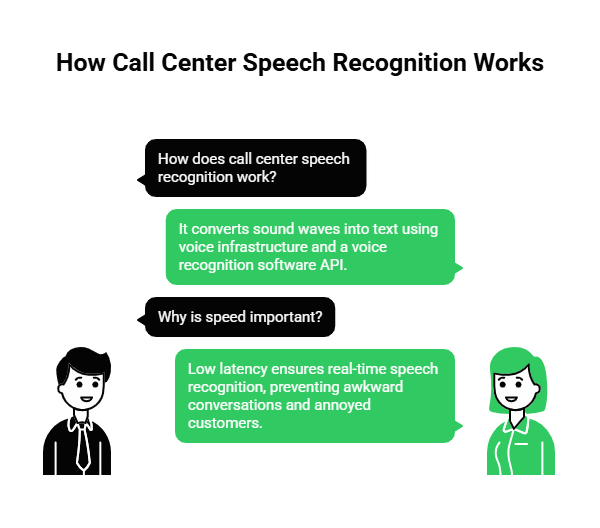
To understand how this works, you have to look at the “journey” of a sound wave. When a customer speaks into their phone, their voice travels as an electrical signal. But a computer brain cannot understand sound waves directly. It needs a way to turn those waves into text.
This is where the voice infrastructure comes in. FreJun AI provides the essential layer that handles this complex process. We handle the complex voice infrastructure so you can focus on building your AI. FreJun captures the raw audio from the call and streams it to your chosen voice recognition software API. The API then looks at the audio and identifies the individual sounds that make up words.
This process must happen incredibly fast. If there is a delay, the conversation will feel awkward and the customer might get annoyed. FreJun AI is designed for low latency, which means it moves the audio data at lightning speed. This allows the speech recognition to happen in real time, so the computer can respond or provide notes while the person is still talking.
Also Read: AI Voice Agents for Ride-Hailing Platforms
What are the main benefits of deploying this technology?
There are many reasons why a business would want to use a voice recognition software API. It is not just about being “fancy” with tech; it is about real results that save money and make people happier. Let us look at the biggest benefits in the table below.
| Benefit | How it Helps the Call Center | Impact on the Customer |
| Automated Transcription | Agents do not have to type notes manually | Faster calls and more focus on the problem |
| Real-time Analytics | Spotting angry customers or common issues | Better service and quicker problem solving |
| 24/7 Availability | AI can handle basic calls at any time | No more waiting on hold for hours |
| Quality Monitoring | Managers can review every call for training | More helpful and polite agents |
| Reduced Costs | Fewer human agents needed for simple tasks | Cheaper products and services |
| Better Accuracy | Computer records exact words spoken | Fewer mistakes with orders or addresses |
Another big advantage is sentiment analysis. This is a type of analytics where the voice recognition software API can tell if a customer is happy, sad, or angry based on their voice. If a caller sounds very upset, the system can immediately send the call to a human manager who is an expert at solving difficult problems. This keeps customers from leaving and going to a competitor.
How do you choose the best voice recognition software API?
Not all APIs are the same. Some are great at understanding different languages, while others are very fast but make a few more mistakes. When you are looking for a voice recognition software API for your call center, you need to consider a few things.
First, look at accuracy. If the API misses every third word, it will cause more problems than it solves. Second, think about speed. You need live speech recognition that happens in under a second. Third, consider the cost. You want a tool that provides great value for every minute of audio it processes.
FreJun AI makes this choice much easier because it is model agnostic. This means you are not locked into one single API. You can bring your own Speech to Text (STT) and Text to Speech (TTS) services.
If a better voice recognition software API comes out next year, you can switch to it without having to rebuild your entire phone system. FreJun acts as the voice transport layer, giving you the freedom to use the best “brain” for your AI.
What are the steps to deploy a voice recognition software API?
Deploying this technology might sound scary, but it is actually very simple if you follow a plan. You do not need to be a scientist to get started.
- Define your goals: What do you want the AI to do? Do you want it to transcribe calls, answer simple questions, or analyze how happy your customers are?
- Set up the voice infrastructure: This is where you connect to FreJun AI. Use the FreJun SDKs to handle the telephony layer. This allows you to stream audio from your calls directly to the cloud.
- Integrate your API: Connect your chosen voice recognition software API to the FreJun stream. FreJun handles the real time media streaming so the audio arrives perfectly.
- Test the system: Run some practice calls to make sure the computer is understanding the words correctly.
- Go live and monitor: Start using the system with real customers and use analytics to see how it is performing.
Ready to see how easy it is to handle voice data? Sign up for FreJun AI and get your API keys to start building today.
How does contact center transcription improve customer service?
Transcription is one of the most powerful tools in a call center. When every word is written down, the company has a perfect record of the conversation. This is helpful for many reasons. If there is a disagreement about what was promised during a call, the manager can just look at the transcript to see the truth.
It also helps with training. Managers can look at the transcripts of their best agents to see what they are doing right. They can then teach those same skills to new employees. By using a voice recognition software API for contact center transcription, the company creates a library of knowledge that helps everyone get better at their jobs.
Furthermore, transcription makes it easier to search for information. Instead of listening to a thirty minute recording to find a specific detail, an agent can just type a keyword into a search bar and find the exact moment a customer mentioned their credit card number or a specific product.
A research indicates that 90% of customers rate an immediate response as important or very important when they have a customer service question. Transcription helps agents find answers faster, which makes those immediate responses possible.
Also Read: Voice AI for Vehicle Service Reminders
Why is low latency critical in a call center environment?
Imagine you are talking to someone on the phone and there is a three second delay. You would keep talking over each other and the conversation would be a disaster. This delay is called latency. In a call center, low latency is the difference between a happy customer and an angry one.
When you use a voice recognition software API, the audio has to travel from the phone to a server, get turned into text, and then the response has to travel back. FreJun AI is built to make this trip as fast as possible. By optimizing the voice infrastructure for speed, FreJun ensures that the AI voicebot can respond almost as fast as a human.
Low latency allows for a natural conversational flow. If the user stops talking, the AI should know almost instantly so it can provide the next answer. If the system is slow, the user might think the call was dropped or that the computer is not listening. This is why high performance media streaming is the foundation of any successful call center deployment.
How does FreJun AI handle the complex voice infrastructure?
Building a phone system from scratch is extremely difficult. You have to deal with thousands of different phone carriers, complex internet protocols, and various audio formats. This is why most developers use a platform like FreJun AI. FreJun acts as the “plumbing” of the voice world.
FreJun AI provides a developer first toolkit that abstracts away all the hard parts. It includes SDKs for both web and mobile apps, so you can embed voice features wherever your customers are. Its core features include direct AI integration and full conversational context management. This means the AI remembers what was said earlier in the call, making the conversation feel much more intelligent.
One of the best features for call centers is elastic SIP trunking. This allows your phone lines to scale up or down automatically. If you have a huge sales day and ten thousand people call at once, the system expands to handle the load. You do not have to worry about people getting a busy signal. FreJun handles the scale so you can focus on making your customer experience better.
What are the best use cases for voice recognition in call centers?
There are so many ways to use a voice recognition software API in a professional environment. Here are a few of the most popular ways companies are using it right now:
- Intelligent IVR: Instead of “press 1 for sales,” a customer can just say “I want to talk to someone about my bill.” The system understands the intent and sends them to the right person.
- AI Receptionists: An AI can answer the phone, identify the caller, and solve basic problems like checking an order status without a human ever getting involved.
- Real-time Agent Assist: While a human agent is talking, the voice recognition software API listens and shows helpful articles or tips on the agent’s screen based on what the customer is saying.
- Automated Surveys: After a call, the AI can call the customer back and ask for feedback. The customer speaks their answers, and the system records them for analytics.
Each of these use cases depends on high quality audio capture. If the audio is fuzzy, the voice recognition software API will make mistakes. FreJun AI ensures that the audio is clear and transmitted without delay, which makes all of these tools much more effective.
How do you ensure security and privacy in a call center?
When you are dealing with customer phone calls, security is the most important thing. People share private information like their addresses, phone numbers, and sometimes even their credit card details. You must protect this data.
FreJun AI is built with security by design. It uses robust protocols to protect data integrity and confidentiality. The infrastructure is geographically distributed, which makes it very hard for the system to go down or be attacked. When you deploy a voice recognition software API through FreJun, you are using an enterprise grade platform that takes privacy seriously.
Companies also need to be careful about how they store transcripts. It is a good idea to use an API that can automatically “redact” or hide sensitive information like social security numbers. This way, even if someone looks at the transcript later, they cannot see the private details. Combining a secure voice layer with a smart API is the best way to keep your customers safe.
Also Read: The Future of Elastic SIP Trunking in an AI-Powered Voice World
What is the future of voice recognition in contact centers?
We are just at the beginning of what this technology can do. In the future, a voice recognition software API will be able to do much more than just turn speech into text. It will be able to understand different emotions more deeply and even predict what a customer is going to ask before they say it.
We might see call centers where the AI and the human work together in perfect harmony. The AI will handle all the boring, repetitive tasks, while the humans focus on the most complex and emotional problems. This will make jobs in call centers much more interesting and rewarding.
As the technology gets better, the voices of the AI agents will sound even more natural. With low latency streaming from FreJun AI, you might not even be able to tell if you are talking to a human or a computer. This will make customer service much faster and more accessible for people all over the world.
Conclusion
Deploying a voice recognition software API is one of the smartest moves a call center can make today. It solves the biggest problems in customer service by providing fast, accurate, and scalable help. From contact center transcription to real time analytics, the benefits are clear for both the business and the customer.
The key to a successful deployment is having the right infrastructure. FreJun AI provides the stable, low latency “plumbing” that allows your AI models to shine. By handling the complex telephony layer and providing a model agnostic platform, FreJun lets you focus on building the best possible experience for your users.
As voice technology continues to improve, the gap between traditional call centers and AI powered contact centers will only grow wider. Now is the time to embrace the power of speech recognition and build a smarter future for customer service.
Want to discuss your specific use case for call center automation? Schedule a demo with our team at FreJun Teler.
Also Read: Call Log: Everything You Need to Know About Call Records
Frequently Asked Questions (FAQs)
A voice recognition software API is a tool that allows developers to add speech to text capabilities to their applications. It takes spoken audio and turns it into digital text that a computer can read and analyze.
It helps by taking away the boring parts of the job. It can automatically write notes, find helpful information during a call, and handle simple questions so the human agent can focus on more important tasks.
No, you do not. FreJun AI provides the infrastructure and SDKs to connect your existing systems to the cloud. You can embed voice features into your web or mobile apps without building everything from scratch.
Yes, modern APIs are incredibly accurate, often reaching over 95 percent. When combined with high quality audio streaming from FreJun AI, the system can understand almost everything a customer says.
Transcription is the process of turning the audio of a phone call into a written document. In a call center, this provides a perfect record of the conversation for training, legal reasons, and customer service reviews.
Most top tier voice recognition software API providers support dozens of languages and even different dialects. Since FreJun is model agnostic, you can choose the API that is best for the specific languages your customers speak.
Low latency ensures that the conversation feels natural. If the AI responds instantly, the customer feels like they are having a real conversation. If there is a delay, it feels broken and frustrating.
Elastic SIP trunking is a feature of FreJun Teler that allows your phone lines to grow or shrink automatically based on the number of calls you are receiving. It prevents busy signals during peak times.
While there is an initial setup cost, it usually saves money in the long run. AI can handle thousands of calls for a fraction of the cost of hiring and training new human employees.