
Have you ever wondered how a company in New York can talk to thousands of customers in Tokyo and London at the same time without any delay? In our modern world, businesses no longer stay inside one city or even one country. They want to reach everyone, everywhere.
To do this, they use a voice recognition software API to understand what their customers are saying in real time. But talking to one person in your own city is easy. Talking to millions of people across different continents is very hard. It requires a special kind of setup that works across the whole planet.
This guide will show you how to take a voice recognition software API and make it work globally so that every customer feels like you are sitting right next to them.
Table of contents
- What is a voice recognition software API?
- Why is Global Speech API Deployment Important for Modern Businesses?
- How Do You Achieve Latency Optimization for Voice Apps?
- What are the Benefits of Region Based STT?
- How Can You Manage Global Telephony Infrastructure?
- What Security Measures are Needed for Global Deployment?
- How Do You Start Your Global Deployment?
- Why is a Developer-First Toolkit Essential for Scaling?
- What is the Future of Global Voice AI?
- Conclusion
- Frequently Asked Questions (FAQs)
What is a voice recognition software API?
A voice recognition software API is a tool that helps computers understand human speech. When a person speaks into a phone or a computer, their voice travels as a sound wave. The API acts like a smart listener. it takes those sound waves and turns them into text that a computer can read and process. This is the first step in building a voice assistant or an automated customer service line.
To make this work well, you need more than just the API. You need a way to carry the voice from the caller to the computer. This is where FreJun AI comes in. FreJun AI is a voice infrastructure platform that handles the complex parts of telephony and real time streaming.
While you focus on making your AI smart, FreJun handles the complex voice infrastructure so you can focus on building your AI. It acts as the pipes that carry the sound, while the voice recognition software API acts as the brain that understands the words.
The Challenge of Distance
The biggest problem with global speech api deployment is distance. Light and data travel very fast, but they still take time to move across the ocean. If a caller in Sydney is talking to a server in London, there will be a delay. This delay can make a conversation feel slow and awkward.
To solve this, developers must learn about latency optimization. This ensures that the computer responds almost instantly, no matter where the caller is located.
Why is Global Speech API Deployment Important for Modern Businesses?
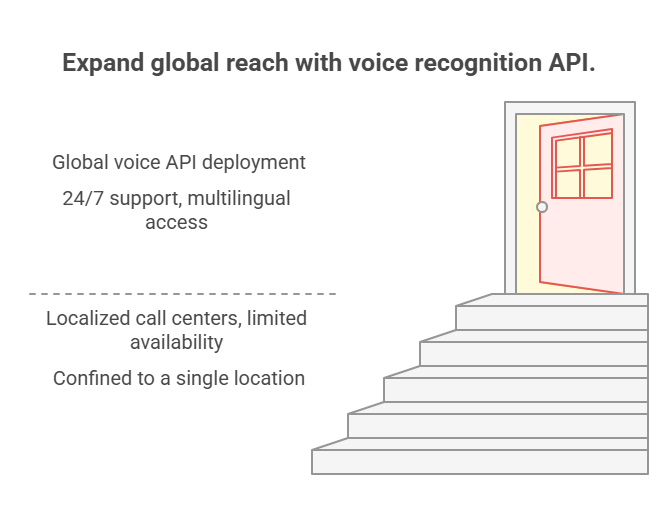
In the past, businesses had call centers in one building. If you called them, you talked to a person in that building. Today, customers expect help 24 hours a day. They want to call at midnight or on a Sunday and get an answer right away.
According to research from Statista, the global market for voice recognition technology is expected to reach nearly $50 billion by the year 2029. This massive growth is happening because businesses are moving toward automation on a global scale.
When you deploy a voice recognition software API globally, you can help customers in their own language and in their own time zone. This makes people feel valued. A slow or broken voice system is a very bad experience. By using a global setup, you ensure that your system is always fast and reliable.
Reaching New Markets
Using a voice recognition software API on a global scale allows a small company to act like a huge corporation. You can launch your service in five different countries in a single day and you do not need to build offices in those countries. You just need a strong digital infrastructure that can handle the voice calls and the speech recognition. This opens up millions of new customers for your business.
Also Read: How to Connect AgentKit Agents to Realtime Voice Calls Using Teler?
How Do You Achieve Latency Optimization for Voice Apps?
Latency is the time it takes for a sound to travel from a caller to the AI and for the answer to come back. In a normal human conversation, the gap between speakers is usually less than 200 milliseconds. If your voice recognition software API takes two seconds to respond, the caller will think the system is broken. This is why latency optimization is the most important part of global deployment.
One way to fix this is by using a geographically distributed infrastructure. Instead of having one big server in the middle of the world, you have many small servers in different regions. When someone calls, the system connects them to the server that is closest to them.
This reduces the distance the data has to travel. FreJun AI is built with this kind of distributed architecture. It ensures high availability and low latency by streaming media through the best possible path.
Real-Time Media Streaming
Another way to reduce delay is through real time media streaming. Instead of waiting for the caller to finish a whole sentence, the system starts processing the audio as soon as the first word is spoken. This is often called streaming or “live” recognition. It requires a very stable connection.
FreJun AI provides the toolkit for this, capturing raw audio and sending it to the voice recognition software API without any buffering or waiting.
What are the Benefits of Region Based STT?
STT stands for Speech to Text. When we talk about region based stt, we mean placing the speech recognition tools in the same part of the world as the caller. If a caller is in France, you use a French server to process their voice. This has several big benefits for your business and your customers.
First, it improves accuracy. Different regions have different accents and dialects. A voice recognition software API that is optimized for a specific region will understand the local way of speaking much better than a general model.
Second, it helps with data laws. Some countries have very strict rules about where customer data can be sent. By using region based stt, you can keep the data inside the borders of that country, which makes your legal team very happy.
The following table shows how global deployment compares to a single location setup.
| Feature | Single Location Setup | Global Deployment (Region-Based) |
| Response Speed | Slow for distant users | Very fast for everyone |
| Reliability | If one server fails, everything stops | If one region fails, others stay up |
| User Experience | Awkward pauses and delays | Natural and smooth conversation |
| Data Privacy | Hard to follow local laws | Easy to keep data in specific regions |
| Scalability | Hard to grow quickly | Easy to add new countries |
Managing Large Call Volumes
When you use a voice recognition software API globally, you might get thousands of calls at the same time. A single server would crash under that much weight. Region based systems share the load. This is where FreJun Teler’s elastic SIP trunking is very helpful. It allows your phone lines to expand and shrink based on how many people are calling. It ensures that no caller ever gets a busy signal.
How Can You Manage Global Telephony Infrastructure?
Telephony is the science of phone calls. It is much more complicated than just sending an email. Every country has its own phone rules and hardware. Managing this on your own is a huge job. This is why most developers use a platform like FreJun AI to handle the voice transport layer. FreJun acts as the plumbing for your global system.
FreJun AI provides a developer first toolkit. This includes SDKs that work on both the server side and the client side. Whether you are building a web app or a mobile app, these SDKs allow you to embed voice features easily.
You do not have to worry about the specific phone hardware in Brazil or the internet speeds in India. FreJun handles those details so your voice recognition software API can do its job perfectly.
Ready to scale your voice application worldwide? Sign up for FreJun AI and get your API keys to start building today.
Model-Agnostic Integration
A great thing about FreJun AI is that it is model agnostic. This means you can use any voice recognition software API you like. You are not locked into one provider. If you find a better API for Japanese speech tomorrow, you can switch to it without changing your whole telephony setup. This gives you the flexibility to always use the best tools for your global customers.
Also Read: AI Voicebot for Power Outage Reporting
What Security Measures are Needed for Global Deployment?
When you send voice data across the world, you must keep it safe. A person’s voice can contain very private information, like credit card numbers or medical details. Security must be built into the system from the very first day. You cannot just add it later as an afterthought.
FreJun AI is engineered with security by design. It uses robust protocols to protect the confidentiality and integrity of every call. This means that even as the data moves through different countries, it stays encrypted and private. For businesses using a voice recognition software API for enterprise tasks, this level of security is a requirement.
Protecting Data Integrity
Global systems are often targets for hackers. By using a distributed infrastructure, you make it much harder for someone to take down your whole system. If one part of the network is attacked, the rest of the regions can keep working. This protects your business from downtime and keeps your customers’ trust. Reliability and security go hand in hand when you are working on a global scale.
How Do You Start Your Global Deployment?
Starting a global project can feel overwhelming, but you can do it in small steps. You do not have to launch in 50 countries at once. You can start with one or two regions and grow from there. The most important thing is to pick the right partners for your infrastructure.
First, choose a voice recognition software API that supports the languages you need. Second, connect that API to a reliable voice infrastructure like FreJun AI. Use the FreJun SDKs to build your application and test it in a few different locations. Once you see that the latency optimization is working and the calls are clear, you can turn on more regions.
FreJun AI makes this journey smooth by offering dedicated integration support. Their team helps you plan your setup and optimize it after it is live. This ensures that your global speech api deployment is successful from the start. With the right tools, you can launch sophisticated voice agents in days instead of months.
Why is a Developer-First Toolkit Essential for Scaling?
Developers are the ones who build the future. If the tools they use are hard to understand, the project will take a long time and cost a lot of money. A developer first toolkit is essential because it provides clear documentation and easy to use code libraries. It removes the friction from the building process.
FreJun AI provides a comprehensive set of SDKs for this reason. These tools allow developers to manage call logic in the backend while embedding voice features in the frontend.
When you are trying to sync a voice recognition software API with a live phone call, you need everything to work perfectly together. FreJun’s toolkit ensures that the voice layer and the AI layer stay in sync, even when the caller is on the move.
Full Conversational Context
One of the coolest features for developers is conversational context management. When a user talks to an AI, the AI needs to remember what was said two minutes ago. If the call moves from a French server to a German server because the user is traveling, that context must stay with them.
FreJun helps manage this data flow, ensuring that the voice recognition software API always has the full picture of the conversation.
What is the Future of Global Voice AI?
We are just at the beginning of the voice revolution. In the future, every business will have a voice. You will be able to call a hotel in Italy and speak English, and the AI will translate and understand you instantly. This will be powered by the same global deployment strategies we talked about today.
As technology improves, latency will get even lower. The voice recognition software API models will become even smarter, understanding emotion and sarcasm. But none of that matters if the voice call itself is scratchy or drops. The infrastructure provided by FreJun AI will continue to be the foundation for these innovations. It is the invisible force that makes global communication possible.
By choosing to deploy your voice tools globally now, you are putting your business ahead of the curve. You are telling your customers that you care about their experience, no matter where they live. You are building a brand that is truly worldwide.
Also Read: Handling Billing Queries with Voice AI
Conclusion
Deploying a voice recognition software API globally is a big goal, but it is one that pays off. It allows you to reach more people, provide better support, and grow your business faster. The key to success is focusing on latency optimization and using region based stt to keep your system fast and accurate.
By partnering with a platform like FreJun AI, you take the stress out of managing complex telephony networks. FreJun handles the voice infrastructure so you can focus on building the smartest AI possible.
Whether you are helping one customer or one million, a global voice setup ensures that your message is always heard clearly. The future of business is conversational, and that conversation is happening all around the world right now.
Want to discuss how FreJun Teler can support your global expansion? Schedule a demo with our team at FreJun Teler.
Also Read: Future Trends in Outbound Calling: AI, Analytics & Intelligent Dialing
Frequently Asked Questions (FAQs)
Using only one server causes high latency for users who live far away. If your server is in New York and a caller is in Singapore, the audio has to travel a huge distance. This creates a delay that makes the conversation feel broken. Global deployment puts servers closer to every user.
STT stands for Speech to Text, which is the specific task of turning audio into text. A voice recognition software API is the tool developers use to access this technology and integrate it into their applications. It often includes other features like speaker identification or language detection.
FreJun AI uses a geographically distributed infrastructure. This means it routes calls through the closest and fastest path possible. It also uses low latency optimization to ensure the audio stream is consistent and clear for your voice recognition software API.
It can be expensive if you try to build your own data centers. However, using cloud based tools and platforms like FreJun AI makes it much more affordable. You only pay for what you use, allowing you to scale your costs as your business grows.
Many modern APIs have a feature called automatic language detection. This allows the system to identify the language being spoken and switch to the correct model instantly. This is very helpful for global businesses that serve people from many different countries.
SDKs, or Software Development Kits, provide the pre built code that developers need to connect their apps to the voice infrastructure. FreJun’s SDKs handle things like microphone access and call management, saving developers hundreds of hours of work.
Elastic SIP trunking connects your digital AI system to traditional phone networks globally. It automatically adjusts the number of available lines based on current demand. This means you don’t have to manually buy new lines in every country you expand into.
Yes, it does. Many countries require that data about their citizens stays within their own borders. By using region based stt, you can process the voice data locally, which helps you stay compliant with laws like GDPR in Europe.
A good global deployment includes redundancy. If a server in one region fails, FreJun AI can automatically route the calls to the next closest region. This ensures that your voice recognition software API remains available to your customers without interruption.
Because FreJun abstracts away the complexity of the telephony layer, you can often go from an idea to a live global deployment in just a few days. You simply connect your AI model to the FreJun API and use the provided SDKs to launch.