
Every developer knows the thrill of that “it works!” moment. You integrate a voice calling SDK, write a few lines of code, and make your first successful, crystal-clear call from your application. It feels like magic.
But there is a vast and perilous chasm between an app that can make one call and an app that can handle one million concurrent calls. This is the chasm of scalability, and crossing it is the true test of a production-grade voice application.
Building for scale is not an afterthought; it is an architectural philosophy that must be woven into your application’s DNA from the very first line of code. A prototype built for a single user will crumble under the weight of real-world demand.
The key to building a voice application that can grow from a handful of users to a global phenomenon is choosing the right foundation and following a clear set of design principles.
This developer guide for voice API will provide a comprehensive tutorial on how to use a modern voice calling SDK to build voice applications that are not just functional, but truly scalable.
Table of contents
- What Does “Scalability” Mean in the Context of a Voice App?
- Why a CPaaS and its SDK is the Only Path to Scale?
- How Do You Set Up Your Initial Voice Calling SDK Integration? (A Scalable Foundation)
- How Do You Architect Your Application for True Scalability?
- Conclusion
- Frequently Asked Questions (FAQs)
What Does “Scalability” Mean in the Context of a Voice App?
In the world of real-time communication, “scalability” is a multi-dimensional concept. It is not just about handling more traffic; it is about handling a more complex and distributed load without any degradation in the user experience. A truly scalable voice application must excel in three key areas.
Concurrent User Scalability
This is the most traditional definition of scale. It is the ability of your application and your underlying voice infrastructure to handle a massive number of simultaneous calls. A successful product launch, a viral marketing campaign, or a critical service alert can cause your call volume to spike from a dozen to tens of thousands of concurrent sessions in a matter of seconds. Your architecture must be able to absorb this spike without a single user hearing a busy signal.
Geographic Scalability
This is about delivering a consistent, high-quality experience to users, no matter where they are in the world. A call between two users in London should be just as clear and low-latency as a call between a user in Tokyo and another in São Paulo. This requires an infrastructure that is not just large, but also globally distributed.
Functional Scalability
This is the ability of your application to evolve and add more complex voice features over time, such as multi-party conferencing, real-time transcription, or AI-powered sentiment analysis, without requiring a complete and costly re-architecture of your core system. Your initial voice calling SDK setup should be a foundation for future innovation, not a cage.
Also Read: Managing Utility Bills via AI Voicebots
Why a CPaaS and its SDK is the Only Path to Scale?
Before you write a single line of application code, the most important decision you will make is the choice of your underlying voice platform. Attempting to build a scalable voice infrastructure from scratch using open-source tools like Asterisk or FreeSWITCH is a monumental undertaking.
You would be responsible for managing the servers, negotiating with carriers, ensuring security, and handling global redundancy, a task that requires a dedicated team of specialized and expensive telecom engineers.
A modern, Communication Platform as a Service (CPaaS) provider, accessed through a voice calling SDK, abstracts away this immense complexity. It provides a pre-built, carrier-grade, globally scalable network as a service. This is the only viable path for the vast majority of development teams.
A recent industry report underscored this, finding that organizations that adopt a CPaaS platform can accelerate their time to market for new communication features by up to 50%.
How Do You Set Up Your Initial Voice Calling SDK Integration? (A Scalable Foundation)
This build voice calling app tutorial will focus on setting up your integration with scalability in mind from day one.
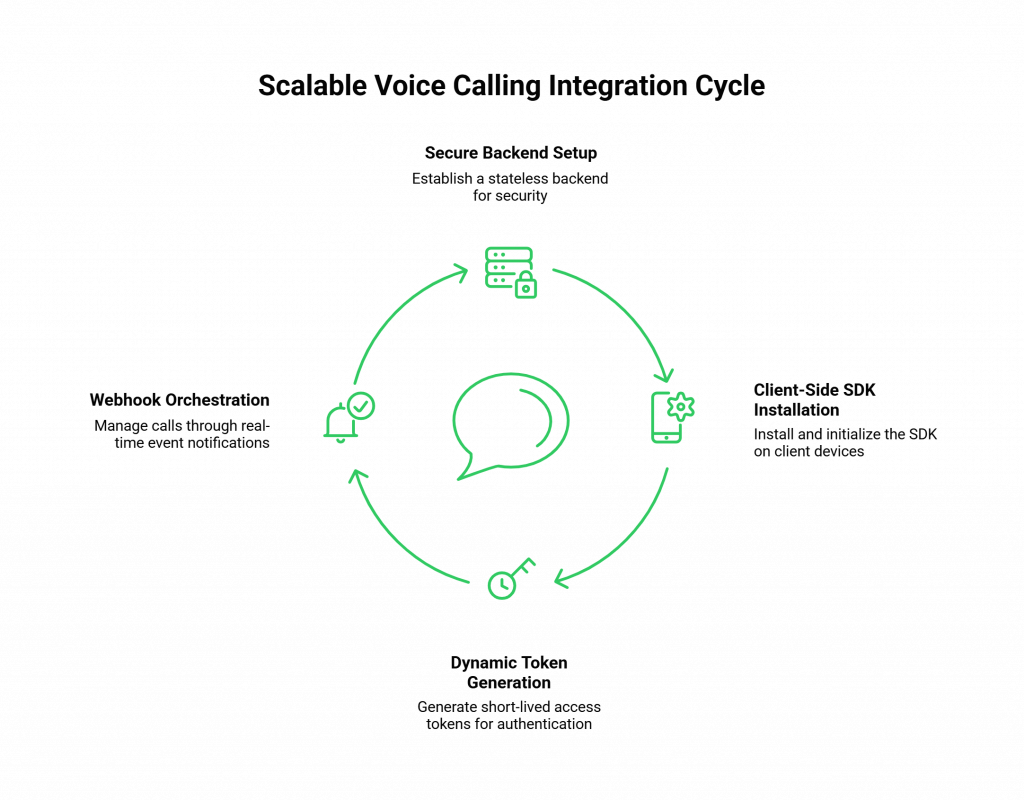
Step 1: The Foundation – A Secure, Stateless Backend
The most critical architectural principle for scalability is to keep your backend application stateless. The state of the live call itself should be managed by the voice platform (like FreJun AI’s Teler engine), not in your application’s memory. Your application should simply react to events (webhooks) sent by the platform.
Crucially, your backend is also your security gatekeeper. Never, ever place your primary API keys or secrets in your client-side (web or mobile) application. Your client should always authenticate with your backend, which then securely communicates with the voice platform.
Step 2: The Client-Side – Installing and Initializing the SDK
A good voice calling SDK will provide libraries for all major platforms (iOS, Android, and JavaScript for the web).
- Installation: Add the SDK to your project using a standard package manager (like npm, CocoaPods, or Gradle).
- Initialization: When your application loads, it needs to initialize the SDK. This typically involves providing an “access token.”
Also Read: Voice Calling API: Simplifying Cloud Communication for Businesses
Step 3: The Handshake – Dynamic, Short-Lived Access Tokens
This is the core of the secure, scalable authentication model.
- Your client application (the user’s browser or mobile app) makes an authenticated request to your backend server.
- Your backend server, using its secret API key, makes an API call to the FreJun AI platform to generate a temporary, limited-permission AccessToken. This token might grant the user the right to make one specific call for the next 15 minutes.
- Your backend sends this short-lived token back to the client.
- The client then uses this token to initialize the voice calling SDK. This ensures your secret keys are never exposed, and each client’s session is securely isolated.
Step 4: The First Call – Orchestrating via Webhooks
Let’s consider an outbound call from your app.
- The user clicks a “call” button.
- Your client, using the initialized SDK, makes a call. You will provide the number to call and, most importantly, a WebhookUrl.
- The FreJun AI platform (Teler) places the call. As the call progresses, Teler will send a series of real-time event notifications (webhooks) to the WebhookUrl you specified (e.g., ringing, answered, completed).
- Your backend receives these webhooks and can then respond with FML/XML commands to control the live call (e.g., play a message, connect to another user, etc.).
This event-driven model is the key to a scalable voice SDK integration. Your backend does not need to maintain a persistent connection for every call; it simply responds to HTTP requests, an architectural pattern that is infinitely scalable using standard web technologies like load balancers and serverless functions.
Ready to start building a voice app that can scale to millions of users? Sign up for FreJun AI!
How Do You Architect Your Application for True Scalability?
Moving beyond the basic setup, true scalability requires embracing a specific set of design principles. This is the core of our developer guide for voice API.
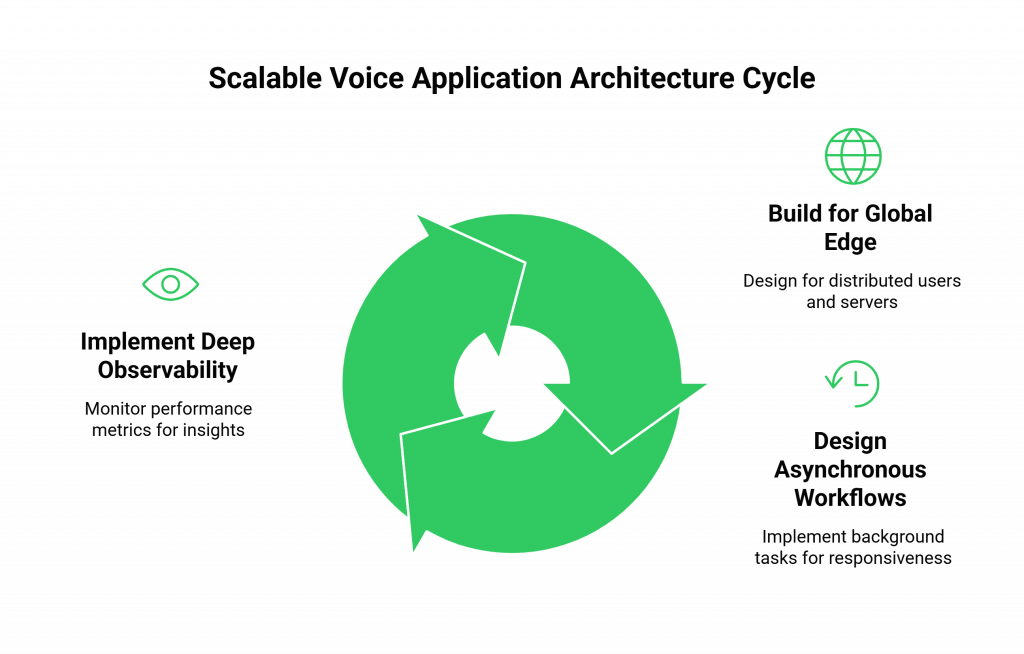
- Build for a Global, Edge-Native World: Do not assume your users and your servers are in the same city. Choose a voice calling SDK that is built on a globally distributed network of Points of Presence (PoPs). A platform like FreJun AI will automatically handle the call at the edge PoP closest to your user, which is the single most effective way to ensure low latency and high quality on a global scale. This is a major trend, with Gartner predicting that by 2025, 75% of enterprise-generated data will be created and processed outside a traditional centralized data center or cloud.
- Design for Asynchronous Workflows: A voice call is a real-time process, but the business logic behind it might not be. If your AI agent needs to perform a slow, complex database query, do not leave the user in dead silence. Design your application to immediately respond with an acknowledgment (“Okay, let me look that up for you.”) while the slow task runs in the background.
- Implement Deep Observability: You cannot scale what you cannot see. A scalable application requires a deep, real-time understanding of its own performance. Use the analytics and logging features of your voice calling SDK to their fullest. Monitor key metrics like Post-Dial Delay (PDD), Mean Opinion Score (MOS), jitter, and packet loss. Set up alerts for failure events. This data is your early warning system, allowing you to spot and fix problems before they impact your users at scale.
Also Read: How Media Streaming Works Behind Every AI-Driven Voice Call
Conclusion
Building a scalable voice application is one of the most rewarding challenges a developer can undertake. It is a journey that moves from the simple magic of the first call to the complex but elegant architecture of a global, production-grade system. The key to success is to choose the right foundation and to build with scalability in mind from the very beginning.
A modern, developer-first voice calling SDK is that foundation. It abstracts away the immense complexity of global telecommunications and provides a powerful, flexible, and scalable set of building blocks.
By adopting an event-driven, stateless, and globally-aware design philosophy, you can build a voice calling app that is not just a feature, but a truly transformative and scalable platform.
Want to walk through the architecture of a highly scalable voice application with one of our experts? Schedule a demo for FreJun Teler.
Also Read: UK Phone Number Formats for UAE Businesses
Frequently Asked Questions (FAQs)
The first step is to design your backend authentication system. You must have a secure server that is responsible for generating short-lived access tokens for your clients. Never embed your primary API keys directly in your client-side application.
Concurrent scalability is the ability to handle a large number of simultaneous calls. Geographic scalability is the ability to provide a high-quality, low-latency call experience to users located anywhere in the world.
A stateless architecture, where the state of the call is managed by the voice platform and not your server’s memory, is crucial for scalability. It means you can easily add or remove instances of your backend application behind a load balancer to handle any amount of traffic without disrupting live calls.
A webhook is the core of the event-driven model. It is a real-time notification that the voice platform sends to your application to inform it of a change in the call’s state (e.g., the call was answered). This allows your application to react and control the call flow intelligently.
The “elastic” nature of the underlying infrastructure handles this automatically. The platform is designed to have a massive pool of on-demand capacity, so it can scale to handle the spike without any calls failing.
An “edge PoP” (Point of Presence) is a data center in a globally distributed network that is physically close to the end-users. Handling a call at the edge is the most effective way to reduce network latency and improve call quality.
PDD is the measure of the time from when a user finishes dialing a number to when they hear the ringback tone. It is a key metric for measuring the performance and efficiency of the underlying carrier network.
Yes. You can write scripts using the voice platform’s API to generate a high volume of concurrent calls to your application. While doing this, you should monitor both your application’s server performance and the call quality analytics provided by the voice platform.