
In the hyper-competitive world of startups, speed is everything. You have a brilliant idea, a lean team, and a burning desire to disrupt the market. But you are also in a constant race against time and a battle for resources. You know that providing an amazing, 24/7 customer experience is a massive competitive advantage, but the idea of building a sophisticated AI voicebot can feel like a daunting, multi-year project reserved for the tech giants with armies of engineers.
Think again. The entire paradigm of AI development has been turned on its head. A new wave of powerful, accessible, and developer-first tools has so radically simplified the process that a small, agile startup can now build and launch a world-class AI voicebot in a matter of weeks, not years. This isn’t about cutting corners; it’s about leveraging the “great abstraction” of modern APIs to build on the shoulders of giants.
This guide is a playbook for the startup founder and the agile developer. We will provide a clear, step-by-step roadmap that demystifies the process and shows you how to go from a simple idea to a live, intelligent voice agent, fast.
Table of contents
Why Should a Startup Prioritize a Voicebot?
For a startup, every decision must be ruthlessly prioritized. Why should building an AI voicebot be at the top of your list? Because it directly solves your three biggest challenges: limited resources, the need for rapid growth, and the battle for customer loyalty.
- It’s a “Force Multiplier” for a Small Team: You can’t afford a 24/7 customer support team. An AI voicebot is your first, and best, employee. It works around the clock, answers every single call, and handles all the repetitive, low-level inquiries, freeing up your small, core team to focus on the high-value, strategic work of building your product and closing your first big deals.
- It’s a “Never Miss a Lead” Growth Engine: Every call that goes to your personal voicemail is a potential investor, a new customer, or a key partner that you just missed. An AI voicebot ensures that every single opportunity is captured, qualified, and acted upon, 24/7.
- It Creates a “Big Company” Experience: A professional, intelligent, and instantly responsive voice experience projects an image of competence and reliability. It allows your startup to punch far above its weight, providing a level of service that can rival that of your largest, most established competitors. The demand for this is clear; a HubSpot report found that 90% of customers rate an “immediate” response as important or very important, and a voicebot delivers that immediacy.
What is the “Lean” Architecture for a Startup Voicebot?
The secret to launching fast is to avoid reinventing the wheel. The “lean” approach is not to build every component from scratch, but to assemble a “best-of-breed” stack of powerful, pre-built, API-driven services. Think of it like building a modern web application—you don’t write your own database or your own web server; you use powerful, existing solutions.
| Component | The Role (“The Job to be Done”) | The “Lean” Solution |
| The Voice Infrastructure | The “nervous system.” Connects to the phone network, provides a phone number, and streams the audio in real-time. | A developer-first voice API platform like FreJun AI. |
| The “Ears” (STT) | Transcribes the user’s spoken words into text. | A high-quality, third-party streaming STT API (e.g., from Google, AssemblyAI). |
| The “Brain” (LLM) | Understands the user’s intent and generates an intelligent response in text. | A powerful, third-party LLM API (e.g., from OpenAI, Anthropic, or an open-source model). |
| The “Mouth” (TTS) | Synthesizes the LLM’s text response into natural-sounding speech. | A high-quality, third-party streaming TTS API (e.g., from ElevenLabs, PlayHT). |
| The “Conductor” | The core logic that you write. It orchestrates the flow of data between all the other components. | A simple, lightweight backend application (e.g., a Node.js or Python server). |
Also Read: How Teler and OpenAI’s AgentKit Are Powering the Next Generation of Voice AI Agents
What is the Step-by-Step “Fast Launch” Playbook?
This is a practical, 4-step guide to going from zero to a live AI voicebot in record time.
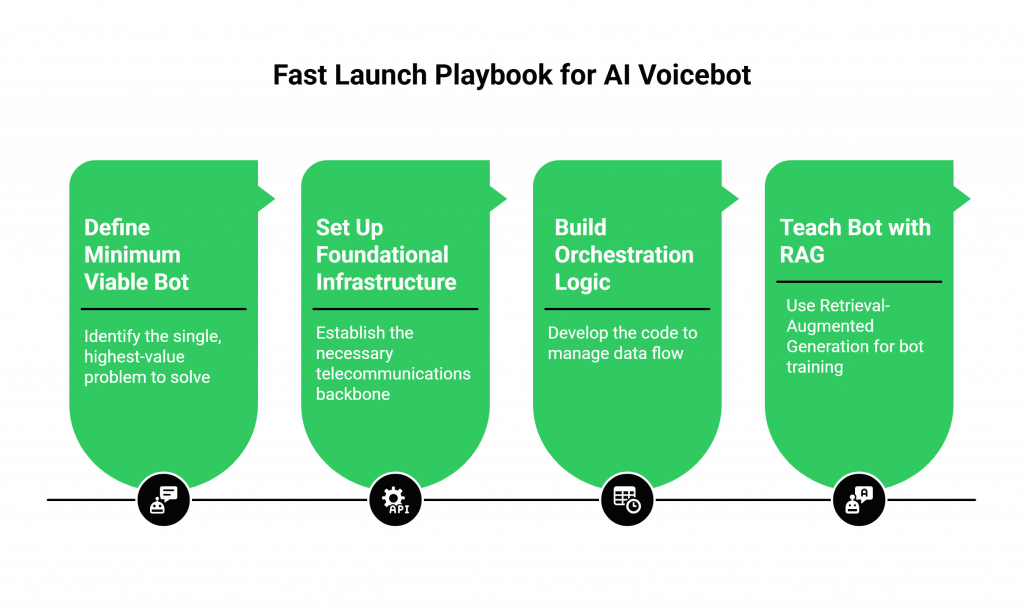
Step 1: How Do You Define Your “Minimum Viable Bot” (MVB)?
This is the most critical first step. Do not try to build a bot that can do everything. Start with the single, highest-value, most repetitive problem you have. For many startups, this is:
- Answering the top 5 most common customer questions.
- Qualifying new inbound sales leads.
- Scheduling product demos.
By ruthlessly focusing on a single, well-defined “Minimum Viable Bot,” you can launch faster and prove the value of the technology immediately.
Step 2: How Do You Set Up the Foundational Infrastructure (in Minutes)?
This is where the magic of the modern voice API comes in. With a developer-first platform like FreJun AI, this step is incredibly fast.
- Sign Up and Get Your API Keys: You can get started in under a minute.
- Get a Phone Number: Use the online dashboard to instantly purchase a phone number for your new bot.
- Set Up Your Backend Server: Create a simple web server with a single API endpoint that will act as your webhook receiver. Use a tool like ngrok to expose it to the internet during development.
- Configure the Webhook: In the FreJun AI dashboard, paste your server’s URL into the phone number’s configuration.
In about 15 minutes, you have built the entire, enterprise-grade telecommunications backbone for your application. This is the power of abstraction.
Step 3: How Do You Build the “Orchestration” Logic?
This is the code that you write. It’s the “conductor” that manages the flow of data. For your MVB, this logic can be surprisingly simple.
- Receive the Incoming Call Webhook: Your server receives the initial notification from the voice platform.
- Start the Conversational Loop: Your code will then manage the real-time loop:
- Receive the live audio stream from the voice platform.
- Forward it to your chosen STT API.
- Send the transcript to your chosen LLM API.
- Send the LLM’s text response to your chosen TTS API.
- Stream the generated audio back to the voice platform.
Also Read: How Developers Can Use Teler and AgentKit to Build Human-Like Voice Agents
Step 4: How Do You “Teach” the Bot Without Complex Training?
For your MVB, you don’t need to do complex AI model training. You can “teach” your bot using a simple, powerful technique called RAG (Retrieval-Augmented Generation). You can simply write a text document with the answers to your top 5 FAQs.
Your orchestration logic will then “look up” the right answer from this document and give it to the LLM as context before it generates the final response. This is a fast and incredibly effective way to make your bot an expert on your business.
Ready to see just how fast you can launch your first AI voicebot? Sign up for FreJun AI and get your API keys to start building.
Also Read: Why Are Businesses Shifting to AI Voice Agents?
Conclusion
The ability to build and launch a sophisticated AI voicebot is no longer a privilege reserved for the tech giants. The “great abstraction” provided by modern, developer-first voice APIs has democratized this powerful technology, putting it directly into the hands of startups and agile development teams. The demand for this technology is surging, with the global Voice Assistant market projected to grow from 2.8 billion in 2021 to 11.2 billion by 2028.
By embracing a lean, API-driven approach and building on a foundation of a flexible, high-performance voice infrastructure, a startup can launch a world-class voice experience in a fraction of the time and at a fraction of the cost of the old way. It’s a powerful way to supercharge your small team, capture every opportunity, and build the future of your business.
Want a personalized walkthrough of the fastest way to get your AI voicebot live? Schedule a one-on-one demo with our team at FreJun Teler.
Also Read: 020 Country Code: Which Area Does It Represent?
Frequently Asked Questions (FAQs)
An AI voicebot is a conversational AI that uses a voice interface to communicate with users. It leverages technologies like Speech-to-Text (STT), a Large Language Model (LLM), and Text-to-Speech (TTS) to have natural, human-like conversations over the phone or a web interface.
For a basic, functional prototype (a “Minimum Viable Bot”), yes. The combination of a modern voice API and a powerful LLM API has dramatically simplified the process. The core logic can often be written in a surprisingly small amount of code.
The most important first step is to define a “Minimum Viable Bot” (MVB). Ruthlessly focus on solving the single, highest-value, most repetitive problem first. Do not try to build a bot that does everything at once.
No. This is the key benefit. A developer-first voice API platform like FreJun AI handles all the deep, complex telephony, so you only need to work with familiar web technologies like APIs and webhooks.
The most cost-effective way is to use a pay-as-you-go, API-driven stack. This means you pay a small, usage-based fee for your voice infrastructure and your AI models, with no large, upfront capital expenditure.
A model-agnostic platform, like FreJun AI, is not tied to a specific AI provider. It gives you the freedom to choose your own “best-of-breed” STT, LLM, and TTS models, which is a massive strategic advantage for a startup that needs to stay agile.
The fastest way is to use a technique called RAG (Retrieval-Augmented Generation). You can provide the AI with a simple text document containing your business’s information (like your FAQs), and the AI can “look up” the correct answer from this document.
Ngrok is a popular development tool that creates a secure, public URL that tunnels directly to a server running on your local machine. It’s essential for testing webhooks from a cloud-based voice platform during the initial development phase.
FreJun AI provides the essential, high-performance voice infrastructure. We provide the instant phone numbers, the simple webhook system, and the ultra-low-latency real-time audio streaming that are the necessary foundation for any high-quality AI voicebot. We handle the “pipe” so you can focus on the “intelligence.”
The next step is to listen and iterate. Analyze the call logs and transcripts to see where the bot is succeeding and where it’s failing. Use this data to continuously improve your conversational scripts and expand the bot’s capabilities to handle more complex tasks.