
The first hour of any school day is a masterclass in controlled chaos. In the front office, the phone rings with a relentless rhythm. One call is a parent reporting a child’s absence. The next is a question about an upcoming field trip. A third is a logistical query about a bus route. All the while, students are lining up for late slips and teachers are stopping by with urgent requests.
For school administrators, this daily deluge of calls is a significant challenge. This is where effective inbound call handling solutions become not just a convenience, but a necessity for a well-run educational institution.
The quality of a school’s communication has a direct and profound impact on its community. Strong parent school communication is a cornerstone of student achievement and well being. When parents feel connected and informed, they become more effective partners in their child’s education.
However, an overwhelmed front office with constantly busy phone lines creates a barrier to this partnership. By modernizing their approach to inbound calls, schools can transform a point of daily stress into a seamless and positive experience for everyone.
Table of contents
What Makes a School’s Communication Needs Unique?
A school is not a typical business, and its front office is not a standard call center. The patterns, nature, and urgency of the calls it receives create a unique environment that requires specialized inbound call handling solutions. Understanding these unique characteristics is the first step to solving the communication challenge. The primary challenges include:
- Extreme Call Volume Peaks: Unlike a business with a steady flow of calls, a school’s call volume is concentrated into intense, predictable peaks. The highest volume occurs in the first hour of the school day, as parents report absences, and in the final hour, with questions about pickups and after school activities.
- Highly Repetitive Nature of Queries: A significant majority of calls are about a small handful of topics. These frequently asked questions typically revolve around attendance, school hours, calendar dates, lunch menus, and fee payment deadlines.
- The Need for an Empathetic Touch: Many calls from parents are driven by concern for their children. Whether a child is sick or has forgotten their lunch, the parent on the other end of the line is often looking for reassurance as much as information. Every call requires a patient and empathetic response.
- Critical Importance of Accuracy: A missed message about a change in a child’s pickup plan or an allergy notification is not a minor inconvenience; it is a serious safety issue. The system for capturing and relaying information must be completely reliable.
How Do Traditional Phone Systems Fail to Meet These Needs?
The traditional “one secretary, one phone line” model is simply not equipped to handle the demands of a modern school. This outdated approach is the root cause of many of the frustrations felt by both parents and staff.

How Does It Impact Parents?
For parents, the traditional system often results in a frustrating communication bottleneck. They frequently encounter busy signals during peak hours, forcing them to call back multiple times. When they do leave a voicemail, they are left with the uncertainty of whether their message was received and when it will be acted upon.
A recent survey highlighted that poor communication is one of the top frustrations for parents when dealing with their child’s school, a problem directly exacerbated by inadequate inbound call handling solutions.
Also Read: How Retailers Use Voice AI for Customer Support?
How Does It Overwhelm Staff?
For front office staff, the constant ringing of the phone is a major source of stress and a significant drain on productivity. They are forced into a reactive mode, spending the majority of their time answering the same basic questions.
This prevents them from attending to the students and teachers right in front of them and from focusing on other critical administrative duties. This constant task switching leads to burnout and a less efficient office environment.
This table shows the stark contrast between the old and new ways of handling calls:
| Feature | Traditional Phone System | Modern Inbound Call Handling Solution |
| Call Capacity | One call at a time per phone line. | Can handle hundreds of calls simultaneously. |
| Availability | Only during office hours, when a person is there to answer. | 24/7/365, providing information and taking messages anytime. |
| Parent Experience | Busy signals, long hold times, voicemail uncertainty. | Instant response, zero hold time, immediate confirmation. |
| Staff Role | Manually answering every single call and taking notes. | Managing exceptions and handling complex, high-value conversations. |
| Data & Logging | Relies on manual notes, which can be lost or misread. | Every call is automatically logged with a clear audit trail. |
How Can Modern Inbound Call Handling Solutions Transform a School?
Modern inbound call handling solutions, particularly those powered by Voice AI, offer a revolutionary approach. By automating the response to the most common and repetitive queries, they can create a communication system that is efficient, reliable, and always available.
How Can AI Automate Key Front-Office Tasks?
An AI-powered voice agent can act as a virtual assistant for the school, handling the bulk of routine calls with perfect accuracy and a friendly tone. This frees up human staff to be more effective and responsive. Key automated tasks include:
- Attendance Reporting: A parent can call, state their child’s name, and report their absence. The AI can understand this, log it directly into the school’s Student Information System (SIS), and provide the parent with a confirmation number.
- Answering FAQs: The AI can be programmed with a knowledge base to instantly answer the top 20-30 frequently asked questions, from “What time does school start?” to “When is the next parent-teacher conference?”.
- Event and Calendar Information: Parents can ask about upcoming holidays, field trips, or sports events, and the AI can provide the dates, times, and any other relevant details from the school calendar.
- Message Taking and Routing: For more complex queries, the AI can intelligently take a detailed message and route it to the correct staff member’s email or voicemail, ensuring it gets to the right person without the parent being put on hold or transferred.
Ready to build a front office that is always responsive and never overwhelmed? Sign up for FreJun AI and explore the tools to create your own solution.
Also Read: Voicebots for Healthcare: A Quick Guide
What Should a School Look for in a Modern Solution?
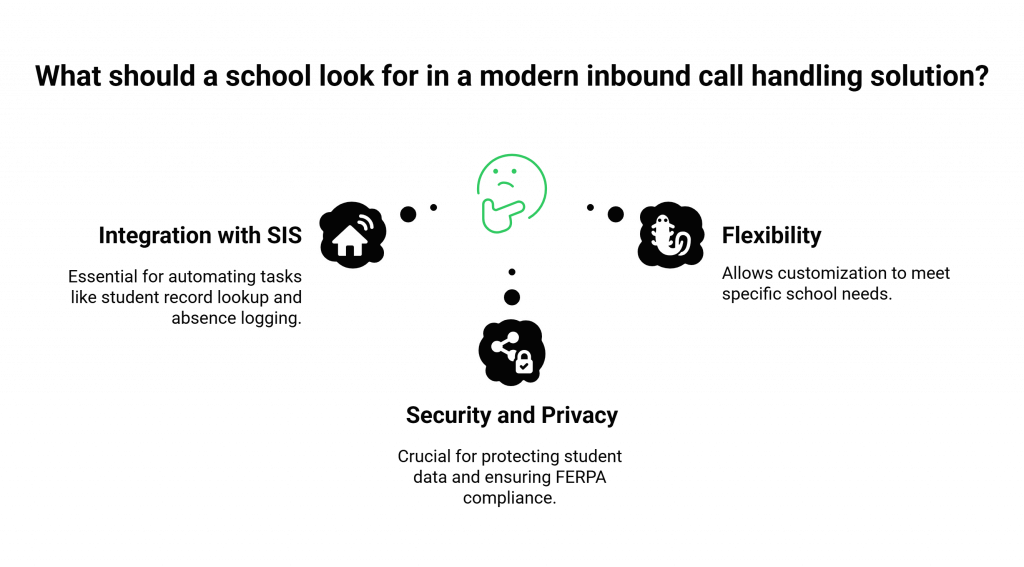
When choosing from the many inbound call handling solutions available, schools need to look for a platform that is flexible, secure, and built for the specific demands of an educational environment.
Why is Integration with the SIS So Important?
For an automated system to be truly effective, it must be able to “talk” to your school’s core database, the Student Information System (SIS). This integration is what allows the AI to perform tasks like looking up a student’s record to log an absence or checking a parent’s contact information.
A solution built on a developer-first platform with robust APIs, like FreJun AI, is essential for creating this seamless connection.
How Does the Solution Ensure Security and Privacy?
Protecting student data is a non-negotiable requirement. Any communication solution a school adopts must be fully compliant with the Family Educational Rights and Privacy Act (FERPA). This means choosing a platform that is built with security by design.
A secure voice infrastructure like FreJun AI ensures that all conversations are encrypted and that sensitive student data is handled with the utmost care, giving you and your families complete peace of mind. We handle the complex voice infrastructure so you can focus on building your AI.
Also Read: How to Automate Lead Qualification Calls with AI?
Conclusion
The front office is the nerve center of a school. An effective, modern approach to communication is the key to a healthy and engaged school community.
By moving beyond outdated phone systems and embracing intelligent inbound call handling solutions, schools can eliminate communication bottlenecks, reduce the burden on their staff, and provide parents with the instant, accessible information they need.
This technological shift is more than just an operational upgrade; it is a fundamental step toward building stronger partnerships with families and creating a better environment for student success.
Want to see how a custom voice AI can be tailored to your school’s unique communication challenges? Schedule a demo for FreJun Teler.
Also Read: Phone Call Transcription: Capture Every Business Conversation with Precision
Frequently Asked Questions (FAQs)
They are systems, tools, and strategies designed to manage the high volume of incoming phone calls that a school receives from parents and the community. Modern solutions often use technology like Voice AI to automate responses and streamline communication.
No, it is a tool designed to support them. It handles the repetitive, high-volume calls, which frees up your valuable staff to focus on in-person interactions, complex problem-solving, and providing care to students.
The AI is integrated with your school’s internal information systems, like the school calendar and student database. This allows it to access and provide accurate, up-to-date information specific to your institution.
The system follows clear emergency protocols. It recognizes keywords indicating urgent situations and immediately transfers the call to a designated staff member or dedicated emergency line.
Yes. AI-powered inbound call handling solutions can use multilingual AI models to communicate with parents in their preferred language, making your school more accessible.
If the AI encounters a query it is not programmed to answer, it has a clear escalation path. It will politely inform the caller that it cannot help with that specific question and will offer to transfer them to a live staff member.