
In the world of modern software development, we stand on the shoulders of giants. When you build a web application, you do not write your own TCP/IP stack or build an HTTP server from scratch. You leverage powerful, high-level abstractions, frameworks and libraries that handle the low-level complexity, allowing you to focus on the unique logic of your application.
For decades, the world of telecommunications has been the glaring exception to this rule. Building a voice application has traditionally meant descending into a rabbit hole of arcane protocols, carrier-specific quirks, and brittle infrastructure. The technology that is finally changing this, that is providing the “HTTP library for voice,” is programmable SIP.
For a developer, the term “SIP” often conjures images of complex configuration files, frustrating NAT traversal issues, and the need for a deep, specialized knowledge of telecommunications. Programmable SIP is a revolutionary paradigm that completely abstracts away this complexity. It is not about making SIP easier to write; it is about making it unnecessary to write at all.
By providing a high-level, developer-friendly API that sits on top of a powerful elastic SIP trunking infrastructure, this new model is radically simplifying telephony integration and is the single most important enabler for the current explosion in voice AI development.
This guide will provide a deep dive into what programmable SIP is, how it transforms the voice application architecture, and why it is the key to rapidly deploying scalable voice apps.
Table of contents
- What Was the World Like Before Programmable SIP?
- What is Programmable SIP?
- How Does This Model Radically Simplify Telephony Integration?
- What Does a Modern Voice Application Architecture Look Like?
- Why is Programmable SIP the Essential Foundation for Voice AI?
- Conclusion
- Frequently Asked Questions (FAQs)
What Was the World Like Before Programmable SIP?
To truly appreciate the simplicity of the programmable model, we must first journey back to the “hard mode” of voice development. Before the advent of modern CPaaS platforms, a developer wanting to deploy a voice app with SIP had two primary, and equally painful, options.
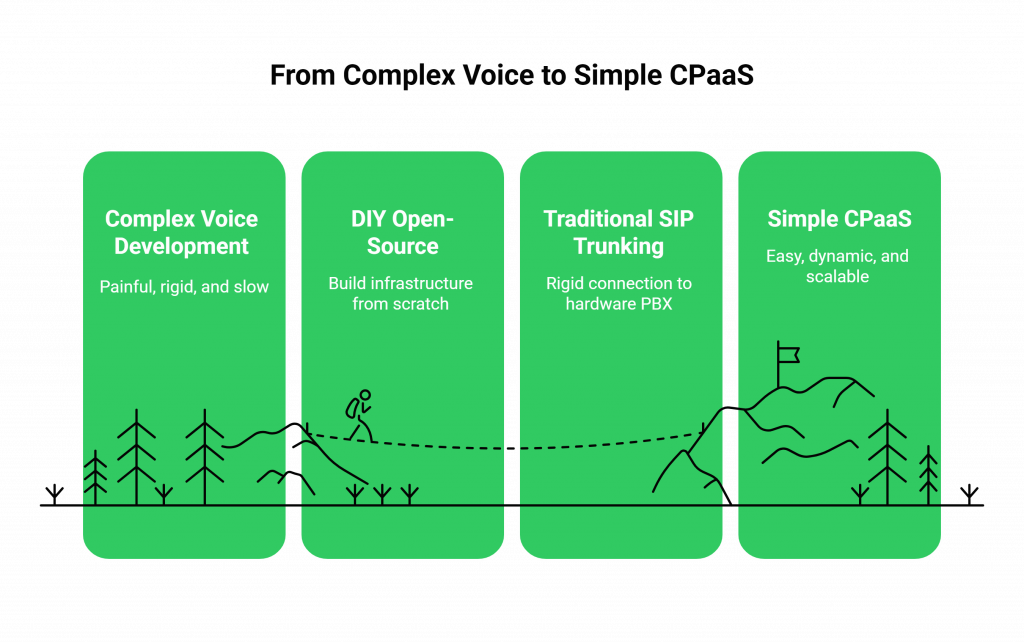
The DIY Path: Open-Source Telephony Servers
The first option was to build the entire voice infrastructure from the ground up using powerful but notoriously complex open-source platforms like Asterisk or FreeSWITCH. This path was a trial by fire. A developer had to become a full-fledged telecom engineer overnight. This required:
- Deep Protocol Knowledge: You had to have an intimate understanding of the SIP protocol, as well as the Real-time Transport Protocol (RTP) for media, and the various codecs (G.711, G.729, Opus) for audio compression.
- Infrastructure Management: You were responsible for setting up, securing, and maintaining your own telephony servers. This included dealing with the nightmare of NAT traversal to get your server to communicate through firewalls.
- Carrier Management: You had to source, contract with, and directly interconnect with traditional SIP trunking carriers, each with its own unique and often poorly documented implementation of the SIP standard.
- A Lack of Scalability: Scaling this DIY infrastructure was a manual, complex, and expensive process of adding more servers and more carrier capacity.
This approach was powerful, but it was also incredibly slow, expensive, and brittle. The level of specialized knowledge required was a massive barrier to entry for the vast majority of software developers.
The complexity of such IT projects is a well-documented problem, with a recent report from the Project Management Institute noting that nearly 12% of IT project investment is wasted due to poor performance.
Also Read: How to Enable Global Calling Through a Voice Calling SDK (Without Telecom Headaches)
The Traditional SIP Trunking Path
The second option was to connect to a traditional, non-programmable SIP trunk. This was simpler in that you did not have to manage the carrier connection, but it was still incredibly rigid. It was designed to connect to a hardware PBX, not a modern, dynamic application. The trunk was a “black box” that terminated at a single IP address, offering no real-time control and no easy way to access the live audio stream, which is an absolute necessity for any AI application.
What is Programmable SIP?
Programmable SIP is a completely different architectural model. It is a managed service that exposes the full power of a global, carrier-grade SIP network through a simple, high-level, and developer-friendly API.
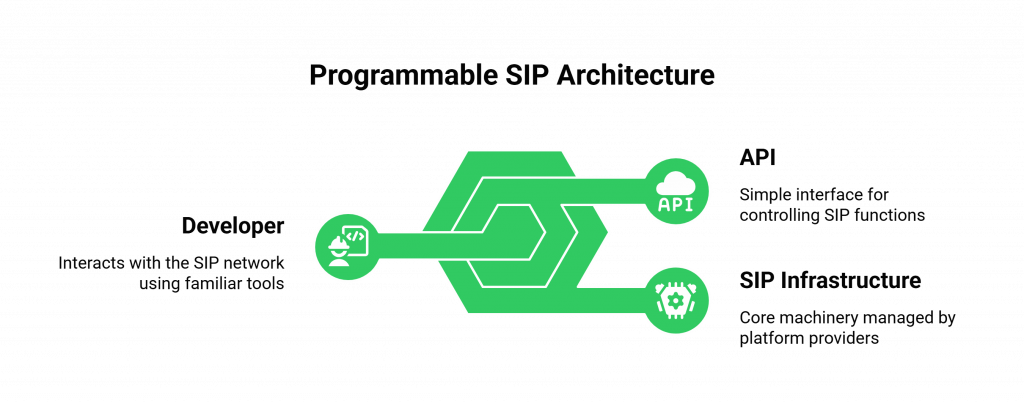
Think of it this way:
- The Engine (Raw SIP Infrastructure): This is the incredibly complex, low-level machinery. It includes the SIP servers, the connections to hundreds of global carriers, the media processing engines, and the globally distributed data centers. A platform provider like FreJun AI builds and manages this engine.
- The Controls (The API): This is the simple, intuitive interface that the developer uses. It is the steering wheel, the pedals, and the dashboard. A developer does not need to know how the engine works; they just need to know how to use the controls to get where they want to go.
The developer interacts with the voice network using the web technologies they already know and love: REST APIs and webhooks. They can make a simple HTTP request to make a call or respond to a webhook with a snippet of XML or JSON to control a live call. This is the essence of SIP for developers, it is not about learning SIP; it is about controlling a SIP network with the tools you already have.
How Does This Model Radically Simplify Telephony Integration?
The programmable model solves the core problems of the old world by introducing a powerful layer of abstraction. It transforms the development process from a low-level engineering challenge into a high-level application design task.
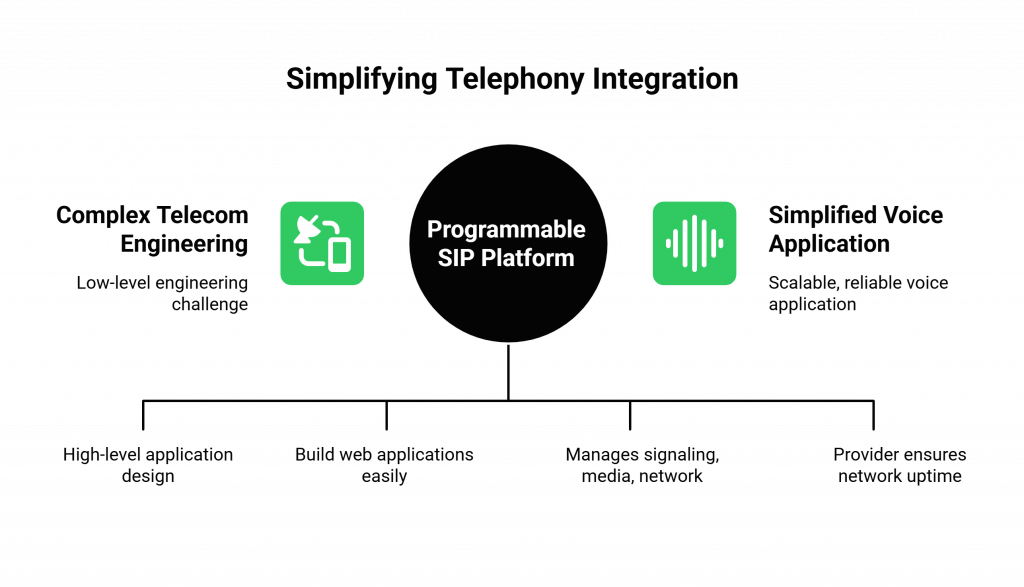
From Telecom Engineering to Web Development
The single biggest simplification is the change in the required skill set. To use a programmable SIP platform, you do not need to be a telecom expert. You need to be a good web developer. If you know how to build a web application that can make and receive HTTP requests, you have all the skills you need to build a powerful, scalable voice application.
Abstracting Away the “Big Three” Technical Complexities
A programmable platform handles the three most difficult parts of voice infrastructure for you.
- Signaling Complexity: It manages all the low-level SIP signaling, including the complex “handshakes,” registrations, and session management.
- Media Handling: It handles the processing of the real-time media (the audio stream). This includes receiving the audio, making it available to your application, and playing audio back to the user.
- Network Traversal and Security: The platform’s globally distributed architecture, with its edge-based Session Border Controllers (SBCs), automatically handles all the NAT traversal and firewall issues. It also provides a hardened, secure front door to the public internet, protecting your application from common telecom attacks.
Also Read: Voice Calling SDKs Explained: The Invisible Layer Behind Every AI Voice Agent
From Brittle Infrastructure to Managed Reliability and Scale
When you build on a programmable SIP platform, you are outsourcing the immense challenge of infrastructure reliability.
- Guaranteed Uptime: The provider is responsible for ensuring the voice network is always on. A platform like FreJun AI is built for carrier-grade reliability with SLAs to back it up. The cost of downtime is a major business risk, with one study estimating that the average cost of a critical server outage can exceed $1 million per hour for large enterprises.
- Elastic Scalability: The underlying infrastructure is a massive, elastic SIP trunking network. This means your application can go from one call to ten thousand simultaneous calls in an instant, and the platform will scale automatically to handle the load.
What Does a Modern Voice Application Architecture Look Like?
The beauty of the programmable SIP model is the elegance and simplicity of the voice application architecture it enables. It is a clean, event-driven, request-response model that will feel very familiar to any web developer.
This table clearly delineates the responsibilities in this modern architecture.
| Responsibility | Your Application (The “Brain”) | The Programmable SIP Platform (The “Voice”) |
| Connecting to the PSTN | No | Yes |
| Managing Phone Numbers | No | Yes |
| Handling SIP Signaling | No | Yes |
| Streaming Real-Time Media | No | Yes |
| Notifying of Call Events | No | Yes (via Webhooks) |
| Deciding What to Do Next | Yes | No |
| Executing Commands | No | Yes |
| Implementing Business Logic | Yes | No |
| Integrating with AI/LLMs | Yes | No |
The workflow is a continuous loop:
- An Event Occurs: A call comes in to one of your numbers.
- The Platform Notifies Your App: The programmable SIP platform sends a webhook (an HTTP POST request) to your application’s designated URL.
- Your App Responds with Instructions: Your application’s code receives the webhook, processes its business logic, and responds with a set of commands (typically in XML or JSON) that tell the platform what to do next.
- The Platform Executes: The platform receives these instructions and executes them on the live call (e.g., “play this audio,” “listen for the user’s speech,” “transfer this call”).
- The Loop Continues: This process repeats for every turn of the conversation until the call ends.
Ready to see just how simple this powerful architecture can be? Sign up for FreJun AI and build your first voice application in minutes.
Also Read: How to Build Scalable Voice Calling Apps Using a Voice Calling SDK?
Why is Programmable SIP the Essential Foundation for Voice AI?
This event-driven, request-response architecture is the perfect match for the way modern AI, and particularly LLMs, work. An LLM is, at its core, a text-in, text-out function. The programmable SIP platform acts as the perfect “adapter” to connect this text-based brain to the voice-based world.
The platform handles the complex, real-time work of converting the user’s speech to text (via an STT engine) and then takes the AI’s text response and converts it back to speech (via a TTS engine).
Your application’s job is simply to pass the text back and forth and to generate the simple commands that orchestrate the conversation. This clean separation of concerns is what allows developers to rapidly deploy a voice app with SIP and AI, without getting bogged down in low-level media processing.
Conclusion
The evolution to programmable SIP represents a fundamental democratization of voice technology. It has taken a capability that was once the exclusive domain of telecom giants and specialized engineers and has placed it directly into the hands of the global community of software developers.
By providing a powerful layer of abstraction that handles all the underlying complexity, this model radically simplifies telephony integration and slashes the time, cost, and expertise required to build a sophisticated voice application.
For any developer or business looking to innovate in the world of communication, programmable SIP is not just a new feature; it is the foundational platform on which the entire future of voice AI will be built.
Want to get a hands-on look at our API and see how you can control a live phone call with just a few lines of code? Schedule a demo with our team at FreJun Teler.
Also Read: UK Phone Number Formats for UAE Businesses
Frequently Asked Questions (FAQs)
Programmable SIP is a modern, cloud-based service that allows a software developer to control phone calls using web APIs. Instead of needing to be a telecom expert, a developer can use simple HTTP requests to make calls, receive calls, and manage live conversations, all from within their own application’s code.
A traditional SIP trunk is a “dumb pipe” that is simply configured to connect to a phone system. Programmable SIP is an intelligent, developer-first platform. It is not something you configure; it is something you program.
No, and that is the key benefit. The platform’s API completely abstracts away the low-level SIP protocol. As a SIP for developers solution, it allows you to work with high-level concepts like “calls” and “audio” using familiar web technologies.
A webhook is a real-time HTTP notification that the programmable platform sends to your application when a call event occurs (like an incoming call or a user finishing their speech). It is the trigger that allows your application to react and control the call flow.
The platform provides a mechanism, often through a specific API command or markup tag (like <Gather> in FreJun AI’s FML), that allows you to capture the caller’s speech. The platform then handles the real-time streaming of this audio to a Speech-to-Text engine.
Yes. A production-grade platform must be built with security as a core principle. This includes encryption for all API and webhook communication (HTTPS), as well as for the call signaling (TLS) and media (SRTP) themselves.
A UCaaS platform is a finished, end-user application for business communications (a softphone, a mobile app, etc.). A programmable SIP platform is an infrastructure-level service for developers. It is a set of building blocks that you can use to build your own custom voice applications or to voice-enable your existing software.
The primary skill needed is experience with a modern, backend programming language (like Python, JavaScript/Node.js, Java, etc.) and a solid understanding of how to work with REST APIs and handle webhooks. No prior telecommunications experience is required.
Our Teler engine is our powerful, globally distributed voice infrastructure. We expose its capabilities through a developer-first set of APIs and a simple markup language (FML). This combination is our implementation of programmable SIP, designed to simplify telephony integration for developers building everything from simple IVRs to complex AI agents.
The scalability is handled by the provider’s underlying elastic infrastructure. The platform is designed to handle massive, sudden spikes in call volume automatically. Your voice application architecture can remain a simple, stateless web application that can be scaled using standard cloud-scaling techniques.