
For decades, the world of telecommunications has been a fortress, guarded by arcane protocols and monolithic hardware. The Session Initiation Protocol (SIP) was a revolutionary force that began to open the gates, allowing voice to travel over the open internet.
But for all its power, traditional SIP was still a rigid system, designed to connect one black box (a PBX) to another. It was a bridge, but a static one. Today, a new evolution of this technology is not just connecting calls but is dynamically orchestrating them in real-time. This is the world of programmable SIP.
This is not just an incremental upgrade; it is a fundamental paradigm shift in how we interact with the voice network. Programmable SIP takes the raw, powerful protocol of SIP and wraps it in a developer-friendly, API-driven layer of abstraction. It is the critical voice AI bridge that is finally allowing the vast, intelligent world of cloud-based AI to have a seamless, real-time conversation with a user on a simple telephone.
For developers and enterprises looking to build the next generation of real time AI conversations, understanding and leveraging this technology is the key to unlocking a new universe of possibilities.
Table of contents
What Was the Limitation of Traditional “Dumb” SIP?
To appreciate the “programmable” revolution, we must first understand the limitations of the world it is replacing. The first wave of SIP adoption was focused on cloud telephony sip as a replacement for old PRI lines. Its job was simple: to take a call from the Public Switched Telephone Network (PSTN) and deliver it to a single, pre-configured IP address, which was typically a company’s IP-PBX.
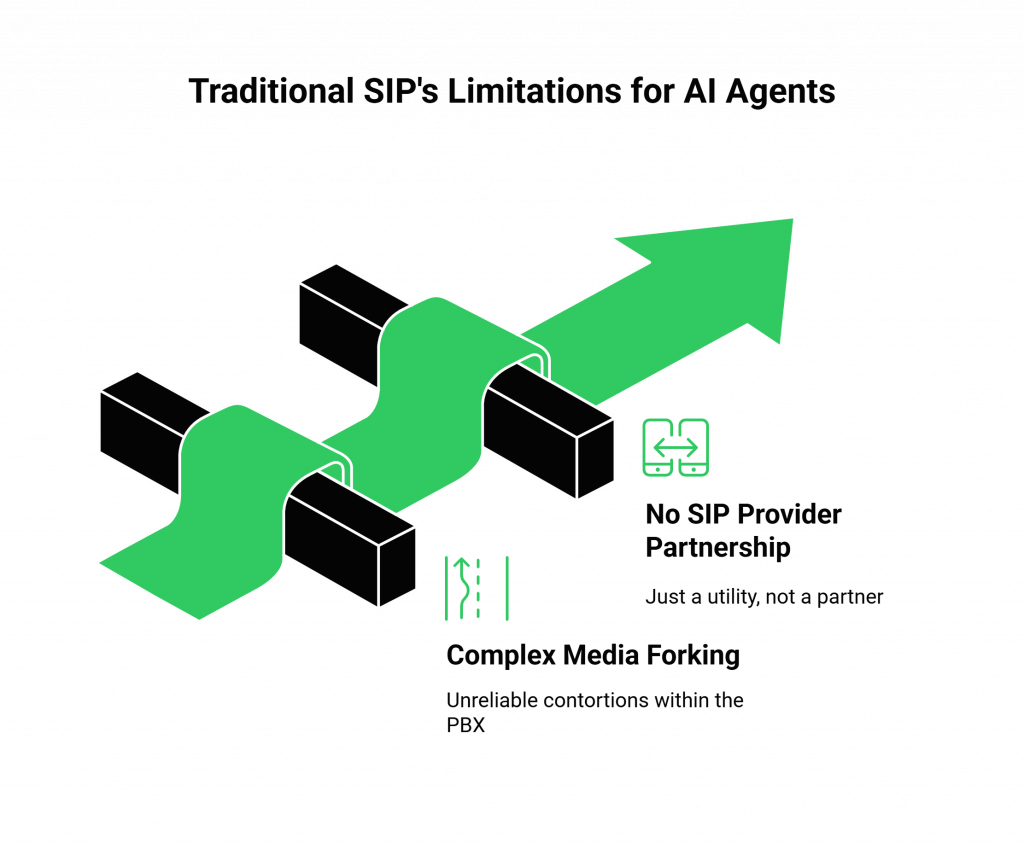
In this model, the SIP trunk was a “dumb pipe.” It had no awareness of the content of the call or the logic of the application. All the intelligence and control lived inside the PBX. For a developer building an AI agent, this was a massive roadblock.
To get the call’s audio to their AI, they had to perform complex and often-unreliable contortions within the PBX to try and “fork” the media stream. The SIP provider was not a partner in the application; it was just a utility.
What Does “Programmable SIP” Actually Mean?
Programmable SIP is a philosophy and an architecture that transforms the SIP trunk from a static utility into a dynamic, software-controlled component of your application. It is a model where every aspect of the call, from the initial routing to the real-time media, can be manipulated by your code via an API.
The Core Principles of a Programmable SIP Cloud
A true programmable sip cloud platform is built on a set of developer-first principles:
- API-Driven Call Control: Instead of a static routing configuration, the platform notifies your application of an incoming call via a webhook. Your application then responds with real-time instructions on what to do next, answer the call, play a message, transfer it, or connect it to an AI.
- Direct, Real-Time Media Access: This is the most critical feature for AI. The platform gives you the programmatic ability to access the raw audio stream (RTP) of the live call. You can instruct the platform, via an API, to create a real-time copy of the audio and stream it directly to your AI’s Speech-to-Text (STT) engine.
- Dynamic SIP Header Manipulation: The platform allows you to programmatically modify the SIP headers on the fly. This enables sophisticated workflows, such as dynamically setting the outbound caller ID for a call or passing custom data from your application into the call’s metadata.
The impact of this API-driven approach is transformative. A recent report from the enterprise software industry highlighted that API-led organizations are able to launch new products and features 3x faster than their peers, an agility that is now possible in the world of voice thanks to programmable SIP.
Also Read: Managing Utility Bills via AI Voicebots
How Does Programmable SIP Act as the Ultimate Voice AI Bridge?
The process of connecting a live phone call to an LLM-powered AI is a high-speed, data-intensive relay race. Programmable SIP acts as the intelligent and highly efficient racetrack for this event.
Let’s follow a single utterance on its journey, from the user’s mouth to the AI’s “brain” and back, to see how each programmable element plays a critical role.
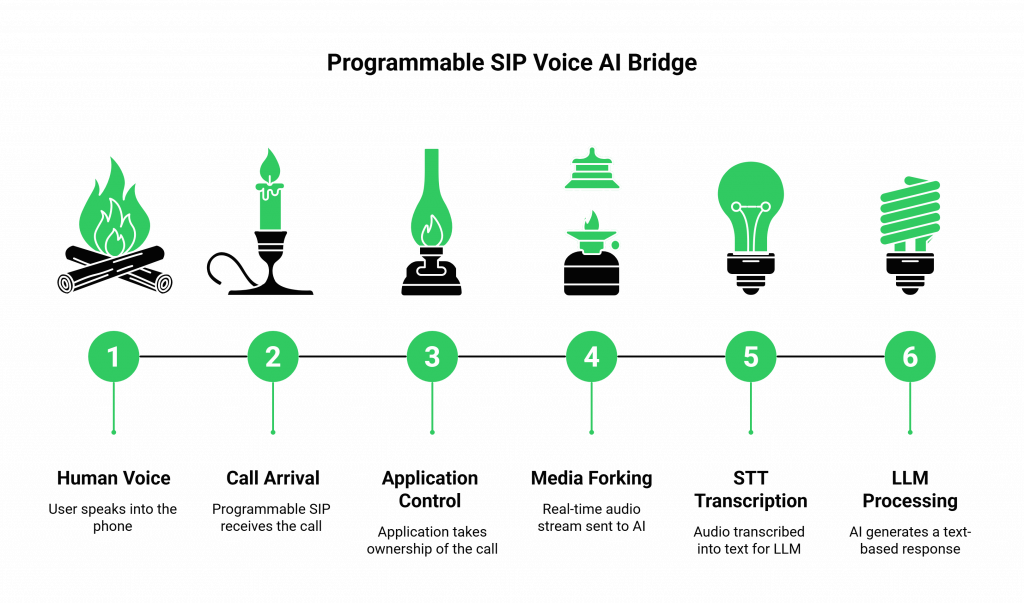
The Inbound Leg: From Human Voice to AI Brain
- Call Arrival and Webhook: A user calls a number. The programmable SIP platform receives the call and, instead of sending it to a PBX, it sends an HTTP request (a webhook) to your application’s endpoint.
- Application Takes Control: Your application receives the webhook. It now has the CallSid and is the “owner” of the call. It responds with an API command that tells the platform to start listening and streaming.
- Real-Time Media Forking: The platform’s media server creates a real-time copy of the user’s audio stream and begins sending it directly to your AI’s STT engine. This is the core of the voice AI bridge.
- Data for the LLM: The STT engine transcribes the audio into text, which is then fed to your LLM for processing.
The Outbound Leg: From AI Brain to Human Ear
- LLM Formulates Response: The LLM generates a text-based response.
- TTS Synthesizes Audio: This text is passed to a Text-to-Speech (TTS) engine, which creates a new audio stream.
- API Command to “Inject” Media: Your application now uses the programmable SIP platform’s API to send a command to “play” or “inject” this newly generated audio stream into the live call.
- User Hears the Response: The platform’s media server seamlessly mixes this new audio into the call, and the user hears the AI’s response.
This entire, complex workflow is made possible because every step is a discrete, programmable action controlled by your application’s code.
This table provides a summary of how programmable SIP enables this AI workflow.
| AI Workflow Requirement | How Programmable SIP Solves It |
| Real-Time “Hearing” | Provides direct, API-driven access to the live audio stream (RTP) for the STT engine. |
| Dynamic Call Logic | Replaces static routing with an event-driven webhook model, allowing your AI to control the call flow. |
| Real-Time “Speaking” | Provides an API to “inject” the AI’s synthesized audio (from the TTS) back into the live call. |
| Contextual Data Passing | Allows for the passing of custom data in SIP headers, enabling you to link a call to a specific user session in your CRM. |
Ready to start building this bridge and give your AI a voice? Sign up for FreJun AI and explore our powerful, programmable voice infrastructure.
Also Read: Voice Calling API: Simplifying Cloud Communication for Businesses
The FreJun AI Approach: Programmable SIP at a Global Scale
At FreJun AI, our entire Teler engine was built on the philosophy of programmable SIP. We saw that the future of cloud telephony sip was not just about connectivity, but about control.
Our platform provides a powerful abstraction layer that handles the immense underlying complexity for you.
- A Globally Distributed Media Core: Our infrastructure is a programmable sip cloud built on a network of globally distributed Points of Presence. This means the real-time media processing happens at the edge, physically close to your users, which is the key to enabling low-latency real time AI conversations.
- A Simple, Powerful API: Our developer-first API and markup language (FML) provide a simple yet powerful set of verbs to control this global media core. You can orchestrate a complex, AI-driven conversation with just a few lines of code.
This is our core promise. We handle the complex, low-level SIP and media processing so you can focus on the intelligence of your application.
The power of a Communication Platform as a Service (CPaaS) like FreJun AI is in this abstraction. The market for CPaaS is booming, with a recent analysis projecting it to reach over $45 billion by 2027, driven by the enterprise demand for this kind of programmable communication.
Also Read: How Media Streaming Works Behind Every AI-Driven Voice Call
Conclusion
The fusion of Large Language Models and real-time voice is set to redefine the landscape of business communication. But this fusion is only possible with a new kind of conversational infrastructure, one that is as dynamic and intelligent as the AIs it is designed to serve.
Programmable SIP is the technological and philosophical cornerstone of this new infrastructure. It transforms the voice network from a dumb pipe into an active, software-controlled participant in the application’s logic.
It is the essential voice AI bridge that is finally allowing the silent, brilliant minds of our AIs to step out of the chat window and have a real conversation with the world.
Want a technical deep dive into how our programmable SIP infrastructure can be the bridge for your specific AI use case? Schedule a demo with our team at FreJun Teler.
Also Read: Telephone Call Logging Software: Keep Every Conversation Organized
Frequently Asked Questions (FAQs)
Standard SIP is primarily for connectivity, it connects your PBX to the phone network with a static configuration. Programmable SIP is about control, it allows your software application to dynamically control every aspect of a live call’s flow and media via an API.
A voice AI bridge is the technological layer that connects an AI’s “brain” (which operates on text and data) to the real-time, audio-based world of a phone call. A programmable SIP platform is the ideal technology to act as this bridge.
A programmable sip cloud platform provides an API that allows your application to request a real-time copy of the call’s audio stream (the media). This stream can then be sent to your Speech-to-Text engine for transcription.
A webhook is the notification mechanism. When a call comes in, the platform sends an HTTP request (a webhook) to your application’s server. This is the trigger that tells your application a call has arrived and that it needs to take control.
No. This is a key benefit. The provider (like FreJun AI) manages the entire global network of complex media servers. Your application simply sends high-level commands to this network via an API.
Yes. A production-grade programmable sip cloud must offer robust security features, including the use of TLS to encrypt the SIP signaling and SRTP to encrypt the real-time audio media, ensuring the conversation is confidential.
Yes. Programmable SIP lets you insert custom SIP headers. You can pass unique identifiers like customer IDs or session tokens. This data becomes part of the call metadata. It is useful for logging, tracking, and added context.
No. A developer-first platform is designed to hide complexity. If you are comfortable with REST APIs and webhooks, you can start building quickly. You do not need deep telecom expertise to create powerful voice applications.
The architecture allows the provider to process the media at an “edge” location that is physically close to the end-user. This dramatically reduces the network travel time for the audio data, which is the most effective way to minimize latency.
The Teler engine is FreJun AI’s globally distributed, programmable SIP cloud. It provides powerful and reliable voice infrastructure. It handles low-level SIP signaling and real-time media processing. Our developer-friendly APIs control this engine directly.